
Flower Delivery in Kuvandyk: Zones, Timing and What to Expect
Kuvandyk sits in the southern Urals, roughly 200 kilometres from Orenburg, and customers there ask us the same things every week: how long will delivery take, which flowers survive the road, and what happens in January when temperatures drop below minus twenty. This article answers all of that plainly, from the shop floor outward.
Where We Deliver in Kuvandyk and the Surrounding District
Kuvandyk is a compact town of around 25,000 people on the Sakmara River, and the delivery zone covers the central streets, the residential mikrorayons on the eastern slope, and the private house districts closer to the river bank. Orders to addresses within the town boundary reach the recipient in the standard window we quote at checkout. The Kuvandyk district stretches well beyond the town itself, taking in villages such as Khalilovo and Preobrazhenka, and delivery to those points adds time because of road conditions, particularly after snowfall in winter or during the spring mud season when unpaved roads become difficult. We ask customers ordering to rural addresses to include the full postal index and any landmark near the building, because house numbering in smaller settlements can be inconsistent and drivers lose time confirming the address by phone. If you are ordering to a workplace, a school or a medical facility in Kuvandyk, note the institution's reception hours in the comments field: many administrative buildings in smaller Russian towns close for lunch between 13:00 and 14:00, and a bouquet arriving during that gap will wait at the door rather than being handed directly to the recipient. The cleaner the address detail, the faster and smoother the handover goes.
Bouquets we can deliver



Delivery Timing: What One to Two Hours Means from Saint Petersburg
Five Flowers is based in Saint Petersburg and the one-to-two-hour window refers to our standard city delivery. For Kuvandyk, which is roughly 1,800 kilometres east of Saint Petersburg, the logistics work differently and customers need to understand this before they order. We work with temperature-controlled courier routes that connect major hubs, and flowers dispatched for Kuvandyk travel through Orenburg before the final leg into the town. The practical result is that same-day delivery in Kuvandyk is available when orders are placed before the morning cut-off time shown on the product page, and next-day delivery is the reliable default for orders placed in the afternoon or evening. This is not a flaw in the service; it reflects the geography honestly. What matters more than the raw travel time is that the flowers are packed in insulated boxes with moisture-retaining wrapping so they arrive in the same condition they left our coolers. Roses travel well in bud because they open gradually after delivery, which is actually an advantage: the recipient sees the flower open over two or three days rather than receiving a bloom already at its peak. Customers who need a guaranteed morning delivery for a birthday should place the order the previous evening and select the earliest delivery slot. We always confirm the slot by message so there is no ambiguity on either side.
Seasonal Varieties That Hold Up on the Road to Kuvandyk
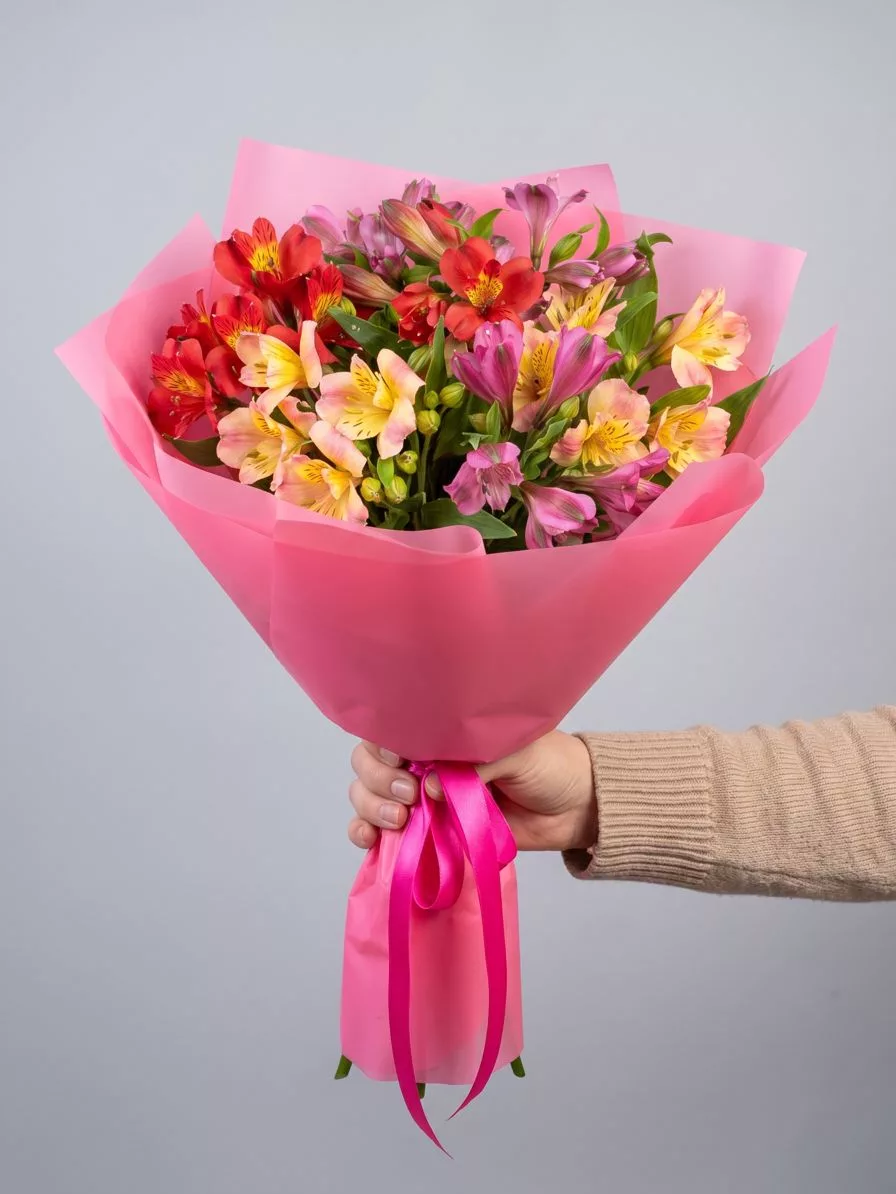
Not every flower in our catalogue is a good choice for a long-distance delivery, and a working florist will tell you that honestly rather than just taking the order. Roses are the most reliable: Dutch spray roses and large-headed garden roses in varieties such as Explorer, Avalanche and Red Naomi travel in tight bud and open without bruising if the packaging temperature stays between two and eight degrees Celsius. Chrysanthemums, both the single-stem Santini type and the larger disbud varieties, are exceptionally road-hardy and arrive looking nearly identical to how they left the shop. Alstroemeria is another strong choice: the stems are sturdy, the buds are numerous and even if one or two open in transit the others follow over the next several days. Flowers we advise against for Kuvandyk distances include open garden peonies in summer, which bruise against packaging, and fully open hydrangea heads, which wilt quickly if the cold chain has any gap. Tulips in winter are fine when sent in bud, but in late April and May they open fast and the timing becomes unpredictable. Orchid stems, particularly Cymbidium and Dendrobium, travel very well in tubes and are a good option when the customer wants something less conventional. The seasonal calendar matters too: in January and February the range of available Dutch imports is actually wider than in midsummer, because the main auction season runs through the European winter and stock is abundant.
Temperature and Packaging: What Happens to Flowers in Winter
Kuvandyk winters are genuinely cold, with January averages around minus fourteen Celsius and occasional dips to minus twenty-five or lower. This is not an abstract concern for flower delivery: an unprotected bouquet left on a doorstep for ten minutes in that temperature will show frost damage on petals, particularly on roses and lilies, and the damage is irreversible. Our standard winter packaging uses a double-wall insulated box with a foil inner layer and a gel sachet that keeps the interior above zero for several hours even when the outside temperature is severe. The driver does not leave flowers on a doorstep; the protocol is to call the recipient on arrival and wait for them to come to the door, or to hand the box to a concierge or security desk if the building has one. Customers should make sure the recipient's phone number is correct and that the person is reachable around the delivery window. If the recipient is at work in an office with a reception desk, that is actually the easiest scenario: the flowers stay indoors from the moment they arrive. The summer situation in Kuvandyk is the opposite problem: July and August temperatures can reach plus thirty-five, and flowers left in a car or a warm hallway deteriorate within an hour. Our summer boxes include additional cooling elements, but the same principle applies: the recipient should be reachable and the handover should be direct. Ordering delivery to an empty address in either extreme season is the single most common reason flowers arrive in poor condition.
Bouquet Choices That Work Well for Kuvandyk Occasions
Russian gift culture around flowers has a few conventions that are worth explaining if you are not familiar with them. Odd numbers of flowers are standard for gifts to living recipients; even numbers are associated with mourning and should be avoided in a celebratory context. A bouquet of eleven roses, fifteen spray roses, or twenty-one mixed stems is completely normal and expected. For a birthday in Kuvandyk, a mid-size arrangement of fifteen large-headed roses in a single colour, wrapped in kraft paper with a satin ribbon, is the most universally well-received option and travels reliably. For a professional occasion such as a teacher's anniversary or a colleague's promotion, a mixed bouquet combining chrysanthemums, alstroemeria and a few accent roses reads as thoughtful without being overly romantic. For a romantic occasion, a single-variety bouquet of red or peach roses in an odd number from eleven upward is the clearest signal and the easiest to pack well. Customers sometimes ask about potted plants as an alternative to cut flowers for long-distance delivery: small succulents and certain orchid varieties in plastic transport pots do travel well, but they require different packaging and the lead time is longer because we need to source the specific plant. If you want a potted option, contact us at least two days ahead rather than ordering same-day. Ribbon colour, paper colour and any add-on such as a soft toy or a box of chocolates can all be specified in the order comments, and we follow those instructions closely.
How to Write the Delivery Address and Recipient Details Correctly
This section sounds administrative but it prevents the majority of failed deliveries. For Kuvandyk, the postal code for the town centre is 462250; addresses in the surrounding villages have different codes and you should verify the correct one before submitting the order. The street name should be written in full Russian transliteration or in Cyrillic if you can type it, because abbreviated street names in smaller towns sometimes match more than one address. The building number, apartment or office number, entrance number and floor are all useful, especially in Soviet-era apartment blocks where the entrance doors are on different sides of the building. Include the recipient's mobile phone number, not a landline: drivers call mobile numbers because they are more reliably answered. If the recipient does not know a delivery is coming and you want it to be a surprise, write that in the comments and we will coordinate the approach carefully, but be aware that a surprise delivery to an apartment building without a concierge is harder to execute cleanly than a delivery to a workplace with reception staff. The name on the order should match what the recipient would recognise if the driver calls and says the name aloud. A common mistake is ordering in a nickname or diminutive that the recipient's colleagues at the delivery address do not recognise, which causes confusion and delays. Double-checking these five points before you click confirm takes two minutes and saves a great deal of back-and-forth on the day.
What to Do After the Flowers Arrive: Care in Kuvandyk's Climate
Flowers that arrive in good condition can deteriorate quickly if the recipient does not know the basic care steps, and in Kuvandyk the climate makes this more relevant than in milder cities. In winter, flowers that have been in cold packaging should be unwrapped gradually at room temperature rather than placed immediately in warm water, because a sudden temperature shift can cause condensation inside the petals and accelerate rot. Let the bouquet sit in its wrapping in a cool room for fifteen to twenty minutes before unwrapping and cutting the stems. Cut stems at a forty-five-degree angle under running water using a sharp knife rather than scissors, which crush the vascular tissue and reduce water uptake. Place the bouquet in a clean vase with fresh cool water and keep it away from radiators, which are running at full output in Kuvandyk homes throughout the long heating season from October to April. In summer, keep flowers away from direct sunlight through south-facing windows and change the water every day rather than every other day, because warm water grows bacteria faster. Roses and chrysanthemums will last seven to ten days with correct care; alstroemeria can go to twelve days. Tulips are shorter, typically five to seven days, but they are dramatic while they last. We include a small care card with every delivery, written in Russian, which the recipient can follow without needing to search for instructions. If the flowers arrive in visibly poor condition, photograph them immediately and contact us: we assess every complaint with the photos and respond the same day.
Ordering flowers to Kuvandyk from Five Flowers is straightforward once you understand the geography and plan accordingly: place the order with enough lead time, fill in the address completely, make sure the recipient is reachable, and choose varieties that travel well for the season. The southern Urals climate is demanding in both winter and summer, but the right packaging and the right flowers handle it reliably. Our team in Saint Petersburg assembles every bouquet to the same standard regardless of the destination, and Kuvandyk customers receive the same quality control that our Saint Petersburg customers do. We deliver bouquets across Russia in 1–2 hours.
Frequently asked questions
Can I order flowers to a village outside Kuvandyk town?
Yes, we deliver to settlements in the Kuvandyk district including Khalilovo and Preobrazhenka. Delivery to rural addresses takes longer than in-town delivery, and road conditions in spring and after heavy snowfall can extend the window. Include the full postal code, the exact street and building number, and a mobile phone number for the recipient.
Which flowers should I avoid ordering to Kuvandyk in winter?
Avoid fully open peonies and large open hydrangea heads in any season for long routes. In winter specifically, avoid any flower that is already at full bloom when it leaves the shop, because transit stress and temperature fluctuation will accelerate petal drop. Roses in bud, chrysanthemums and alstroemeria are the most reliable winter choices for this distance.
What if the recipient is not home when the flowers arrive?
Our driver calls the recipient on arrival. If there is no answer, the driver will attempt a second call and wait a short time. If the address has a concierge or security desk, flowers can be left there. We strongly recommend confirming the recipient is available during the delivery window, especially in winter when leaving flowers outside even briefly risks frost damage.
Is same-day delivery to Kuvandyk always possible?
Same-day delivery is available for orders placed before the morning cut-off shown on the product page. For orders placed in the afternoon, next-day delivery is the reliable option. The cut-off time accounts for the distance between Saint Petersburg and Kuvandyk and the temperature-controlled routing through Orenburg. Next-day delivery with a morning slot is the most dependable choice for time-sensitive occasions.
Why does the number of flowers in a bouquet matter in Russia?
In Russian tradition, bouquets with an odd number of stems are given as gifts to living recipients, while even numbers are associated with mourning. A bouquet of eleven, fifteen or twenty-one flowers is completely standard for birthdays and celebrations. If you are ordering from outside Russia, this is worth knowing so the gift reads exactly as you intend it to.
Ready to send a bouquet?
Pick a city, choose the flowers, and we will hand them over with a photo confirmation.
Choose a city →