
Flower Delivery in Labytnangi: Zones, Timing and Prices
Labytnangi sits on the western bank of the Ob River, directly across from Salekhard, and customers who call us about delivery here almost always ask the same first question: can you actually get there? The answer is yes, but the logistics are genuinely different from delivering to a city with a road network that connects to the rest of Russia without a ferry or a frozen river crossing. Understanding those differences before you place an order saves disappointment on both sides.
Where in Labytnangi We Deliver and Where We Do Not
Labytnangi is a compact city of roughly 25,000 people, and the residential districts — Mikrorayon, the central streets around Lenin Avenue, and the station area near the railway terminus — are all reachable within a single delivery run. The industrial outskirts and the scattered settlements further north along the Ob require advance coordination and are not covered under our standard same-day window. When you place an order, confirm the exact street and building number: Labytnangi has a handful of streets with nearly identical names, and a wrong turn in winter, when temperatures regularly drop below minus 25 Celsius, means flowers arrive cold-damaged or not at all. The railway station district is our most frequently requested destination because the Trans-Polar Railway terminates here, and people regularly send flowers to meet someone arriving by train. If the recipient is picking up at the station rather than at a home address, note that in the order comments — it changes the delivery window. Apartment buildings in the central microdistrict are straightforward. Private houses on the city's edge sometimes have unmarked gates or no visible number, so a working phone number for the recipient is not optional, it is the single most important field in your order form. We call ahead in all cases, but in Labytnangi the call matters more than in most cities because the driver cannot afford to circle the block in deep frost waiting for a callback.
Bouquets we can deliver



How Long Delivery Actually Takes from Order to Door
Our standard promise is one to two hours from the moment the order is confirmed and paid. In Labytnangi, the realistic window is two to three hours for most addresses in the central districts, and up to four hours for addresses near the city boundary. The reason is straightforward: flowers are assembled in Saint Petersburg and dispatched via our regional fulfillment chain to the Yamalo-Nenets Autonomous Okrug. Local road conditions, particularly from October through April, add time that we cannot compress without risking the bouquet. In summer, the Ob ferry crossing between Salekhard and Labytnangi operates on a schedule that is weather-dependent, and high water or wind can delay a crossing by an hour or more. We account for this in the quoted delivery window when you order, but customers sometimes see the standard one-to-two-hour language on the site and assume it applies uniformly. It does not, and we prefer to tell you that plainly rather than have you waiting by the door. For time-sensitive occasions — a birthday where the person leaves the apartment at a specific time, an anniversary dinner with a hard start — order at least five to six hours ahead and specify the deadline in the comments. We will confirm whether that window is achievable on the day you are ordering, not after the fact. Same-day orders placed before noon local Labytnangi time have the highest success rate. Orders placed after 6 p.m. local time are fulfilled the following morning as a default unless you have arranged otherwise.
Which Flowers Survive the Journey to Labytnangi in Good Condition
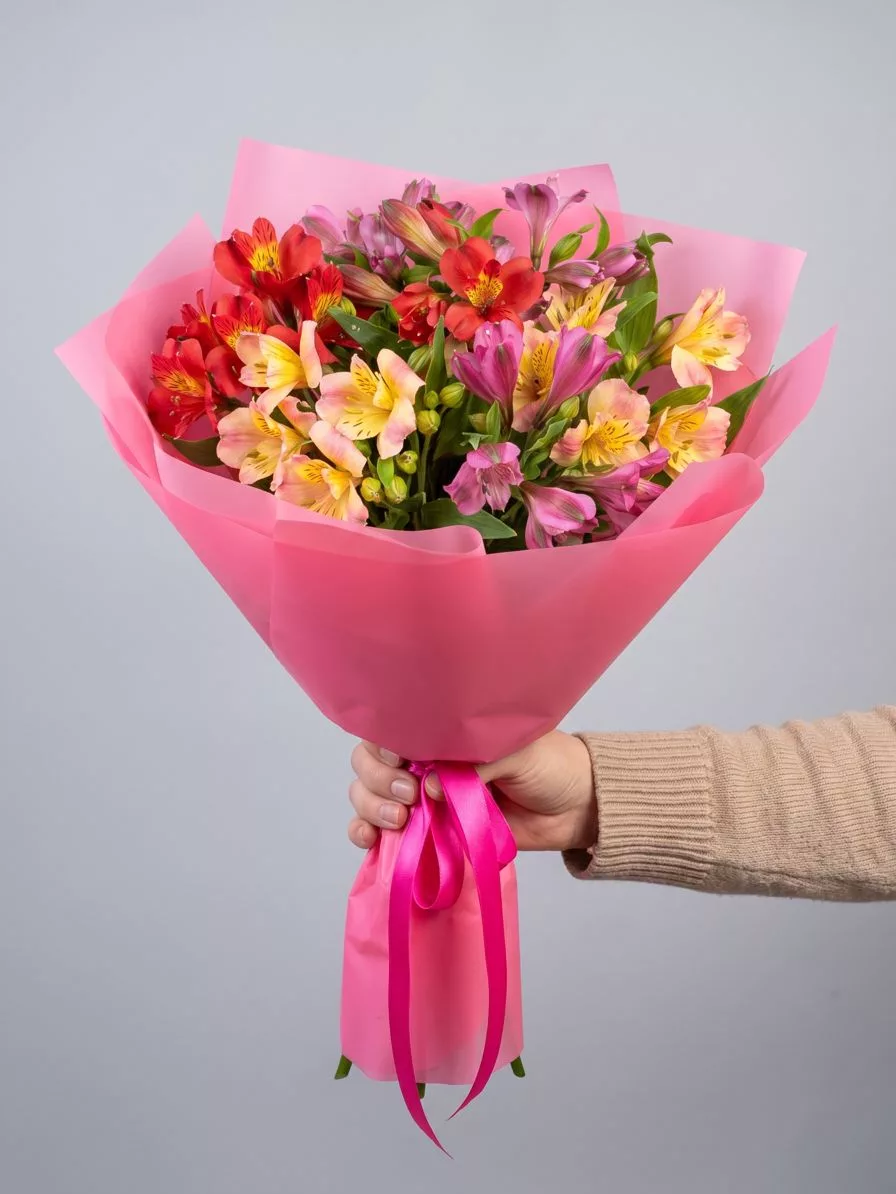
Cold-chain integrity is the central question for any Far North delivery, and the answer depends heavily on which varieties you choose. Roses, particularly spray roses with smaller heads, travel better than large-headed garden roses because they are less prone to bruising in transit. Dutch chrysanthemums — both single-stem disbuds and spray types — are exceptionally durable and arrive looking fresh even after a long cold-weather run. Alstroemeria is another reliable choice: the buds are tight when cut, open gradually over several days, and the stems are sturdy enough to handle temperature fluctuation without wilting. Carnations, both standard and mini, are among the hardiest flowers in the trade and are a sensible backbone for any bouquet going to Labytnangi. What we advise against for this destination: open peonies in summer, which are too fragile for a multi-stage journey; large tropical anthuriums, which are cold-sensitive below plus 12 Celsius and can blacken quickly; and fully open garden roses, which shed petals under vibration. Tulips are available and popular, but they should be ordered in bud — a fully open tulip will not survive a four-hour transit in a cold van. Eustoma, also called lisianthus, is a good middle-ground choice: it looks delicate but actually holds well in transit if cut at the right stage. When you see a bouquet described as containing open blooms or fully developed heads, that is a flag for Labytnangi orders — ask us to substitute tighter-stage stems of the same variety before we assemble.
Seasonal Considerations: Winter Cold and Summer Flooding
Labytnangi has two seasons that create delivery challenges, and they are opposite in nature. Winter, which runs from October to April with the hardest months being December through February, is the cold problem. Flowers must be wrapped in multiple layers of insulating kraft paper and placed in a thermal box for the final leg of delivery. Even so, if the recipient does not answer the door within a few minutes of the driver arriving, the bouquet can suffer. Roses are particularly vulnerable: petals that freeze even briefly develop translucent patches and collapse within hours of thawing. We always call ahead precisely to prevent this, but the recipient needs to actually be ready to open the door. Summer brings the opposite issue. The Ob River floods its banks during the spring melt, typically in May and early June, and road access to parts of the city can be disrupted. The ferry schedule becomes unreliable during high water. For deliveries between mid-May and mid-June, we recommend ordering a day in advance rather than same-day, because we may need to reroute or reschedule depending on river conditions that morning. July and August are the most straightforward months logistically: roads are clear, the ferry runs reliably, and the temperature range — usually between plus 15 and plus 25 Celsius — is ideal for cut flowers. If you are planning a delivery for a summer event, July is statistically the most predictable month to work with in Labytnangi. September is pleasant but the first frosts can appear by late in the month, so check the forecast before ordering open-bloom varieties.
Packaging: What Keeps a Bouquet Alive Across That Distance
Customers sometimes ask whether the bouquet will look like the photo on the website after traveling to Labytnangi. The honest answer is: yes, if the packaging is done correctly and the varieties are appropriate for the journey. Our standard packaging for Far North destinations uses a water-retaining stem wrap — a damp pad of florist foam or a water vial on each stem group — sealed inside kraft paper, then placed inside a rigid cardboard box lined with insulating material. This is not decorative packaging; it is functional cold-chain packaging, and it means the outer presentation is a box rather than an open bouquet. The recipient unwraps it, which is actually a small ceremony that customers in warmer cities rarely experience. We include unwrapping instructions in Russian inside every box, and you can request that we add a note in another language if the recipient does not read Russian. The ribbon and decorative paper wrapping that you see in the product photos is placed inside the box around the kraft layer, so the bouquet does look as presented once opened — the box is just the outer shell. Do not ask us to ship without the box to save on presentation: an unwrapped bouquet going to Labytnangi in January will not arrive in presentable condition. The box is not an upsell; it is the minimum viable packaging for this geography. If you are ordering for a corporate event where the presentation moment matters — an award, a formal thank-you — let us know and we will add a ribbon to the outside of the box so the recipient has something to untie before reaching the flowers.
What Information You Must Provide When Ordering to Labytnangi
Orders to Labytnangi fail more often due to incomplete information than any other reason, and the pattern is consistent. The most common gap is a phone number that goes unanswered. In a city where a driver cannot safely wait outside in minus 30 Celsius weather, an unreachable recipient means the delivery is aborted and rescheduled, which may push it past the occasion entirely. Provide two contact numbers if you can: the recipient's mobile and, if the delivery is to a workplace, the office landline or a colleague's number. The second most common problem is an incomplete address. Labytnangi uses a microdistrict-and-building system in parts of the city that is not always intuitive for people who have not lived there. If you know the building number and entrance number, include both. If the apartment is on an upper floor with a door code, include that too — our driver will not buzz every apartment in the building. The third issue is timing mismatch. Customers sometimes order for a surprise delivery without considering that the recipient might be at work, at a medical appointment, or out of the city. A surprise is lovely; an undeliverable surprise is expensive and disappointing. If you want the delivery to be a surprise, coordinate with someone at the destination who can be physically present to receive it even if the intended recipient is not the one opening the door. Finally, specify the occasion in the order notes. This helps us choose the right stage of bloom: a birthday bouquet meant to last three days in a warm apartment should be assembled differently from a bouquet that will be photographed immediately and then placed in a cool hallway.
Customs Around Giving Flowers in Russia That Visitors May Not Know
If you are ordering flowers for someone in Labytnangi and you are not familiar with Russian customs around bouquets, a few things are worth knowing so you do not accidentally send the wrong signal. The most important rule is the odd-number convention: bouquets for living recipients are always assembled with an odd number of stems — one, three, five, seven, eleven, and so on. Even numbers of flowers are associated with mourning in Russian tradition, and while younger urban recipients may be less strict about this, a florist who sends an even-numbered bouquet to a Russian address is making a visible error. All of our bouquets follow this convention automatically, but if you are requesting a custom count, keep it in mind. Red roses carry a romantic meaning and are understood that way by most recipients, regardless of the sender's intention. If you are sending flowers to a colleague, a teacher, or a business contact and want to avoid any ambiguity, mixed bouquets with chrysanthemums, alstroemeria, or eustoma read as celebratory and neutral rather than romantic. White flowers are appropriate for many occasions — graduations, professional milestones, housewarmings — and are not exclusively associated with weddings as they might be in some other cultural contexts. Yellow flowers have a complicated reputation in older Russian tradition, sometimes associated with separation, though this is far less observed among people under 40 today. If you are uncertain, a mixed bouquet with multiple colors is the safest choice and also tends to last longer because you are not relying on a single variety. Include a card with your name and a brief message: anonymous flowers in Russia are unusual and can cause confusion rather than delight.
Delivering flowers to Labytnangi is achievable and we do it regularly, but it rewards customers who plan ahead, provide complete information, and choose varieties suited to the journey. The geography is real — the river, the cold, the distance from the main road network — and working with it rather than against it is what gets a fresh, presentable bouquet to your recipient's door. Order with enough lead time, pick cold-hardy stems, make sure someone is reachable at the delivery address, and the rest is our problem to solve. We deliver bouquets across Russia in 1–2 hours.
Frequently asked questions
Can you deliver flowers to Labytnangi on the same day I order?
Yes, for orders placed before noon Labytnangi local time on weekdays. Same-day delivery to central districts takes two to three hours from order confirmation. Orders placed in the evening are fulfilled the following morning by default. During spring flooding season, May through mid-June, we recommend ordering a full day ahead due to ferry schedule variability.
What flowers are best for a delivery to Labytnangi in winter?
Spray roses, chrysanthemums, alstroemeria, and carnations are the most reliable choices for winter delivery to Labytnangi. They tolerate temperature fluctuation and vibration better than large open-bloom varieties. Avoid fully open peonies, open garden roses, and tropical anthuriums in cold months — these varieties are sensitive below plus 12 Celsius and may arrive damaged.
Will the bouquet look like the photo on the website after traveling so far?
Yes, provided the varieties are appropriate for the journey and the packaging is correct. We use insulated boxes with moisture-retaining stem wraps for Labytnangi deliveries. The decorative wrapping is inside the box, so the bouquet looks as presented once unwrapped. The box itself is functional cold-chain packaging, not a substitute for presentation.
Why do Russian bouquets always have an odd number of flowers?
In Russian tradition, even numbers of flowers are associated with mourning and are brought to funerals. Bouquets for living recipients are always odd-numbered — one, three, five, seven, and so on. All Five Flowers bouquets follow this convention automatically. If you request a custom stem count, keep this in mind to avoid sending an unintended message.
What happens if the recipient does not answer the door when the driver arrives?
Our driver calls ahead before arriving. If the recipient is unreachable, the driver waits briefly — in extreme cold, waiting outside is not possible for long. The delivery is then rescheduled, which may push it past the intended occasion. Always provide a working mobile number and, if possible, a backup contact at the delivery address.
Ready to send a bouquet?
Pick a city, choose the flowers, and we will hand them over with a photo confirmation.
Choose a city →