
Flower Delivery in Maloyaroslavets: Zones, Timing and What to Expect
Maloyaroslavets sits about 120 kilometres southwest of Moscow, and customers ordering flowers there from Saint Petersburg almost always have the same first question: will the bouquet still look fresh when it arrives? The honest answer depends on which flowers you choose, how the order is packaged and what time of year you are sending. This article covers all three, plus the delivery zones inside the city, realistic timing windows and the details most people forget to check until it is too late.
Delivery Zones Inside Maloyaroslavets and What They Mean for Your Order
Maloyaroslavets is a compact city of roughly 27,000 residents, and its street grid is straightforward enough that a single delivery run can reach most addresses without the zone complications you find in larger cities like Kaluga or Obninsk. The central districts around Ploshchad Mira and the streets running toward the Luzha River are the easiest to reach, and orders there typically land within the tighter end of the promised window. Addresses on the outer residential edges, particularly the newer housing blocks on the northern side near the bypass road, add between 20 and 40 minutes to the final leg. When you place an order, always enter the full street name and building number including the corpus letter if there is one. Russian addresses often have a main building number and a secondary corpus designation, and mixing them up sends the courier to entirely the wrong entrance. If the recipient lives in a gated residential compound, leave the gate code or a phone number in the comment field. Couriers cannot buzz every intercom in a block to find one apartment, and a failed delivery attempt means the flowers sit in a warm vehicle longer than they should. District names alone are not enough — always use the postal address format with street, building and apartment number written out in full.
Bouquets we can deliver



Realistic Timing: What 1–2 Hours Actually Means for a City This Size
The 1–2 hour window that Five Flowers advertises refers to the time between order confirmation and the moment the courier hands over the bouquet. For Maloyaroslavets specifically, orders placed before noon on weekdays consistently land within that window. Orders placed in the evening, particularly after 18:00, may push into a 2–3 hour range because the volume of same-day orders peaks in late afternoon across the entire delivery network. The most reliable slot is 10:00 to 14:00. If you need the flowers at a specific time, say for a birthday dinner at 19:00, place the order by 16:00 at the latest and write the target delivery time clearly in the comment field. Do not assume the system will guess it from context. Russian florists read order comments carefully, and a specific request written plainly will almost always be honoured. Weather is the other variable. In January and February, when temperatures in the Kaluga Oblast regularly drop below minus 15 degrees Celsius, packaging becomes heavier and transit times can stretch. In July and August, heat above 30 degrees Celsius is the opposite problem. Both extremes are manageable with proper insulation, but they are reasons to avoid ordering the most temperature-sensitive varieties during those months and to choose sturdier stems instead. Timing and temperature together determine whether a bouquet arrives in shop condition or merely in acceptable condition.
Which Flowers Travel Well on This Route and Which Do Not
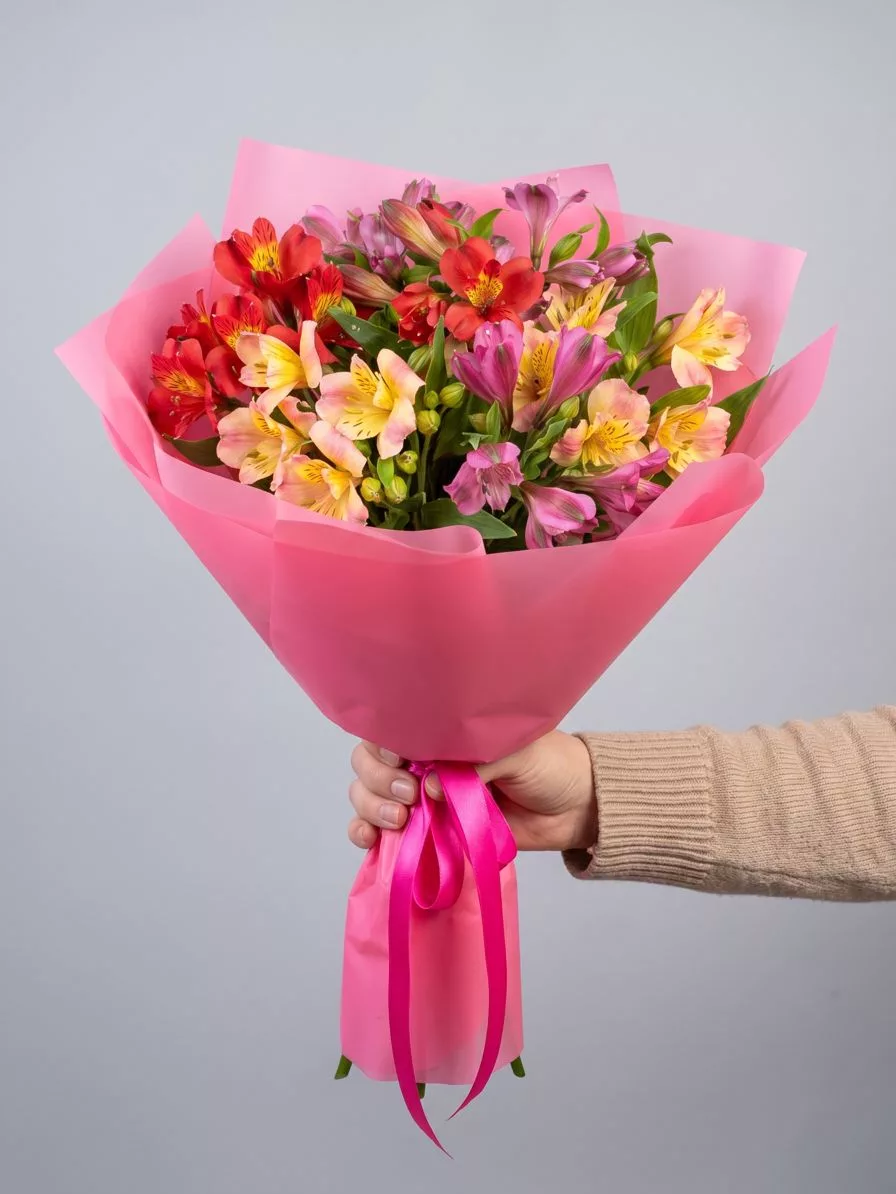
The route from Saint Petersburg to Maloyaroslavets involves road transit, and not every flower handles vibration and temperature shifts equally well. Roses with a stem length of 60 to 70 centimetres are the most reliable long-distance flower in the Russian market. Varieties such as Explorer, Red Naomi and Mondial have thick petals and a firm calyx that resist bruising during transport. Spray roses, which carry multiple smaller blooms on branching stems, are almost as robust and add volume without adding fragility. Chrysanthemums, particularly the large single-headed santini and standard varieties, are excellent travellers and hold water efficiently in transit packaging. Alstroemeria is another strong choice: the buds open gradually over several days, so even if a few petals shift during transit, the overall bouquet continues to develop after delivery. Flowers that require more caution on this route include garden roses with very open blooms, which bruise easily, and delicate ranunculus, which wilt quickly if the packaging loses humidity. Tulips in spring are popular and travel well when cut at the bud stage, but fully open tulips do not survive vibration without petal loss. Peonies in season, roughly May through June, are worth ordering if they are packed as tight buds — they will open beautifully over two to three days in the recipient's home. Knowing these distinctions lets you choose a bouquet that looks as good on arrival as it did when it left the shop.
Seasonal Availability and What Changes Month by Month
Customers sometimes order a specific flower they saw in a photo and are surprised to learn it is not available. Flower availability in Russia follows both agricultural seasons and import cycles, and Maloyaroslavets orders draw from the same supply as the rest of the network. In winter, December through February, the reliable core is roses, chrysanthemums, carnations, gerberas and orchid stems. These arrive primarily from Ecuador, Colombia and the Netherlands and are available year-round, but winter is when they dominate because domestic greenhouse production is at its lowest. From March onward, Dutch tulips flood the market in the weeks around International Women's Day on 8 March, which is the single busiest flower holiday in Russia. If you are ordering for that date, place the order at least 48 hours in advance. April and May bring ranunculus, anemones and the first peonies. Summer months offer the widest variety, including lisianthus, statice, sunflowers and dahlias from domestic growers. September marks the beginning of chrysanthemum season in Russia, and large decorative chrysanthemums in burgundy, white and yellow are widely available and excellent value. October through November is a quieter period between seasons, and roses and spray flowers are the safest choices. Knowing the season before you choose a bouquet means you are selecting from what is actually fresh in the warehouse that week, not from a photograph taken six months earlier.
Packaging for Long Transit: What Keeps the Bouquet Alive
A bouquet that looks perfect in the shop can arrive in poor condition if the packaging is wrong, and this is one area where customers have no direct control but should understand what to expect. For deliveries to Maloyaroslavets, flowers are wrapped in aqua packaging, which means the stem ends sit in a small water reservoir sealed with a rubber cap or gel sachet. This keeps stems hydrated for up to six hours, which comfortably covers the transit window. On top of the aqua layer, the bouquet is wrapped in kraft paper or a combination of paper and film to protect petals from physical contact with the box interior. In cold weather below minus 10 degrees Celsius, an insulating layer of non-woven thermal material is added around the outer wrap before the box is sealed. This matters most for roses, which suffer cell damage if petal temperature drops below minus 2 degrees Celsius even briefly. In summer heat, a cold pack is placed alongside the stems to keep the micro-environment inside the box below 20 degrees Celsius during the final delivery leg. When the recipient opens the box, the first thing they should do is trim the stem ends by one to two centimetres at a diagonal cut and place the flowers immediately in clean water. This single step extends vase life by two to three days compared to placing untrimmed stems directly into a vase. Remind the recipient of this if you are sending flowers as a surprise.
Common Mistakes When Ordering to Maloyaroslavets
The most frequent mistake is leaving the recipient's phone number blank or entering the sender's number instead. The courier needs to reach the person at the door, especially in apartment buildings where there is no reliable intercom access from the street. If the recipient is not answering and there is no contact number, the courier waits a standard interval and then the order is flagged as undeliverable, which means the flowers spend extra time in transit conditions. The second mistake is ordering for a time that is too precise without accounting for city traffic. Maloyaroslavets itself has light traffic, but the approach roads from the Moscow direction can slow during morning and evening peaks, particularly on the M3 highway corridor. A 30-minute buffer on either side of your target time is sensible. The third mistake is choosing flowers based on colour alone without reading the variety description. A bright yellow bouquet in summer might be sunflowers, which are robust, or it might be yellow roses, which need more careful handling. Asking the shop to confirm what variety is in stock on the day of delivery takes two minutes and prevents disappointment. The fourth mistake, especially from customers unfamiliar with Russian customs, is not including a card message. In Russia, arriving flowers without a signed card can create genuine confusion about who sent them, particularly for workplace deliveries where several people may have the same birthday in the same week. A short written message costs nothing and removes all ambiguity.
How to Check Your Order Status and What to Do If Something Goes Wrong
Once an order is confirmed, you receive a confirmation with an order number. Use that number if you need to contact the shop about the status. The most useful question to ask is not where the courier is right now but whether the order has been dispatched, because dispatch confirmation means the flowers are packed and moving. Asking for a GPS location of the courier is not standard practice in Russian flower delivery and will not give you useful information. If the delivery window has passed and you have not received confirmation of delivery, call the shop directly rather than sending a message, because phone calls are resolved faster for time-sensitive situations. If the bouquet arrives and a stem is damaged or a flower has bruised during transit, take a photograph immediately before doing anything else with the flowers. A clear photograph taken within 30 minutes of opening the box is the basis for any quality claim. Shops can replace damaged items or issue a partial credit, but they need visual evidence of the condition at arrival, not a description given the following day. For orders to Maloyaroslavets specifically, transit damage is uncommon when the packaging is correct, but it does happen with very delicate varieties during extreme weather. Choosing hardier flowers in January or July is the simplest way to avoid the situation entirely. A little planning at the order stage removes almost all the risk from the delivery stage, and that is the main thing experienced flower senders learn after their first few orders.
Flower delivery to Maloyaroslavets works reliably when the order has a correct address, a reachable phone number for the recipient and a flower selection that suits the season and the current temperature. The city is small enough that most deliveries complete within the standard window, and the main variables are the ones you control at the moment of ordering. Choose varieties that travel well, pack timing with a sensible buffer and write a card message. Those three habits make the difference between a bouquet that impresses and one that merely arrives. We deliver bouquets across Russia in 1–2 hours.
Frequently asked questions
Can I order flowers to Maloyaroslavets the same day?
Yes, same-day delivery to Maloyaroslavets is available for orders placed before 16:00. Orders placed in the evening may shift into the following morning window depending on order volume. For a specific delivery time, write it clearly in the comment field when placing the order rather than assuming it will be inferred.
What is the best flower to send to Maloyaroslavets in winter?
Roses, chrysanthemums and carnations are the most reliable choices in winter because they tolerate cold packaging conditions and do not bruise easily during transit. Avoid fully open garden roses or delicate ranunculus in January and February. The shop adds thermal insulation to all winter orders going to the Kaluga Oblast region.
Do I need to be home to receive the delivery?
Someone needs to be available to receive the bouquet in person. Flowers cannot be left outside a door or in a building lobby unattended, both for quality reasons and because packages left in communal areas are frequently moved. Make sure the recipient's phone number is entered correctly so the courier can call on arrival.
What happens if the recipient is not home when the courier arrives?
The courier will call the number provided and wait a short interval. If there is no response, the order is returned and rescheduled. To avoid this, confirm with the recipient that they will be available during the delivery window, or arrange delivery to a workplace address where someone is reliably present throughout the day.
Is it necessary to include a card message with the bouquet?
It is not required but strongly recommended, especially for workplace deliveries or shared apartment buildings where multiple people might be celebrating the same occasion. In Russian custom, an unsigned bouquet creates genuine uncertainty about the sender. A brief written message removes all ambiguity and is a standard part of any thoughtful flower gift.
Ready to send a bouquet?
Pick a city, choose the flowers, and we will hand them over with a photo confirmation.
Choose a city →