
Russian flower etiquette: why the number of flowers matters
5 min read
There is one rule about flowers in Russia that everybody there knows and almost no foreigner does. Break it and the bouquet still arrives, still looks lovely, and still lands wrong.
Odd for the living, even for the dead
A bouquet given to a living person always contains an odd number of stems: one, three, five, seven, nine, eleven. An even number — two, four, six, ten — is what you bring to a funeral or lay at a grave. This is not a soft preference or a fading superstition. A Russian florist will not hand you an even bouquet for a birthday, and a Russian recipient will count.
The rule has a ceiling. Somewhere around fifteen to twenty-one stems people stop counting, and large bouquets — twenty-five, fifty-one, one hundred and one roses — are sold and given without anyone auditing the arithmetic. Below that ceiling, count.
Colours that carry a meaning
- Yellow flowers have a reputation for meaning separation, kept alive largely by a famous pop song. Younger people mostly laugh at it; older people mostly do not. If in doubt, avoid yellow for a romantic gift and use it freely for friends, colleagues and celebrations.
- Red roses read as romantic, the same as everywhere. Sending them to a colleague or a friend's mother sends a message you may not intend.
- White is not funeral-coded in Russia the way it is in parts of Asia. White flowers are wedding flowers, and perfectly ordinary as a gift.
- Carnations, especially red ones, carry a strong association with military remembrance and Victory Day. They are not an insult, but they are rarely a romantic choice.
Who gives flowers to whom
Flowers in Russia are given to women far more often than to men, and given often — for a birthday, for the first of September, for March the eighth, for no reason on a Wednesday. A man receiving flowers is unusual but no longer strange, particularly for a milestone birthday or a professional achievement. If you are sending to a man and want to be safe, a plant, a large mixed arrangement, or flowers with a bottle or a gift attached reads more naturally than a dozen roses.
Odd-count bouquets



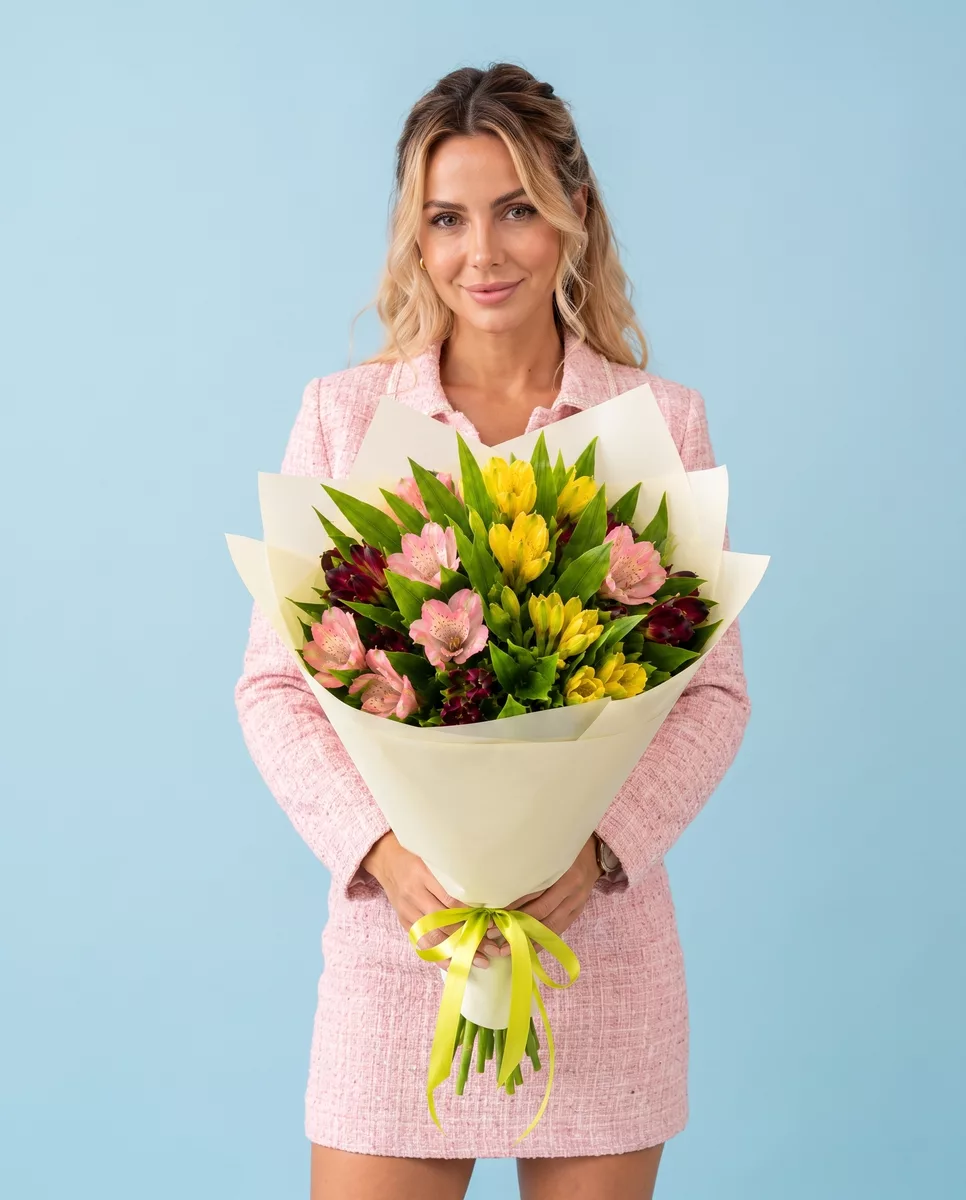
Small conventions that matter
- Flowers are unwrapped before being handed over indoors in a formal setting, but a wrapped bouquet at the door is entirely normal for a delivery.
- You do not give flowers with the left hand, and you do not hand them over across a threshold — an old superstition still observed by plenty of people.
- Potted plants are a warm gift for a home and a slightly odd one for a romantic gesture.
- A short note in Russian is worth far more than a longer one in English. Even three words show the effort.
If you are ordering from abroad
What the season does to your options
Russia spans eleven time zones and the domestic growing season is short, which means the flower market runs heavily on imports for most of the year. From October through April, the bulk of what arrives in Moscow and Saint Petersburg comes from Ecuador, the Netherlands, and Kenya — long-stem roses, chrysanthemums, carnations, alstroemeria, and standard spray fillers. These travel well and hold their count reliably, so a florist can build a precise odd-number bouquet without substituting at the last minute. From May through August the picture changes: peonies from Russian and Belarusian growers flood the market between late May and mid-June, tulips from domestic greenhouses are cheap and abundant through spring, and sunflowers become the default filler from July onward. If you are ordering for a specific date in late May and you want peonies, place the order at least a week ahead — they sell out fast and a florist who runs short will swap in something else without always telling you. September and early October sit in a gap: summer varieties are finishing and the main import shipments are ramping back up, so availability can be patchier than at other times of year. For March the eighth, which is the biggest single flower day in the Russian calendar, order no later than a week in advance regardless of what you want; florists take pre-orders from mid-February and walk-in stock on the day itself is expensive and limited. Knowing the season tells you whether to name a specific flower or give the florist latitude to choose what is actually good that week.
What goes wrong when ordering from outside Russia
The most common mistake is treating a Russian florist order like a standard international delivery — picking a photo online, paying, and assuming the result will match. Russian florists build bouquets by hand from what is physically in the shop or at the wholesale market that morning, and the finished piece will reflect local taste in proportion, wrapping style, and filler choices. That is not a flaw; it is how fresh flowers work. The problem comes when a customer specifies a bouquet built around a variety that is not in season or not stocked locally, then is surprised by the substitution. When you order, name the flower type and the colour range, not a specific cultivar or a photograph. If you have a hard requirement — white flowers only, no red, must include lilies — state it explicitly in the order notes rather than assuming it is obvious from an image. Delivery address details are the second failure point. Russian addresses follow a different structure: city, street, building number, and often a separate corpus or block number, plus an apartment number and an entry code for the building door. Missing the corpus number or the door code means the courier waits outside and the recipient never knows the flowers arrived. Ask the recipient or whoever gave you the address to confirm all fields, including the intercom code. Timing is the third issue. Same-day delivery in Moscow and Saint Petersburg is genuinely available from most established florists, but it depends on order cutoff times that vary by district. If the occasion is time-sensitive — a birthday dinner, a performance — specify the delivery window and confirm it is achievable before you pay.
How Russian bouquets are actually built and what that means for your order
A standard Russian gift bouquet is denser than what most Western customers expect. The wrapping is structural — kraft paper, fabric, or a combination — and it is folded high around the stems so the flowers sit in a cone that can be held or stood upright without a vase. This is not decorative habit; it is practical for the recipient, who may be receiving the bouquet at a door, on a street, or in a theatre lobby and needs to carry it for some time before getting it into water. When you are ordering, do not ask for a flat or hand-tied style unless you specifically want something that diverges from local convention — the recipient may find it harder to manage. Greenery and filler are used generously. Ruscus, pittosporum, eucalyptus, and bear grass are standard; they add volume without raising the stem count in a way that disrupts the odd-number rule, because Russian florists count only the feature flowers, not the foliage. If someone tells you a bouquet of five roses feels small, that is because they are imagining five stems total — in practice, five roses with proper greenery and a well-wrapped cone is a respectable gift that does not read as minimal. For a significant occasion — a major birthday, an anniversary, a professional milestone — the step up is not from five to six but from five to seven, nine, or eleven, or a move to a larger feature flower like a grand-format rose or a double peony stem. Ask the florist what reads as generous at the current market price rather than guessing by stem count alone.
You do not need to manage any of this yourself. Every bouquet we make for a gift is an odd count by default, and if you tell us the occasion we will steer the colours accordingly. Say who it is for and why, and let the florist apply the local rules — that is the part you are buying. We deliver bouquets across Russia in 1–2 hours.
Frequently asked questions
Is the odd-number rule really taken seriously?
Yes. It is one of the most consistently observed conventions in Russian daily life. Florists build bouquets as odd counts by default and recipients notice an even one.
Does the rule apply to large bouquets?
Not really. Above roughly fifteen to twenty-one stems people stop counting, which is why bouquets of twenty-five or fifty-one roses are common and unremarkable.
Are yellow flowers actually bad luck?
They carry an association with separation, mostly kept alive by a well-known song. Many younger Russians ignore it entirely. For a romantic gift it is easy enough to avoid.
Can I send flowers to a man in Russia?
Yes, though it is less common. A large mixed arrangement, a plant, or flowers combined with another gift reads more naturally than romantic roses.
Ready to send a bouquet?
Pick a city, choose the flowers, and we will hand them over with a photo confirmation.
Choose a city →