
Flower Delivery in Nizhnyaya Salda: Zones, Timing and What to Expect
Nizhnyaya Salda is a compact industrial town in Sverdlovsk Oblast, and customers ordering flowers here for the first time usually have the same three questions: can you actually reach my street, how long will it take, and will the flowers look fresh when they arrive. The answers depend on a few specific details about the town's layout, the season, and which varieties you choose — and getting those details right is the difference between a bouquet that impresses and one that disappoints before it even leaves the box.
Where We Deliver in Nizhnyaya Salda and the Surrounding Area
Nizhnyaya Salda sits along the Salda River and covers a relatively modest footprint, but the town is not a single uniform grid. The central streets around the main square and the metallurgical plant district are the most straightforward addresses to reach. Residential blocks further toward the outskirts, including older private-house sectors with unpaved lanes, can add time to a delivery, particularly in spring when road surfaces are at their worst after the thaw. When you place an order, entering the full address — building number, apartment or house number, and any entry code for a secured lobby — prevents the courier from waiting outside and the bouquet from sitting in a cold hallway longer than necessary. Addresses in the immediate surrounding villages and settlements attached administratively to Nizhnyaya Salda are handled on a case-by-case basis depending on road conditions and current order volume. The safest approach is to confirm availability for outlying addresses at the time of ordering rather than assuming coverage. We do not restrict delivery to a single district: the whole of Nizhnyaya Salda proper is served. What changes between zones is the realistic delivery window, not whether we can reach you at all. Private houses with no clear street numbering — a common situation in older Russian towns — should be accompanied by a brief landmark note in the order comments, something like 'green fence, second house from the corner of Zavodskaya.' That single line saves significant time.
Bouquets we can deliver



Delivery Timing: What the 1–2 Hour Window Actually Means
The 1–2 hour delivery promise is a real operational target, not a marketing phrase, but it requires a word of context for customers who have not ordered flowers this way before. The clock starts from the moment the order is confirmed and the bouquet is assembled, not from the moment you click the button on the website. Assembly itself takes between fifteen and thirty minutes depending on the complexity of the arrangement and whether your chosen flowers need any conditioning time — roses that have been in cold storage, for example, need a few minutes to adjust before they are wrapped or they may show stress marks on the petals. In Nizhnyaya Salda, the 1–2 hour window is realistic for central addresses during standard hours. Evening orders placed after 20:00 may shift to the following morning slot if the recipient will not be home, and it is always worth noting a preferred delivery time in the comments. The most common timing mistake customers make is ordering for a specific event time — say, a birthday dinner at 19:00 — and placing the order at 18:30. Flowers need time to be assembled properly, and a rushed arrangement shows. Order at least two to three hours before the moment you want the bouquet to arrive. If the recipient is at work and can only receive the delivery during a lunch break, state that window explicitly. Couriers in smaller towns like Nizhnyaya Salda often handle more than one delivery per run, so a precise time preference helps route planning considerably.
Which Flowers Travel Best to Nizhnyaya Salda
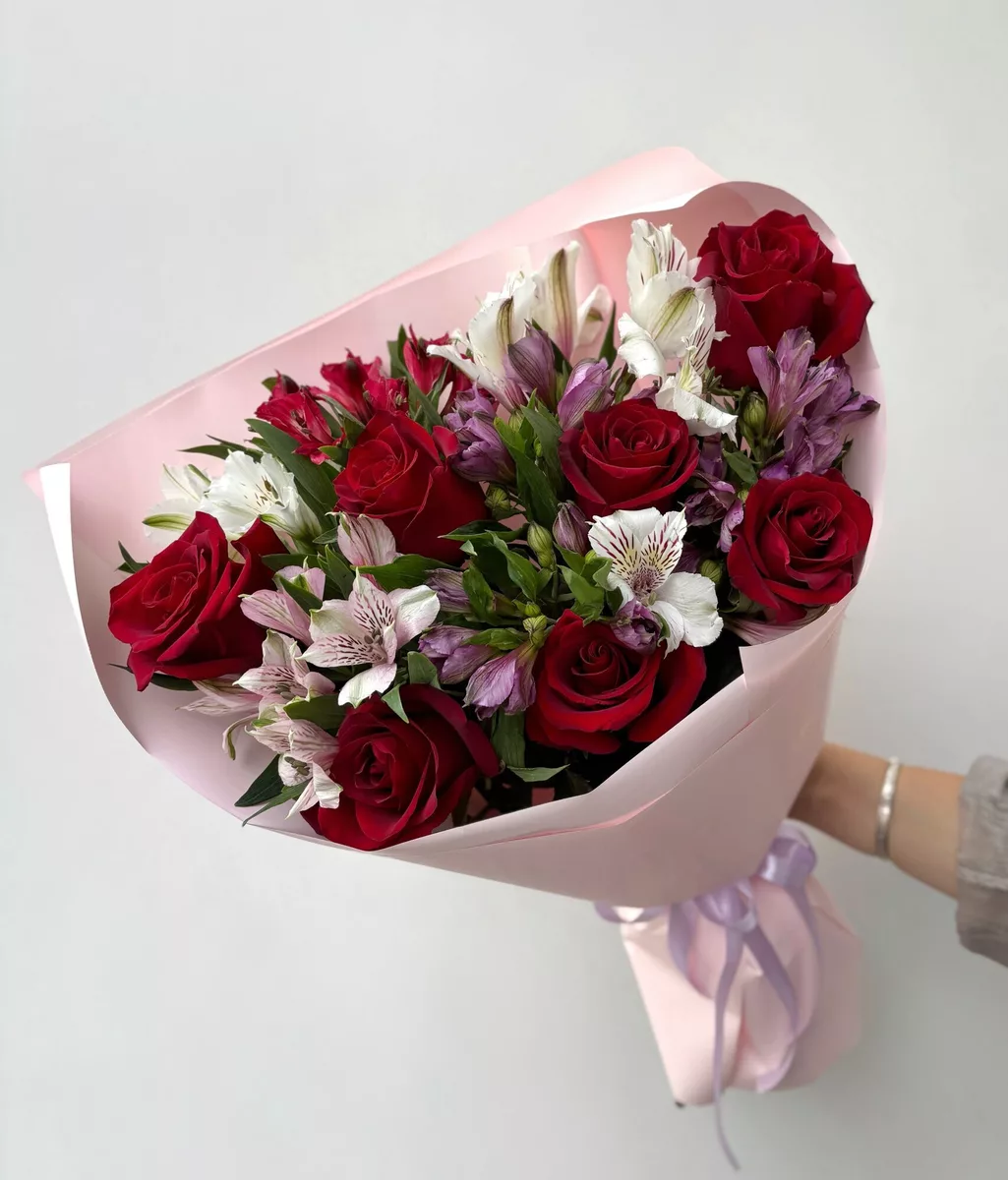
Not every variety handles a delivery journey equally well, and this matters more in a town like Nizhnyaya Salda than in a major city where the transit time is shorter. Roses are the most requested flower and they travel reliably when the stems are properly hydrated and the buds are at the right stage — fully closed buds that open over the next day or two are ideal; flowers that are already fully open are more vulnerable to petal bruising in transit. Spray chrysanthemums are exceptionally durable and hold their appearance for seven to ten days after delivery, making them a strong choice for anyone who wants lasting value. Alstroemeria is another variety that ships well: the stems are firm, the buds open gradually, and the flowers are not sensitive to brief temperature fluctuations the way tulips can be. Tulips deserve a specific note. In winter and early spring they are widely available and popular, but they are phototropic — they bend toward light — and they respond dramatically to temperature changes. A tulip bouquet left in a warm car for twenty minutes will droop noticeably. Couriers are briefed on handling them upright and away from direct heat, but if you are ordering tulips for a recipient who will not be home to receive them, consider whether the delivery location will be temperature-controlled. Peonies, when in season between late May and early July, travel well in bud form and are one of the most impressive flowers for a recipient who has not seen them before.
Seasonal Conditions in Nizhnyaya Salda and How They Affect Your Order
Sverdlovsk Oblast has a pronounced continental climate, and Nizhnyaya Salda experiences it fully. Winters are long and cold, with temperatures regularly dropping below minus fifteen Celsius from December through February. At those temperatures, flowers in transit need insulated packaging — exposed petals freeze within minutes in open air, and a frozen rose petal turns black and soft once it thaws, which is irreversible. All winter deliveries include insulated wrapping as standard, but the recipient should bring the bouquet indoors immediately and unwrap it in a room-temperature space rather than leaving it on a cold balcony or near a drafty entrance. Spring is the trickiest season logistically. The thaw period — typically March through mid-April — turns many secondary roads into mud, which slows delivery times and occasionally makes specific addresses temporarily harder to reach. Ordering a day in advance for a spring event is a practical hedge. Summer in Nizhnyaya Salda is warm but not extreme, and flowers generally travel well in June and July. August can bring heat that stresses delicate varieties like garden roses and sweet peas, so for summer deliveries in hot weather, specifying a morning delivery window keeps the bouquet in better condition. Autumn is a reliable season for delivery: moderate temperatures, stable roads, and strong availability of chrysanthemums, gerberas and dahlias, which are all well-suited to the conditions. Knowing the season when you order is not just background information — it directly shapes which varieties your florist will recommend and how the bouquet is packaged.
Bouquet Choices That Make Sense for Common Occasions in Nizhnyaya Salda
Russian flower-giving customs are specific enough that a customer unfamiliar with them can accidentally make an awkward choice. The most important rule is that bouquets given as gifts must contain an odd number of stems — this is a firm social convention across Russia, and even-numbered bouquets are associated with mourning. A florist following Russian custom will automatically compose bouquets in odd numbers, but if you are specifying exact stem counts in your order, keep this in mind. For birthdays, roses remain the dominant choice, and a compact arrangement of fifteen to nineteen stems in a single colour reads as generous without being overwhelming. Red roses are strongly romantic in Russian custom, so for a colleague or teacher, a mixed-colour arrangement or a spray of chrysanthemums is more appropriate than a red rose bouquet. For school events — and Nizhnyaya Salda has several schools where flowers are given on the first of September, the last school bell in May, and graduation — gladioli and chrysanthemums are traditional. Gladioli in particular are the classic teacher's flower in Russia, and a single large stem or a bundle of three is a recognisable and appreciated gesture. For a new home or a housewarming, potted plants are increasingly popular alongside cut flowers because they last longer. If you are sending flowers to someone you do not know well, a mixed seasonal bouquet with no strong colour symbolism — whites, creams, light pinks — is the safest and most universally well-received choice.
What to Check Before You Confirm Your Order
A few minutes spent verifying details before you submit an order prevents the most common delivery problems. First, confirm the recipient will actually be at the address during the delivery window. Flowers left with a neighbour or a building concierge are a reasonable backup, but only if you have explicitly noted that arrangement in the order comments and the concierge is expecting a delivery. Do not assume the recipient will be available — especially for workplace deliveries, where the person may be in a meeting or away from their desk. Second, check the phone number you provide for the recipient. The courier will call ahead of arrival, and an incorrect or switched-off number means the delivery stalls. If the recipient should not know about the flowers in advance — a surprise delivery — note this and provide an alternative contact number for the courier to use if there is a problem at the address. Third, review the card message if you are including one. Card messages in Russia are typically brief and direct — a name, a wish, a signature. Long paragraphs are unusual and can feel awkward in the context of a small gift card. Four to five lines is the practical maximum for a standard card. Fourth, if you are ordering a specific variety — say, white peonies or yellow tulips — and you have a strong preference, note a substitute in case that exact variety is not available on the day. Seasonal availability shifts quickly, and a florist who knows your second choice can act without needing to contact you for approval, which keeps the delivery on schedule.
Tracking Your Delivery and Communicating With the Courier
Once your order is confirmed and assembly begins, you will receive a notification. In Nizhnyaya Salda, as in any town outside a major metropolitan area, the delivery process is more direct than in a large city: there is typically one courier per delivery rather than a dispatch chain, which means communication is straightforward. If you need to update the delivery address or change the time window after placing the order, contact customer support as early as possible — changes made after the bouquet is assembled and the courier has departed are difficult to accommodate. The courier will call the recipient's number before arriving. If the recipient does not answer, the courier will attempt the number a second time and then contact the ordering customer. Having both numbers correct in the order form is the single most effective way to prevent a failed delivery. For recipients in apartment buildings with entry codes or intercoms, the code should be in the order notes. Many older buildings in Nizhnyaya Salda have intercom systems that work inconsistently, and a note saying 'intercom often broken, please call on arrival' is genuinely useful information for the courier. Once the bouquet is delivered, the recipient should trim the stems by one to two centimetres at a diagonal cut and place the flowers in clean water immediately. Flowers that have been in transit for an hour or more benefit from a fresh cut, and this small step extends their vase life by two to three days. A note on this is sometimes included with the bouquet, but it is worth knowing in advance so the recipient is prepared.
Ordering flowers to Nizhnyaya Salda is straightforward once you understand the practical variables: the address detail, the delivery window, the season, and the variety. The customers who are happiest with their deliveries are the ones who spend two minutes filling in the order notes carefully — a correct phone number, a building entry code, a preferred time window, and a note about substitutes if needed. Everything else — the assembly, the packaging for the weather, the routing — is handled on this end. The flowers that arrive are fresh, properly wrapped for the temperature, and assembled by florists who know which varieties hold up and which need extra care in transit. We deliver bouquets across Russia in 1–2 hours.
Frequently asked questions
Can you deliver to private houses in the outskirts of Nizhnyaya Salda?
Yes, private houses within Nizhnyaya Salda proper are covered. For addresses on unpaved lanes or in attached settlements outside the town boundary, confirm availability when placing the order. Including a landmark note — a fence colour, a nearby building — helps the courier locate the address without delays, especially in areas where street numbering is inconsistent.
How should the recipient handle flowers in winter when it is very cold outside?
Bring the bouquet indoors immediately and unwrap it in a room-temperature space. Do not leave it on a balcony or near a cold entrance door. Trim the stems by one to two centimetres and place in clean water. Flowers chilled below freezing show petal damage once they thaw, so speed from courier to vase matters more in winter than in any other season.
Is it possible to send flowers to a workplace address in Nizhnyaya Salda?
Workplace deliveries work well as long as the recipient is at their desk and the building has a clear reception or entry point. Note the company name and floor or office number in the order comments. If the recipient has an irregular schedule or may be in meetings, specify a narrow time window and provide a mobile number so the courier can coordinate arrival directly.
What is the correct number of stems to include in a gift bouquet in Russia?
Always an odd number — three, five, seven, eleven, fifteen and so on. Even-numbered bouquets follow a mourning convention in Russian custom and are not appropriate as celebratory gifts. Florists composing standard arrangements follow this automatically, but if you specify an exact stem count, make sure it is odd to avoid an unintentional message.
Which flowers last the longest after delivery to Nizhnyaya Salda?
Spray chrysanthemums consistently last seven to ten days with basic care. Alstroemeria and carnations also have strong vase life. Roses last five to seven days when stems are recut and water is changed every two days. Tulips and anemones are shorter-lived at three to five days but make a strong visual impression. For longevity, chrysanthemums are the practical choice.
Ready to send a bouquet?
Pick a city, choose the flowers, and we will hand them over with a photo confirmation.
Choose a city →