
Flower Delivery in Sol-Iletsk: Zones, Timing and What to Expect
Sol-Iletsk sits in the southern Orenburg region where summer temperatures regularly push past 35 °C and winters drop hard below zero. Both extremes matter when you are sending flowers, because a bouquet that travels forty minutes in the wrong conditions arrives looking nothing like it left the cooler. At Five Flowers we ship fresh-cut stems from Saint Petersburg with same-day and next-day windows, and the questions we hear most often from Sol-Iletsk customers are about timing, about which flowers actually survive the journey, and about what happens at the door. This article answers all of that plainly.
Which Parts of Sol-Iletsk We Reach and How Long It Takes
Sol-Iletsk is a compact town of roughly 27,000 people, and the central districts around Lenin Street and the salt lake resort zone are the most frequently served addresses. Delivery windows to Sol-Iletsk run from one to two hours once the order is confirmed and the bouquet is dispatched. The resort area on the southern edge of town, including streets adjacent to Razval Lake, falls within the standard delivery boundary, so guests staying at sanatoriums or rented accommodation there can receive flowers without any zone surcharge. Addresses on the far northern outskirts, particularly industrial streets beyond the main rail crossing, may require an additional thirty minutes depending on traffic and road conditions — always mention a landmark or gate code if the building is off the main grid. The Ilek River corridor on the western side of town is fully covered. When you place an order, the confirmation message gives you a precise delivery window rather than a vague estimate, so the recipient does not have to wait at the door for hours. If you are sending to a hotel or sanatorium in the resort zone, include the room number and ask reception in advance whether they accept deliveries at the front desk, because some wellness facilities have restricted entry hours, especially in the high summer season from June through August.
Bouquets we can deliver



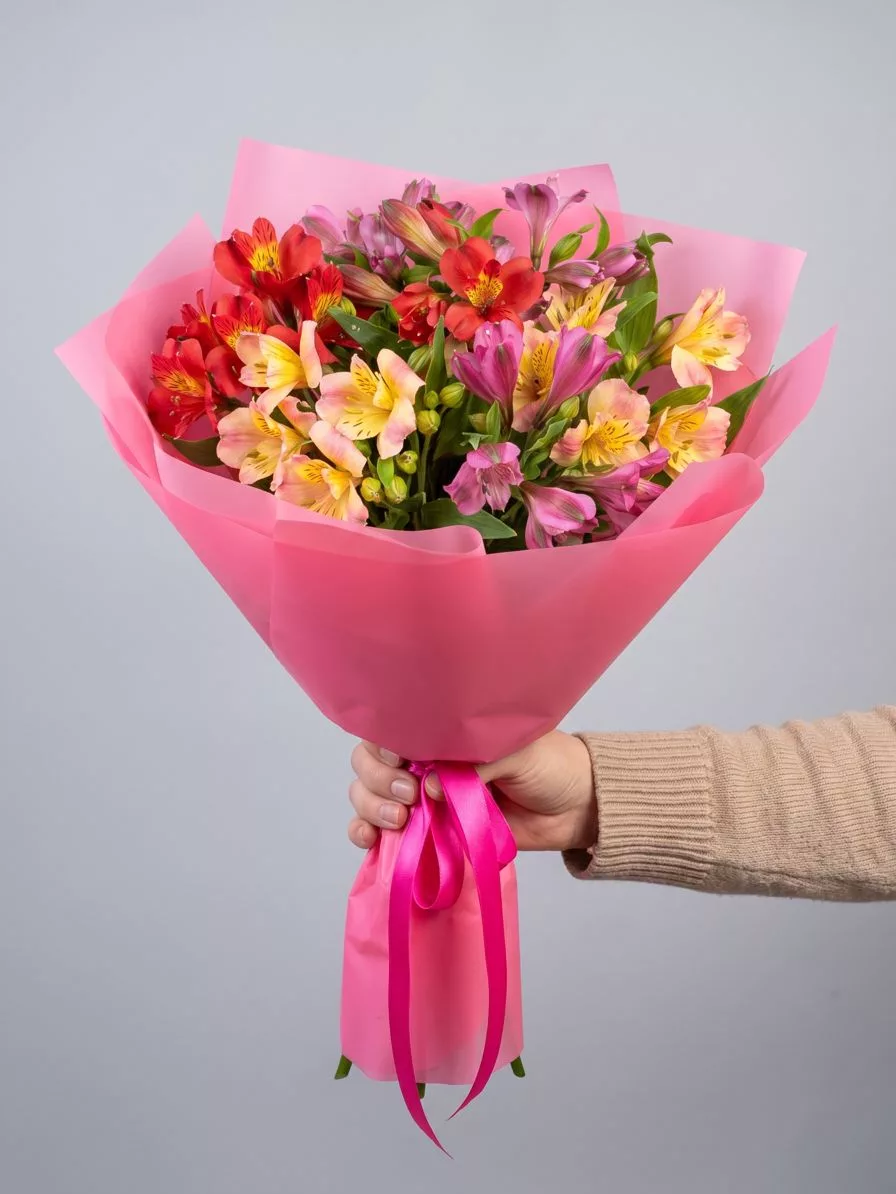
Summer Heat and Which Flowers Survive the Journey
Sol-Iletsk summers are genuinely harsh, and this is where most ordering mistakes happen. When outdoor temperatures are above 30 °C, delicate open-faced blooms like garden roses with many petals, hydrangea, and fully open peonies lose their shape within twenty to thirty minutes outside a cooled environment. The varieties that hold up best in transit during July and August are spray roses, alstroemeria, chrysanthemum, eustoma, and carnation — all of them have tighter petals and thicker stems that retain water longer. Sunflowers are a popular choice in this region and they are genuinely robust, though they drink water quickly once they arrive, so the recipient should trim the stems and place them in a deep vase immediately. Tropical stems such as anthurium and bird of paradise handle heat better than most people expect because they originate in warm climates, and they are worth considering for summer orders. When you order during a heat wave, select a morning or early evening delivery slot rather than midday, because the temperature differential between the cooler and the street is smallest at those times. Our packaging for summer orders uses insulated wrapping and damp floral foam to extend the safe transit window, but the recipient should still move the bouquet indoors within five minutes of receiving it. Asking the delivery team to call ahead fifteen minutes before arrival is a simple step that makes a real difference to how the flowers look when the door opens.
Winter Delivery: Frost, Wrapping and What to Do at the Door
Winter in Sol-Iletsk means temperatures regularly between minus 15 °C and minus 25 °C from December through February, and flowers are genuinely vulnerable at those levels. Roses, ranunculus, and anemone are the most frost-sensitive: their petals develop translucent patches and then collapse within minutes of exposure if they are not properly wrapped. Our winter bouquets leave the shop in layered kraft and thermal sleeve packaging, and the outer wrap stays on until the flowers are inside a heated room — this is not decorative, it is protective, and removing it on the doorstep is the single most common mistake recipients make. Once indoors, let the bouquet rest in a cool room for ten to fifteen minutes before unwrapping, because moving from minus 20 °C directly into a warm apartment causes condensation that damages petals. Chrysanthemums, spray roses, and alstroemeria are again the most reliable winter varieties because they tolerate brief cold exposure better than large-headed blooms. Tulips, which are extremely popular for Russian celebrations, handle winter transit reasonably well when they are in bud stage — fully open tulips are more vulnerable. If the recipient is outdoors, for example at a stadium entrance or a train station, the delivery team will keep the bouquet in the vehicle until the handover moment. For corporate orders going to an office building with a cold entrance lobby, specify the floor and ask someone to meet the courier at the lift.
Popular Occasions in Sol-Iletsk and What People Actually Order
The salt lake resort draws visitors from across Russia, particularly from May through September, and a significant share of Sol-Iletsk flower orders are from people sending to friends or family who are staying at the resort for a health cure. Bouquets for this purpose tend to be compact and practical — stems that last four or five days in a simple glass, because resort guests rarely have access to a proper vase or a cool storage spot. Spray roses, carnations, and single-variety chrysanthemum bunches work well in this context. Birthday deliveries are the most common order type year-round, and the most requested colour combination in this region is red and white, followed by yellow and orange. For anniversaries, mono-bouquets of roses in a single colour are consistently popular — red roses in 25, 51, or 101 stems are the classic Russian anniversary gift, and the number carries meaning: odd numbers are for the living, even numbers are traditionally not given as gifts in Russia, which surprises many customers who are not familiar with the custom. International Women's Day on 8 March is the single busiest delivery day of the year anywhere in Russia, and Sol-Iletsk is no exception. Orders placed less than 48 hours before 8 March frequently face limited variety availability, so booking early in late February is strongly advised. Teacher's Day in early October is another peak, when children's parents send flowers to schools, and single chrysanthemum stems or small mixed bouquets are the standard choice.
Timing Your Order: Slots, Cut-Off Times and Same-Day Rules
Same-day delivery to Sol-Iletsk is available for orders placed before a cut-off time that varies slightly by season — in summer the florist workday extends later, while in winter the last same-day slot closes earlier to account for road conditions. As a general rule, orders placed before 14:00 local Orenburg time reliably reach Sol-Iletsk addresses the same day. Orders placed between 14:00 and 18:00 can often still be fulfilled same-day, but the available bouquet selection narrows because some varieties sell out. Evening orders, meaning anything after 18:00, default to next-morning delivery, which is often the better choice anyway because recipients are more likely to be home and alert. For surprise deliveries, the morning slot between 09:00 and 12:00 works best in residential areas, while office deliveries land better between 10:00 and 15:00 when the recipient is reliably at their desk. Saturday delivery follows the same schedule as weekdays. Sunday delivery is available but with a reduced variety selection, so if you have a specific flower in mind — say, a mono-bouquet of white eustoma or a particular colour of lisianthus — ordering on Saturday for Sunday delivery gives the team time to confirm availability. Public holidays are the exception: on major Russian holidays including New Year, 8 March, and 23 February, demand spikes sharply and standard timing windows extend. Pre-ordering two to three days ahead on those dates is not overcautious, it is simply practical.
What to Check Before You Confirm Your Order
The most frequent delivery problems we see from Sol-Iletsk orders come down to four things: an incomplete address, a recipient who does not answer the phone, a gate or intercom code that was not shared, and a mismatch between the requested flower and what is actually in season. On the address point, Sol-Iletsk has several streets with similar names and some newer residential blocks that are not yet on standard navigation maps — always include the building number, the apartment or office number, and the nearest landmark or cross street. The recipient's phone number must be a working Russian mobile number, because the courier calls ahead before arrival; if the recipient has a foreign SIM or no signal, arrange for someone else to receive the bouquet. Intercom codes and gate entry details should go in the order comment field. On the flower question, varieties like peonies and tulips have defined seasons: peonies are available from roughly late April through June, tulips are abundant from January through April and again in autumn, and ordering these outside their season means either a substitution or a delay. When you are unsure whether a variety is available, use the comment field to write your second choice — this speeds up the process considerably instead of waiting for a callback. Finally, check the delivery address against the zone map before paying, because addresses more than a set distance from the town centre may require advance scheduling rather than a standard one-to-two-hour window.
Caring for the Bouquet After Delivery: Practical Steps for Recipients
A florist's job ends at the door, but the life of the flowers continues for several more days if the recipient follows a few straightforward steps. The first thing to do after bringing the bouquet inside is to cut the stems at a 45-degree angle under running water or in a bowl of water — this prevents an air bubble from sealing the cut end and blocking water uptake. Remove any leaves that sit below the waterline in the vase, because submerged leaves rot quickly and contaminate the water, shortening the life of the entire bouquet. Change the water every day or every other day and re-cut the stems each time. In Sol-Iletsk's dry climate, particularly in summer, flowers drink faster than in more humid regions, so check the water level daily. Keep the bouquet away from direct sunlight and away from heating vents or air-conditioning units — both dry the air around the petals rapidly. The ideal room temperature for most cut flowers is between 15 °C and 20 °C. Roses and alstroemeria typically last seven to ten days with proper care. Chrysanthemums can last two weeks or longer. Eustoma and lisianthus hold well for ten days. Tropical varieties like anthurium last three weeks or more. If any single stem wilts before the others, remove it immediately so it does not release ethylene gas, which accelerates ageing in the surrounding blooms. These are not complicated steps, but they make the difference between a bouquet that lasts four days and one that lasts ten.
Sol-Iletsk is not a large city, but it has a real mix of delivery situations — resort guests, residential buildings, offices, and outdoor handovers at the salt lake — and each one has its own small set of considerations. The core advice is consistent: match the flower variety to the season and the temperature, give a complete address with a working phone number, and order early on peak dates. When those three things are in place, fresh flowers reach Sol-Iletsk addresses in good condition and on time, which is exactly what the person sending them intended. We deliver bouquets across Russia in 1–2 hours.
Frequently asked questions
Can I order flowers to a sanatorium in the Sol-Iletsk resort zone?
Yes, the resort zone including addresses near Razval Lake is within our standard delivery area. Include the sanatorium name, building number, and room number in the address field. It also helps to inform the front desk in advance, as some wellness facilities have restricted entry hours, particularly during peak summer season.
Which flowers should I avoid ordering in Sol-Iletsk during July and August?
Avoid fully open large-headed roses, hydrangea, and open peonies during peak summer heat. These varieties lose their shape quickly above 30 °C. Better summer choices are spray roses, alstroemeria, carnation, eustoma, and sunflowers, all of which have tighter or thicker petals that hold up during transit in warm conditions.
Why do Russian bouquets always have an odd number of flowers?
In Russian tradition, even numbers of flowers are associated with mourning and are brought to funerals. Gifts for living recipients are always in odd numbers — 1, 3, 5, 11, 25, 51, 101. This is a widely observed custom across Russia, and most customers outside Russia are simply not aware of it until someone mentions it.
What is the latest I can order for same-day delivery to Sol-Iletsk?
Orders placed before 14:00 Orenburg local time reliably reach Sol-Iletsk the same day. Orders between 14:00 and 18:00 can often still be fulfilled same-day with a narrower variety selection. Anything after 18:00 defaults to next-morning delivery, which is frequently the more practical option for residential addresses.
How should the recipient handle the bouquet in winter when it arrives very cold?
Keep the outer packaging on until the bouquet is inside a heated room. Then let it rest unwrapped in a cool interior space for ten to fifteen minutes before placing it in water. Moving frozen stems directly into warm air causes condensation damage. Trim the stems at an angle under water once the flowers have acclimatised to room temperature.
Ready to send a bouquet?
Pick a city, choose the flowers, and we will hand them over with a photo confirmation.
Choose a city →