
Flower Delivery in Sosnogorsk: Zones, Timing and What to Expect
Sosnogorsk sits in the Komi Republic, roughly 1,200 kilometres northeast of Moscow, and customers there ask us the same question every week: can you actually get fresh flowers here the same day? The honest answer is yes, with planning. This article walks through every part of the process — which streets and districts we reach, how long transit realistically takes, which bouquets arrive in the best condition, and what details to double-check when you place an order.
Where in Sosnogorsk We Deliver and What Counts as the City
Sosnogorsk is a compact city, but its administrative boundaries include several settlements that sit kilometres apart from the central district. When customers write 'Sosnogorsk' in the address field, they sometimes mean the railway microdistrict near the Sosnogorsk station, the Nizhniy Odes settlement to the south, or the Yarega area to the west. Each of these adds travel time and, in winter, road conditions that vary considerably from the paved central streets. The core delivery zone covers the central part of the city — streets around Komsomolskaya, Lesnaya, and the main administrative quarter — with standard timing. Outlying settlements such as Yarega and Nizhniy Odes are reachable but require a longer delivery window, so when you order, write the full address including the settlement name, not just 'Sosnogorsk.' We also serve addresses along the Ukhta–Sosnogorsk corridor, since many residents have workplaces or relatives on that stretch. If you are unsure whether your specific address falls inside the main zone, call before ordering rather than after: it saves everyone time and prevents a bouquet sitting in a vehicle longer than it should. The courier route is planned fresh each morning based on confirmed orders, so an early order placed by 9 a.m. gets the best slot in the day's schedule. Late orders placed after 4 p.m. are still possible but may shift to the following morning delivery window depending on courier availability and the distance to your address.
Bouquets we can deliver



Realistic Delivery Timing from Saint Petersburg to Sosnogorsk
We are based in Saint Petersburg, and Sosnogorsk is not next door. Flowers leave our shop already assembled and conditioned, then travel by refrigerated transport to the Republic of Komi. The standard delivery window for Sosnogorsk is 24 to 48 hours from the moment your order is confirmed and paid. Same-day delivery in the classic sense — order at noon, flowers at 3 p.m. — is not available for this region, and any service claiming otherwise for a destination this far from a major city should be questioned carefully. What we can offer is next-day delivery when you order before 12:00 noon Moscow time, and two-day delivery for orders placed later in the afternoon or for addresses in outlying settlements. The timing also depends on the season. In January and February, road conditions between Syktyvkar and Sosnogorsk can slow transport, and we build a buffer into winter orders precisely because of this. Summer orders move faster. When a customer tells us the flowers are for a birthday at 6 p.m. on a specific date, we work backwards from that deadline: we confirm the latest order time that still allows safe arrival, and we tell you that time plainly before you pay. Do not assume that ordering the evening before a morning celebration is safe for this distance — for Sosnogorsk, order at least 36 hours ahead to be comfortable, and 48 hours ahead in winter months.
Which Flowers Travel Well on the Komi Route
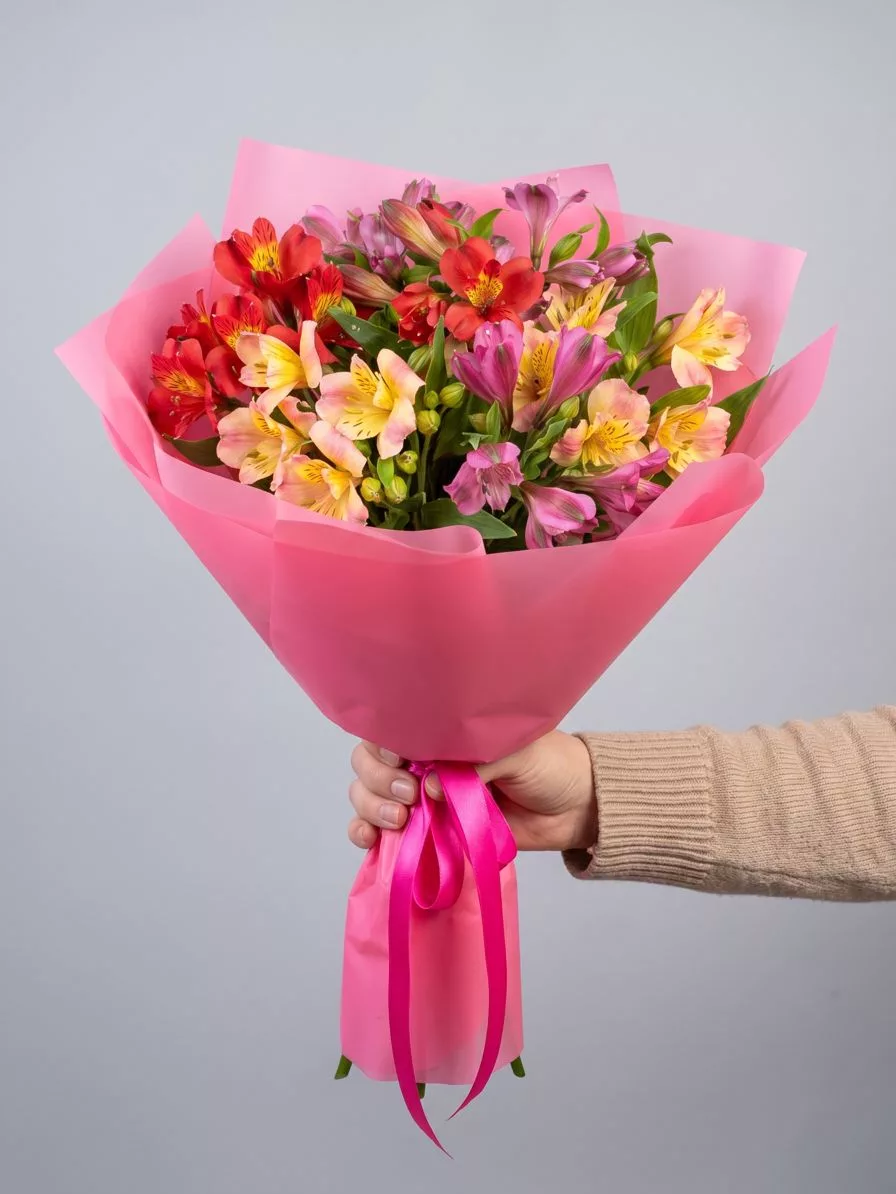
Not every flower handles a 1,200-kilometre journey in the same condition, and this is where florist experience matters more than catalogue photographs. Roses are the most common request, and they travel well when cut at the correct stage — tight bud, not fully open — because they continue opening gradually during transit. We use varieties with firm, dense petals: spray roses, standard large-head roses, and garden-style varieties with layered petals all arrive reliably. Chrysanthemums, both single-stem and spray types, are excellent travellers: their stems are robust, they hold water efficiently, and temperature fluctuations affect them less than they affect tropical flowers. Alstroemeria is another solid choice for long-distance orders — it has a naturally long vase life, the buds are compact during transit, and it opens beautifully once placed in water at the destination. What we steer customers away from for Sosnogorsk orders: open garden peonies in full bloom, which bruise easily; delicate ranunculus in summer heat; and any arrangement with tropical foliage that dries out quickly in heated vehicle cabins during winter. Tulips in season — roughly February through April — travel acceptably if ordered in bud, but they open fast once warm, so they suit same-week delivery rather than orders timed to arrive more than two days out. When you call or write to us, mention the travel distance and we will tell you directly which varieties are in good condition that week and which to avoid.
Packaging and Temperature: What Keeps Flowers Safe in Transit
The journey from Saint Petersburg to Sosnogorsk passes through varying climates and, in winter, temperatures that can drop well below minus twenty degrees Celsius in the Komi Republic. Packaging is not decorative for long-distance orders — it is functional insulation. Bouquets travelling to Sosnogorsk are wrapped in aqua-packs, which are small water-filled pouches that clip onto the cut stems and keep them hydrated throughout transit. The outer wrapping is kraft paper layered with a thermal film sleeve that slows heat loss in winter and prevents direct sunlight from warming the flowers in summer. In January and February, we add an additional insulating layer for Sosnogorsk orders specifically, because the final leg of delivery — from the transport hub to the recipient's door — can expose the bouquet to outdoor temperatures for several minutes. Customers sometimes remove the packaging as soon as they receive the flowers, which is understandable, but we recommend placing the entire wrapped bouquet in a bucket of cool water for thirty minutes first, then unwrapping. This lets the stems rehydrate fully before they are exposed to room temperature air. The indoor temperature in Sosnogorsk apartments in winter is typically warm — central heating in Russian apartment buildings runs hot — so keep flowers away from radiators and windowsills above heating units. A cool corner of the room, away from direct heat, extends vase life by two to three days compared with flowers sitting near a radiator.
How to Place an Order Correctly for a Sosnogorsk Address
The most common mistake we see on orders to Sosnogorsk is an incomplete address. Russia uses a specific address format — city, street, building number, apartment number — and for Sosnogorsk this should also include the settlement name if the address is outside the central district. An order that says 'Sosnogorsk, Lesnaya 12' is processable; an order that says 'near the school' is not. When ordering online, fill every address field: if there is a field for apartment number, fill it even if the recipient lives on the ground floor, because couriers use that information to confirm delivery. The recipient's phone number is mandatory for Sosnogorsk orders. Our courier will call ahead — typically 30 to 60 minutes before arrival — so the recipient can be available. If the recipient is at work and cannot receive a call, note that in the order comments and provide an alternative contact. For surprise deliveries, you can ask us to call you first instead of the recipient, and we will coordinate the handover through you. Payment is accepted in full at the time of ordering, not on delivery, for all regional orders including Sosnogorsk. This is standard practice for deliveries outside Saint Petersburg. If you want a specific ribbon colour, a card with a handwritten message, or a particular flower excluded from a mixed bouquet, add that in the comments field — we read every comment before assembling the order, and it is far easier to adjust before assembly than after.
Seasonal Availability and What Changes Through the Year
Sosnogorsk customers order flowers year-round, and the most popular moments are February 14th, March 8th — International Women's Day, which is the single largest flower-buying day in Russia and genuinely important here, not just a calendar note — and May 9th, Victory Day, when many families place orders for older relatives. For March 8th, we recommend ordering at least five days in advance for Sosnogorsk, because demand across all Russian regions spikes simultaneously and transport slots fill quickly. Roses and tulips dominate March 8th orders, and tulip availability is excellent in late February and early March since Dutch and domestic greenhouse supplies are at their peak. In summer, from June through August, the route to Sosnogorsk is at its easiest — roads are clear, temperatures are manageable with standard packaging, and a wider range of varieties is available including lisianthus, gerbera, and seasonal garden flowers. Autumn brings chrysanthemum season, which is ideal for Sosnogorsk orders because chrysanthemums are among the hardiest long-distance flowers available. In December, orders increase around New Year, which in Russia is celebrated with more intensity than in most Western countries — it is the primary gift-giving holiday, not Christmas. Flowers for New Year in Russia are typically given on December 31st or January 1st, and orders for Sosnogorsk placed after December 28th need expedited handling, so contact us directly rather than relying solely on the website form during that period.
What to Check After the Flowers Arrive in Sosnogorsk
When a bouquet arrives after a 24-to-48-hour journey, the recipient should do a few things immediately to get the best vase life from the flowers. First, cut one to two centimetres off the bottom of each stem at a diagonal angle using a sharp knife, not scissors, which crush the stem tissue and reduce water uptake. Do this under running water or while the stems are submerged, which prevents air bubbles from blocking the cut. Second, remove any leaves that would sit below the waterline in the vase — submerged leaves rot quickly and contaminate the water, shortening the life of the entire bouquet. Third, fill the vase with cool, clean water and change it every two days. Tap water in Sosnogorsk is fine for this purpose. If the bouquet came with a sachet of flower food — a small paper packet attached to the wrapping — dissolve it in the vase water according to the instructions on the packet; it contains sugars and a mild bactericide that genuinely extend vase life. If the flowers look slightly wilted immediately after unpacking, this is normal after a long journey. Place the freshly cut stems in deep cool water for two hours before arranging them in a display vase. In most cases, flowers recover fully within a few hours of proper rehydration. If after 24 hours in water the flowers have not recovered, contact us with a photograph — we take quality complaints seriously and will discuss the situation with you directly.
Delivering flowers to Sosnogorsk is entirely possible, and customers there receive the same quality of assembly and the same varieties as customers in Saint Petersburg — the difference is planning ahead. Order at least 36 hours before your deadline, write the full address including settlement name, keep the recipient's phone available, and choose varieties suited to the journey. When those conditions are met, a fresh, well-packaged bouquet arrives in good condition and lasts a full week in the vase. We deliver bouquets across Russia in 1–2 hours.
Frequently asked questions
Can I order flowers for same-day delivery in Sosnogorsk?
Same-day delivery is not available for Sosnogorsk due to the distance from Saint Petersburg. The standard window is 24 to 48 hours. For next-day delivery, place your order before 12:00 noon Moscow time. In winter, build in 48 hours to account for road conditions between Syktyvkar and Sosnogorsk.
Which bouquets are best for a long journey to the Komi Republic?
Roses in tight bud, spray chrysanthemums, and alstroemeria are the most reliable choices for long-distance delivery. They hold water well, tolerate temperature changes, and arrive in presentable condition. Avoid fully open peonies, tropical foliage, and ranunculus for orders travelling more than 24 hours.
Do I need to be home to receive the delivery in Sosnogorsk?
Yes. Our courier calls the recipient 30 to 60 minutes before arrival. If the recipient cannot take calls, provide an alternative contact in the order comments. For surprise deliveries, we can call you instead and coordinate the handover. Leaving flowers unattended at a door is not recommended, especially in winter temperatures.
Why does March 8th require ordering so far in advance for Sosnogorsk?
International Women's Day on March 8th is the highest-demand flower day in Russia. Transport capacity across all regions fills up simultaneously. For Sosnogorsk specifically, we recommend ordering five days ahead to secure a delivery slot and to guarantee that the varieties you want — particularly tulips and roses — are available in the quantities needed.
What should the recipient do if the flowers look wilted on arrival?
Cut one to two centimetres off each stem at a diagonal angle, remove leaves below the waterline, and place the bouquet in deep cool water for two hours. Most flowers recover fully after rehydration following a long journey. If they do not improve within 24 hours, send us a photograph and we will address the situation directly.
Ready to send a bouquet?
Pick a city, choose the flowers, and we will hand them over with a photo confirmation.
Choose a city →