
Flower Delivery in Unecha: Zones, Timing and What to Expect
Unecha sits in the Bryansk region close to the Belarusian border, and customers ordering flowers here often ask the same first question: will they actually arrive fresh? The answer depends on the route, the season and the varieties you choose. Here is everything that matters before you place an order.
Where We Deliver in Unecha and the Surrounding Area
Unecha is a compact town of roughly 25,000 people built around its railway junction, and the delivery zone covers the central streets, the residential districts along Komsomolskaya and Lenina, and the private house sectors on the town's edges. Orders to addresses within the main built-up area move fastest. Outlying villages within about 15 kilometres of the town centre — including settlements along the Bryansk highway corridor — are served on request, though those runs are scheduled rather than on-demand and need to be confirmed when you place the order. If you are sending flowers to a workplace such as the railway depot administration or one of the district hospital buildings, add the full institutional address including building number and any gate or entrance detail, because large sites have multiple entry points and drivers lose time without that information. Residential blocks built in the Soviet era often have unmarked entrances, so include the entrance number if you know it. For private houses in the newer neighbourhoods on the southern edge of town, a landmark or a short description of the turning helps more than coordinates alone. The clearer the address, the closer the actual delivery time will be to the window you see at checkout. Unecha is not a city where every street is indexed in mapping software, so human-readable directions genuinely matter here.
Bouquets we can deliver



Typical Delivery Times and How the Route Affects Freshness
Orders placed before noon on weekdays usually reach addresses in the town centre within two to three hours. Evening orders, meaning anything placed after 17:00, are typically scheduled for the following morning unless you specifically request a same-day late slot and the order is confirmed by the team. The Bryansk region sits roughly 380 kilometres south-west of Moscow, and flowers dispatched from Saint Petersburg travel in refrigerated transport to a regional hub before the final leg into Unecha itself. That logistics chain means the flowers you receive have been kept at between two and six degrees Celsius throughout transit, which is the correct storage range for cut roses, chrysanthemums and alstroemeria. Temperature discipline matters more than raw speed: a rose held at four degrees for eight hours arrives in better condition than one left at room temperature for two hours. When you order in summer, especially July and August when daytime temperatures in the Bryansk region regularly reach 28 to 30 degrees Celsius, the final handoff from the vehicle to the recipient should happen quickly. Ask the recipient to put the bouquet in water within fifteen minutes of receiving it, trim the stems at an angle under running water, and keep it away from direct sunlight and draughts. That routine adds three to five days to vase life regardless of variety.
Which Flowers Hold Up Best on a Long Route
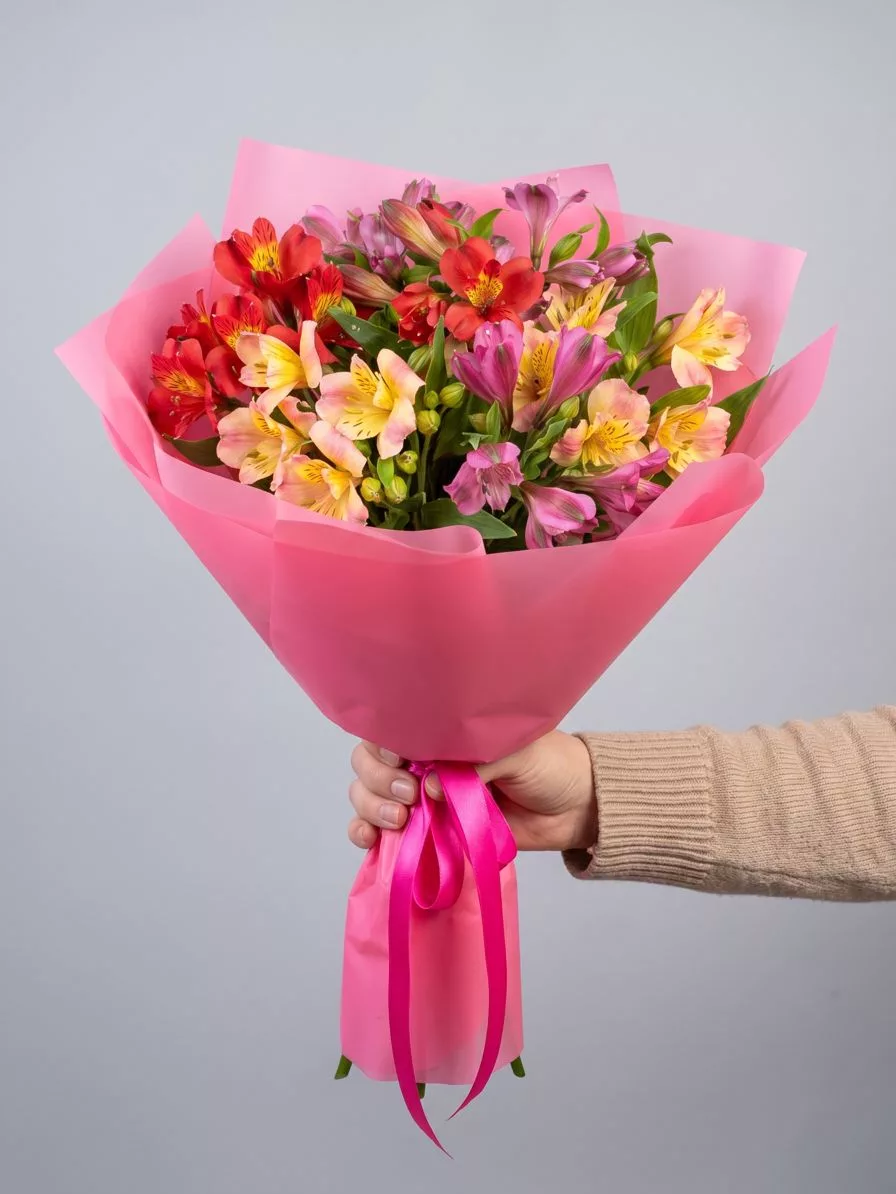
Not every variety is equally suited to a multi-stage delivery. Roses are the most reliable long-distance flower: a well-conditioned garden rose or a spray rose travels well as long as the cold chain holds. Dutch roses in standard sizes — 50 cm and 60 cm stems — are the workhorses of long-distance orders. Chrysanthemums, both the single large-headed santini type and the multi-stem spray varieties, are exceptionally tough and arrive looking nearly identical to how they left the warehouse. Alstroemeria is another dependable choice: it buds tightly for transport and opens over several days at home, effectively giving the recipient a bouquet that improves over the first 48 hours. Gerberas are more fragile because their stems bruise easily, but a good florist packs them individually in sleeves and they travel acceptably. Tulips in late winter and spring are popular in Russia around the 8th of March holiday — International Women's Day, which is the largest flower-giving occasion in the country — but they are sensitive to temperature swings and need to be ordered with that in mind. Peonies, when in season from May through June, are best ordered as tight buds because they open en route and arrive at a beautiful mid-bloom stage rather than fully open. Orchid stems and tropical varieties like anthuriums are generally not recommended for very long routes unless the order is specifically planned with extra transit time built in. Stick to the varieties above for reliable results in Unecha.
Bouquet Sizes and Stem Counts That Make Sense for Unecha
Customers sometimes order a single-variety mono-bouquet of 25 or 51 roses for major occasions, and that format works well because it is easy to pack securely and the recipient immediately understands the gesture. In Russia, odd numbers of flowers are the cultural norm for gifts — even numbers are traditionally reserved for funerals, so a bouquet of 15 or 25 stems reads as a celebration, while 14 or 24 can cause confusion. If you are ordering from outside Russia and were not aware of this convention, now you know, and it is worth following. A medium bouquet of 15 mixed stems — for example, five roses, five chrysanthemums and five alstroemeria — is a practical and visually full arrangement that ships well and suits most occasions from birthdays to professional congratulations. Larger arrangements with foam-based designs or tall vase arrangements are harder to deliver intact over long distances and are better suited to local same-day orders in cities with our own florists on the ground. For Unecha, hand-tied bouquets wrapped in kraft paper or a fabric sleeve are the most reliable format. If the order is for a birthday, the recipient's name and a short message card can be included — specify this in the order notes. For workplace deliveries, a sealed envelope with the card is more appropriate than an open tag. Bouquets of 7, 11 and 15 stems are the most commonly ordered sizes for Unecha and they represent a sensible balance between visual impact and practical transit.
Ordering for Russian Holidays and Peak Periods
The flower calendar in Russia has several peaks that directly affect lead times and availability, and customers ordering to Unecha need to factor these in. The 8th of March, International Women's Day, is the single busiest day of the year — demand across the country spikes for the entire week preceding it, and tulips, mimosa and roses become scarce by the 6th or 7th. If you are ordering for the 8th, place the order by the 4th at the latest to secure the variety you want. The 14th of February, Valentine's Day, has grown significantly in popularity in Russia over the past decade and creates a secondary peak, particularly for red roses. The 1st of September, the first day of the school year, is a major occasion for children's bouquets — chrysanthemums and gladioli are traditional choices for teachers. New Year and the period around the 31st of December bring demand for winter arrangements. Outside these peaks, Unecha is a smaller market and orders placed with 24 hours' notice are almost always fulfilled without issue. For birthdays and anniversaries on ordinary dates, same-day orders placed before 11:00 local time are the safest. If you are ordering a surprise delivery and the recipient does not know to expect flowers, include a working phone number for the recipient so the driver can coordinate the handoff without spoiling the surprise by calling you repeatedly while you are unavailable.
What to Check Before You Confirm the Order
Several small details consistently cause delays or failed deliveries, and checking them takes less than two minutes. First, verify the phone number for the recipient: a single transposed digit means the driver cannot reach the person and the bouquet sits in the vehicle. Second, confirm the exact address including the flat or office number — in Unecha's multi-storey residential blocks, the entrance number is often more useful than the flat number alone because the driver can call from outside. Third, check the delivery time window against the recipient's actual schedule: if they work a shift and will not be home until 19:00, a 14:00 delivery will either be left with a neighbour or require rescheduling. Fourth, if the flowers are a surprise, make sure someone will physically be at the address to receive them — flowers cannot be left in an unheated stairwell in winter without damaging them, and in summer they deteriorate quickly outside refrigeration. Fifth, review the bouquet composition for any known allergies: some people react to strongly scented lilies or to the pollen of certain chrysanthemum varieties, and it is better to substitute than to send something the recipient cannot keep indoors. Finally, re-read the message card text before submitting — it is the part of the order customers most often want to change after confirming, and amendments to card text are possible up to the point when the order enters packing.
Care Instructions to Pass On to the Recipient in Unecha
A good bouquet can last seven to ten days with basic care, or three to four days if the recipient does not know what to do with it. The most important step is the first one: trim one to two centimetres off each stem at a 45-degree angle using a sharp knife or scissors, then place the stems immediately in clean, cool water. The angled cut increases the surface area absorbing water. Remove any leaves that fall below the waterline, because submerged foliage rots quickly and contaminates the water with bacteria that block the stems. Change the water every two days and re-trim the stems each time. Keep the bouquet away from radiators, television sets and fruit bowls — ethylene gas released by ripening fruit accelerates wilting in roses and tulips noticeably. In Unecha's winters, which are genuinely cold with temperatures regularly dropping below minus ten degrees Celsius in January and February, the recipient should not leave the flowers near a cold exterior wall or a draughty window overnight. If the bouquet arrived with a sachet of flower food, dissolve it in the vase water according to the instructions on the packet — these sachets contain a mild biocide and a sugar source that genuinely extend vase life. For tulips specifically, keep the water level low, about five centimetres, because tulips continue to grow after cutting and will bend toward light if the stems are too deep. Passing these five points on to the recipient when you tell them the flowers are coming takes thirty seconds and doubles the enjoyment they get from the bouquet.
Unecha is reachable, and fresh flowers delivered there are entirely practical as long as the order is placed with enough lead time, the address is precise and the varieties are chosen with the route in mind. Roses, chrysanthemums and alstroemeria are the dependable choices. Peak holiday periods need earlier planning than usual. Everything else follows from getting those basics right. We deliver bouquets across Russia in 1–2 hours.
Frequently asked questions
Can flowers be delivered to Unecha on the same day I order?
Yes, for orders placed before 11:00 local time on weekdays. Orders placed later in the day are typically scheduled for the following morning. If you need a same-day evening delivery, contact the team directly to check whether a late slot is available for your specific address in Unecha before completing checkout.
Why do bouquets in Russia always have an odd number of flowers?
Even numbers of flowers are traditionally associated with funerals in Russian culture, while odd numbers signal celebration and goodwill. A bouquet of 11 roses reads clearly as a gift; a bouquet of 12 can cause awkward confusion. This convention applies across Russia regardless of the occasion, so it is worth following when ordering for any Russian recipient.
What is the best flower to order for delivery to Unecha in winter?
Roses and chrysanthemums are the most reliable in cold weather because they tolerate temperature fluctuations better than more delicate varieties. Spray roses in particular pack tightly, travel well and open beautifully over two to three days. Avoid tropical varieties like anthuriums in deep winter as they are sensitive to cold during the final outdoor handoff.
Can I order a delivery to a village near Unecha rather than the town itself?
Deliveries to villages within roughly 15 kilometres of Unecha are possible but need to be confirmed with the team before checkout. These runs are scheduled rather than on-demand, so the delivery window is wider. Provide the full address including the village name and any local landmark to help the driver navigate roads that may not appear in standard mapping apps.
How should the recipient store the bouquet if they are not home when it arrives?
Ideally, someone should be present to receive the flowers. If that is not possible, a trusted neighbour in a warm indoor space is the best option. Flowers should never be left in an unheated stairwell in winter or in direct sunlight in summer. Provide the driver with a backup contact number so the handoff can be coordinated without the bouquet being left unattended.
Ready to send a bouquet?
Pick a city, choose the flowers, and we will hand them over with a photo confirmation.
Choose a city →