
Flower Delivery in Zeya: Zones, Timing and What to Expect
Zeya sits in the Amur Oblast, roughly 630 kilometres north of Blagoveshchensk, and customers there ask us the same questions every week: can you actually get fresh flowers here, how long will it take, and will the roses survive the journey in January? The short answers are yes, one to two days depending on your district, and yes if you choose the right varieties. This article runs through every practical detail so your order arrives exactly as you imagined it.
Where We Deliver in Zeya and the Surrounding Districts
The city of Zeya itself, including the central streets around Lenin Square, the residential mikrorayons on the eastern bank of the Zeya River, and the areas near Zeya Hydroelectric Station, all fall within our standard delivery zone. Orders to these addresses move fastest because the courier route is straightforward and well-established. Settlements in the broader Zeysky District — including Tygda, Overyanovka and several smaller villages along the P482 road — are also served, though transit time adds roughly half a day compared to central Zeya. Customers sometimes assume that because Zeya is remote, delivery stops at the city boundary. That is not the case. We route shipments via Blagoveshchensk and onward through the regional transport network, which means villages within about 80 kilometres of the city centre are reachable within the same delivery window as the city itself, provided the road conditions are normal. During spring thaw, usually late April into May, some unpaved routes become difficult and we may ask you to confirm the road status before dispatch. The best approach when ordering for an address outside central Zeya is to enter the full street name and house number in the comment field, note any landmark if the building is hard to find, and specify whether there is an intercom or a gate code. Couriers in smaller settlements often navigate by landmark rather than numbered houses, and a brief note saves significant time on the day of delivery.
Bouquets we can deliver



Typical Delivery Timing and What Affects It
From the moment you confirm payment, the standard window to an address in central Zeya is one to two hours if the order is placed before 18:00 local Zeya time, which runs on UTC+9. Orders placed in the evening are prepared overnight and dispatched with the first morning run, typically arriving before noon the following day. For addresses in outlying settlements the window extends to 24 to 48 hours, and we always confirm the exact slot with you by message before dispatch. Several factors can shift timing. Zeya experiences genuinely cold winters — temperatures regularly drop below minus 25 Celsius from December through February — and extreme cold slows vehicle preparation and affects how long flowers can safely remain in transit. We pack bouquets in insulated kraft sleeves and, when temperatures go below minus 20, add a heat-retaining inner wrap. High-demand dates are the other main variable. Around 8 March, International Women's Day, which is the single biggest flower occasion in Russia, order volumes across the country spike sharply. If you are ordering for that date, placing the order three to five days in advance is not overcautious — it is simply practical. The same applies to 14 February. Customers who order on the day itself on those dates risk missing their preferred variety or a same-day slot entirely. For birthdays and ordinary occasions mid-week, same-day delivery to central Zeya is reliably achievable.
Which Varieties Travel Well to Zeya
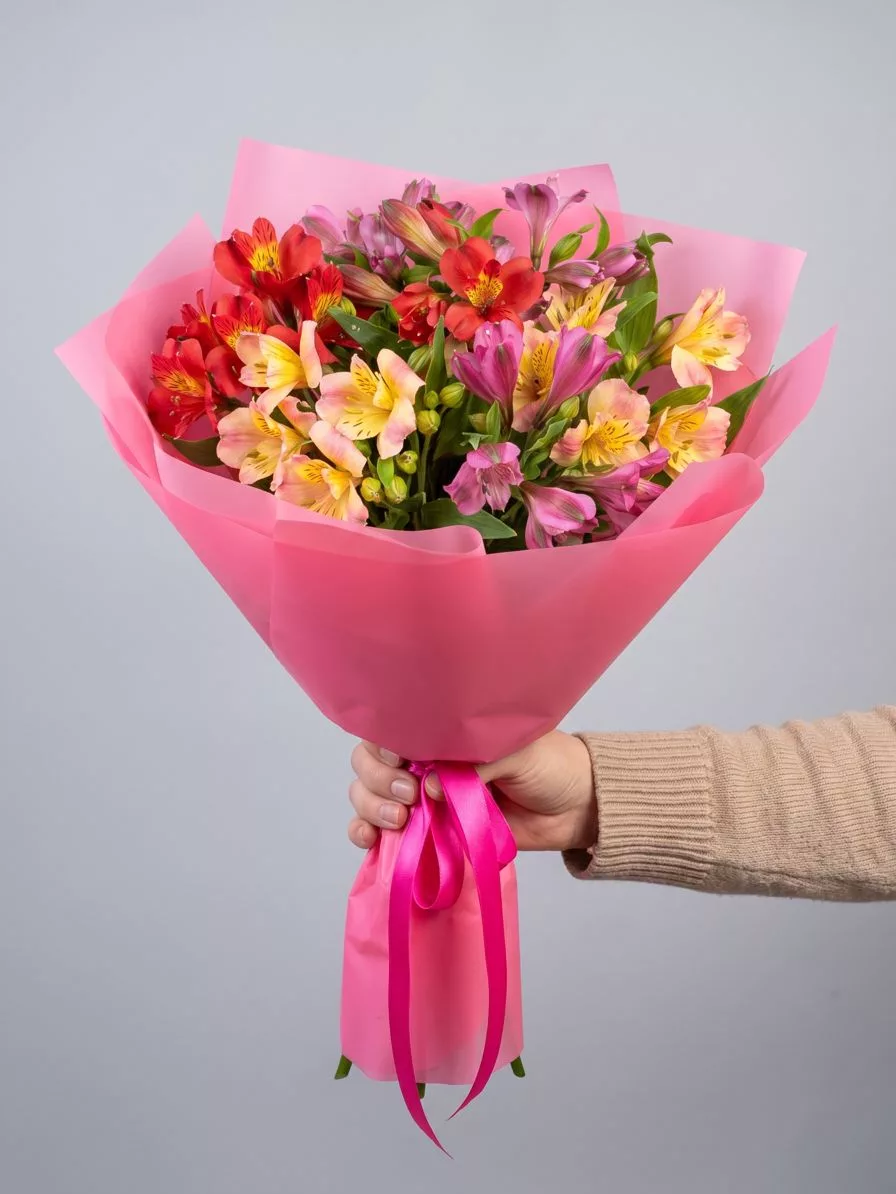
Not every flower handles a long transit equally well, and knowing which varieties are robust saves disappointment. Spray chrysanthemums are among the best travellers — their stems are firm, their petals close tightly during cold transport and they open fully once in a warm room. Standard chrysanthemums in white, yellow and burgundy are almost always available and hold for ten to fourteen days after arrival. Alstroemeria is another reliable choice: compact clusters, strong stems and a vase life that often reaches twelve days. For customers who specifically want roses, we recommend garden-style varieties with dense, many-petalled heads — David Austin-type roses — rather than long-stemmed hybrid teas, because the tighter bud structure tolerates temperature fluctuation better during the final leg of delivery. Tulips are popular in spring, particularly March, and they travel well when cut short and packed upright. Lisianthus, sometimes called eustoma, is a flower many customers outside large cities have not encountered: it resembles a peony but costs considerably less and lasts longer in a vase, making it excellent value for Zeya deliveries. Tropical varieties like strelitzia or anthurium are available but less advisable in deep winter, as their cell structure is sensitive to cold shock below minus 10. If you want something dramatic for a winter occasion, a compact arrangement built around spray roses, waxflower and eucalyptus will look striking, survive the journey and stay fresh for a week or more in the recipient's home.
Seasonal Availability and What Changes Month to Month
Zeya's climate is continental and severe, which means the rhythm of flower availability matters more here than in warmer Russian cities. From November through February, locally grown flowers are essentially absent from the supply chain, so everything arrives via greenhouse cultivation from central Russia or imported stock. During this period chrysanthemums, carnations, roses and alstroemeria are consistently available. Peonies, which are enormously popular in Russia and appear on most wish lists, have a natural season running from late May through July. Outside those months, peonies can be sourced but at higher cost and with less consistent quality, so we are straightforward with customers about that. March is the month when tulips dominate. The weeks around 8 March see Dutch tulip imports flood the Russian market, and quality is generally excellent at that time. We receive shipments specifically timed for that peak and can usually fulfil large tulip orders placed five or more days ahead. Summer, from June through August, is when ranunculus, lisianthus, matthiola and various garden roses are at their best and most affordable. Autumn brings solidago, hypericum berries and dahlias into the mix — varieties that look particularly good in the warm amber tones of October. One thing customers sometimes get wrong is assuming that a flower they saw in a photo on our site is always available. The catalogue reflects what we carry across the season; the order form shows live stock. Checking the form on the day you order gives the most accurate picture of what is ready to go.
Packaging for Cold Weather and Long Transit
Packaging for a Zeya delivery in January is a different task from packaging a bouquet for a ten-minute drive across Saint Petersburg. We approach it in layers. The flowers are conditioned in water for several hours before packing, which means their cells are fully hydrated and better able to withstand the dry, cold air of transit. Stems are then wrapped in damp kraft paper close to the cut ends, and the whole bouquet goes into a rigid box rather than a soft sleeve when temperatures are severe. The box provides structural protection against compression in a vehicle and acts as a basic insulating chamber. For orders during the coldest months we include a small gel heat pack placed at the base of the box, away from the flower heads. This keeps the interior of the box at roughly 5 to 10 degrees Celsius even when outside temperatures are well below zero. Customers sometimes open a winter delivery and find the outer paper slightly damp or the flowers more closed than expected — this is normal and not a sign of damage. Put the stems in lukewarm water, place the bouquet in a room that is not directly next to a radiator, and within two to four hours the blooms will open. Avoid placing flowers on a cold windowsill in winter; the glass conducts cold directly to the petals. A central table away from both heat sources and drafts is ideal. If a stem arrives visibly bent or a head is bruised on arrival, photograph it immediately and contact us — we resolve genuine transit damage the same day.
How to Place an Order Correctly for Zeya
The most common mistake we see on Zeya orders is an incomplete address. Russia uses a postal format that includes the region, district, city, street, house number and apartment number, and omitting any of these means the courier has to make a phone call that delays the whole run. When you fill in the delivery address, write it in full even if it feels excessive. If the recipient lives in a multi-storey building, the entrance number and floor are genuinely useful, not just optional extras. The second most common issue is a mismatch between the requested delivery time and the order placement time. If you need flowers at 14:00 and you place the order at 13:30, that is not achievable for Zeya. Build in at least two hours for central addresses and a full day for outlying settlements. The third thing to check is the recipient's phone number. We send the courier's contact details to the recipient by message before arrival, and if the number is wrong or the phone is off, the delivery cannot be completed. For surprise deliveries where you do not want the recipient to know in advance, note in the comment field that we should call you rather than the recipient, and we will coordinate accordingly. Finally, if you are ordering a large arrangement — say, 51 roses or a box arrangement with multiple flower types — confirm availability by contacting us directly before placing the order online. Large compositions require preparation time that the standard checkout flow does not automatically account for.
Russian Flower Customs Worth Knowing Before You Order
Customers unfamiliar with Russian traditions occasionally run into surprises, so a brief explanation is useful. The most important custom is the odd-number rule: bouquets in Russia are given in odd numbers of stems — 1, 3, 5, 7, 11, 15, 25, 51, 101. Even numbers are associated with memorial occasions, and presenting someone with a bouquet of 10 or 12 roses at a birthday or celebration is considered inauspicious. Our bouquet compositions are already built around odd counts, but if you are requesting a custom arrangement, keep this in mind. Yellow flowers carry a specific symbolic weight in Russian culture. Yellow roses or yellow tulips are sometimes associated with separation or ill feeling, depending on the recipient's age and background. Older recipients in particular may read yellow flowers negatively. If you want a warm, sunny arrangement without that risk, orange and peach tones work beautifully and carry no such associations. White flowers are generally positive — they read as elegant and sincere — and are appropriate for most occasions including birthdays, anniversaries and professional congratulations. Wrapping style also carries meaning: a bouquet presented without any wrapping looks unfinished and somewhat careless by Russian standards. We always wrap, but if a recipient comments on the packaging, they are noticing the presentation as part of the gift, not criticising the flowers themselves. Understanding these conventions means your order lands exactly as you intend it, without any unintended signal to the recipient.
Ordering flowers to Zeya is straightforward once you know the zone, the timing and the varieties that handle the journey well. Place the order with a complete address, give yourself a realistic lead time especially in winter or around major holidays, and choose robust varieties like chrysanthemums, alstroemeria or spray roses if you want the longest vase life after arrival. Five Flowers handles the rest — conditioning, packing, cold-weather preparation and the delivery itself — so the bouquet that reaches your recipient looks as close as possible to what left our workroom. We deliver bouquets across Russia in 1–2 hours.
Frequently asked questions
Can you deliver flowers to a village outside Zeya city centre?
Yes. Settlements within roughly 80 kilometres of central Zeya are within our delivery zone, including several villages along the main regional roads. Transit to these addresses takes 24 to 48 hours rather than the one-to-two-hour city window. Enter the full address including any landmarks in the comment field when ordering.
Will roses survive the cold during a winter delivery to Zeya?
They will if packed correctly. We use insulated boxes, damp kraft wrapping around the stems and a gel heat pack at temperatures below minus 20 Celsius. Dense-petalled varieties such as garden-style roses handle cold transit better than long-stemmed hybrid teas. On arrival, place stems in lukewarm water and keep the bouquet away from cold windowsills.
How far in advance should I order for 8 March delivery to Zeya?
Three to five days ahead is the practical minimum. Order volumes across Russia spike sharply in the week before 8 March, which affects both stock availability and delivery slot capacity. Placing your order early also gives you the best choice of varieties, particularly tulips, which are the most requested flower for that date.
Why do Russian bouquets always have an odd number of flowers?
Even numbers of flowers are traditionally associated with memorial occasions in Russia, so gifting an even-numbered bouquet at a celebration is considered inauspicious. All our standard compositions use odd counts. If you request a custom arrangement, simply specify the number of stems and we will ensure it follows the convention.
What should I do if the flowers arrive looking closed or slightly wilted?
Cold transit causes buds to close and stems to stiffen temporarily. Trim one centimetre from each stem at a diagonal, place them in lukewarm water in a room away from direct heat and drafts, and wait two to four hours. If a stem is visibly bent or a head is bruised, photograph it on arrival and contact us immediately for same-day resolution.
Ready to send a bouquet?
Pick a city, choose the flowers, and we will hand them over with a photo confirmation.
Choose a city →