
Employee Birthday Flowers in Russia: Let the Florist Handle the Schedule
Every HR manager we work with has the same story: they remembered eleven out of twelve birthdays this quarter, and the one they missed was the head of logistics. Flowers for employee birthdays in Russia are not optional goodwill — in most companies they are an understood commitment, and a forgotten celebration lands harder than no policy at all. The fix is not a better spreadsheet. It is handing the list to a florist who treats your calendar the way a florist treats a wedding order: everything confirmed in advance, nothing improvised on the morning.
Why Birthday Flowers Matter More in Russian Workplace Culture
In Russia, a birthday is treated as a personal holiday rather than just a date on a calendar. Colleagues are expected to acknowledge it, and a company that does nothing is noticed. Flowers are the default gift because they require no guessing about taste, size or dietary restriction. A bouquet handed over at the start of the workday — before the meetings begin — signals that the company planned ahead, which itself carries weight. Failing to mark the day at all reads as indifference rather than neutrality, so the stakes for HR are higher than they might appear to someone from outside the culture.
The practical pressure falls on HR teams who are already managing onboarding, compliance and payroll cycles. Birthday flowers become one more recurring task that sits outside any formal workflow, which is exactly why they get dropped. We see it most often in companies with between thirty and two hundred employees — large enough that no single manager knows every birthday by memory, small enough that there is no dedicated events budget with its own coordinator. The solution is not to hire someone new. It is to treat the florist as the coordinator, supply the data once, and let the shop run the schedule from there. We have been doing this for corporate clients in Saint Petersburg for years, and the model transfers cleanly to deliveries across Russia within our one-to-two hour window.
Bouquets we can deliver



What Information the Florist Actually Needs From HR
When an HR manager contacts us to set up a recurring birthday program, the first conversation is always about data, not flowers. We need four things: the employee's name, their birthday, the delivery address, and the budget per bouquet. Everything else — variety, colour palette, size — we handle based on the budget and what is fresh that week. Some HR teams also send us the employee's gender and department, which helps us calibrate the arrangement, but it is not required to get started. A plain spreadsheet with those four columns is enough to build a full-year schedule.
One mistake we see regularly is HR sending us a list in January and assuming the job is done. Employees change addresses, go on parental leave, or leave the company entirely. We ask clients to send us a monthly update — additions, removals, address changes — so we are not delivering a bouquet to someone who left in March. We set a standing reminder for our account contact at each company on the first of every month. It takes them five minutes to reply with any changes, and it prevents the awkward situation of a bouquet arriving at a desk that has been empty for six weeks.
For companies with employees across multiple Russian cities, we also need to know the delivery time preference. Most corporate clients choose morning delivery between nine and eleven, before the workday gets busy. We confirm each order forty-eight hours in advance internally, so the flowers are cut and conditioned in time to arrive fresh.
Choosing Varieties That Work for a Year-Round Program
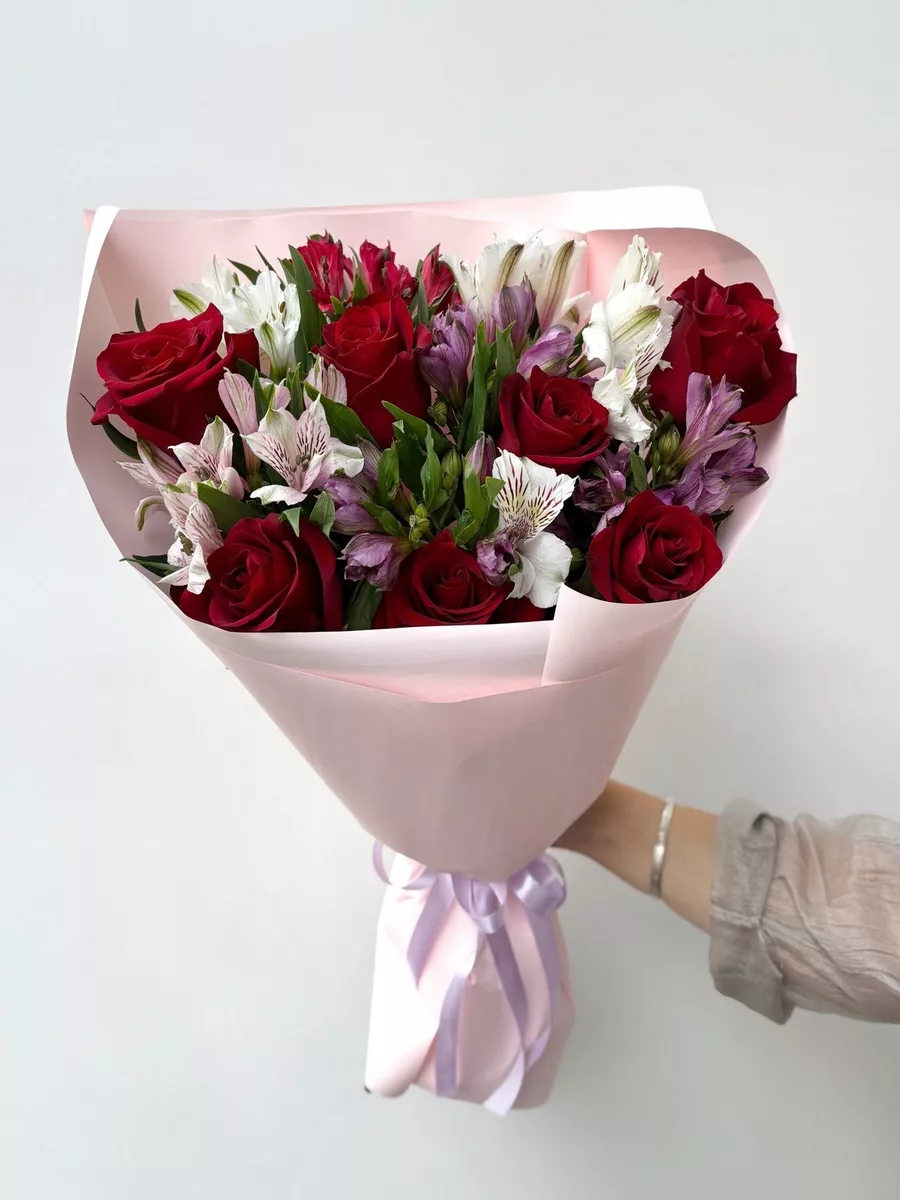
A birthday program running across twelve months cannot rely on the same flowers in January as it does in July. Roses are the one variety that holds year-round because they are grown in controlled greenhouse conditions and available in consistent quality regardless of season. We use spray roses and large-head garden roses interchangeably depending on what is tightest in quality that week. For corporate accounts we stay with varieties that travel well — roses, alstroemeria, chrysanthemums and lisianthus are the core four, because all of them tolerate the temperature shifts that happen during delivery in Russian winters and summers.
Tulips are the flower HR teams most often request for spring birthdays, and they are genuinely excellent from February through April. Outside that window, tulips become unreliable — they are sensitive to heat above eighteen degrees and will open too fast in a warm office before the recipient even gets home. We tell clients this plainly and substitute with something that will actually last. Peonies follow the same seasonal logic: available from late May through July in Russia, spectacular when they are in, and not something we will promise outside that window.
For employees who are known to prefer something less traditional, we sometimes build arrangements around seasonal foliage — eucalyptus, ruscus, pittosporum — combined with one focal flower. These read as considered rather than generic, which matters when the same HR team is sending flowers to the same person every year. Variety rotation keeps the program from feeling like a vending machine.
Scheduling Delivery So the Bouquet Arrives at the Right Moment
Timing inside a corporate birthday program is more precise than a standard one-off order. The bouquet needs to arrive when the employee is actually at their desk, not sitting in reception for two hours or handed to a colleague who forgets to pass it on. We ask HR clients to specify whether the recipient works standard hours, shifts, or remotely, because each scenario needs a different approach. For office-based employees, delivery between nine-thirty and eleven in the morning works in almost every case — the person is settled, colleagues are around to witness the moment, and the flowers have the whole day to be appreciated.
For remote employees, we deliver to their home address, which requires confirming that someone will be there. We recommend HR send a brief internal message the day before — something like a meeting invite with no details — to make sure the person is home. It does not ruin the surprise; it prevents a bouquet sitting on a doorstep in a Moscow July where temperatures can reach thirty degrees and flowers deteriorate within an hour.
We build each delivery into our route schedule forty-eight hours in advance. For birthdays that fall on weekends, we discuss with the HR contact whether to deliver on Friday afternoon, Monday morning, or the Saturday itself. Most companies prefer Friday so the gesture lands before the weekend rather than after it. We note the preference per employee in the account file and apply it consistently without needing to be asked again each time.
Common Mistakes HR Teams Make With Flower Programs
The most common mistake is starting the program without a clear budget per head. We have had companies tell us to send something nice and then push back on the invoice because they imagined a smaller arrangement. Set a fixed amount per bouquet at the start — it makes every downstream decision automatic and prevents any awkward conversation later. A mid-range budget per bouquet covers a solid single-variety arrangement of fifteen to twenty stems with wrapping and a card. A higher budget opens up mixed compositions with premium focal flowers.
The second mistake is not accounting for name days. In Russia, some employees also celebrate their name day, which is tied to the Orthodox calendar and falls on a different date from their birthday. A few companies ask us to cover both. We can do it, but HR needs to supply the name day dates separately — we do not maintain that data ourselves. If you are not sure whether your team observes name days, ask once during onboarding and note it in the employee file.
Third, and this one surprises people: do not send yellow flowers without checking first. In Russian tradition, yellow flowers — particularly yellow roses — are associated with separation or the end of a relationship. Not every employee holds this belief, and younger urban professionals often do not, but in a corporate context where you are representing the company, it is simpler to avoid yellow as a dominant colour entirely. We default to white, pink, red or mixed palettes for corporate accounts unless a client specifically requests otherwise.
Setting Up the Account and What to Check Before the First Delivery
Opening a corporate account with us takes one conversation and one document — a list of employees with the four data points described earlier. We assign a single account manager who handles all communication for that company, so HR is never explaining context to a different person each time. The account manager confirms the first three deliveries manually with the HR contact before moving to a fully automated schedule. This trial period catches any address errors, timing mismatches or preference adjustments before they become a pattern.
Before the first delivery goes out, check three things. First, confirm the delivery address includes a floor and office number — a building address alone can send a driver to the wrong entrance in a large business complex. Second, verify the recipient's phone number is current, because our driver will call ahead when they are ten minutes away. Third, confirm whether the company wants a printed card with each bouquet and, if so, what the standard message should read. Some companies use the director's name on the card; others use a department name or simply the company name. We print it consistently across all deliveries once you decide.
For companies sending flowers to employees in cities outside Saint Petersburg, the same account structure applies. We deliver across Russia within our standard one-to-two hour window, and the scheduling logic is identical. The account manager handles routing internally — HR does not need to think about logistics beyond supplying the address and confirming the time preference per city.
A birthday program that runs without weekly intervention from HR is not complicated to build — it requires one setup conversation, one spreadsheet, and a monthly five-minute update. The florist carries everything else: variety selection, seasonal substitutions, delivery routing, timing adjustments for remote workers, and the cultural details that matter in a Russian workplace context. What HR gets back is a program that feels personal to each employee because the flowers are fresh, appropriate and on time, every time, without anyone in the office having to remember the date. We deliver bouquets across Russia in 1–2 hours.
Frequently asked questions
Can we set up deliveries for employees in multiple Russian cities at once?
Yes. We deliver across Russia within a one-to-two hour window and manage all cities from a single corporate account. You supply the addresses and time preferences per location once, and we build each city into the schedule. Your HR contact deals with one account manager regardless of how many cities are involved.
What happens if an employee is on leave on their birthday?
If you notify us before the delivery date, we reschedule to the employee's return date or redirect to their home address. This is why the monthly update matters — a quick note that someone is on parental leave until April lets us hold that delivery and reschedule automatically rather than sending flowers to an empty desk.
Are there flowers we should avoid for Russian employees?
Yellow flowers as a dominant colour carry connotations of separation in Russian tradition and are best avoided in corporate gifting. Even numbers of stems are associated with mourning, so all our arrangements use odd numbers by default. We apply both rules automatically to every corporate account without needing a reminder.
How far in advance do we need to supply the birthday list?
We ask for the list at least one week before the first delivery date. For a full-year program starting in January, sending us the list in mid-December gives us time to build the schedule, confirm addresses and run the trial deliveries. For individual additions mid-year, forty-eight hours notice is sufficient.
Can the bouquet include a personalised card with the employee's name?
Yes. We print a card for every delivery in a corporate program. You choose the message template once — for example, the employee's name, a set phrase and the company name — and we apply it to every bouquet automatically. If specific employees need a different message, note it in the account file and we handle it per delivery.
Ready to send a bouquet?
Pick a city, choose the flowers, and we will hand them over with a photo confirmation.
Choose a city →