
Defender of the Fatherland Day: Flowers, Combinations and Delivery on Feb 23
Every year around February 20, the shop starts getting the same question: is it strange to send flowers to a man on February 23? The short answer is no — it has never been strange in Russia, and the longer answer involves knowing which flowers read as a genuine gift rather than an afterthought, what to pair them with, and how early you need to order if you want delivery on the day itself rather than the morning after.
What February 23 Actually Is and Why Flowers Fit
Defender of the Fatherland Day is a public holiday in Russia observed on February 23. It originated as a Soviet military commemoration but has long since broadened into a general men's day, roughly equivalent in social function to International Women's Day on March 8. Most Russian men receive some form of gift on this date regardless of whether they have served in the military — colleagues give small presents at the office, families mark the occasion at home, and romantic partners treat it as a counterpart to the gifts men are expected to give on March 8. Flowers are entirely conventional. The hesitation some customers outside Russia feel comes from associating flowers with women's celebrations, but that association is cultural, not botanical. In Saint Petersburg florists see consistent demand for men's bouquets on February 23 every year, and the requests are not ironic — people want something that looks intentional and well-chosen. The practical challenge is not social acceptability but timing. February 23 falls in the middle of winter, supply chains are under pressure from the upcoming March 8 rush, and certain varieties run short as early as February 21. Ordering on the day itself is possible but carries real risk of substitution or delay. Understanding the holiday as a genuine gifting occasion — not a novelty — is the first step to choosing something that lands well.
Bouquets we can deliver

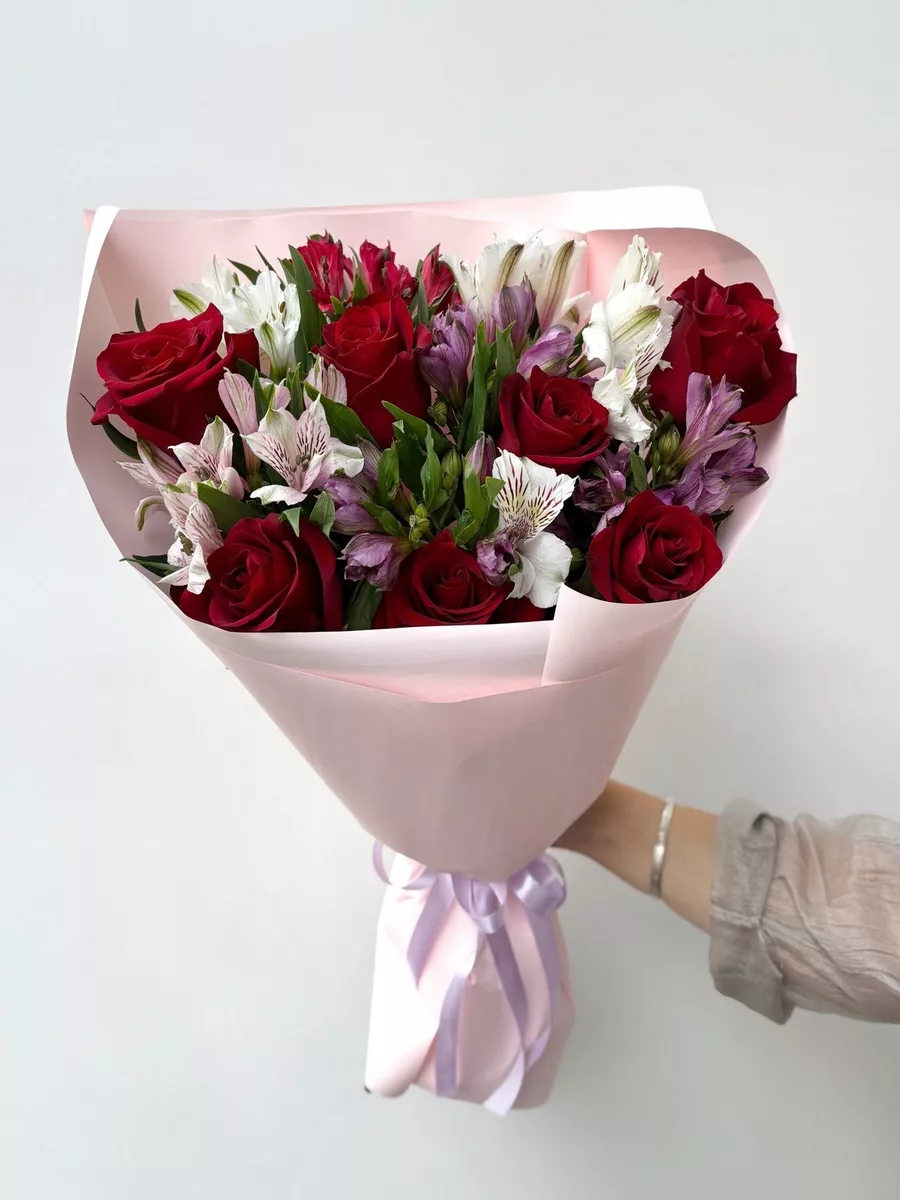

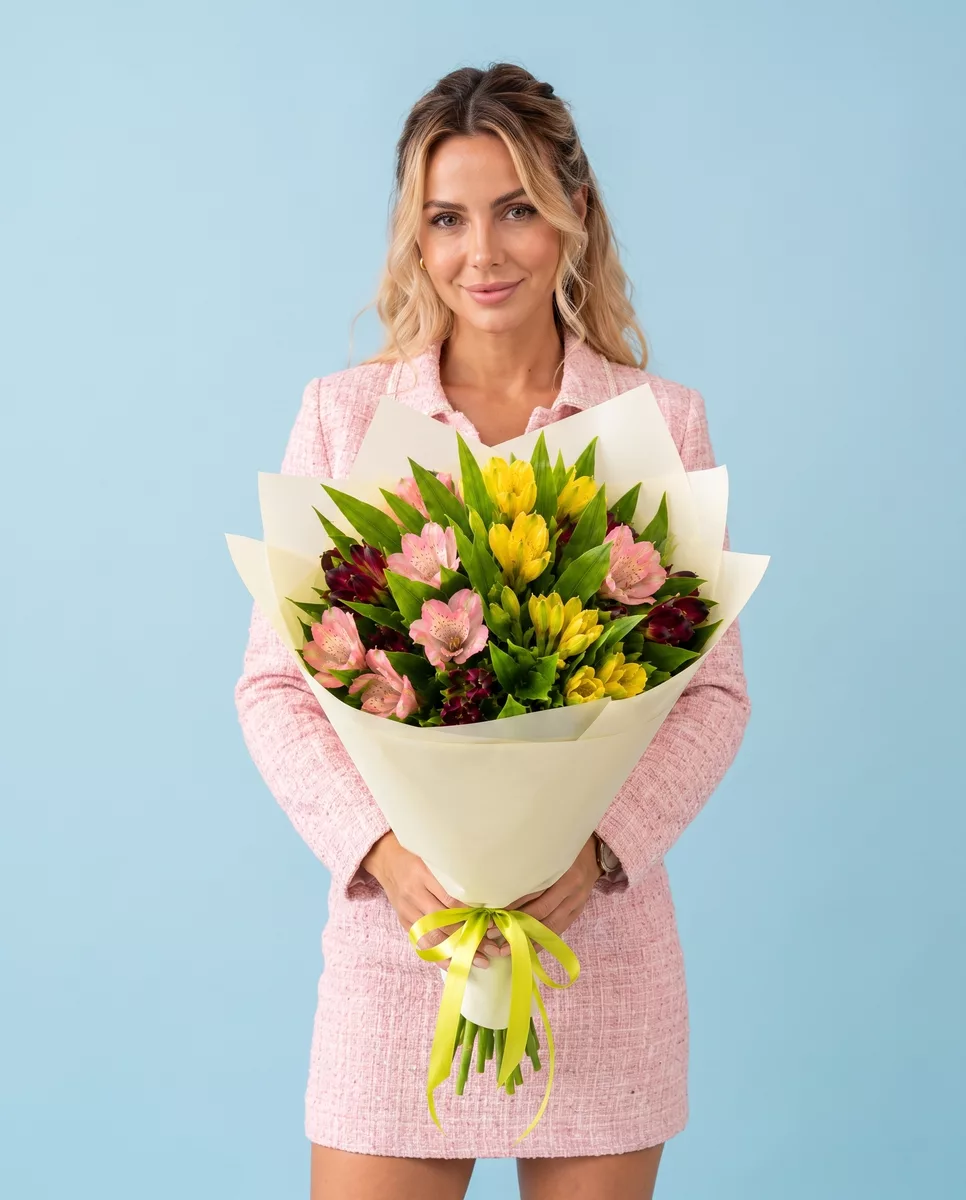
Which Flowers Are Actually Chosen for Men on This Date
The most common request for February 23 is a single-variety bouquet that reads as considered rather than decorative. Anthuriums are the most popular choice: their waxy, architectural spathe reads as bold and unfussy, they hold well in winter temperatures, and they come in deep red, near-black burgundy, and white — all of which work for men's gifting. Proteas, particularly Protea cynaroides, are a strong second choice: large, structural, and long-lasting, they feel substantial without being delicate. Chrysanthemums in single-stem spray form — not the small button type — are widely used in men's bouquets because they are long-lived and unambiguously direct. Tropical varieties such as Strelitzia reginae, the bird-of-paradise flower, appear regularly in February 23 orders because their graphic form appeals to customers who want something visually distinct. What customers tend to avoid, and florists generally steer away from, are pastel roses in soft pinks or lavenders — not because men cannot receive them, but because the sender usually wants the bouquet to read as deliberate rather than default. Deep-toned roses in burgundy, terracotta, or near-black varieties like Black Baccara work well and remain widely available in February. Tulips are popular in February but skew toward the March 8 wave; they are usable for the 23rd but supplies tighten fast. The cleaner move is to choose varieties with strong structure and a longer vase life, since many recipients are not practiced at flower care.
Combinations That Work: Flowers Alongside Other Gifts
A significant share of February 23 orders are not flowers alone. The shop regularly assembles combinations where a compact bouquet or a single statement stem accompanies something else the customer has chosen — a bottle of whisky or cognac, a box of chocolates, a book, a grooming set. These combinations work well for two reasons: they acknowledge that not every man has a strong relationship with flowers as a standalone gift, and they give the recipient something immediately usable alongside something that will last several days in a vase. When pairing flowers with a bottle, the most practical approach is a tight, round bouquet of five to seven stems rather than a large arrangement — the flowers complement the gift rather than competing with it for attention. Anthuriums and proteas hold their shape without a vase of water for the time it takes to deliver and unwrap, which matters when the recipient is at an office rather than at home. For corporate gifting on February 23 — which is common in Russian workplaces — small identical arrangements for each male employee are standard. These are usually chrysanthemum sprays or single anthurium stems with minimal greenery, chosen for uniformity and ease of handling rather than drama. The mistake customers make with combinations is over-ordering on the flower side: a large bouquet next to a large gift looks cluttered and makes the delivery harder to manage. One well-chosen stem or a compact five-stem bouquet is almost always the right scale when flowers are part of a larger package.
February Cold and What It Does to Cut Flowers in Transit
Saint Petersburg in February averages temperatures well below freezing, and that has direct consequences for cut flowers in transit. Cold damage on flowers is not always visible immediately — a rose or tulip that looks fine when unwrapped can show petal browning within twelve hours if it was exposed to frost during delivery. The varieties that tolerate cold transit best are the ones that dominate February 23 orders for good reason: anthuriums are tropical but handle brief cold exposure better than thin-petaled flowers because their spathe is dense and waxy. Proteas are similarly robust. Chrysanthemum sprays are among the most cold-tolerant cut flowers available and rarely show transit damage even in hard frost conditions. What suffers most in cold transit are open roses — particularly large-headed varieties — and any flower with thin, papery petals. Ranunculus, anemones, and garden roses are February staples for women's gifting but are risky for outdoor delivery in temperatures below minus ten Celsius without proper insulation. The shop wraps cold-weather deliveries in insulating kraft layers with a heat-sealed interior when temperatures drop sharply, but the safest approach from the customer's side is to choose structurally robust varieties and to specify whether the recipient is at a home address or an office, since office lobbies are usually warm and the flower spends less time exposed. Asking for delivery to a building entrance rather than waiting outside is worth noting in the order comments.
Timing: When to Order and What Happens If You Wait
February 23 is not March 8, but it is close enough to the March 8 rush that wholesale flower supplies are already under strain by the third week of February. Growers and importers prioritize the larger holiday, and some varieties — tulips in particular — are deliberately held back for March 8 orders, which means availability for the 23rd is genuinely limited compared to an ordinary February week. Ordering two to three days ahead is the practical standard for getting the variety you actually want. Orders placed on February 22 in the evening can usually be fulfilled on the 23rd, but the range of available varieties narrows and substitutions become more likely. Orders placed on the morning of the 23rd for same-day delivery are possible — the shop delivers within one to two hours of order confirmation — but the customer should be prepared to accept what is in stock rather than specifying a particular variety. The delivery window matters too. February 23 is a public holiday, which means many recipients are at home rather than at an office, but it also means traffic patterns in Saint Petersburg shift. Morning deliveries before noon on the holiday tend to move faster than afternoon slots, which can slow down as family gatherings begin and parking becomes harder in residential areas. If the gift is intended as a morning surprise, ordering the evening before with a specified morning delivery window is the most reliable approach. Late-evening delivery on the 23rd is available but should be confirmed when placing the order.
What Customers Get Wrong When Ordering for February 23
The most common mistake is ordering the same thing the customer would order for a woman on March 8 and assuming it translates directly. A large pastel mixed bouquet with gypsophila filler reads as a women's gift in the Russian context — not because the flowers are inappropriate for men, but because the composition signals a particular occasion. It is not offensive, but it is not considered. The second mistake is underestimating lead time and then accepting a substitution without asking what is being substituted. If you ordered proteas and the shop substitutes chrysanthemums, that is a reasonable trade. If the substitution is small spray roses in pink, that is worth pushing back on. Always ask what the substitution is before confirming. The third mistake is ordering for office delivery without checking whether the recipient's office is actually open on February 23. It is a national public holiday and many offices are closed. Delivery to a closed office address wastes the order and the flowers. Check the recipient's schedule before selecting the delivery address. The fourth mistake is choosing flowers without considering vase life in a male recipient's household. Many men do not own a vase and will not think to buy one. A compact arrangement in a ceramic pot or a single large stem in a weighted sleeve that can stand in a water glass is more practical than a large loose bouquet that requires immediate care. Noting this when ordering — asking for a self-contained presentation — is something the shop can accommodate with advance notice.
Checking Your Order Before It Goes Out: A Practical List
Before confirming any February 23 order, run through four things. First, verify the delivery address and confirm whether it is a home or office address, and whether that office is open on the holiday. Second, check the delivery time window against the recipient's likely schedule — if they are spending the day with family outside the city, a home delivery will miss them. Third, read the substitution policy: if the exact variety matters to you, say so explicitly in the order notes and ask the shop to contact you before substituting rather than proceeding automatically. Fourth, look at the card message. February 23 cards in Russia are typically direct and warm rather than elaborate — a short, genuine sentence lands better than a long formal message. If you are sending from outside Russia and are unsure of the tone, keeping it simple is always correct. Beyond these four points, the flower care instructions matter more for February 23 than for many other occasions because the recipient may genuinely not know what to do. Ask the shop to include a care card with the delivery — trim the stems at an angle, change the water every two days, keep away from radiators. In a winter apartment with dry heating air, this advice can extend vase life by three to four days. A well-chosen bouquet that lasts ten days makes a stronger impression than a more expensive one that wilts in three because nobody trimmed the stems.
February 23 is a real gifting occasion in Russia and flowers are a real part of it — not a workaround or a novelty. The customers who get it right order two days ahead, choose structurally robust varieties suited to winter transit, and think about whether the recipient has somewhere to put a loose bouquet. The customers who get it wrong wait until the morning of the 23rd, order something designed for March 8, and send it to an office that is closed for the holiday. The gap between those two outcomes is almost entirely a matter of timing and a few practical choices made before the order is confirmed. We deliver bouquets across Russia in 1–2 hours.
Frequently asked questions
Is it actually acceptable to give a man flowers on February 23 in Russia?
Yes, completely. Flowers for men on February 23 are a normal part of how the holiday is observed in Russia. It is not considered unusual or ironic. The key is choosing varieties and a composition that read as intentional — structural flowers like anthuriums or proteas rather than a soft pastel mixed bouquet.
Which flowers last longest when delivered in February cold?
Anthuriums, proteas, and chrysanthemum sprays are the most cold-tolerant cut flowers available in February. They handle brief exposure to freezing temperatures without immediate visible damage and have vase lives of ten days or more when properly cared for. Thin-petaled flowers like open roses and ranunculus are more vulnerable to frost damage in transit.
Can I order flowers on the morning of February 23 and still get same-day delivery?
Yes, same-day delivery is available, but variety selection will be limited to what is in stock. February 23 falls close to the March 8 rush, so supplies are already under pressure. If a specific variety matters, order two to three days ahead. Morning orders on the 23rd are more reliably fulfilled than afternoon orders.
What should I do if the recipient's office might be closed on the holiday?
Confirm before ordering. February 23 is a national public holiday in Russia and many offices are closed. If there is any doubt, use a home delivery address or schedule delivery for the day before. A delivery to a closed office address cannot be redirected once the courier is en route.
What is a good flower and gift combination for February 23?
A compact five to seven stem bouquet paired with a bottle of spirits or a box of chocolates is the most common and well-received combination. Keep the bouquet tight and structured — anthuriums or a single large protea work well — so it complements the main gift rather than competing with it. Avoid large loose arrangements when flowers are part of a larger package.
Ready to send a bouquet?
Pick a city, choose the flowers, and we will hand them over with a photo confirmation.
Choose a city →