
Flowers for Your Boss in Russia: Etiquette, Varieties and Bouquet Ideas
Every week someone calls us from a Moscow office or writes from abroad asking the same thing: I need to send flowers to my director, what is acceptable? The question sounds simple but it carries real stakes — a bouquet that is too intimate, too funerary in colour, or too sparse in size can embarrass both the sender and the recipient. This article gives you the practical information florists use when putting together a professional gift: which varieties hold up in an office, which colours read as respectful rather than romantic, how many stems is enough, and what to check before you place the order.
Why Giving Flowers to a Boss Is Normal in Russia
In many Western workplaces, flowers between colleagues feel unusual or even inappropriate. Russia works differently. Flowers are a standard professional gesture on birthdays, on 8 March (International Women's Day), on professional holidays such as Teacher's Day or Doctor's Day, and on significant work anniversaries. A department that forgets to mark its director's birthday with at least a small bouquet is noticed, and not positively. For overseas contacts sending a gift to a Russian counterpart, this context matters: the gesture will be understood immediately and appreciated as culturally literate rather than excessive. The expectation is not a grand romantic arrangement but a composed, well-chosen bouquet that signals effort and respect. Size and quality matter more than novelty here. Russians read a bouquet quickly — they notice whether the stems are fresh, whether the flowers are fully open or still tight, and whether the wrapping is neat. A single wilted rose sends the wrong message regardless of intent. If you are ordering from abroad, same-day delivery within one to two hours is achievable in Saint Petersburg and across major Russian cities, which means you do not need to plan days ahead. The key is placing the order before noon local time to give the florist time to select stems at peak condition. Understanding that flowers are a normal professional currency in Russia removes most of the anxiety around the gesture.
Bouquets we can deliver



Colours That Work and Colours to Avoid
Colour is the first thing a Russian recipient reads in a bouquet, and the rules are more specific than most outsiders expect. White flowers are safe and respected in a professional context — white roses, white lisianthus, white chrysanthemums. They read as formal and clean without any romantic undertone. Cream and ivory shades work equally well. Soft yellow, particularly in roses or freesia, signals warmth and is considered appropriate for a senior colleague or a director. Peach and coral tones are well-received for female recipients and carry no problematic associations. Red is where most overseas senders go wrong. A bouquet of red roses sent to a boss, especially a female boss from a male employee, reads as romantic in Russia, not professional. Even a mixed bouquet dominated by red carries that reading. If red is the only option because the recipient is known to love it, dilute it with white or cream flowers and make the arrangement clearly formal in structure. Pure white lilies deserve a separate note: in Russia, white lilies are strongly associated with mourning and funerals. Avoid them entirely in a professional gift, even though they are popular in Western sympathy arrangements. Purple and violet tones are neutral and work well — purple lisianthus, lavender spray roses, and violet statice all read as elegant without any negative associations. Orange is cheerful and acceptable for a creative environment. Blue flowers, such as blue delphinium or blue hydrangea, are uncommon enough to feel distinctive without being risky.
Which Varieties Hold Up in an Office Environment
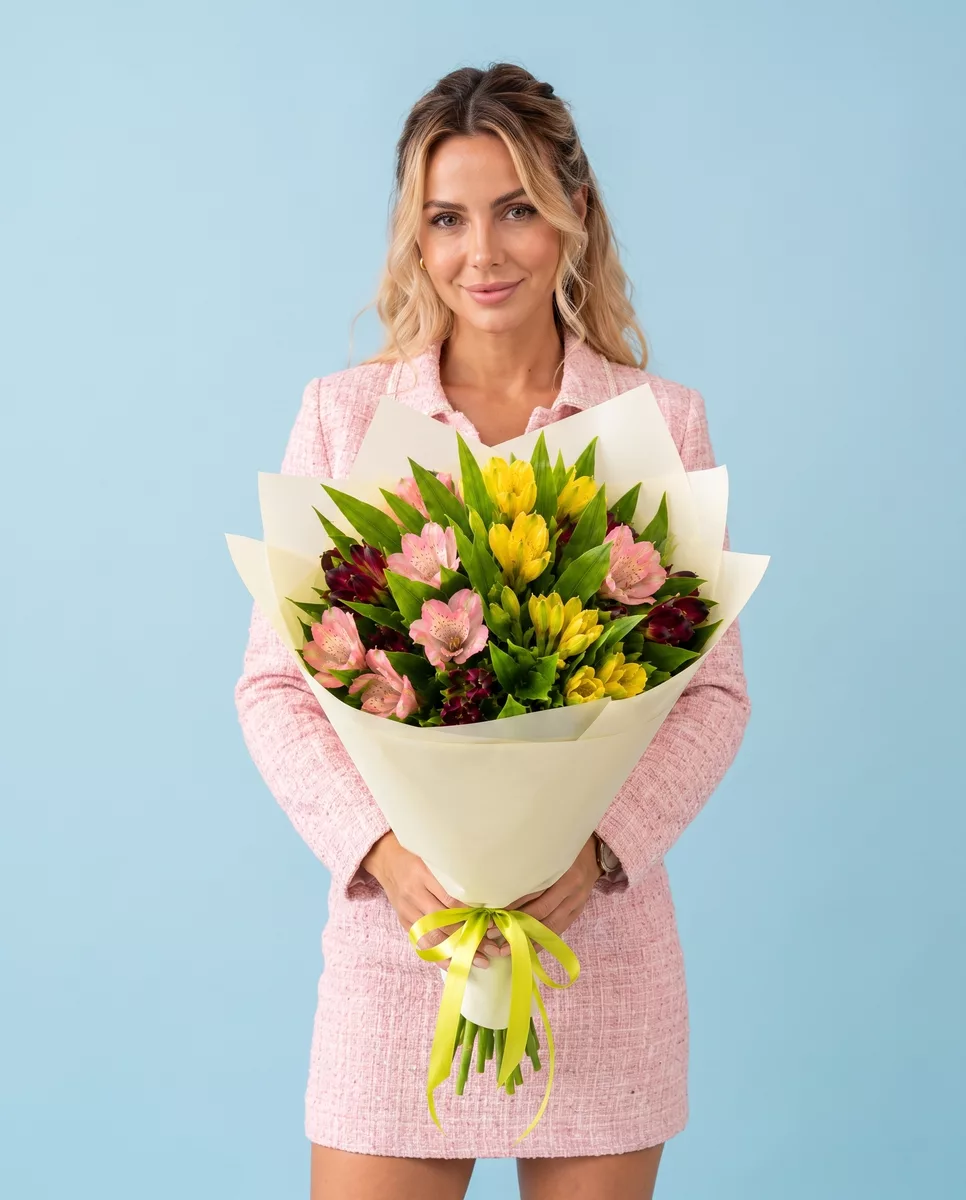
A bouquet delivered to an office faces a specific challenge: it needs to survive a full working day, possibly without water, in a heated room. This is not a living room where someone will immediately put flowers in a vase. The florist's job is to choose varieties that remain presentable for at least six to eight hours out of water, and that do not drop petals or release heavy pollen onto a desk. Spray roses are the most reliable choice for office delivery. They are compact, long-lasting, and come in dozens of professional colours from white through peach to soft coral and lavender. Garden roses, such as David Austin varieties, are more dramatic and impressive but require water sooner. Standard roses in bud form — not fully open — travel and hold well. Alstroemeria is underrated for professional bouquets: it lasts exceptionally well, holds colour, and a stem carries multiple flowers, giving visual volume without bulk. Lisianthus, sometimes called eustoma, looks like a delicate peony but is far sturdier and holds without water for hours. Chrysanthemums, particularly the spray varieties, are workhorses — they stay fresh, do not wilt, and are inexpensive enough to allow a generous bouquet at a reasonable price point. Avoid open lilies in any colour for the office: the pollen stains clothing and documents, and the scent in an enclosed space can be overwhelming. Avoid fully open peonies for the same reason — they drop petals quickly once warm. Gypsophila and eucalyptus as filler hold well and add structure without the risks.
Bouquet Size and Stem Count for a Professional Gift
In Russia, the number of flowers in a bouquet carries meaning that most foreign buyers are not aware of. The rule is simple: even numbers of flowers are given at funerals and mourning occasions. A professional or celebratory bouquet must have an odd number of stems — 11, 15, 19, 25, or more. This is not a superstition that educated Russians ignore; it is a real social norm that the recipient will notice immediately. A bouquet of 10 roses, however beautiful, will cause confusion or discomfort. Always confirm the stem count with your florist before the order is placed. For a direct manager or team leader, 11 to 15 stems of a quality variety is the standard range — substantial enough to show effort without being so large it becomes awkward to carry home. For a senior director, department head, or CEO, 21 to 25 stems is appropriate, or a mixed bouquet of equivalent visual weight. A bouquet that looks sparse signals that the sender did not think much about the gift. Russians are accustomed to generous arrangements, and a five-stem bouquet reads as an afterthought unless it contains something truly exceptional, such as large-headed garden roses or premium peonies in season. If the budget is limited, it is better to choose a less expensive variety in a full count than an impressive variety in too few stems. Alstroemeria and spray chrysanthemums allow you to build a visually full bouquet without stretching the budget, and both varieties are taken seriously by Russian recipients.
8 March and Other Key Dates for Boss Gifts in Russia
International Women's Day on 8 March is the single most important flower date in Russia, and it applies directly to giving flowers to a female boss. Every woman in a Russian workplace expects to receive flowers on this day — from colleagues, from the team she manages, and often from clients. The demand is enormous, and florists across Russia work at full capacity from 6 March through the morning of 8 March. If you are planning a bouquet for a female director on 8 March, place the order at least two days in advance. Delivery slots fill by the afternoon of 7 March in most cities. The bouquet on this day should be notably generous — this is not the occasion for a modest arrangement. Roses, tulips in spring, and mimosa are traditional 8 March flowers. Tulips are particularly associated with the holiday and are expected; a bouquet of 15 to 21 tulips in pink, white, or yellow is classic and always correct. Birthdays are the second most common occasion. In Russia, the birthday bouquet is given on the day itself, not the day before, which is considered bad luck. A boss's professional anniversary at the company, or a promotion, is also a standard gift occasion. Professional holidays — Teacher's Day on 5 October, Doctor's Day on the third Sunday of June, and similar dates — are taken seriously in relevant sectors. If your Russian counterpart works in medicine or education, acknowledging their professional holiday with flowers is a gesture that will be remembered.
What to Write on the Card
The card that accompanies a professional bouquet in Russia is usually brief and formal. Russian workplace culture values restraint in written messages to superiors — a long, effusive note can read as insincere or sycophantic. A good card for a boss's birthday contains three elements: a direct congratulation, a short expression of respect or appreciation for their leadership, and a wish for continued success or good health. Four to six sentences is the right length. If you are writing in Russian, the standard opening is Уважаемый or Уважаемая, meaning Respected, followed by the first name and patronymic. Using a patronymic — the middle name derived from the father's first name — is a mark of genuine respect in a professional context and distinguishes a thoughtful sender from someone who just ordered flowers without thinking. If you do not know the patronymic, a card in English or with just the first name is preferable to guessing. For overseas senders, writing the card in English is entirely acceptable and often appreciated as a personal touch. Keep the tone warm but not familiar. Avoid jokes, irony, or overly personal observations about the recipient's personality. Do not mention the price or the effort involved in sourcing the bouquet. If the occasion is a professional holiday rather than a birthday, acknowledge the specific role — congratulate a doctor on Doctor's Day, a teacher on Teacher's Day — rather than sending a generic message. Specificity reads as genuine attention.
Ordering from Abroad: Timing, Delivery and What to Confirm
Sending flowers to a boss in Russia from another country involves a few practical steps that differ from domestic ordering. The most important is time zone. Saint Petersburg is UTC+3, Moscow is also UTC+3, and eastern cities such as Yekaterinburg and Novosibirsk are further ahead. If you are ordering from Western Europe or North America, calculate the local time at the delivery address before placing the order. An order placed at 9 a.m. in New York is 4 p.m. or 5 p.m. in Saint Petersburg — still workable for same-day delivery, but only just. For guaranteed same-day delivery, the order should reach the florist before 2 p.m. local time at the destination. Confirm the exact delivery address including the office floor and suite number — a large business centre in Saint Petersburg or Moscow can have dozens of companies, and a vague address causes delays. Ask whether the recipient is expected to be in the office on the delivery date; Russian office workers sometimes work from home or travel, and a missed delivery on a birthday is a frustrating outcome. Confirm the recipient's full name as it appears on their office directory, since reception desks in formal Russian offices will ask for identification before releasing a delivery. Specify the delivery window if the occasion is time-sensitive — for example, before a morning meeting. A reputable florist will confirm the order by email or messenger, provide a tracking update, and send a photo of the completed bouquet before dispatch. If none of these confirmations are offered, ask for them explicitly.
Giving flowers to a boss in Russia is a well-established professional gesture, and getting it right is mostly a matter of knowing a handful of specific rules: odd stem counts, no red roses in a professional context, no white lilies at all, and generous sizing relative to the seniority of the recipient. The varieties that work best in an office — spray roses, alstroemeria, lisianthus, spray chrysanthemums — are not exotic or difficult to source, and they hold up through a working day without a vase. The dates that matter most, particularly 8 March, require advance planning because demand is genuinely high. For overseas senders, the time zone calculation and the delivery address details are the two points most likely to cause a problem, and both are easy to resolve with a quick confirmation before the order is placed. A well-chosen bouquet sent to a Russian boss lands exactly as intended: as a mark of professional respect from someone who understood the culture well enough to get the details right. We deliver bouquets across Russia in 1–2 hours.
Frequently asked questions
Is it appropriate for a male employee to send flowers to a female boss in Russia?
Yes, and it is expected on 8 March and on her birthday. The key is to keep the bouquet clearly professional in colour and composition. Avoid red roses, which read as romantic. White, peach, coral, or mixed pastel arrangements are safe. Sending from the whole team rather than individually removes any ambiguity about intent.
Can I send flowers to a male boss in Russia?
Yes, though it is less common than gifting to female managers. Birthdays and professional holidays are the appropriate occasions. Choose a structured, non-floral-looking arrangement — compact roses, lisianthus, or a mixed bouquet in white and green tones. Avoid anything that reads as delicate or decorative. A potted plant is also an acceptable alternative for a male recipient.
How far in advance should I order for 8 March delivery?
At least two days before, meaning by 6 March at the latest. Florists across Russia operate at maximum capacity from 6 through 8 March, and delivery slots in the morning of the 8th fill by the afternoon of the 7th. If you are ordering from abroad, factor in the time zone difference and place the order even earlier to be safe.
What is the minimum bouquet size that is considered respectful for a senior director?
For a senior director or CEO, 21 stems of a quality variety is the practical minimum for a birthday or major occasion. Fewer stems read as insufficient for that level of seniority. If budget is a constraint, choose a less expensive variety such as alstroemeria or spray roses in a full count rather than reducing the number of premium stems.
Why do Russian florists insist on odd numbers of flowers?
Even numbers of flowers are associated with funerals and mourning in Russian tradition. Presenting an even-numbered bouquet at a birthday or professional occasion causes genuine discomfort for the recipient. This rule applies regardless of the recipient's age or background. Always confirm the stem count — 11, 15, 21, 25 — before the order is finalised.
Ready to send a bouquet?
Pick a city, choose the flowers, and we will hand them over with a photo confirmation.
Choose a city →