
Flowers for Your Wife in Russia: Bouquet Styles, Colours and Sizes That Work
Most men ordering flowers for their wife from abroad or from another city make the same mistake: they pick what looks impressive in a photo and forget that the bouquet has to land well in a hallway, be carried up stairs, and still mean something when she opens the door alone. The variety, the stem count, the wrapping colour — these details decide whether she feels seen or just gifted. This article gives you the concrete choices that work, explained by florists who put these bouquets together every day.
What Russian Women Actually Expect From a Delivered Bouquet
Russia has a strong flower culture, and women here read bouquets carefully. An odd number of stems is the standard for a living recipient — even numbers are reserved for funerals, and florists will always correct an even count without being asked, but it is worth knowing so you can order confidently. The most common sizes are 11, 15, 19, and 25 stems; anything under 9 tends to feel token, and anything over 35 becomes difficult to carry and to vase without a large home. Roses remain the dominant romantic flower, but they are not the only option that reads as romantic: peonies in season, ranunculus, and garden spray roses all land warmly. What matters more than variety is density — a bouquet that looks full and three-dimensional photographs well, travels well, and feels substantial when held. Russian women also notice wrapping. Kraft paper with a single ribbon reads as thoughtful and florist-quality; cellophane alone reads as supermarket. Ask specifically for paper wrapping if you want the bouquet to feel considered. Finally, a handwritten card matters enormously here. A printed sticker is not the same thing. Most women will keep a handwritten card for years, and the absence of one is noticed immediately. If you are ordering remotely, type your message carefully — punctuation, her name, something specific — and the florist will write it by hand.
Bouquets we can deliver



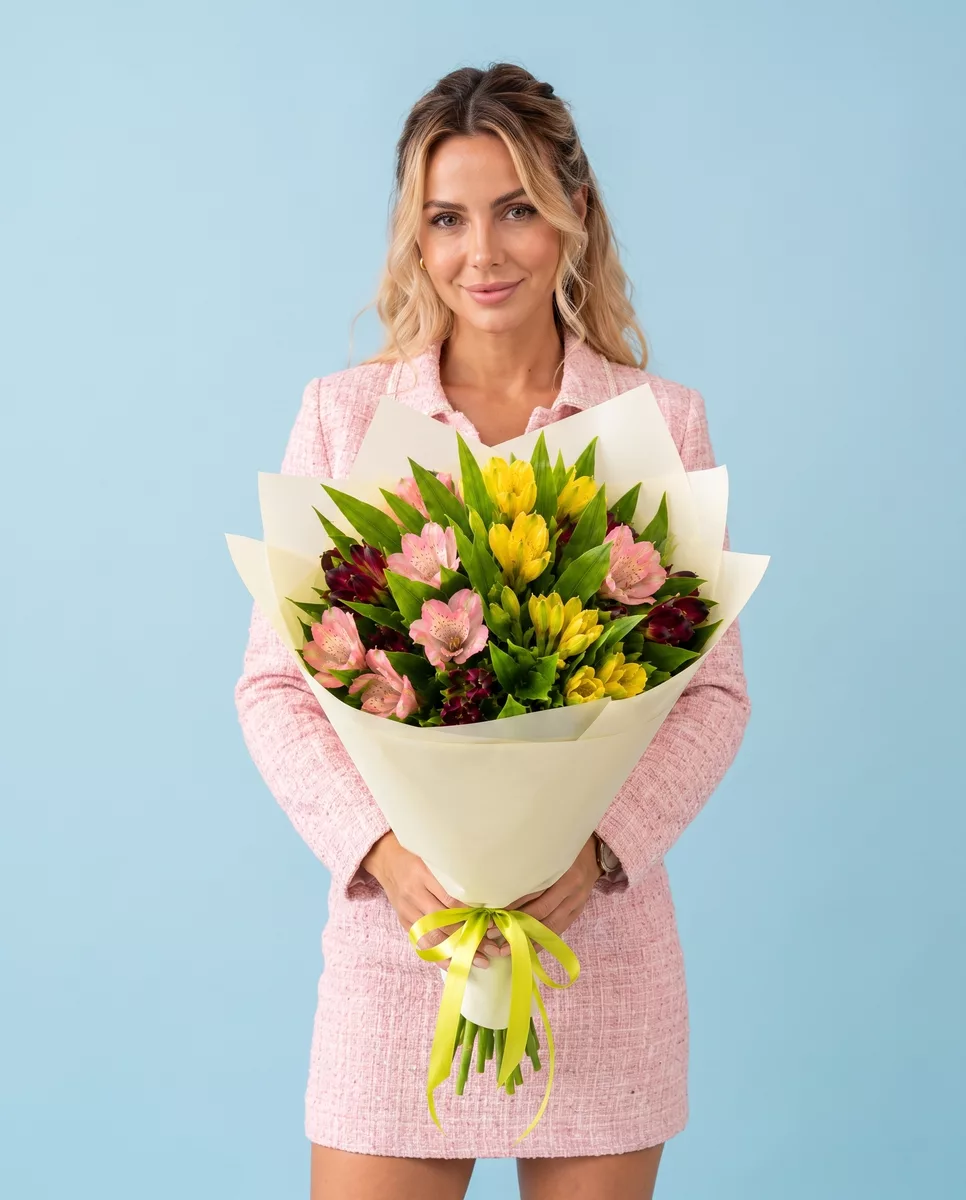
Roses: Which Varieties and Colours to Choose
Not all roses are equal, and the variety affects how long the bouquet lasts and how it looks on arrival. Long-stemmed Ecuadorian roses — varieties like Explorer, Red Naomi, and Avalanche — have large heads, strong stems, and stay open for seven to ten days with proper care. These are the roses worth ordering for a significant occasion. Dutch spray roses, such as Bombastic or Lydia, are smaller-headed and clustered; they add texture and volume to mixed bouquets but feel less formal on their own. For a monobouquet intended to read as romantic, stick with Ecuadorian long-stems. Colour carries meaning in Russia just as elsewhere, but the conventions are specific. Red is unambiguously romantic and remains the most popular choice for wives. White reads as elegant and is appropriate for any age; it also photographs beautifully. Pink — particularly dusty rose and blush tones — has grown significantly in popularity over the last several years and feels modern without being cold. Yellow roses are fine and not associated with negative meaning in contemporary Russian culture, despite older superstitions you may have read about; however, they do not read as specifically romantic, so save them for friendship or congratulation contexts. Avoid mixing too many colours in a rose bouquet if your goal is romantic rather than festive — a tight palette of one or two tones looks more intentional. A 15-stem bouquet of red Naomi roses in kraft paper with eucalyptus is one of the most reliably well-received combinations the shop puts together.
Beyond Roses: Peonies, Ranunculus and Tulips
Peonies are the flower women most often request for themselves, which makes them an excellent choice for a wife who has opinions about flowers. The season in Russia runs roughly from late April through June, and during that window the price is reasonable and the quality is excellent. Outside of season, peonies are imported and cost significantly more; they also arrive tighter and may not open as fully. If you are ordering in May or June, a 9 or 11-stem peony bouquet in white, blush, or coral is a strong choice that will feel seasonal and fresh. Ranunculus are available most of the year from Dutch growers and are a florist favourite for good reason: they have layered petals that look like a cross between a rose and a peony, they hold well in transit, and they are less expected than roses, which can make them feel more personal. A bouquet of 15 mixed-colour ranunculus — cream, peach, and terracotta — reads as curated and thoughtful rather than default. Tulips are strongly associated with spring and with March 8th, International Women's Day, which is the biggest flower holiday in Russia by volume. If you are ordering around that date, tulips are appropriate and expected; at other times of year they read as slightly seasonal-odd, though they are available year-round from Dutch stock. If your wife specifically loves tulips, order them — but if you are choosing without a strong preference from her, roses or ranunculus are safer outside of February and March. Lilies are popular but polarising due to their strong scent; check whether your wife tolerates strong fragrance before ordering.
Size, Stem Count and Bouquet Format
The size of a bouquet communicates something, and getting it wrong in either direction is a real risk. A 5-stem bouquet sent for an anniversary reads as afterthought regardless of the flower quality. A 51-stem arrangement sent to a studio apartment creates a logistical problem before it creates joy. The practical sweet spot for a romantic delivery to a wife is 15 to 25 stems for a monobouquet, or a mixed composition that fills roughly the same visual space. Monobouquets — all one variety — look clean and intentional. Mixed bouquets — roses with eucalyptus, ranunculus with wax flower, peonies with veronica — look lush and florist-made. Both work; the choice depends on whether you want something graphic and bold or something abundant and layered. Round bouquets, where all stems are gathered to a central point and the flowers form a dome, are the most classic format and travel well. Cascading or asymmetric bouquets look striking in photos but can arrive slightly dishevelled if the courier has a long route. For delivery across a city like Saint Petersburg, a tight round bouquet in firm paper wrapping is the most reliable format. Hat boxes with flowers arranged inside have become popular and are a good option when the recipient lives in a building with a concierge or when you want something that photographs unusually well. They cost more and the flowers are slightly less long-lived than in a traditional bouquet because the stems are cut shorter, but the presentation is genuinely impressive and the box can be reused.
Colours That Read as Romantic Versus Colours That Read as Festive
The distinction between romantic and festive matters when you are sending flowers specifically to your wife rather than to mark a general celebration. Romantic palettes are typically narrow: one or two colours, often with a neutral like white, cream, or dusty green from foliage. Red and white together is a classic combination. Blush and ivory reads as intimate and soft. Deep burgundy alone is dramatic and romantic. These palettes work because they feel chosen rather than assembled. Festive palettes are broader: orange, yellow, and red together; mixed pastels across five or six varieties; bright mixed tulips in every available colour. These are excellent for birthdays with a crowd, for office deliveries, for congratulating a new mother. They are not wrong for a wife, but they read differently — more celebratory, less specifically romantic. If your wife's birthday is the occasion and she is the kind of person who loves colour and abundance, a bright mixed bouquet is entirely appropriate. If the occasion is your anniversary or you simply want to say something personal, keep the palette tight. Foliage matters more than most people realise. Ruscus and salal are dark and structural; eucalyptus adds a soft grey-green and a mild scent; wax flower adds tiny white or pink clusters that fill space beautifully. A bouquet with good foliage looks considered and full even at a modest stem count. Ask the florist to include foliage rather than leaving the stems bare — bare stems are fine in a very large bouquet but look sparse in a 9 or 11-stem arrangement.
Timing the Delivery: When to Schedule and What to Avoid
Delivery timing is one of the most overlooked parts of a flower order, and it is where a lot of otherwise good gestures go wrong. If your wife is at work, a delivery to her office can be wonderful — she receives the flowers publicly, which most women enjoy — but only if you are certain she is in the office that day and not in meetings all afternoon. A bouquet sitting at a reception desk for four hours in a warm office is a bouquet that has aged. Home delivery is more reliable for quality but requires someone to be present or a secure place to leave the flowers. In Russia, most apartment buildings have a concierge or a coded entrance; tell the florist the entrance code and floor when you order, and specify whether the courier should call ahead. The best delivery windows for home delivery are mid-morning (10:00 to 12:00) when most people are home and the day feels unhurried, or early evening (17:00 to 19:00) when a working wife has just returned. Avoid scheduling for late evening if the occasion is a surprise — flowers arriving at 21:00 when she is already tired and winding down land differently than flowers arriving when she walks in from work. For March 8th specifically, order at least two to three days in advance. Demand on that date is extreme, same-day availability is limited, and delivery windows fill by the evening of March 7th. The same applies to February 14th, though that date is less dominant in Russia than March 8th. For all other dates, same-day ordering with a two-hour window is standard and reliable.
What to Check Before You Confirm the Order
Before you confirm, run through a short checklist that experienced customers have learned from getting it wrong once. First, confirm the delivery address in full: street, building number, apartment number, entrance number if the building has multiple entrances, floor, and door code if there is one. In Saint Petersburg specifically, many buildings have a separate entrance code and an intercom; provide both. Second, confirm that the recipient will be reachable by phone — the courier will call when close, and if she does not answer, the delivery cannot be completed. Third, check the card message for spelling and completeness. A card that says only her name with no message is worse than no card; write at least two sentences. Fourth, specify wrapping preferences if you have them — paper colour, ribbon colour, whether you want foliage included. Fifth, if the flowers are a surprise, tell the florist explicitly so the courier knows not to announce the sender's name on the phone. Sixth, if she has allergies — particularly to lily pollen, which is the most common floral allergen — state this clearly. The florist can remove stamens from lilies or substitute the variety entirely. Finally, if you are ordering from outside Russia, make sure you have a way to confirm delivery. A good shop will send you a photo of the completed bouquet before dispatch and confirm delivery by message. Ask for this service when you order if it is not offered automatically — it is standard practice for remote orders and gives you certainty that the bouquet arrived as intended.
Sending flowers to your wife when you are not there to hand them over is not a lesser gesture — it is a different one, and it works best when the details are deliberate. The variety, the stem count, the palette, the wrapping, the card, the delivery window: each of these is a decision, and each one either adds to the feeling or dilutes it. The florists at Five Flowers handle remote orders from husbands and partners every day, and the orders that land best are the ones where the sender took ten minutes to think through what she actually likes rather than what looks impressive in a thumbnail. If you are uncertain, call and describe her — her style, her home, the occasion — and let the florist make the call. That conversation takes five minutes and produces a better bouquet than any amount of scrolling through a catalogue. We deliver bouquets across Russia in 1–2 hours.
Frequently asked questions
Is it true that even numbers of flowers are bad luck in Russia?
Even numbers are associated with mourning and are used at funerals, so they are avoided for living recipients. Any reputable florist will automatically adjust an even count to odd. When ordering, simply specify 11, 15, or 19 stems and you will never have this problem. The convention is widely observed and genuinely matters to most Russian women.
What is the most popular flower for wives in Russia outside of roses?
Peonies are consistently the flower women say they would choose for themselves, which makes them an excellent gift. They are at their best from late April through June. Outside of that window, ranunculus are the strongest alternative — widely available, long-lasting, and visually similar to peonies in their layered structure. Both read as romantic and personal rather than generic.
Can I order flowers for delivery in Saint Petersburg from abroad?
Yes. Five Flowers handles international remote orders regularly. You need a confirmed delivery address with entrance and apartment details, a working Russian mobile number for the recipient, and a card message. Payment is processed online. The shop sends a photo of the finished bouquet before dispatch and confirms delivery, so you have certainty from wherever you are ordering.
How far in advance should I order for March 8th, International Women's Day?
Order at least two to three days before March 8th. It is the single busiest flower date in Russia by a significant margin, and same-day availability on March 8th itself is extremely limited. Delivery windows on March 7th and 8th fill early. Ordering on March 5th or 6th gives you full choice of varieties, wrapping, and delivery time.
What should I do if my wife is allergic to strong flower scents?
State the allergy clearly when you order. Lilies are the most common problem — their pollen is a strong allergen — and florists can either remove the stamens before delivery or substitute the variety entirely. Roses, ranunculus, and most tulips have minimal scent and are safe choices for sensitive recipients. Eucalyptus has a mild herbal scent that most people tolerate well.
Ready to send a bouquet?
Pick a city, choose the flowers, and we will hand them over with a photo confirmation.
Choose a city →