
Flowers for Russian Client Meetings: What Arrives at the Table
The question we hear most often on weekday mornings goes something like this: a PA calls at nine, the clients arrive at eleven, and she needs something on the conference table that does not look like it was grabbed from a petrol station. This is not a decorating problem — it is a logistics and variety problem, and it has a straightforward solution if you know what to order, what to avoid, and what to tell the courier when they ring the doorbell.
Why the Table Arrangement Matters in a Russian Business Context
In Russian office culture, the meeting room is read as a signal of how seriously the host takes the guest. A bare table with a water jug reads as indifference; a heavy floral centerpiece that blocks eye contact reads as overreach. What lands well is a low, compact arrangement — something that sits below shoulder height when people are seated and fills roughly the center third of the table without crowding documents or laptops. This is not a written rule anywhere, but it is consistent across the feedback we receive from corporate clients in Saint Petersburg and from recipients in Moscow, Kazan and Novosibirsk.
Russian business guests, particularly at a first meeting, tend to notice the flowers without commenting on them directly. The arrangement signals preparation and attention to detail, which in a negotiation context translates as respect for the other party's time. A wilted stem or a bloom that has already started to open flat will be noticed in the same quiet way — and it will register negatively. This is why the variety choice and the delivery window are not secondary details; they are the whole point.
The practical implication is that you should not order the arrangement the morning of the meeting and expect it to arrive looking its best if the room is warm. Conference rooms in Russian offices are often kept at eighteen to twenty-two degrees Celsius, which is fine for people but accelerates bloom opening in roses and ranunculus. Ordering a day ahead and storing the arrangement in a cooler anteroom overnight is the correct approach when the schedule allows it.
Bouquets we can deliver



Varieties That Hold Their Shape Through a Long Meeting
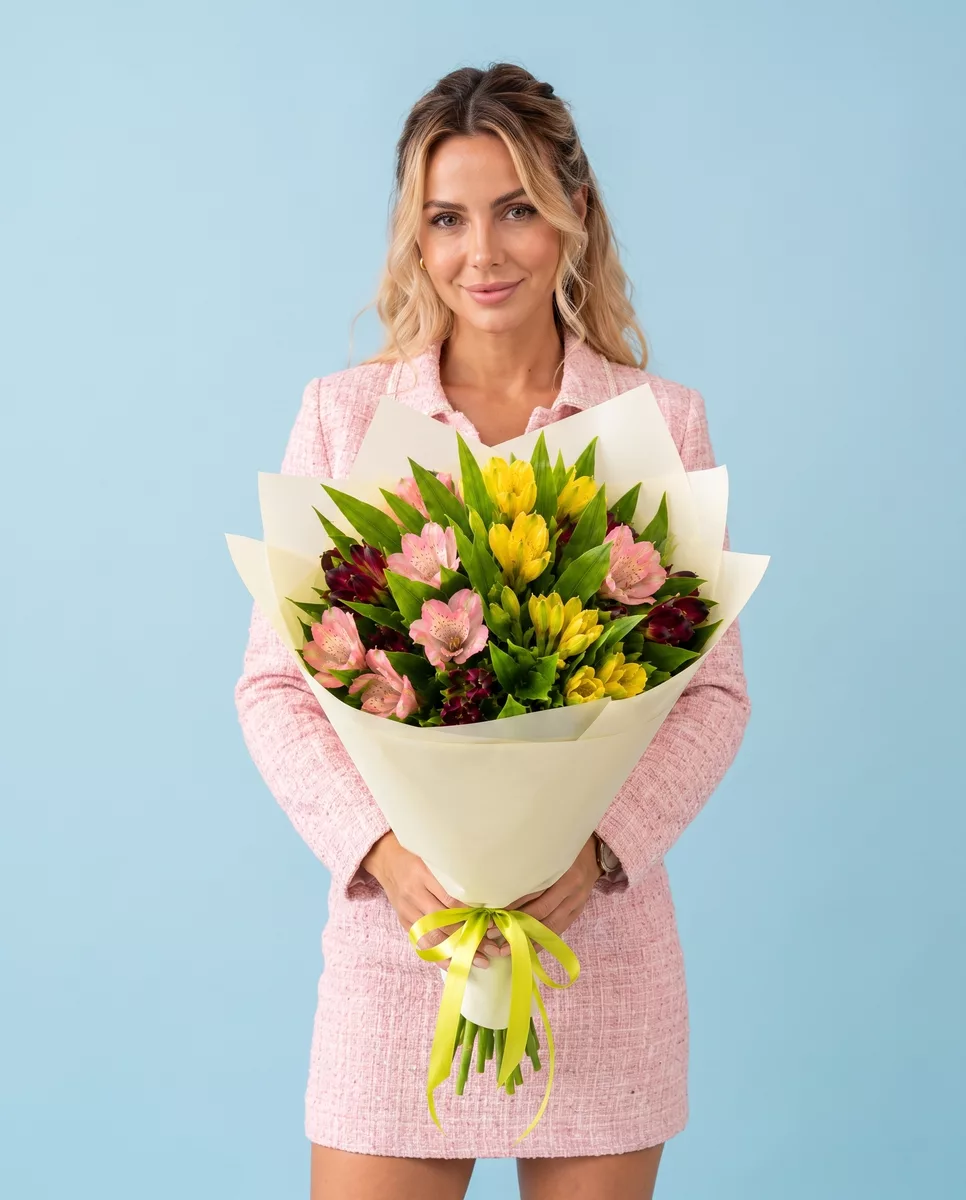
The first filter when choosing varieties for a business table is vase life under office conditions, not visual drama. Spray chrysanthemums in white or pale yellow are the most reliable option we carry: they do not drop petals, they tolerate dry office air, and a single bunch fills a low arrangement without requiring much supporting greenery. Alstroemeria is a close second — the buds open gradually over several days, which means the arrangement looks intentional rather than rushed, and the stems are sturdy enough to survive courier transit without individual wrapping.
Garden roses in the David Austin style — varieties like Juliet or Keira — hold their cup shape for forty-eight to seventy-two hours at room temperature, which covers even an extended meeting day. Standard long-stem roses are a different matter: at twenty degrees they open fully within twelve to eighteen hours, so a nine-o'clock delivery for an eleven-o'clock meeting is fine, but the same arrangement will look spent by the following morning if the client relationship requires a second day of talks. Lisianthus, also called eustoma, is underused in corporate settings and worth knowing: it looks similar to a peony at a fraction of the price, it tolerates warmth better than peonies do, and it comes in white, cream and soft purple, all of which read as professional rather than festive.
What to avoid: gerbera daisies wilt at the stem before the petals show any sign of trouble, which creates an arrangement that looks structurally collapsed even when the blooms are still bright. Tulips in a warm room will open and droop within four hours. Sunflowers read as informal in most Russian business contexts unless the client's brand specifically uses them.
Size, Shape and Table Geometry
A conference table in a standard Russian office seats six to ten people and measures roughly one-and-a-half to two-and-a-half metres in length. The arrangement should occupy a circle of no more than thirty to forty centimetres in diameter and stand no taller than twenty-five centimetres — this keeps it below the sightline of seated adults and prevents it from becoming a visual barrier between the two sides of the table. We build these as dome-shaped low arrangements in a wide, heavy ceramic or glass vessel rather than a tall vase, because a tall vase on a smooth conference table is a spill risk every time someone reaches across.
For a smaller meeting room — four seats, a round table — the same dome shape works but the diameter can shrink to twenty centimetres. The vessel weight matters here too: a lightweight plastic pot will slide when the table vibrates from a door closing nearby, which is a small but real problem in open-plan offices. We use ceramic vessels with a flat base as the default for all business deliveries for exactly this reason.
If the table is long enough to warrant two arrangements rather than one, place them at equal intervals in the middle third of the table rather than anchoring them at each end. Two arrangements at the ends create a symmetry that reads as formal dining rather than business meeting, which is a different register. One central arrangement is almost always the right call for a working meeting, and two central arrangements spaced about sixty centimetres apart work for a table seating more than eight.
Colour Logic for Professional Settings
White and cream are the safest starting point for any first client meeting because they do not carry associations with a specific occasion the way red does. In Russian culture, red roses in particular are strongly associated with romantic intent, and a table full of red blooms at a business meeting will produce at least a moment of confusion, even if no one says anything aloud. This is one of the most common mistakes we correct when a client calls with a vague brief — they ask for something impressive and default to red roses because they know roses are expensive, but the colour choice undermines the intended message.
Soft yellow — not bright sunflower yellow but the pale yellow of spray chrysanthemums or cream-tipped alstroemeria — reads as warm and approachable without crossing into celebratory territory. It works particularly well when the meeting involves a long-term client relationship rather than a first introduction, where a slightly warmer tone is appropriate. Pale pink, especially in lisianthus or garden roses, is neutral enough for most business contexts and tends to be well received by mixed-gender groups.
Purple and burgundy are acceptable in small quantities as accent colours but should not dominate the arrangement. Green arrangements — eucalyptus, fern, succulents — are increasingly common in tech and creative industry offices and read as contemporary rather than formal, which may or may not match the tone of the meeting. If you are unsure about the client's industry or office aesthetic, white and cream with a small amount of greenery is the arrangement that has never produced a complaint in our delivery history.
Timing the Delivery: What the Window Actually Looks Like
We deliver within one to two hours of order confirmation across Saint Petersburg, and we extend delivery to other Russian cities through our own logistics. The first thing to establish when ordering for a meeting is the hard deadline — not the meeting start time but thirty minutes before it, because the arrangement needs to be placed, any protective wrapping removed, and the vessel checked for water level before the guests arrive. An arrangement that is still being unwrapped when the client walks in has the opposite effect of the one intended.
For a meeting at eleven in the morning, the order should be placed no later than eight-thirty to allow for a nine-thirty delivery, which gives the receiving PA time to place the arrangement and deal with any surprises. If the office building has a reception desk that holds deliveries rather than allowing direct floor access, add another thirty minutes to that buffer. We ask about building access at the time of order for exactly this reason — a courier waiting in a lobby for a security escort is a courier who is not meeting your deadline.
Temperature during transit is managed through insulated packaging, but the arrangement should not sit in a hot car or a cold entrance hall for more than twenty minutes after delivery. In winter in Saint Petersburg or Novosibirsk, a cold entrance hall can cause condensation damage to petals within that window, particularly on roses and lisianthus. Ask the recipient to bring the arrangement to room temperature gradually by placing it in a cool but interior space for ten minutes before the final placement.
What to Check When Placing the Order
The four things that determine whether the arrangement arrives correctly are the delivery address with floor and office number, the recipient's phone number, the hard deadline, and the vessel preference. If any of these is missing or vague, the order will either be delayed or arrive in the wrong format. We have delivered arrangements in tall vases to rooms that had no surface tall enough to hold them safely — this is a fixable problem but it requires a call and sometimes a replacement vessel, which costs time.
Specify the table dimensions if you know them, or at least the number of seats. A florist who knows the table seats eight will not send a twenty-centimetre arrangement that disappears on a two-metre surface. If you do not know the table size, describe the room type: boardroom, small meeting room, executive office. These three categories map to different arrangement sizes in our standard range and allow us to make a reasonable judgment without a measuring tape.
Ask about the room temperature if the meeting is in summer or if the building is known for strong central heating in winter. A room that runs at twenty-four degrees in January will open spray roses within six hours; if the meeting runs long or continues the next day, you may want to switch to chrysanthemums or alstroemeria for that booking. Finally, confirm whether the arrangement will be reused after the meeting — if the client is taking it home or it will remain in the office for several days, that changes the variety selection toward longer-lasting options and away from anything that is at peak bloom on delivery day.
After the Meeting: What Happens to the Flowers
In Russian business culture, it is common for the host to offer the table flowers to the guest at the end of the meeting, particularly if the guest is a woman or if the meeting concluded positively. This is a gesture of hospitality rather than a formal protocol, but it is common enough that it is worth planning for. If there is a realistic chance the arrangement will be offered as a gift, choose varieties that travel well — alstroemeria and spray chrysanthemums hold up in a bag or car; garden roses and lisianthus are more fragile and will bruise if handled roughly during transit home.
If the arrangement stays in the office, it should be moved from the conference table to a reception area or a desk where it can continue to do its work as a visual signal of the company's attention to environment. An arrangement left on a conference table that is not in use will be noticed by the next group to use the room, which extends the value of the original order. Water should be checked and topped up daily; a ceramic vessel typically holds enough water for two days without attention, but a smaller vessel in a warm room may need daily refilling.
For recurring client meetings — weekly or fortnightly — a standing order for a fresh arrangement delivered each time is more cost-effective than placing individual orders, and it removes the morning-of logistics pressure entirely. We manage standing orders with a fixed delivery window and a consistent variety rotation so that the arrangement is never identical week to week, which avoids the impression that the office simply leaves the same flowers out indefinitely. Freshness is the point, and a rotation makes that freshness visible.
A table arrangement for a client meeting is a functional object with a specific job: it signals preparation, it sets a professional tone, and it does that job quietly without requiring anyone to comment on it. The variables that determine whether it succeeds are variety, timing, size relative to the table, and colour relative to the occasion — not the total number of stems or the cost of the individual blooms. Order with a thirty-minute buffer before the meeting start, specify the table and room, and choose varieties that hold their form at office temperature. Everything else follows from those three decisions. We deliver bouquets across Russia in 1–2 hours.
Frequently asked questions
Can I order a table arrangement the same morning as the meeting?
Yes, if you order at least two and a half hours before the meeting starts. That window covers our one-to-two hour delivery time plus the thirty minutes the recipient needs to place the arrangement before guests arrive. For buildings with lobby security or restricted floor access, add another thirty minutes to be safe.
Are red roses appropriate for a Russian business meeting?
Red roses carry strong romantic associations in Russian culture and are likely to create confusion at a formal business meeting, especially a first meeting. White, cream, pale yellow or soft pink are the appropriate choices. If red is part of the company's brand colours, use it as a small accent rather than the dominant colour.
How long will the arrangement last through a full day of meetings?
Spray chrysanthemums and alstroemeria will look good for three to four days at standard office temperature. Garden roses and lisianthus hold well for forty-eight to seventy-two hours. Standard long-stem roses at twenty degrees or above will be fully open within twelve to eighteen hours of delivery, so they suit a single-day meeting but not a multi-day event.
What vessel type is safest for a conference table?
A wide, low ceramic vessel with a flat base is the most reliable choice. It keeps the arrangement below the sightline of seated guests, reduces spill risk compared to a tall vase, and is heavy enough not to slide on a smooth table surface. We include an appropriate vessel with all business table arrangement orders.
Do you deliver table arrangements to cities outside Saint Petersburg?
Yes, we deliver across Russia using our own logistics. Delivery times vary by city but the ordering process is the same. Specify the hard deadline and building access details at the time of order so we can confirm the delivery window before you commit the slot to your meeting schedule.
Ready to send a bouquet?
Pick a city, choose the flowers, and we will hand them over with a photo confirmation.
Choose a city →