
Flowers for a Colleague's Work Anniversary: Office Delivery in Russia
Work anniversaries in Russian offices have become a genuine occasion over the past decade, and the expectation of flowers is real. If you are based in London, Berlin, or New York and want to send something to a colleague in Moscow or Saint Petersburg marking five, ten, or twenty years with the company, the logistics are manageable — but only if you understand how Russian office buildings receive deliveries, what varieties actually survive a lobby wait, and what the local custom looks like from the recipient's side.
What a Work Anniversary Means in a Russian Office
In Russia the professional milestone — called a yubiley trudovoy deyatelnosti in formal contexts, though colleagues simply say 'anniversary at work' — is treated with more ceremony than in many Western offices. A colleague completing five years is typically acknowledged publicly, often with a short speech from a manager and a gift presented in front of the team. Ten and twenty-five year marks carry even more weight, and flowers arriving at the office during working hours are considered a visible, public sign of respect rather than a private gesture. The bouquet sits on the desk for the rest of the day, which means presentation matters as much as fragrance. Russians working in large corporations have absorbed some Western HR culture, but the expectation of flowers has not faded — if anything, it has sharpened, because a delivered bouquet signals that someone made a deliberate effort rather than handing over a gift card. For a sender abroad, this context matters: you are not just ordering flowers, you are participating in a semi-public workplace ritual. The bouquet will be seen by the recipient's entire team, so size and composition should reflect the seriousness of the occasion. A small mixed bunch appropriate for a birthday feels underdressed for a ten-year mark. A structured, generous arrangement of twenty-five or more stems in a single dominant variety reads as intentional and respectful in this setting.
Bouquets we can deliver



Choosing Varieties That Hold Up in an Office Environment
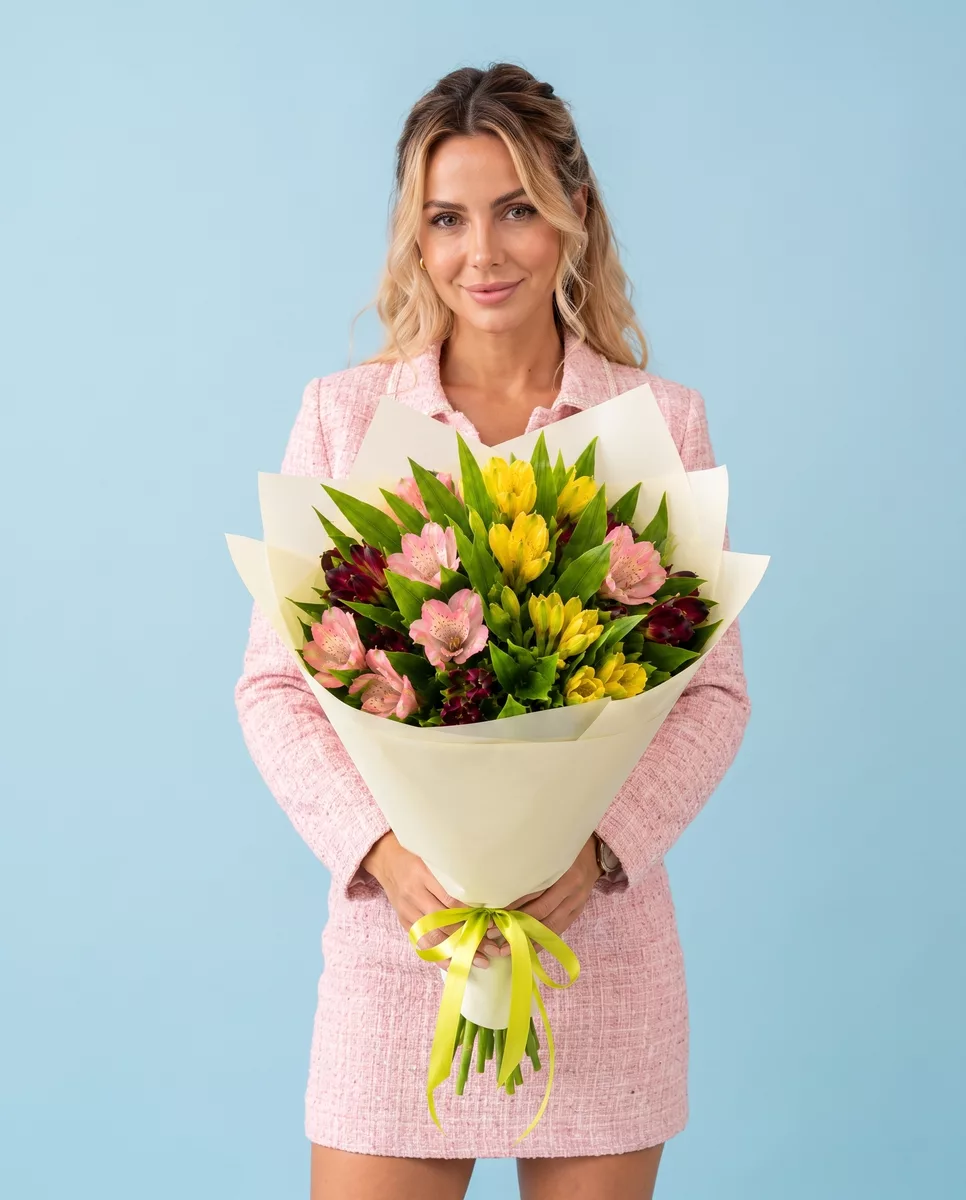
Office buildings in Moscow and Saint Petersburg are heated aggressively from October through April, with indoor temperatures routinely reaching 24 to 26 degrees Celsius. This is the first practical constraint on variety selection. Flowers that look spectacular in a cool florist cabinet can droop within two hours in a dry, overheated reception area or open-plan office. Roses are the safest choice for longevity: Ecuadorian large-headed varieties such as Explorer, Red Naomi, and Mondial have thick petals and a long vase life even in warmth, provided they arrive properly hydrated. Spray roses add volume without inflating the stem count and hold their shape well. Chrysanthemums — single-headed santini or the larger disbud type — are genuinely heat-tolerant and carry no negative association in a workplace context; the old idea that chrysanthemums belong only at funerals applies to very specific all-white arrangements, not to the mixed or yellow varieties common in office bouquets. Alstroemeria is another practical choice: it opens slowly, meaning it looks fresh for four to five days after delivery. Eustoma (lisianthus) adds a ruffled texture that reads as premium without being fragile. What to avoid: tulips wilt quickly in warmth and drop petals on desks; garden-style dahlias and ranunculus are beautiful but soft and short-lived in heated rooms; heavily scented oriental lilies can trigger headaches in enclosed offices and are genuinely unpopular in this setting. Stick to the workhorses and the bouquet will still look good when the recipient photographs it to send to family that evening.
Sizing and Composition for a Professional Milestone
Russian florists and their customers think in stem counts more than in bouquet weight or diameter, so when you read a product description or place a custom order, the number of stems is the clearest signal of how the gift will read. For a five-year anniversary, twenty-five to thirty-one stems in a tightly structured mono-bouquet — all one variety, same colour — is a solid choice. The odd number is a Russian convention for celebratory occasions: even numbers are reserved for mourning, and while younger recipients in international companies may not react strongly either way, it costs nothing to respect the tradition and avoids any awkward moment. For a ten-year mark, consider thirty-five to fifty-one stems or a mixed composition with a clear dominant flower supported by two accent varieties. The colour palette for office delivery should lean toward white, cream, soft pink, or yellow for a neutral professional tone. Red roses are entirely appropriate but read as more personal and romantic in Russian culture, so they work best when you know the recipient well or the team culture is informal. Avoid purple and dark burgundy combinations for this occasion — they are beautiful but carry a heavier, more formal register that feels better at a retirement than a milestone. Packaging matters in this context: a craft-paper wrap with a satin ribbon, or a clear cellophane with a structured bow, both read as considered. Box arrangements have become popular in Russian offices because they travel flat and do not require immediate vase placement, which is practical in a busy open-plan environment.
Timing the Delivery to a Moscow or St Petersburg Office
Office delivery in Russia requires more precision than home delivery because the window of opportunity is narrow. Most corporate buildings in Moscow and Saint Petersburg operate Monday through Friday, with reception open from roughly 09:00 to 18:00 local time. Security desks in larger business centres will sign for a delivery, but the flowers need to reach the recipient while they are at their desk — not sitting in a lobby for three hours. The safest target window is 11:00 to 15:00 local time, which avoids the morning rush of meetings and the afternoon wind-down when people start leaving early. Moscow is UTC+3 year-round; Saint Petersburg is also UTC+3. If you are ordering from London, that is a three-hour offset in winter and a two-hour offset in summer when the UK is on BST. From New York the offset is eight hours in winter. Do the arithmetic before you fill in the delivery time field, because a mistake here means flowers sitting in a lobby overnight. When you place the order, confirm the recipient's office address including the building number, floor, and the name on the door or the company name as it appears at reception — Russian business centres often have multiple tenants and a courier needs specific information to get past security. If you know the recipient has a lunch break between 13:00 and 14:00, target arrival at 12:30 so the flowers are on the desk when they return. Same-day delivery within one to two hours is available in both cities, which gives you flexibility if you realise the anniversary date is today.
Placing the Order from Abroad: What You Actually Need
Ordering from overseas involves a few practical steps that catch people out the first time. You will need the recipient's full office address in Russian or transliterated Latin characters — Google Maps transliteration is usually accurate enough for a courier. You will need a working phone number for the recipient or a contact at the office, because couriers call ahead in Russia as standard practice, especially in large business centres where access is controlled. If you do not have the recipient's direct number, a colleague's number or the company reception number works. Payment from abroad is straightforward: international Visa and Mastercard are accepted, and the order form on the site works in English. The card charge will appear in rubles at your bank's current exchange rate. Write the card message in English if that is your shared language with the recipient — there is no requirement for Russian. Keep the message short and professional: one or two sentences acknowledging the milestone and expressing genuine congratulation. Avoid overly effusive phrasing, which can read as hollow in Russian workplace culture; something direct and specific to the number of years lands better. If the anniversary falls on a Monday, order by Friday afternoon Moscow time to confirm availability and lock in the delivery slot. Russian public holidays occasionally shift working days — Victory Day on 9 May and National Unity Day on 4 November are the most common disruptors — so check the Russian calendar if your date falls near either of those. The shop's customer service can confirm whether a specific date is a working day.
Common Mistakes Senders Make and How to Avoid Them
The most frequent error is providing an incomplete address. Russia uses a specific address format: city, street, building number, sometimes a corpus or stroenie number for a building in a complex, then office or floor. Missing the corpus number means the courier arrives at the wrong building in the same courtyard — a surprisingly common layout in Soviet-era business districts. Double-check the address against the company's official website or a business card if you have one. The second common mistake is ordering for a date that turns out to be a Russian public holiday. The recipient is not in the office, the flowers sit in transit or are returned, and the moment is lost. Russia has more official public holidays than most European countries, and some are moved to adjacent Mondays, so a date that looks like a regular Thursday can be a day off. The third mistake is choosing a very strongly scented bouquet without thinking about the office environment. Oriental lilies, hyacinths, and tuberose are genuinely problematic in enclosed spaces and are the varieties most often mentioned when recipients apologise to colleagues for the smell. A beautiful bouquet of white lilies will cause complaints in an open-plan office. Stick to low-scent varieties: roses, chrysanthemums, alstroemeria, and eustoma are all nearly odourless. The fourth mistake is cutting the delivery window too tight. If you order at 16:30 Moscow time for same-day delivery to an office that closes at 18:00, there is almost no margin for traffic or building access delays. Order by 14:00 local time for same-day office delivery to be confident the flowers arrive during working hours.
What Happens After the Flowers Arrive
Understanding the post-delivery moment helps you write a better card message and choose a better bouquet. In a Russian office, when flowers arrive for a colleague, it is common for the team to gather briefly, for the bouquet to be unwrapped publicly, and for the recipient to say a few words. This is not universal — startup culture in Moscow is more casual — but it happens often enough that the bouquet will be seen by many people, not just the recipient. This is why a well-structured, clearly composed arrangement matters more than a loose garden-style bunch: it photographs well and reads as intentional from across a room. The recipient will almost certainly photograph the bouquet and share it in a family or friend group chat — this is standard behaviour across all age groups in Russia. A card with a legible, warm message that can also be photographed adds to the gesture. After the workday, most recipients take the flowers home. This means the bouquet needs to travel: box arrangements are easier to carry on public transport than a large wrapped bouquet, which is worth considering if the recipient commutes by metro. Saint Petersburg and Moscow both have extensive metro systems and most office workers use them. A compact, sturdy arrangement in a decorative box survives a metro journey better than a tall cellophane-wrapped bouquet. If you know the recipient drives to work, this is less of a concern, but it is a detail worth thinking through when you select the format.
Sending flowers to a colleague in Russia for a work anniversary is a gesture that lands well when the details are right. The variety choice needs to account for heated office interiors, the stem count should reflect the weight of the occasion, the delivery window needs to match Moscow or Saint Petersburg working hours in local time, and the address must be complete down to the building corpus number. Get those four things right and the bouquet does exactly what a good gift should do: it arrives at the right moment, looks serious and considered, and gives the recipient something visible and public to mark a milestone they have genuinely earned. We deliver bouquets across Russia in 1–2 hours.
Frequently asked questions
Can I send flowers to a Russian office if I am ordering from outside Russia?
Yes. The order form accepts international Visa and Mastercard payments, and you can write the card message in English. You will need the recipient's office address in full, including building and floor details, and a contact phone number for the courier. The charge appears in rubles at your bank's exchange rate. Same-day delivery is available in Moscow and Saint Petersburg.
Is it true that even numbers of flowers are inappropriate in Russia?
Even-numbered bouquets are associated with mourning in Russian tradition, so celebratory arrangements use odd numbers: twenty-five, thirty-one, fifty-one stems and so on. Younger recipients in international companies may not react strongly to this, but using an odd number costs nothing and avoids any awkward association. All standard bouquets from Five Flowers follow this convention automatically.
Which flowers should I avoid sending to a Russian office?
Avoid strongly scented varieties — oriental lilies, hyacinths, and tuberose cause complaints in enclosed, heated offices. Tulips wilt quickly in warm indoor temperatures. All-white chrysanthemum arrangements carry a funerary association and are best avoided. Roses, alstroemeria, eustoma, and spray chrysanthemums in mixed colours are safe, long-lasting, and well-received in a professional setting.
What delivery time slot should I request for an office delivery?
Target arrival between 11:00 and 15:00 Moscow or Saint Petersburg local time, which is UTC+3 year-round. This avoids morning meetings and catches people before the afternoon wind-down. If you are ordering from London in winter, add three hours to your local time to get Moscow time. Order by 14:00 local time for same-day delivery to ensure the flowers reach the office before closing.
Does a work anniversary bouquet need to look different from a birthday bouquet?
Yes, in practice. A work anniversary is a semi-public, professional occasion, so the arrangement should be larger and more structured than a typical birthday bunch. Mono-bouquets in a single variety, or compositions with one clear dominant flower, read as deliberate and respectful. The colour palette should lean neutral — white, cream, yellow, or soft pink — unless you know the recipient and the team culture well.
Ready to send a bouquet?
Pick a city, choose the flowers, and we will hand them over with a photo confirmation.
Choose a city →