
Flowers for a Russian Company Anniversary or Jubilee Event
Russian corporate jubilees — a company turning 10, 25, or 50 years — are formal occasions with specific expectations around flowers that catch many event planners off guard. The arrangements are not decorative afterthoughts; they are part of the ceremony, presented to directors, handed to speakers, and placed on tables where partners and officials sit. Get the scale wrong or choose the wrong palette and the flowers read as casual, which in a Russian boardroom context is a problem. This guide covers what actually works: which varieties hold up under event lighting and warm conference rooms, which formats suit a jubilee stage versus a reception table, and what to sort out with your florist at least 72 hours before the event.
What a Russian Corporate Jubilee Actually Expects from Flowers
A Russian company anniversary, especially a round number like 10, 20, 25, or 50 years, is treated with the seriousness of a state occasion at many firms. Flowers appear in at least three roles: presentation bouquets given to founders or directors on stage, table arrangements for the presidium or head table, and standing compositions near the entrance or at the podium. Neglecting any one of these three makes the event look unfinished to Russian guests, who notice the absence immediately. Presentation bouquets at these events are large by Western standards — 51, 75, or even 101 stems is not unusual, because odd numbers are the rule for living recipients in Russian tradition. Even numbers are strictly associated with mourning, so a 50-stem bouquet, however logical it sounds for a 50th anniversary, will draw uncomfortable looks from older guests. The color palette for formal jubilees leans toward white, cream, burgundy, and deep red rather than bright mixed tones; these read as serious and respectful. Gold accents in foliage or ribbon are common for milestone anniversaries. Event planners unfamiliar with these conventions sometimes order what they would choose for a Western gala — loose, colorful, informal — and the result feels mismatched to the ceremony around it. Understanding the occasion's formality level before placing an order saves significant rework.
Bouquets we can deliver



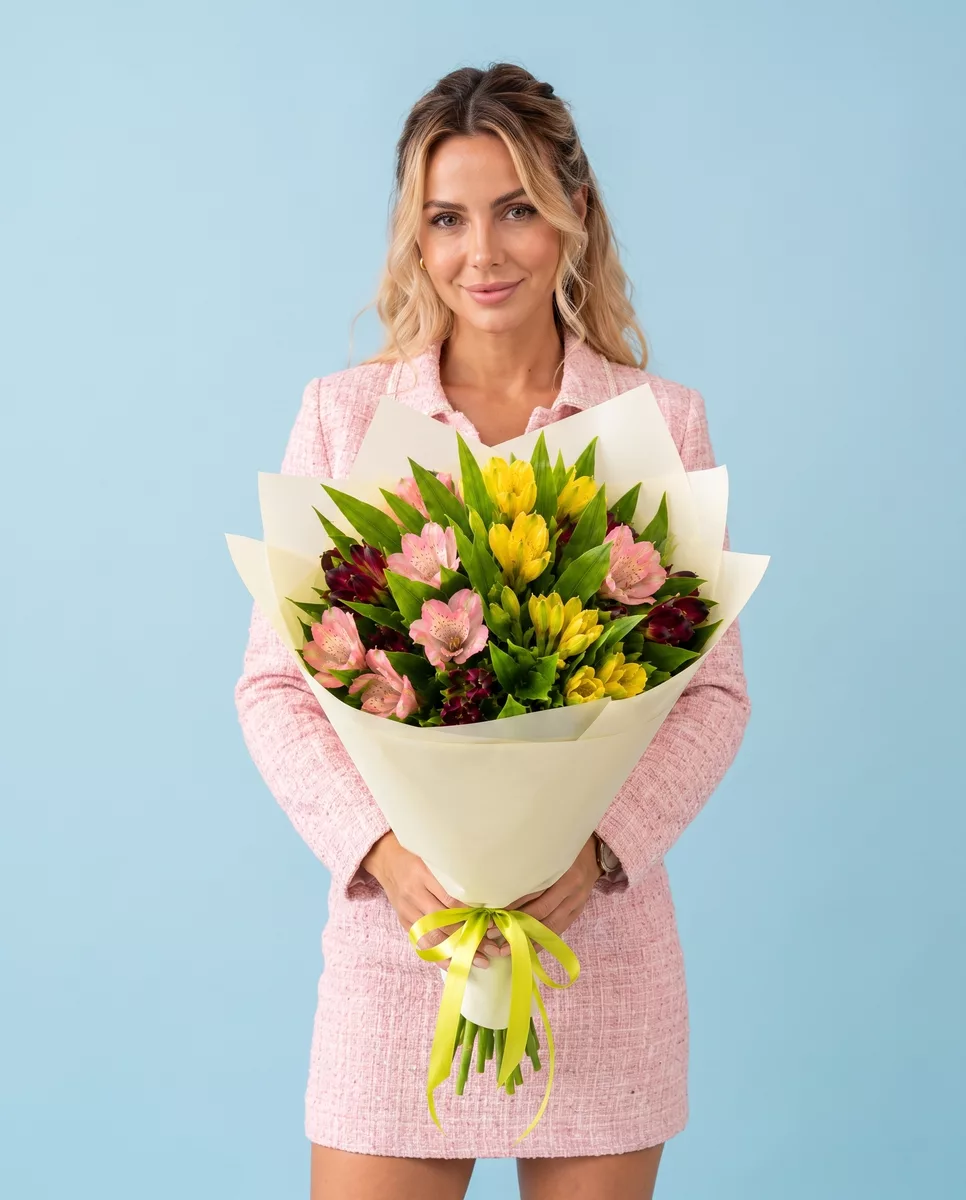
Varieties That Perform Well in Conference Rooms and Event Halls
Temperature is the first practical constraint. Conference halls and banquet rooms in Russian cities are heated aggressively in autumn and winter, often reaching 22 to 24 degrees Celsius inside while fresh stock arrives from a van in near-freezing outdoor air. Varieties that cannot handle that temperature swing for six to eight hours will droop before the ceremony ends. Garden roses and spray roses are reliable choices — they open gradually under warmth rather than collapsing. Large-headed hybrid tea roses, particularly varieties with dense petal counts such as Explorer or Avalanche, hold their shape well under event lighting and warm air. Eustoma, also called lisianthus, is a strong performer for table arrangements because its multiple buds open progressively, keeping the arrangement looking fresh across a long evening. Chrysanthemums — both single-stem and spray types — are durable and widely used in Russian corporate floristry; they carry no negative associations in a professional context. Orchids, particularly Phalaenopsis stems cut and arranged in low vases, add a formal tone to presidium tables and last the full event without water if the stems are properly conditioned. Carnations in burgundy or white remain a classic choice for presentation bouquets at jubilees; they are long-lasting and hold up to handling during a ceremony. Avoid tulips and anemones for warm indoor events — both wilt quickly once they leave refrigeration and will not survive a three-hour ceremony in a heated hall.
Presentation Bouquets for Directors and Founders: Size and Structure
The bouquet handed to a director or founder on stage at a jubilee is the most visible floral element of the entire event, so its structure matters as much as its flowers. It needs to photograph well from a distance — tight clusters of small flowers disappear on a stage; large focal blooms like garden roses, peonies in season, or standard roses at 60 to 70 centimeters stem length read clearly. A typical formal presentation bouquet for a senior executive at a Russian corporate jubilee runs between 51 and 75 stems, assembled in a round or slightly cascading hand-tied form wrapped in matte or kraft paper with a satin ribbon in the company colors. Shiny cellophane wrapping is considered low-quality at formal events in Russia and is worth avoiding explicitly when you brief your florist. If the company has a brand color, incorporating it into the ribbon or adding a complementary flower in that shade is a detail that senior Russian managers notice and appreciate — it signals that the flowers were chosen specifically, not pulled from stock. For events where multiple people receive bouquets — a founding team of four or five directors — the bouquets should be identical in size and composition. Variation in bouquet size between recipients creates an unintended hierarchy that causes real awkwardness. Order all presentation bouquets as a matched set and confirm this explicitly when placing the order.
Table Arrangements for the Presidium and Reception Tables
The presidium table — the long head table where senior leadership and honored guests sit facing the room — needs arrangements that are visible to the audience without blocking sightlines between the people seated there. Low, wide compositions work best: a horizontal arrangement of 40 to 60 centimeters in width but no more than 30 centimeters in height keeps the table formal without creating a visual barrier. White and cream roses combined with eucalyptus branches or ruscus give a clean, authoritative look that suits this position. For reception tables where guests mingle before or after the main ceremony, taller arrangements in narrow vases are appropriate because no one is seated looking across them. Single-variety arrangements — all white eustoma, all cream roses — look more deliberate and expensive than mixed arrangements of the same budget, which is useful when managing costs across a large event. Round tables in banquet halls typically seat eight to ten people and need an arrangement that reads from all sides equally; a dome-shaped composition in a low footed vase works for this format. Rectangular tables need either one long central runner of flowers or two or three smaller compositions spaced evenly — a single small arrangement on a long table looks forgotten. Confirm the table dimensions and shapes when you brief the florist, because the arrangement format depends entirely on this information. Foliage choices matter more than many planners realize: dark green ruscus and eucalyptus read formal; lighter, feathery foliage like asparagus fern reads casual and is better suited to less formal settings.
Entrance and Stage Compositions: Scale and Structural Choices
Large standing arrangements at the entrance or flanking a stage backdrop are the second most photographed element after presentation bouquets, and they need to be sized to the space. A standard conference hall entrance requires arrangements of at least 80 to 100 centimeters in height to register visually; anything shorter looks like it belongs in a hotel lobby rather than a jubilee venue. Floor-standing vases in metal or ceramic with large branching compositions of roses, eustoma, and decorative branches — dried or fresh eucalyptus, twisted willow, or ornamental grass — are the most common format for Russian corporate events in this size range. Stage backdrops sometimes use flower walls, but these are expensive, require significant lead time, and need to be built on-site, which means the florist needs access to the venue at least three to four hours before the event starts. If access is restricted, discuss this before committing to a flower wall format. Potted orchids — Phalaenopsis in large decorative pots — are an alternative for flanking a stage; they look substantial, require no water management on the day, and can be gifted to the company afterward, which is a practical detail that Russian clients often appreciate. Whatever format is chosen for entrance or stage compositions, the color palette must match the presentation bouquets and table arrangements. Disconnected palettes across different floral elements at the same event look like the flowers came from different orders, which undermines the impression of a carefully planned occasion.
Timing the Order and Delivery for a Jubilee Event
A corporate jubilee is not an order you place the day before. For an event requiring matched presentation bouquets, presidium arrangements, table compositions, and entrance pieces, the florist needs a minimum of 72 hours to source the correct quantities of specific varieties in good condition. Premium roses in a specific color, large-headed eustoma in white or cream, or any special foliage branch may not be available from the wholesale market on short notice in the quantities a large event requires. Place the order at least five to seven days ahead if the event is large, and confirm the final stem counts and delivery time no later than 48 hours before. Delivery timing for a corporate event is more precise than for a home delivery. Flowers should arrive at the venue no more than two hours before the event starts — early enough to arrange and condition them, late enough that they are not sitting in a warm hall for four hours before guests arrive. If the venue is in a business district with restricted access or loading dock rules, clarify this when booking: a florist arriving with large floor arrangements at a downtown Saint Petersburg business center needs to know about elevator dimensions, security check-in procedures, and whether there is a service entrance. Refrigerated transport matters for summer events — June through August in Saint Petersburg can reach temperatures that damage flowers in transit without proper cooling. Ask explicitly whether the delivery vehicle is temperature-controlled when ordering for a warm-weather jubilee.
Common Mistakes Event Planners Make When Ordering Jubilee Flowers
The single most common mistake is ordering even numbers of stems for presentation bouquets without realizing the cultural implication. It comes up repeatedly with planners from outside Russia and is easy to avoid once you know about it — always confirm the stem count is odd. The second common mistake is underestimating quantity. A jubilee for a company of 200 employees with a presidium of eight people, four directors receiving bouquets, ten reception tables, and a stage backdrop is a substantial floral order, and planners sometimes budget for a fraction of what the event actually requires. Walk through each location in the venue and count the floral positions before requesting a quote. The third mistake is choosing seasonal flowers without checking whether they are actually in season. Peonies are available in Russia from approximately May through June; ordering them for a November jubilee means they will either be unavailable or very expensive because they are imported from distant growing regions. Ask what is in good supply for your event date rather than specifying varieties from a mood board without checking availability. The fourth mistake is not confirming the palette across all elements. Planners sometimes choose flowers from different references — table arrangements from one inspiration image, bouquets from another — and end up with a warm ivory tone on the tables and a cool white in the bouquets, which clash visibly in photographs. Send all references to the florist together and ask them to confirm the palette is consistent before the order is confirmed.
A Russian company anniversary is a formal occasion with real expectations around floral scale, color palette, stem counts, and timing, and meeting those expectations is a matter of knowing the conventions rather than guessing at them. Choose varieties that hold up in warm indoor spaces, keep presentation bouquets in odd numbers, match the palette across every floral position in the venue, and place the order with enough lead time for the florist to source the right material. The flowers at a jubilee are seen by everyone in the room and remembered in the photographs for years, which is reason enough to treat this part of the event planning with the same care as the venue and the catering. We deliver bouquets across Russia in 1–2 hours.
Frequently asked questions
Why do Russian jubilee bouquets always have an odd number of stems?
In Russian tradition, even numbers of flowers are given at funerals and mourning occasions. Odd numbers are for living recipients at celebrations. This applies to all presentation bouquets regardless of the anniversary number — a 50th anniversary still calls for 51, 75, or 101 stems in the bouquet given to the honoree.
Which flowers should I avoid for a corporate event in a heated indoor venue?
Tulips and anemones wilt quickly once removed from refrigeration and will not hold up through a three-hour ceremony in a room heated to 22 degrees or more. Garden roses, standard roses, eustoma, chrysanthemums, and carnations are all significantly more durable and are better choices for long indoor events.
How far in advance should I place a large corporate jubilee flower order?
At minimum 72 hours, and ideally five to seven days ahead for events requiring matched presentation bouquets, presidium arrangements, and large entrance or stage pieces. Specific varieties in large quantities need to be sourced from wholesale markets in advance, and short-notice orders risk substitutions that change the palette or composition.
Can the company keep the flowers after the jubilee event?
Yes, and this is worth planning for. Potted Phalaenopsis orchids used as stage or entrance pieces can be gifted to the company or its directors after the event. Cut arrangements in vases can be redistributed to offices. Mentioning this intention when ordering means the florist can choose containers that are practical to transport and reuse afterward.
Does the color palette need to match the company's brand colors exactly?
Not exactly, but incorporating the brand color into the ribbon, a secondary flower, or foliage choice is a recognized detail at Russian corporate events. The primary palette of white, cream, or burgundy can stay consistent while a brand accent color appears as a complementary element, which signals deliberate planning without making the arrangements look like marketing materials.
Ready to send a bouquet?
Pick a city, choose the flowers, and we will hand them over with a photo confirmation.
Choose a city →