
Flowers for a Russian Friend's Birthday: Picking the Right Bouquet
Every week customers message us from abroad asking the same thing: their friend in Moscow or Saint Petersburg has a birthday, they want to send flowers, and they have no idea where to start. The questions are always practical — what colors are acceptable, what arrives fresh in February, does the number of stems actually matter. This article answers all of that directly, based on what we see ordered, refused, and rearranged on the shop floor every day.
Why Odd Numbers of Stems Matter More Than You Think
In Russia, even numbers of flowers are reserved for funerals. This is not a vague superstition — it is a firm social rule that most Russians over thirty take seriously, and many younger people follow out of habit. If you order a bouquet of twelve roses without specifying otherwise, a Russian recipient will notice immediately, and the association is uncomfortable regardless of the occasion. The rule applies to the total stem count, not to the number of varieties. A bouquet of ten stems mixing roses, lisianthus, and eucalyptus is still an even number and still carries the wrong signal. The practical fix is simple: always confirm that the final stem count is odd. At Five Flowers we apply this automatically for birthday orders, but if you are ordering anywhere, check the item description or ask directly before paying. Bouquets of eleven, fifteen, nineteen, or twenty-five stems are the most common sizes for birthday deliveries because they hit the right price brackets while staying odd. The one context where Russians sometimes relax this rule is very large arrangements of fifty or a hundred stems, where the count becomes ceremonial rather than literal — but for a standard friend's birthday bouquet, stick to odd numbers without exception. Getting this right costs nothing and getting it wrong creates a moment of awkwardness the recipient has to quietly manage.
Bouquets we can deliver



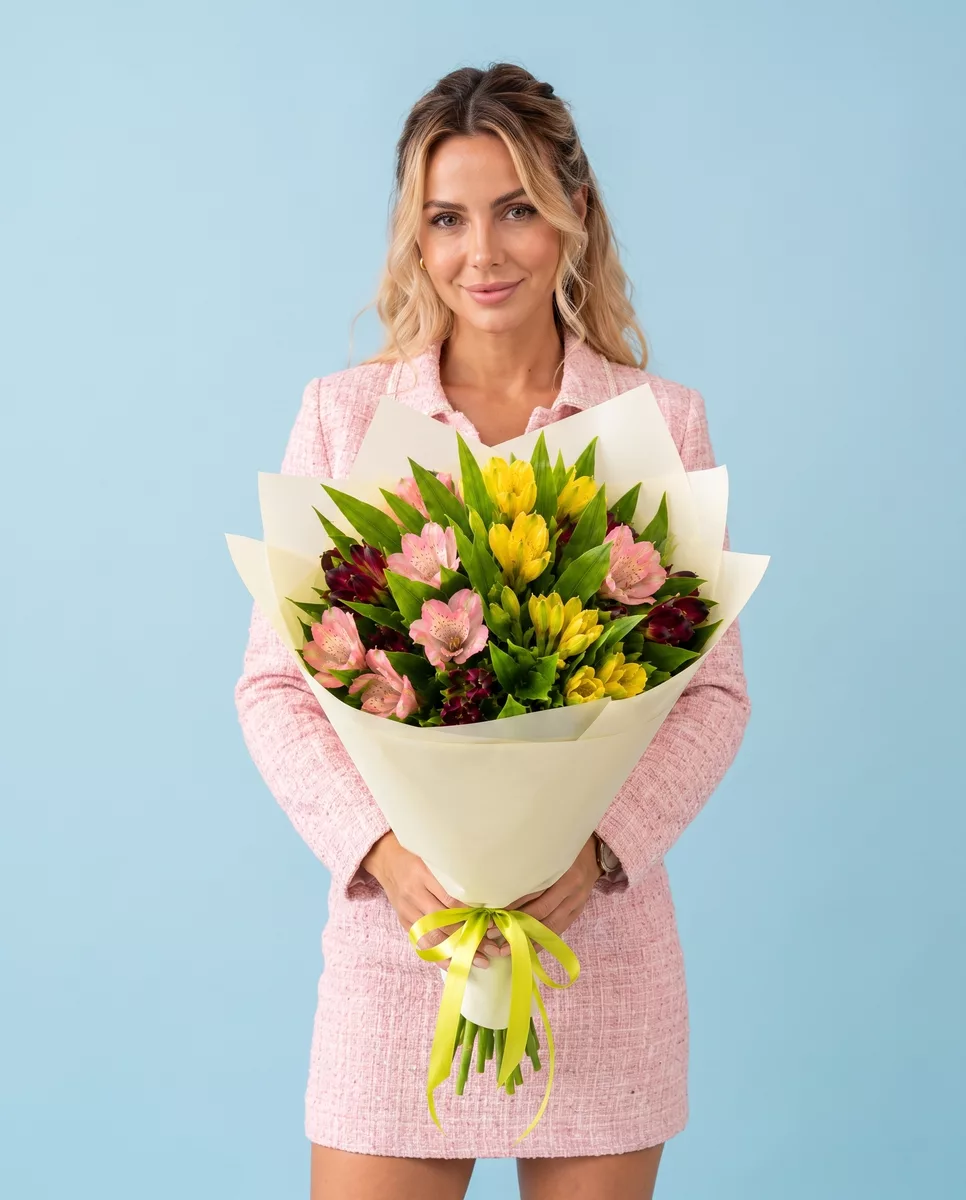
Color Associations Russians Actually Hold About Birthday Flowers
Red roses remain the most recognized romantic signal in Russia, so sending a bouquet of pure red roses to a female friend can read as a declaration rather than a birthday wish, depending on your relationship. This does not mean red is forbidden — red mixed with white, peach, or coral reads as celebratory rather than romantic, and most recipients interpret it that way without overthinking. White flowers carry no mourning association in Russia for birthdays the way they do in some other cultures; white roses, white lisianthus, and white ranunculus are perfectly standard in celebration bouquets. Yellow flowers had a strong negative association in Soviet-era folklore — yellow roses in particular were said to signal betrayal or separation — and while younger Russians in cities often dismiss this entirely, recipients over forty may still react to a solid yellow bouquet with mild unease. The safe approach is to mix yellow with other colors rather than building a monochrome yellow arrangement. Pink in all its shades — from pale blush to deep fuchsia — is universally safe and genuinely popular for female friends' birthdays. Orange and coral have grown significantly in popularity over the last five years, particularly in bouquets featuring garden roses, spray roses, and ranunculus. Purple and violet tones in flowers like lisianthus, statice, and certain tulip varieties read as elegant and are commonly requested for friends in their thirties and forties. Blue flowers are rare in nature and mostly appear in dyed arrangements; most experienced florists avoid dyed stems for birthday deliveries because the color fades unevenly within two days.
Seasonal Availability and What Actually Arrives Fresh
Russia imports the majority of its cut flowers through large distribution hubs, and Saint Petersburg receives fresh stock from the Netherlands, Ecuador, Kenya, and Colombia on regular freight schedules. What this means practically is that roses, chrysanthemums, alstroemeria, and standard carnations are available year-round with consistent quality. The seasonal variation shows up most sharply in garden-style flowers. Ranunculus are reliably available from January through May; after June the quality drops and by August most florists stop ordering them because they do not survive the transit temperatures. Peonies have a genuine season in Russia from approximately late April through June — during this window they are abundant and well-priced, but outside it they are either unavailable or imported at high cost with compromised vase life. Tulips are strong from February through April and are among the most requested birthday flowers during that window. Lisianthus is available most of the year but peaks in quality from spring through early autumn. If you are ordering in July or August and want something beyond standard roses, spray roses, and chrysanthemums, communicate that flexibility to the florist because the range of reliably fresh options narrows in summer heat. Deliveries in Saint Petersburg during summer need to account for temperatures that can reach 28–30 degrees Celsius; flowers sitting in a car for more than twenty minutes in that heat will show stress. Five Flowers uses refrigerated transport, but it is worth confirming this detail with any florist you use. Winter orders from November through February are actually easier for delicate varieties because ambient temperatures help rather than hurt.
Which Flower Varieties Work Best for a Friend's Birthday
Garden roses — the full, multi-petaled varieties such as David Austin-style roses sourced from Ecuador — are the most requested premium option for female friends' birthdays and justify the higher stem price because they look substantially different from standard long-stem roses. They work well in odd-number bouquets of eleven or fifteen stems, often mixed with eucalyptus, ruscus, or pittosporum for volume. Standard spray roses are a practical choice when budget matters; each stem carries multiple blooms, the vase life is excellent at seven to ten days with proper care, and they mix well with almost any other variety. Lisianthus — sometimes called eustoma — is a strong supporting flower that adds texture and a ruffled look without overpowering the arrangement; it is popular in bouquets aimed at friends who find roses too formal. Ranunculus in season are arguably the most photogenic birthday flower available, with layered petals that hold for five to seven days in a cool room. Chrysanthemums deserve mention because they are misunderstood: single-stem large chrysanthemums are associated with formal occasions and memorial use in Russia, but spray chrysanthemums in small clusters are common in everyday birthday bouquets and carry no such association. Tulips are straightforward and beloved, especially in mixed-color assortments; a bouquet of fifteen mixed tulips is a classic, unfussy birthday gift that most Russian women in their twenties through fifties receive warmly. Peonies in season need no supporting cast — five or seven full peonies with minimal greenery is a complete and impressive birthday bouquet by any measure.
Personal Touches That Make the Delivery Feel Thought Through
A handwritten card matters more than most international senders expect. Russians place real value on written words at celebrations — a birthday without some form of written greeting feels incomplete. When ordering remotely, write your message in the order notes exactly as you want it to appear, including punctuation. If you write in English and the recipient reads English, that is fine; if you want the message in Russian and you are not a native speaker, write it in English in the notes and ask the florist to translate it accurately rather than running it through an automatic translator, which often produces phrases that sound odd or overly formal. Packaging choice affects the first impression significantly. Kraft paper wrapping with twine reads as artisan and relaxed; cellophane wrapping with ribbon reads as more formal and traditional — both are appropriate, but they signal different things. For a close friend, the craft paper style tends to feel more personal. Some customers add a small box of chocolates or a candle to the order; this works well when the recipient lives alone or when you want the delivery to feel more like a gift set than a single item. Timing the delivery matters practically: most people prefer to receive birthday flowers before noon so they can enjoy them through the day and show them to anyone visiting. If the birthday falls on a workday and the friend works in an office, a delivery to the office between ten and noon is often the most memorable option — it creates a public moment that a home delivery does not. Confirm the delivery address format carefully, including apartment number, floor, and any door code, because failed deliveries on birthdays are the complaint we hear most often.
What to Check Before Confirming Your Order
The delivery address is the single most common source of failed or delayed birthday deliveries. Russian addresses require the city, street name, building number, apartment number, and often a door entry code or intercom number. If you are ordering from abroad and got the address from your friend in a chat message, double-check that the building number and apartment number are separate fields — Russian addresses sometimes include a corpus or building section number that looks like part of the apartment number but is not. Confirm the recipient's phone number is current and reachable, because the courier calls ahead in most cases. Ask specifically whether the delivery zone is covered within the promised time window; Five Flowers delivers across Saint Petersburg within one to two hours, but if your friend lives in a suburb or a newly developed district on the city edge, confirm this explicitly rather than assuming. Check what happens if the recipient is not home — a good florist will hold the bouquet in a cool environment and reattempt delivery rather than leaving flowers outside a door in summer heat. Verify the stem count in the final bouquet description before paying to confirm it is an odd number. If you are ordering roses, ask what variety — some shops substitute standard commercial roses for garden roses without notifying the customer when stock runs short. Read the care card policy: a quality florist includes written care instructions with every birthday delivery, which matters because many Russian apartments are kept quite warm in winter due to central heating, and flowers in a warm room need water changes every day to last well. Finally, screenshot or save your order confirmation with the delivery time window noted clearly.
Timing Your Order for Same-Day and Next-Day Birthday Delivery
Same-day delivery for birthday flowers in Saint Petersburg is realistic if you place the order before two in the afternoon for an evening delivery, or before noon for a midday arrival. Five Flowers operates same-day delivery with a one-to-two-hour window from order confirmation, which means a 10 AM order can reach your friend by noon and an order placed at 3 PM can arrive by 5 PM. The constraint is not logistics but flower preparation — a bouquet needs time to be assembled, conditioned, and wrapped properly, and rushing that process produces a bouquet that looks assembled in a hurry. For birthdays that fall on weekends or public holidays, order the day before if possible, specifying the delivery time for the morning of the birthday. Russian public holidays cluster around early January, late April through early May, and early November; florists are open during these periods but order volumes are high and same-day slots fill faster than on ordinary days. If you are ordering from a significantly different time zone — say, from the United States West Coast — keep in mind that when it is evening for you, it may already be the following morning in Saint Petersburg. A birthday delivery ordered at 9 PM Pacific time arrives as a next-day order in Saint Petersburg terms, which is fine as long as you account for it. Next-day orders allow more flexibility in variety choice because the florist can source specific stems that may not be in current stock. For particularly special varieties like full garden peonies in season or specific David Austin rose varieties, a next-day or two-day advance order gives the best chance of getting exactly what you want rather than a substitution.
Sending flowers to a friend in Russia from abroad is straightforward once you know the specific conventions — odd stem counts, the color considerations that actually matter by age group, and the seasonal windows for the varieties worth requesting. The practical checklist is short: confirm odd numbers, avoid solid yellow or solid red for a platonic friend, check seasonal availability for anything beyond roses and chrysanthemums, get the address details exactly right including the apartment and door code, and order before noon for same-day morning delivery. Everything else is preference. A well-chosen bouquet of fifteen spray roses in coral and white, delivered on time with a handwritten card, does more than an elaborate arrangement that arrives late or goes to the wrong floor. We deliver bouquets across Russia in 1–2 hours.
Frequently asked questions
Is it rude to send an even number of flowers to a Russian friend?
Yes, in Russian custom even numbers of flowers are associated with funerals and mourning, so sending an even-numbered bouquet to a birthday recipient creates an uncomfortable association. Always confirm the total stem count is odd — eleven, fifteen, nineteen, and twenty-five are common sizes. A reputable florist will apply this rule automatically for birthday orders, but it is worth verifying before you pay.
Can I send yellow flowers for a Russian birthday?
A solid yellow bouquet carries a historical association with betrayal or a relationship ending in Russian folklore, and recipients over forty may still react to it. Mixing yellow with white, orange, or coral removes this association entirely and reads as cheerful and celebratory. Yellow tulips in a mixed-color spring bouquet are completely standard and well-received, so the issue is monochrome yellow rather than yellow as a component.
What flowers are available in Russia in winter for a birthday delivery?
Winter is actually a reliable season for many varieties. Roses, lisianthus, alstroemeria, spray roses, and chrysanthemums are available year-round with consistent quality. Tulips begin arriving in good supply from late January through February. Ranunculus are available from January onward. The challenge is summer, not winter — ambient heat in July and August stresses delicate flowers during transit more than cold weather does.
How far in advance should I order birthday flowers for delivery in Saint Petersburg?
For standard varieties like roses and tulips, same-day ordering before noon works reliably for midday delivery. For specific premium varieties such as garden roses in particular colors, David Austin-style roses, or peonies in season, ordering one to two days ahead gives the florist time to source exactly what you want. Weekend and holiday birthdays benefit from a next-day advance order because same-day slots fill quickly during high-demand periods.
Should I write the card message in Russian or English?
Either works, depending on your friend's language preference. If you write in English and your friend reads English comfortably, an English message is personal and appropriate. If you want Russian text but are not a fluent speaker, write the message in English in your order notes and ask the florist to translate it — this produces more natural phrasing than automatic translation tools, which often generate formally correct but oddly stiff Russian sentences for birthday greetings.
Ready to send a bouquet?
Pick a city, choose the flowers, and we will hand them over with a photo confirmation.
Choose a city →