
Flowers Russian Graduates Receive at Vypusknoj: Varieties and Timing
Every June, Russian secondary schools hold Vypusknoj — a graduation ceremony and evening celebration that functions as prom, graduation dinner and family milestone rolled into one night. Flowers are not optional here. A graduate arriving without a large, well-composed bouquet would genuinely stand out, and not in a good way. Families living abroad — parents working in Berlin, grandparents in Tel Aviv, relatives in New York — call us regularly asking what to send, how big it should be, and whether roses are really the right choice. This article answers those questions with the specificity a working florist can offer.
What Vypusknoj Actually Is and Why Flowers Matter So Much
Vypusknoj literally means 'graduation day' and marks the end of the eleventh grade, the final year of Russian secondary school. Students are typically seventeen or eighteen years old. The day usually falls in late May or the third week of June, depending on the school's calendar and city. The ceremony itself happens at the school in the afternoon, followed by an evening banquet, dancing, and in Saint Petersburg specifically, the famous White Nights boat parade along the Neva. Flowers appear at every stage: teachers receive small bouquets from students as a collective gift, and graduates themselves are handed arrangements by parents, grandparents, and other relatives. The cultural expectation is that a graduate's bouquet should be large enough to be visible in photographs, structured enough to hold its shape through four to six hours of carrying, and composed of flowers that read as celebratory rather than everyday. A single supermarket bunch of ten carnations would be considered an embarrassment by most families. The bouquet is also a prop in dozens of photographs — school steps, city monuments, waterfront locations — so stem length, color saturation and overall silhouette matter practically, not just aesthetically. Florists working through Vypusknoj season see a sharp spike in orders starting ten days before the ceremony date, and same-day orders on the evening itself are common from relatives who miscalculated time zones or simply left it late.
Bouquets we can deliver


The Most Common Flowers in a Vypusknoj Bouquet
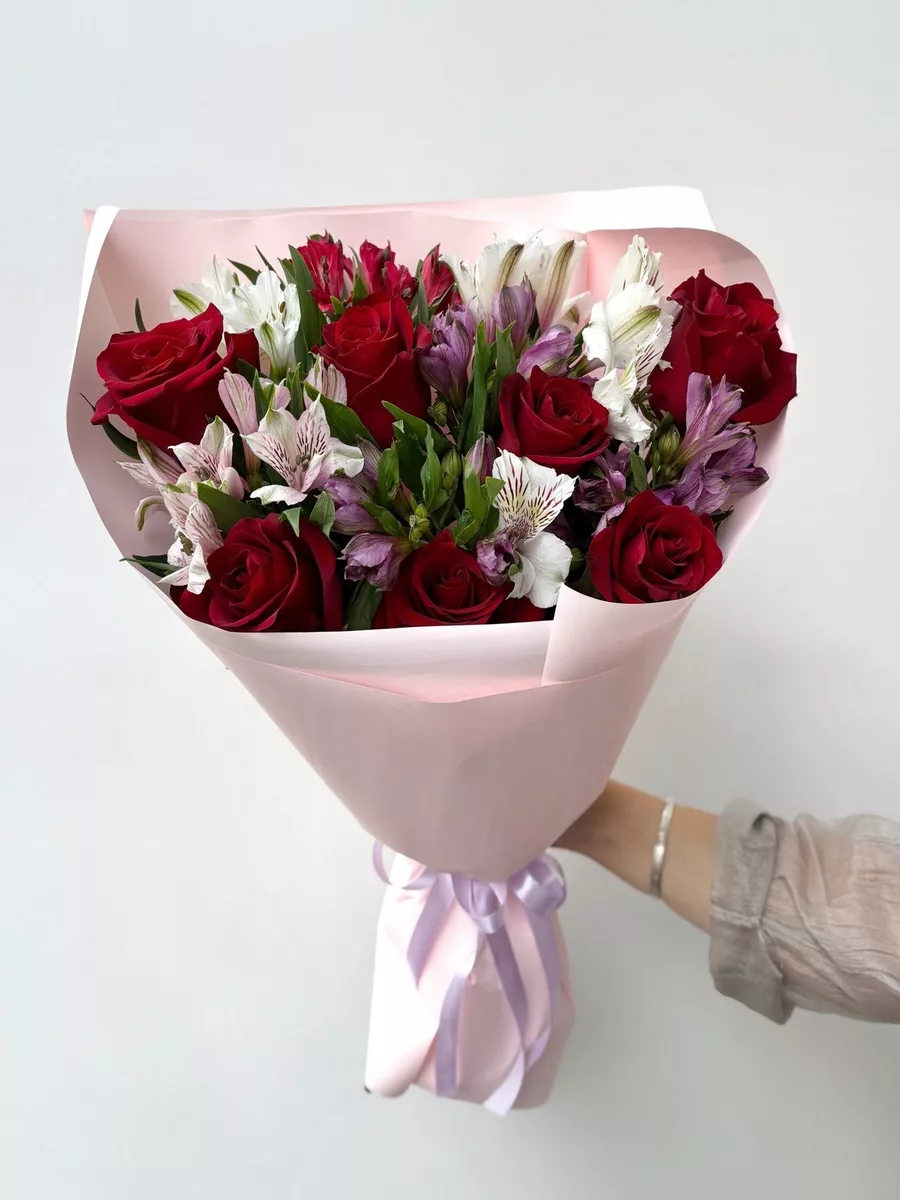
Roses dominate Vypusknoj bouquets in Russia, and the preference is strongly for large-headed varieties with long stems. Ecuadorian roses — grown at altitude and known for heads that reach six to seven centimetres in diameter — are the default choice for premium arrangements. White, cream, blush pink and red are the most requested colours, roughly in that order. Peonies are the second most popular flower when they are in season, which they reliably are in late May and early June. A peony-forward bouquet reads as luxurious and seasonal, and the large blooms photograph well. Ranunculus appear frequently as a supporting flower because their layered petals add texture without competing with the focal blooms. Eustoma, sometimes sold under the name lisianthus, is used as a filler that adds volume and a ruffled edge to compositions. Spray roses — smaller-headed roses on branching stems — are used to fill mid-range bouquets without increasing cost dramatically. Hydrangea appears in roughly a third of the arrangements we assemble for this occasion, usually in white or pale blue, because a single head fills significant visual space and keeps a bouquet looking full even when stem count is moderate. Tulips are less common at Vypusknoj than at, say, March 8th celebrations, but they do appear in bouquets for graduates who specifically request them or whose families want a lighter, spring-weight arrangement rather than something heavy and formal. Chrysanthemums are avoided by most florists for this occasion because they carry associations with mourning in Russian culture.
Bouquet Sizes and What They Signal
Russian graduation bouquets are categorised informally by stem count and overall diameter, and these categories carry social meaning that families abroad often underestimate. A small bouquet — fifteen to twenty-five stems — is considered appropriate from a classmate or a distant acquaintance, not from a parent. A medium arrangement of thirty to fifty stems is what most parents send when they want something respectable without going to excess. Large bouquets of sixty to one hundred stems are common from grandparents or from parents who want the arrangement to be a statement. Arrangements described as 'box bouquets' or 'hat-box arrangements' — flowers packed densely into a round box rather than wrapped in paper — have become fashionable in the last five years and tend to run between forty and seventy blooms in a compact, structured format that is easier to carry and photographs as a clean circle of colour. The round format also travels better in a car, which matters because graduates move between multiple locations during the evening. Cascade bouquets, where stems trail downward from a central mass, appear occasionally but are less practical for a long night of movement. When a relative abroad calls to place an order, the most useful information they can give us is their relationship to the graduate, because that single fact tells us the appropriate size range immediately. A bouquet from a parent that arrives at the same size as one from a classmate will be noticed and remembered.
Colour Choices and What Graduates Actually Prefer
White and cream remain the most requested palette for Vypusknoj, partly because they photograph cleanly against the formal dresses graduates typically wear, and partly because white reads as celebratory and clean across Russian cultural contexts. Blush pink and soft coral are a close second, particularly popular with graduates in their late teens who are choosing their own arrangements rather than receiving whatever a parent orders. Red roses appear in roughly one in five bouquets, usually ordered by older relatives who associate red with celebration and formality. Bright yellow, orange and fuchsia arrangements are less common but do appear, particularly for graduates who want something that stands out in a crowd of white and pink. Graduates who are heading to art school or design programmes sometimes request unusual colour combinations — burgundy and terracotta, for instance, or deep purple with white — and these tend to be ordered directly by the students themselves. Blue flowers are requested occasionally; we use delphinium or blue hydrangea for these orders, as truly blue roses do not exist despite what some online images suggest. Bi-colour compositions mixing white roses with pink peonies and green foliage are consistently the most popular single arrangement type we produce for this occasion, because the combination works in photographs under both natural White Nights light and indoor banquet lighting. Families ordering remotely should note that graduates who are wearing a specific dress colour often have opinions about flower colours, so asking the graduate directly before placing the order avoids the most common mismatch.
Timing the Delivery: When the Bouquet Must Arrive
Vypusknoj ceremonies in Saint Petersburg typically begin between eleven in the morning and two in the afternoon, with the school portion lasting two to three hours. The graduate needs to have the bouquet before the ceremony starts, not after, because the photographs on the school steps — which are among the most important images of the day — happen immediately after the official proceedings conclude. This means a delivery window of nine to eleven in the morning is the safest target for families ordering remotely. Evening deliveries do happen and are sometimes requested for the banquet phase, but they carry more risk: graduates are moving between locations, phone reception at venues can be unreliable, and a missed delivery on this particular evening is difficult to recover from. We deliver across Saint Petersburg within one to two hours of order confirmation, but on peak Vypusknoj dates — which cluster on specific Fridays and Saturdays in June — order volume is high and early booking is the practical solution. Families in different time zones should calculate the delivery window against Moscow time, which Saint Petersburg follows, and place the order the evening before if there is any uncertainty. Flowers for Vypusknoj should be kept at eight to twelve degrees Celsius until the moment of delivery; our drivers use temperature-controlled transport, but if a recipient is accepting a bouquet on behalf of the graduate, they should keep it away from direct sun and heat sources until the ceremony.
What Families Abroad Get Wrong When Ordering
The most frequent mistake is underestimating size. A family in Germany or the United States will often compare a Russian Vypusknoj bouquet to what they remember from their own school graduation and order accordingly — which produces something far too small for the occasion. Russian graduation bouquets are genuinely large by Western European standards, and arriving with something modest when classmates are carrying armfuls of flowers is uncomfortable for the graduate. The second common error is ordering too early in the wrong sense: placing an order weeks in advance without specifying a delivery date and time, then assuming the shop will work it out. We need a confirmed delivery address, a recipient phone number and a target delivery window, not just a date. The third mistake involves flower selection based on what is available in the country where the family is living. Sunflowers, for instance, are popular at summer celebrations in many countries but are not a standard Vypusknoj flower in Russia and can read as an odd choice. Gerbera daisies fall into the same category. If a family is unsure, asking for a florist's recommendation within a colour preference is always a better approach than specifying an unusual variety. The fourth issue is delivery address accuracy. Graduates often attend ceremonies at their school but receive family bouquets at home before leaving, or at the venue afterward. Confirming the exact address and the graduate's phone number — not just a parent's number — ensures the delivery reaches the right person at the right moment.
How to Place a Vypusknoj Order from Outside Russia
Ordering from abroad is straightforward if the information provided is complete. The shop needs the full delivery address including apartment number and entrance code if applicable, the recipient's mobile number with the Russian country code, the preferred delivery window in Moscow time, and any specific flower or colour preferences. Payment is processed in rubles and can be made by international card through the website. The order confirmation will come by email and includes a tracking update when the courier departs. For families who want to include a card message, the text can be written in English or Russian — we print and attach it to the arrangement. The card is the detail most often forgotten and most appreciated by graduates, particularly when the sender is far away. If the order is placed more than forty-eight hours in advance, it is worth confirming the delivery date again the day before, especially during the peak Vypusknoj weekend, when order volume is highest and any address or timing ambiguity should be resolved early. Families who are uncertain about flower availability on a specific date can contact us directly; June availability for peonies, for instance, depends on the season and the specific week, and we will say honestly if a requested variety is not going to be at its best. A substitute offered by the florist is almost always a better result than insisting on a flower that has passed its seasonal peak.
Vypusknoj is one occasion where the bouquet genuinely matters — to the graduate, to the family, and to the photographs that will be kept for decades. Getting it right from abroad means knowing the expected scale, choosing varieties that hold up through a long evening, and timing the delivery so the flowers arrive before the school steps photographs, not after. The families who call us having read nothing about Russian graduation customs and simply ask 'what would you send your own daughter' consistently end up with the right arrangement. That instinct — to ask the florist rather than guess — is the most reliable approach of all. We deliver bouquets across Russia in 1–2 hours.
Frequently asked questions
How far in advance should I order a Vypusknoj bouquet from abroad?
Placing the order one to three days before the ceremony date is ideal. Same-day delivery is available across Saint Petersburg within one to two hours, but on peak Vypusknoj Saturdays in June, ordering the evening before removes any timing risk. Always specify the delivery window in Moscow time when ordering from a different time zone.
Are peonies reliably available for Vypusknoj in June?
Peonies are generally in season during late May and the first two weeks of June in Russia, which overlaps well with most Vypusknoj dates. Availability depends on the specific week and the year's growing conditions. We recommend confirming peony availability when placing your order rather than assuming they will be in stock on a particular date.
What is a reasonable stem count for a bouquet from a parent?
A bouquet from a parent typically contains between thirty and sixty stems, depending on the flower variety and the family's preference. Roses and peonies with large heads can create a substantial arrangement at thirty-five stems; smaller flowers like spray roses or ranunculus need higher stem counts to achieve the same visual weight.
Can I write the card message in English?
Yes. We print and attach card messages in both English and Russian. Write the message exactly as you want it to appear when placing the order. If you would like the message translated into Russian, mention this in the order notes and we will handle it.
Why are chrysanthemums not recommended for Vypusknoj?
Chrysanthemums are strongly associated with funeral and memorial occasions in Russian cultural tradition. Sending them to a graduate would be considered an inappropriate choice by most Russian families, regardless of the sender's intentions. Roses, peonies, eustoma and hydrangea are all safe and well-received alternatives for this celebration.
Ready to send a bouquet?
Pick a city, choose the flowers, and we will hand them over with a photo confirmation.
Choose a city →