
Flowers for a Russian New Baby: Boy or Girl Colours, Timing and Varieties
Every week someone calls the shop and asks the same thing: 'I want to send flowers when my friend leaves the maternity hospital — what do I order?' The question sounds simple but it involves Russian customs that are not obvious to people outside the country, a delivery window that can close in under an hour, and flower choices that will either look exactly right or slightly off. This article covers the colour conventions Russians actually follow, the varieties that hold up during a doorstep handover, and the timing rules that prevent a bouquet from arriving to an empty flat.
Why Colour Matters More Than Usual at a Russian Birth
In Russia the colour of a newborn bouquet is read as a direct statement about the baby, and guests take it seriously. Arriving with the wrong colour does not cause offence, but it does create a small awkward moment — the kind that a florist hears about later. The convention is straightforward: pink shades for a girl, blue shades for a boy, and white when you do not yet know the sex or want to stay neutral. This is not a Soviet-era rule that has faded; it is still the dominant expectation in Saint Petersburg and across most Russian cities in the 2020s. The mother, her partner and the grandparents will all notice the colour immediately, often before they look at the flowers themselves. The convention also extends to ribbon and wrapping. A bouquet assembled in pink blooms but wrapped in kraft paper with a blue ribbon sends a mixed signal. Consistent colour throughout the packaging is what makes the arrangement read cleanly. At Five Flowers we match ribbon, tissue and outer wrap to the dominant flower tone precisely because of this. It is also worth knowing that very dark shades — deep burgundy, oxblood red, dark purple — are considered inappropriate for a birth gift in Russian culture. They carry associations that belong to other occasions. Keep the palette light and the saturation moderate, and the bouquet will be read exactly as intended.
Bouquets we can deliver



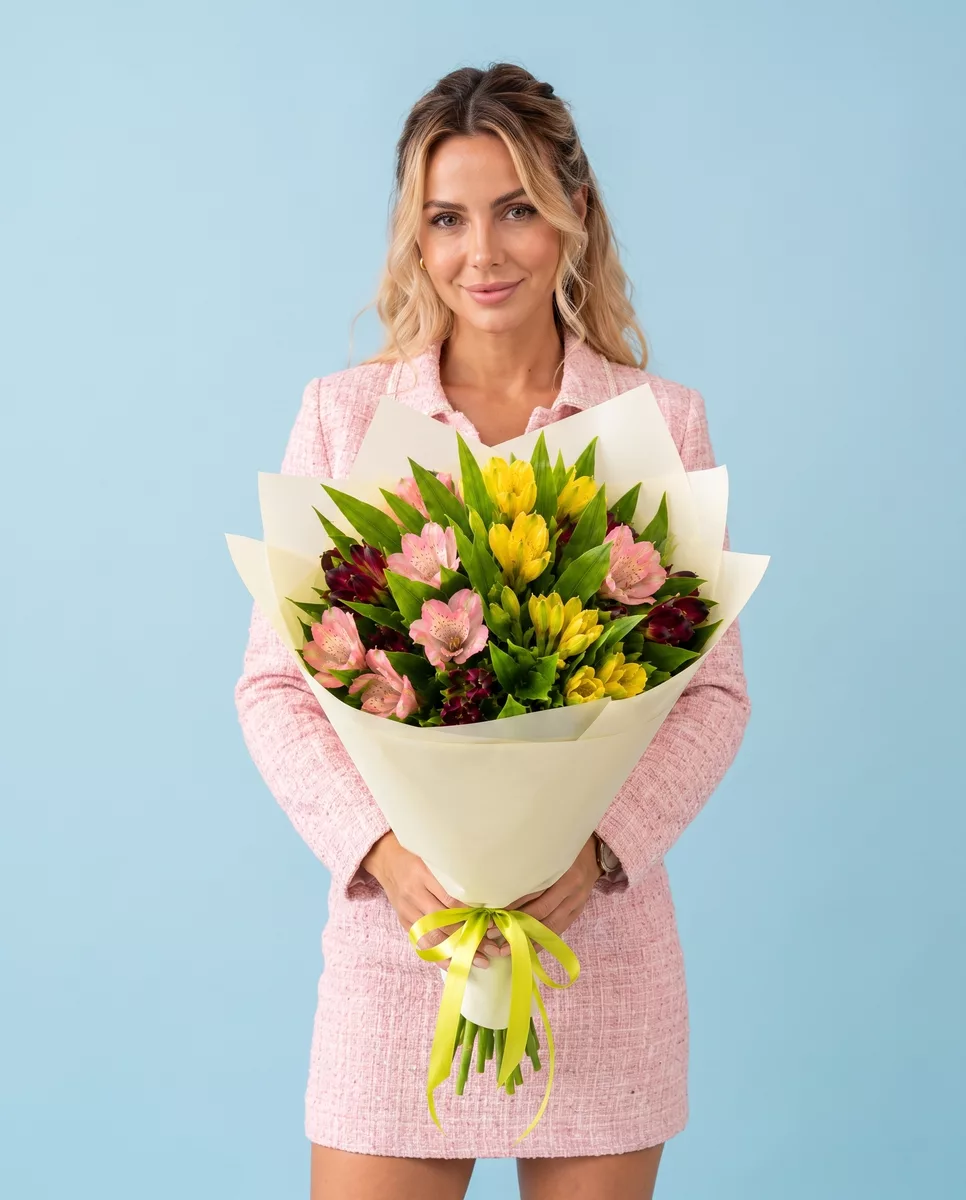
Pink Bouquets for a Girl: Varieties That Actually Work
For a girl the go-to palette runs from pale blush through soft rose to a warmer candy pink. The varieties that deliver this reliably are spray roses, standard roses in the Lovely Jewel or Aqua cultivars, pink lisianthus, pink ranunculus when in season, and pink alstroemeria for bouquets where longevity matters most. Spray roses are particularly useful here because their small clustered heads give a soft, layered look without requiring a large stem count, which keeps the arrangement manageable for a new mother who may be holding a baby. Ranunculus is a seasonal flower — available roughly from late winter through early spring in good volume — and its tightly packed petals photograph beautifully, which matters because birth bouquets are almost always photographed. Outside ranunculus season, pink lisianthus fills the same visual role with better vase life. Pink peonies appear in the question regularly, and they are a strong choice from May through June when Russian suppliers have them in volume. Outside that window, peonies are available but expensive and often not fully open on arrival, which disappoints. A reliable pink bouquet for a girl does not need to be large. Seven to nine stems of spray roses with eucalyptus or pittosporum as green filler, wrapped in blush tissue, is coherent and appropriate. Avoid mixing pink with white in equal proportions if you want the colour message to read clearly — white dilutes the signal and the arrangement starts to look like a neutral gift rather than a girl-specific one.
Blue Bouquets for a Boy: Working Around a Difficult Colour
Blue is the hardest colour to source in fresh flowers, and this is the single most common point of confusion when ordering a boy bouquet. Truly blue flowers are rare in the commercial cut-flower trade. Delphiniums give a genuine blue — from pale sky to deep cobalt — and they are the backbone of any boy bouquet assembled with colour accuracy in mind. Hydrangeas in blue and blue-violet shades are available year-round from Dutch growers and work well as a large focal flower. Agapanthus offers a blue-purple cluster that reads as blue in photographs and in person. Beyond these three, most flowers marketed as blue are actually violet or lavender, which is a different colour family. Irises in the Blue Magic or Professor Blaauw varieties are a practical choice and are widely available. The mistake buyers make is ordering a bouquet described as blue-themed without checking what that actually means for the shop. A bouquet of purple lisianthus and lavender roses is not a boy bouquet by Russian convention — it is a purple bouquet. When ordering, ask specifically for delphiniums or blue hydrangea as the dominant element. Foliage choices matter here too. Eucalyptus in its blue-grey form, brunia or dusty miller all reinforce the blue-cool palette without introducing warm green tones that pull the arrangement toward neutral. A boy bouquet assembled from delphiniums, blue hydrangea and eucalyptus with white accents reads unambiguously and holds well for two to three days in a cool room.
White Bouquets When You Do Not Know the Sex
White is the accepted neutral in Russian newborn culture and it carries no negative associations in this context — it reads as clean, celebratory and appropriate for either sex. This matters because not every buyer knows the baby's sex before ordering, and some parents choose not to share it in advance. White roses, white lisianthus, white spray roses and white chrysanthemum blooms in the Zembla or Bacardi varieties all work well. White ranunculus is excellent when in season. White tulips are a strong option from November through April when Dutch tulip supply is at its peak. The practical advantage of a white bouquet is that it is easier to assemble with consistent quality because white flowers are always in stock in high volume. A pink or blue bouquet depends on specific varieties being available on a given day; a white bouquet almost never has a supply problem. The one thing to discuss with the shop when ordering white is the foliage. A white bouquet with heavy dark green foliage can look funereal, which is the opposite of the intention. Ask for light green filler — soft ruscus, Italian ruscus, or pittosporum — and keep the proportion of green lower than the white. Adding a small amount of pale blush, very light lavender or pale yellow as an accent colour warms the arrangement without losing the neutral reading. White is also the right choice when the gift is going to a family that has not shared whether they follow the colour convention — it is impossible to get wrong.
Timing the Delivery Around Hospital Discharge
This is where most orders go wrong, and it is worth understanding why. In Russia, mothers are discharged from the maternity hospital in a specific ceremony called vypisnaya. The family gathers at the hospital entrance, photographs are taken outside, and then everyone moves to the home. The window between the mother leaving the hospital and arriving home is typically thirty to ninety minutes depending on traffic and distance. If a bouquet arrives before she does, it sits outside the door or with a neighbour. If it arrives too late, the celebration moment has passed. The reliable approach is to schedule delivery for approximately two hours after the confirmed discharge time and to the home address, not the hospital. Hospitals in Saint Petersburg do not accept flower deliveries for patients in maternity wards as a general rule, and attempting to deliver there creates complications. Confirm the discharge time the day before with the person coordinating the event, then place the order with that two-hour buffer built in. Five Flowers delivers within one to two hours of order placement across Saint Petersburg, which means you can place the order once you receive confirmation that the family has left the hospital and the bouquet will arrive at roughly the right moment. Have the recipient's phone number ready when ordering — the courier will call ahead, which is standard practice and prevents missed deliveries when the family is still in transit.
Temperature, Packaging and the Doorstep Handover
A newborn delivery has one physical constraint that most other deliveries do not: the recipient is holding or attending to a baby and cannot manage a loose, unwrapped armful of stems. Packaging matters practically, not just aesthetically. Bouquets for birth gifts should be assembled in a way that allows one-handed holding — a tight round shape with a clean stem base rather than a wide flat arrangement. Aqua packaging, where stems sit in a small water sachet secured at the base, keeps flowers fresh for the duration of delivery and is worth requesting for any order that will travel more than thirty minutes. Temperature is a real issue in both directions. In Saint Petersburg winters, flowers moving from a warm shop through freezing outdoor air and into a warm flat experience rapid temperature change. Roses and ranunculus are the most sensitive to this — petals that were firm in the shop can bruise during a cold transit. Our couriers use insulated packaging in winter months, but if you are ordering in January or February, mention that the delivery is a birth gift and ask about cold-weather wrapping. In summer, the risk is heat rather than cold. Flowers left in a warm car for more than twenty minutes begin to wilt at the stem. Delivery in summer should be scheduled for morning or early evening when temperatures are lower, and the recipient should be told to transfer stems to water immediately. A brief note with care instructions tucked into the packaging solves this without requiring a phone conversation at an already busy moment.
Common Mistakes and What to Ask the Shop
The mistakes that come up repeatedly in birth flower orders fall into a short list. First, ordering too early: a bouquet placed the day before discharge and held overnight loses a full day of vase life and often arrives already slightly past its best. Order on the day of discharge. Second, not confirming the delivery address: discharge ceremonies sometimes end at a grandparent's flat rather than the parents' home, and a courier sent to the wrong address creates a delay that is hard to fix quickly. Third, choosing flowers primarily for their appearance in photographs rather than their durability. Flowers that look spectacular in a florist's display — open garden roses, fully blown peonies, large open tulips — are often already at the end of their vase life. Ask for flowers that are at the bud or half-open stage, which means they will open beautifully over the following two to three days in the home. Fourth, skipping the message card. In Russian birth culture a written message is expected; arriving without one feels incomplete. Keep it brief — a sentence of congratulation and the sender's name is enough. Fifth, not specifying the baby's sex when placing the order. A shop that does not know whether to build around pink or blue will default to white or mixed, which may not be what you intended. When you call or order online, lead with the sex of the baby and the colour expectation — it takes ten seconds and eliminates any ambiguity about what arrives at the door.
Russian birth flower conventions are consistent enough that following them takes only a little knowledge and a well-timed order. Pink for a girl, blue built around delphiniums or hydrangea for a boy, white when the sex is unknown or you want to stay neutral — these three rules cover the vast majority of situations. The timing question is answered by building a two-hour buffer after confirmed discharge and ordering to the home address. The variety question is answered by asking for half-open stems rather than fully blown ones, and by matching foliage and wrapping to the dominant flower colour. Get those details right and the bouquet does exactly what it is supposed to do: arrive at the right door at the right moment, looking like it was chosen by someone who knew what they were doing. We deliver bouquets across Russia in 1–2 hours.
Frequently asked questions
Can I send flowers directly to the maternity hospital in Saint Petersburg?
Most maternity hospitals in Saint Petersburg do not accept flower deliveries for patients in the ward. The standard approach is to schedule delivery to the family home, timed to arrive roughly two hours after the confirmed discharge. This ensures the flowers are waiting when the mother and baby arrive rather than sitting unattended at a hospital reception desk.
What if I do not know whether the baby is a boy or a girl?
Order a white bouquet. White is the accepted neutral in Russian birth culture and carries no negative associations. White roses, white lisianthus or white spray roses with light green foliage read as celebratory and appropriate regardless of the baby's sex. Avoid heavy dark green foliage, which changes the tone of an all-white arrangement.
Are there flowers I should avoid for a newborn gift in Russia?
Avoid very dark shades — deep burgundy, oxblood red and dark purple — as these carry associations that do not suit a birth occasion in Russian culture. Also avoid flowers that are already fully open when they arrive, since they will last only a day or two in the home. Ask for bud-stage or half-open stems so the arrangement develops over several days.
How far in advance should I place the order?
Place the order on the day of discharge rather than the day before. A bouquet held overnight loses a full day of vase life. Once you receive confirmation that the family is leaving the hospital, place the order immediately. Five Flowers delivers within one to two hours across Saint Petersburg, so same-day ordering gives you precise control over arrival timing.
What is a reasonable stem count for a newborn bouquet?
Seven to eleven stems is practical for a birth gift. A new mother is often holding a baby and cannot manage a very large arrangement at the door. A tight round bouquet of seven to nine spray rose stems with foliage, or five to seven standard roses, is coherent and easy to handle. Larger arrangements work better as a gift brought in person rather than delivered by courier.
Ready to send a bouquet?
Pick a city, choose the flowers, and we will hand them over with a photo confirmation.
Choose a city →