
Flowers for a Russian Newborn: Sending to New Parents
Every week we take calls from people who have just heard a baby was born and want to send something beautiful within the hour. The questions are almost always the same: white or pink, roses or something softer, and can you actually get flowers into a maternity ward? This article answers all of that plainly, with the specific varieties and timing details you need to make the order without second-guessing yourself.
What Russians Traditionally Give When a Baby Arrives
In Russia, flowers for a newborn are not just a polite gesture — they are the expected first gift, sent before toys or clothes, and they arrive as close to the birth as possible. The tradition is rooted in the idea that the mother deserves celebration the moment the hard part is over, not a week later when she is already home and exhausted. Most families expect a bouquet to appear at the maternity ward within the first day or two, sometimes within hours of the birth announcement. The flowers are nearly always for the mother rather than the baby, though the colour and composition do signal something about the child. Roses are the default choice across Russia and have been for decades — they read as serious and generous, which matters when relatives and colleagues are watching what you send. Chrysanthemums, spray roses and lisianthus are common additions that add volume without competing with the main stems. Tulips appear frequently in spring deliveries because they are fresh and relatively affordable in season. What you almost never see at a Russian birth celebration are lilies with open blooms, because their heavy scent is considered unsuitable for a newborn's environment, and anything in dark red or burgundy, which carries associations with more formal or somber occasions. Stick to soft, clean compositions and you will not make a mistake.
Bouquets we can deliver



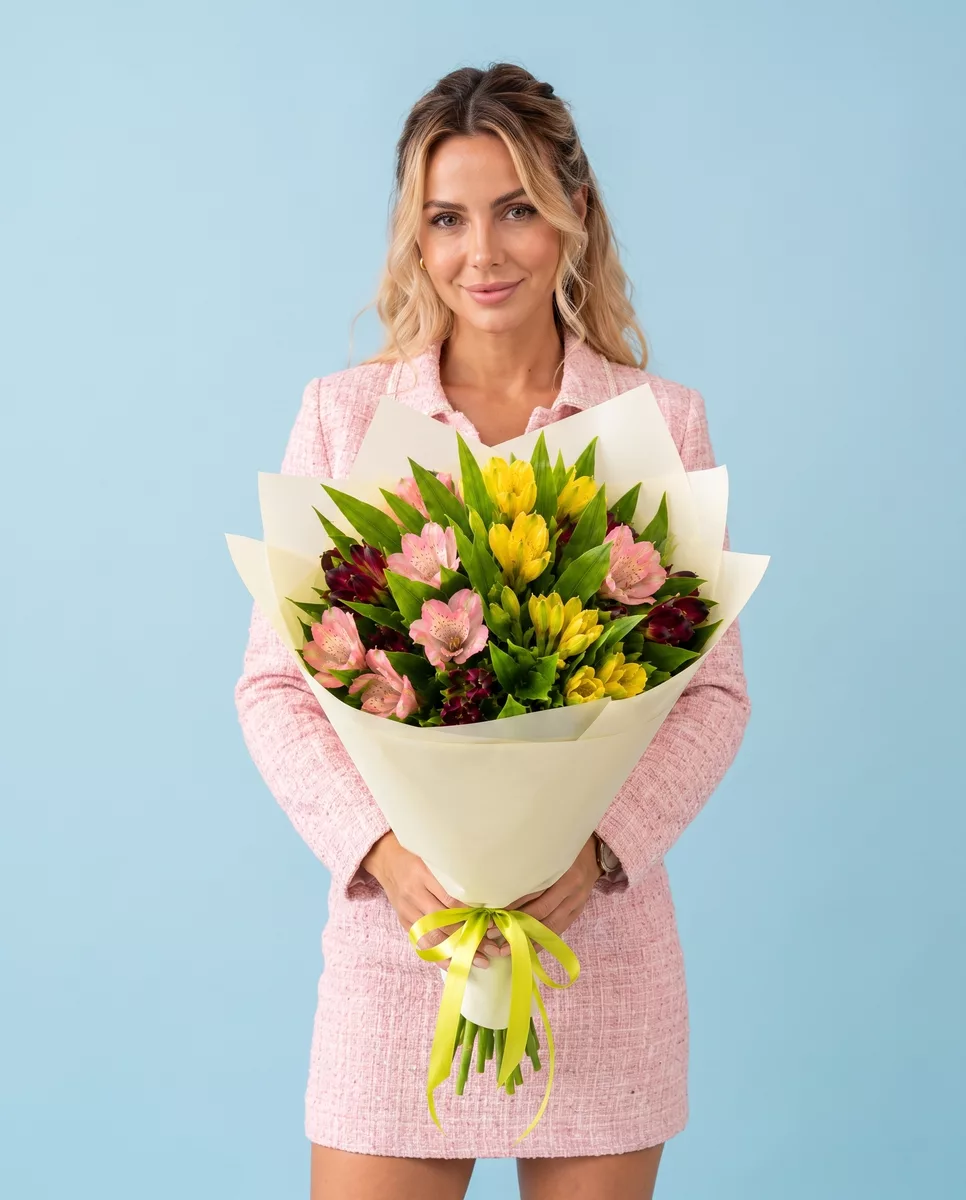
Pink for Girls, White for Boys: Understanding the Colour Logic
The colour conventions in Russia are nearly the inverse of what many Western buyers expect. Pink is firmly associated with girls, which matches international convention, but white and pale blue are the colours used for boys — not blue alone, and certainly not bold primary colours. In practice, most florists default to white for a boy because pale blue roses and spray roses do exist but are less reliably available year-round. White compositions are also considered the most elegant option regardless of the child's sex, so if you are not certain of the gender or simply want to play it safe, an all-white bouquet of garden roses, white lisianthus and white spray roses is always appropriate. For a girl, soft pink garden roses combined with pale pink ranunculus or pink spray roses is the standard choice. Peach tones sit in a middle ground that works for either, and some customers choose peach specifically when they want something warmer than white but are unsure of the colour rules. Avoid red roses entirely for newborn occasions — they are the flower of romantic love in Russian culture and will read as a strange or even inappropriate choice at a maternity ward. Avoid purple and deep violet for the same reason: those shades carry a formality that does not suit a birth celebration. The safest palette is always light: white, cream, soft pink, pale peach, and very occasionally the palest lavender for a girl.
Which Varieties Hold Up Best for Maternity Ward Delivery
A bouquet sent to a maternity ward faces conditions that most flowers are not designed for. Hospital corridors are warm and dry, rooms are often overheated, and the flowers may sit without fresh water for several hours if staff are busy and the mother has limited mobility. This means variety selection matters more than it does for a home delivery. Garden roses — the full-headed variety, not hybrid tea — are the most reliable choice because they are bred for longevity and open slowly over several days. Spray roses are similarly tough and add texture without wilting quickly. Lisianthus, sometimes called eustoma, is an excellent supporting flower: it looks delicate but is actually one of the hardiest cut flowers available, lasting up to two weeks in moderate conditions. Ranunculus are beautiful and popular for newborn bouquets but are more temperature-sensitive — they need to arrive in a well-hydrated state and will not tolerate a warm car or a long wait. Peonies, when in season, are a favourite because of their soft, layered look, but they open very fast in warmth, so they are best ordered when you know the bouquet will be received within a couple of hours. Avoid open-bloom oriental lilies completely — the scent is too strong for a room with a newborn. Freesia has a lighter fragrance that most people find acceptable, but if you are unsure whether the mother is sensitive to scent, stick to unscented varieties. Greenery like eucalyptus or ruscus extends the life of the arrangement and adds a clean, modern look.
Delivering to a Maternity Ward: What to Know Before You Order
Maternity wards in Russia operate on strict visiting rules, and these rules vary significantly between hospitals. Some wards in Saint Petersburg allow flower delivery directly to the room during set visiting hours, typically two windows of one to two hours each day. Others accept deliveries only at a reception desk, where staff hold the bouquet until the mother can receive it or a family member collects it. A small number of facilities, particularly those with stricter infection-control policies, do not accept fresh flowers on the ward at all and will ask the courier to leave the bouquet at the entrance. Before placing an order for maternity ward delivery, call the hospital's main reception and ask specifically about their current flower policy — this takes three minutes and prevents a wasted trip. When you place the order with us, provide the hospital name, the patient's full name, the ward number if you have it, and any visiting hour restrictions you have been given. Our courier will call ahead when approaching the hospital. It is also worth noting that the mother may be moved between wards — from delivery to postnatal — within the first twenty-four hours, so confirming her current location on the day of delivery is important. If direct ward access is uncertain, many customers choose to send flowers to the home address instead, timed to arrive within a day of the mother's discharge, which is usually three to five days after a standard birth.
Home Delivery After Discharge: Timing and Practical Details
Sending flowers to the home after discharge is often the more practical option, and it gives you more freedom with composition size and fragrance. The mother is usually home within three to five days of a standard birth, and the first week at home is when the most visitors arrive — which means a beautiful arrangement on the table matters to her more than you might expect. For home delivery, you can choose larger compositions and include flowers that need a vase, rather than the tightly wrapped hand-tied bouquets that work better for hospital settings. A wide-headed garden rose arrangement in a ceramic vase, or a mixed bouquet of peonies and lisianthus, makes a strong impression without being difficult to handle. Timing the delivery is straightforward: confirm the discharge date with the family and place the order for the morning of that day or the following morning, once she has had a night to settle. Avoid scheduling delivery for the very moment of arrival home — the family will be occupied with the baby, luggage and first feeds. A mid-morning slot, between ten and noon, tends to work well. Make sure someone will be at the address to receive the bouquet; if there is uncertainty, add a note to the order requesting the courier call ahead. Flowers left on a doorstep in summer heat or winter frost will not survive, and a second delivery attempt adds delay. Our delivery window across Saint Petersburg is one to two hours from order confirmation, which gives you precise control over timing.
Bouquet Size and Composition: What Actually Makes Sense
New parents are managing a lot, and an enormous bouquet that requires a large vase, daily water changes and careful placement away from the baby is not always the gift it appears to be. This is a real consideration, not a reason to send something small and forgettable. The practical sweet spot for a newborn bouquet is fifteen to twenty-five stems in a hand-tied format with a water-retaining wrap, which means the mother can place it directly in any container without fussing. If you want to send something more substantial, a pre-arranged bouquet in a box or a low ceramic arrangement is easier to manage than a tall vase piece in a household that is currently operating on no sleep. Single-variety bouquets — all white garden roses, or all soft pink spray roses — are currently very popular for birth occasions because they look intentional and expensive without requiring complex arrangement. Mixed compositions work well when the florist controls the palette tightly: white, cream and pale pink together reads as cohesive; adding yellow or orange breaks the softness of the occasion. Foliage choice also matters more than customers usually realise. Eucalyptus adds a clean, slightly medicinal scent that most people find pleasant and that complements a birth theme well. Ruscus and pittosporum are neutral and long-lasting. Avoid heavy tropical foliage like monstera leaves, which look dramatic in editorial photography but feel out of place in a domestic newborn setting. Ask us to keep the composition light and the palette consistent and we will handle the rest.
Common Mistakes When Ordering Newborn Flowers in Russia
The most frequent mistake we see is ordering too late. A birth announcement goes out, the buyer feels the urgency, then spends an hour comparing options online and places the order in the early afternoon — at which point the window for same-day maternity ward delivery may have already closed, depending on visiting hours. Place the order as soon as you hear the news, even if you need to adjust the delivery address later. The second common mistake is choosing flowers based on appearance in a photograph rather than seasonal availability. Peonies photographed in a studio look extraordinary, but if you order them in November you will receive a version that has been in cold storage for months and may open in a day. Ask us what is fresh that week and let that guide the composition. Third, many buyers forget to include the father or partner in the delivery note — the bouquet is addressed to the mother, which is correct, but a short handwritten message that acknowledges both parents is always appreciated. Fourth, some customers request strongly scented flowers — gardenias, tuberose, open oriental lilies — because they smell beautiful in a shop. In a maternity ward or a small flat with a newborn, strong fragrance can be genuinely uncomfortable. Keep the scent profile light. Finally, do not assume that a more expensive bouquet is automatically a better choice for this occasion. A tight, well-hydrated arrangement of twenty garden roses in a single colour will outlast and outperform a loose mixed composition twice the price that was assembled hours before delivery.
Sending flowers for a newborn in Russia is a specific act with real conventions behind it, and getting those conventions right takes about five minutes of preparation. Know the sex of the baby, confirm the delivery location and its access rules, choose varieties that will hold up in the conditions they are heading into, and place the order the moment you hear the news. Everything else — palette, composition, size — follows logically from those decisions. We handle newborn deliveries across Saint Petersburg every day and can advise on what is freshest and most appropriate at the time you call. The goal is always the same: a bouquet that arrives in good condition, looks genuinely beautiful, and tells the new mother that someone thought carefully before sending it. We deliver bouquets across Russia in 1–2 hours.
Frequently asked questions
Can flowers actually be delivered to a maternity ward in Saint Petersburg?
Yes, but policies differ between hospitals. Some allow direct room delivery during visiting hours, others accept bouquets only at reception, and a few do not permit fresh flowers on the ward at all. Call the hospital's main reception before ordering to confirm their current policy, then pass that information to us when you place the order so our courier knows what to expect.
What colour flowers do you send for a baby boy in Russia?
White is the standard choice for a boy in Russia, often combined with cream or very pale green foliage. Pale blue roses exist but are not always reliably in stock. Avoid pink, which is firmly associated with girls, and avoid red entirely. An all-white garden rose bouquet is the safest and most widely accepted option for a boy.
Are lilies appropriate for a newborn bouquet?
Open-bloom oriental lilies are not recommended because their scent is very strong and can be uncomfortable in a room with a newborn or in a maternity ward. Asiatic lilies have less fragrance and are occasionally used, but most florists working on newborn occasions avoid the lily family entirely and use lisianthus or garden roses instead for a similarly soft, layered look.
How far in advance should I order flowers for a new baby?
Order as soon as you hear the birth announcement. Same-day delivery to a maternity ward depends on visiting hours, which may close in the early afternoon, so a morning order gives you the most options. If you are sending to a home address after discharge, you have more flexibility, but placing the order the evening before the planned delivery date is still advisable to confirm availability of specific varieties.
Is it better to send flowers to the hospital or wait until the mother is home?
Both are appropriate, and many people do both. A hospital bouquet arrives at the most emotionally significant moment and is highly appreciated, but it needs to be compact and unscented to suit ward conditions. A home delivery gives you more freedom with size and composition and lands when the mother has more time to enjoy it. If you are uncertain about hospital access, home delivery is the more reliable choice.
Ready to send a bouquet?
Pick a city, choose the flowers, and we will hand them over with a photo confirmation.
Choose a city →