
Flowers for Russian Office Openings and Ribbon-Cutting Ceremonies
Every week someone calls us the morning of their ribbon-cutting asking whether a standard bouquet will do for a formal opening. It will not. Russian office openings follow a recognisable script — speeches, a scissors moment, photography, then a reception — and the flowers need to survive all four acts, look sharp under flash lighting, and still be standing when the last guest leaves four or five hours later. This article tells you exactly which arrangements work, which varieties hold up, and what to confirm when you place the order.
What Russian Office Openings Actually Look Like
A Russian office or retail opening typically runs in three distinct phases. First comes the official part: a short programme of speeches by management or local officials, sometimes a blessing by a priest if the owner requests it, and the ribbon cut itself. Second is the photography session, which in practice means ten to twenty minutes of posed shots with the ribbon, the scissors, and whatever floral arrangements are standing nearest the entrance. Third is a buffet or seated reception inside the new premises. Flowers are present at all three stages, which means they are not decorative afterthoughts — they are working props that appear in official photos distributed to press and social media. Russian business culture treats the opening as a statement of seriousness, so arrangements that look sparse, wilted, or casually assembled reflect on the company. Guests notice, and so do cameras. The outdoor ribbon-cut is the detail most foreign organisers underestimate. If the ceremony is in April, October, or November in Saint Petersburg, temperatures can sit between two and eight degrees Celsius, and some varieties — hydrangea in particular — will droop within thirty minutes of cold wind exposure. If the ceremony is in July or August, direct sun on dark-stemmed roses can cause petal curl within an hour. Knowing the outdoor conditions at your venue is the first piece of information a florist needs before recommending anything.
Bouquets we can deliver

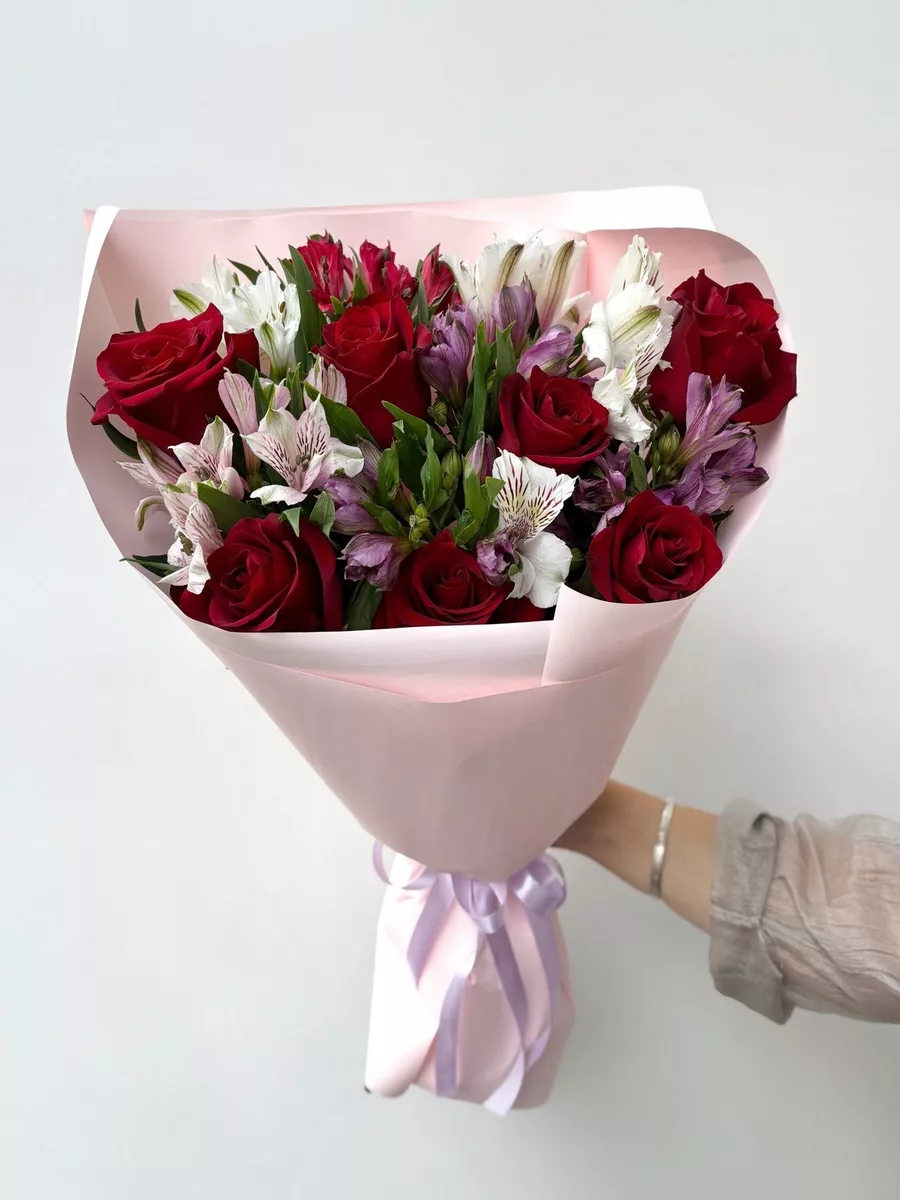

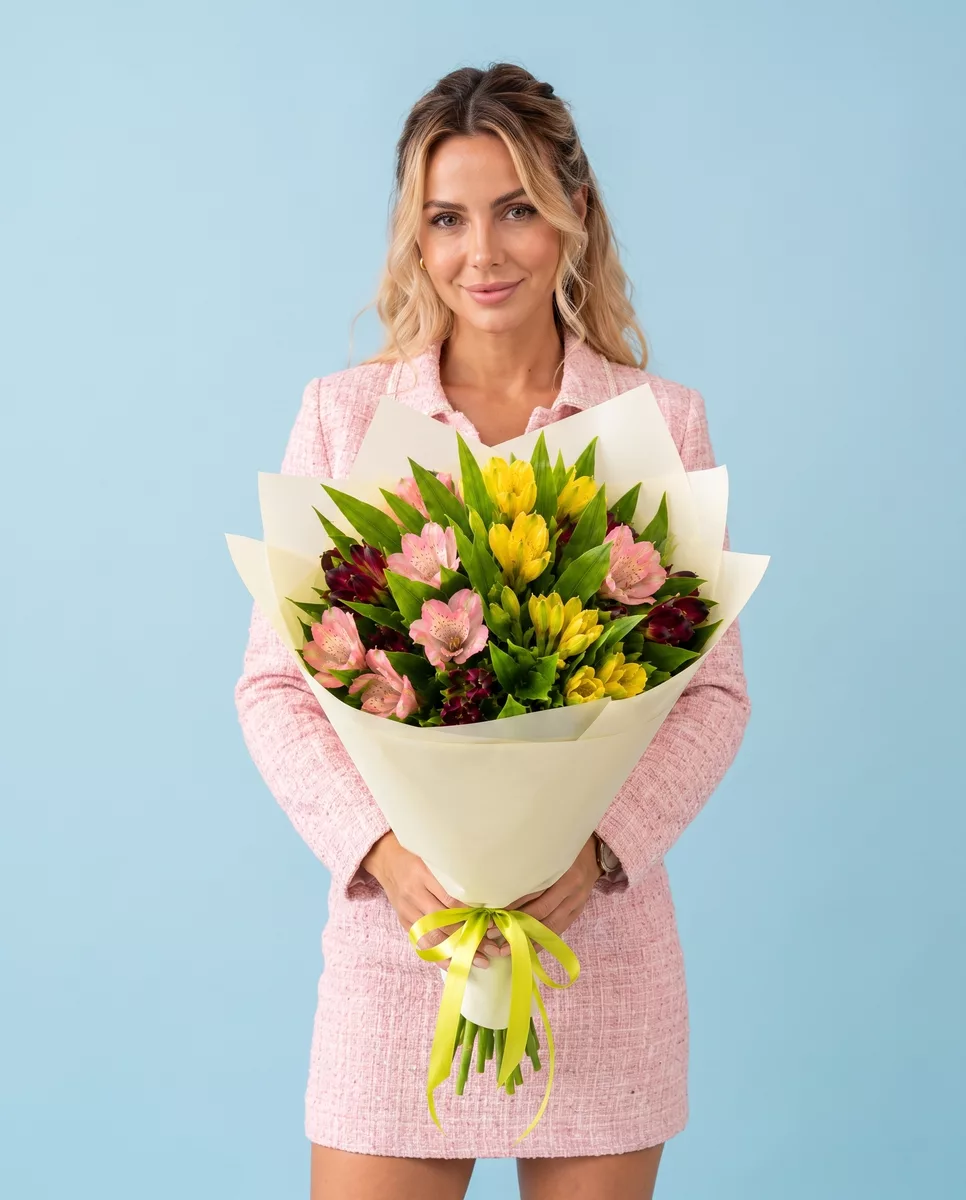
Arrangements That Photograph Well Under Event Lighting
Photographers at Russian openings typically work with two light sources: natural light outside during the ribbon cut, and mixed artificial light inside during the reception. Arrangements need to read clearly in both. The single biggest mistake is ordering flowers in pale cream or white when the backdrop is a white wall or a light-coloured banner — the bouquet disappears in photos. Deep red spray roses, burgundy calla lilies, coral gerbera, and orange ranunculus all hold contrast against neutral backdrops and reproduce well even with a phone camera. Column arrangements placed at either side of the ribbon are the most photographed element at any opening. These are tall, structured pieces — typically on a stand reaching 140 to 160 centimetres — built around a central flower with strong stems: large-headed chrysanthemums, eustoma, or standard roses in saturated colours. Avoid open peonies for column work: they are beautiful but drop petals under handling and look ragged by the time the photographer arrives. For the ribbon itself, a garland or swag of fresh greenery — eucalyptus, ruscus, or salal — with clusters of spray roses or alstroemeria attached at intervals gives the scissors shot a clean, intentional look. Alstroemeria is underrated here: it is dense, long-lasting, and holds its colour under flash. Table centrepieces for the reception inside should be lower than 35 centimetres so guests can see each other across the table, and should repeat at least one colour from the entrance arrangements to create visual continuity across the event photographs.
Varieties That Last a Full Event Day Without Refrigeration
An opening ceremony from setup to final guest departure typically spans six to eight hours. During that time the flowers will not be refrigerated, may be handled repeatedly for photographs, and will sit in rooms where heating or air conditioning is running. Choosing the wrong varieties means the arrangements look tired by the reception, which is exactly when guests are closest to them. Chrysanthemums — both standard single-stem and spray types — are the most reliable choice for all-day durability. They do not drop petals, they tolerate temperatures between 15 and 25 degrees Celsius without visible stress, and they come in white, yellow, bronze, and deep burgundy. Gerbera is similarly robust if the stems are cut correctly and placed in fresh water — it can hold for ten to twelve hours without wilting noticeably. Standard roses in bud stage rather than fully open will continue to open gradually through the day, which actually improves their appearance over time rather than degrading it. Avoid fully open garden roses, open peonies, and tulips for event work: tulips continue to grow after cutting and will bend toward light, changing the shape of any arrangement within two hours. Lisianthus, also sold as eustoma, is an excellent structural flower for formal work — it has a layered petal structure similar to a rose but lasts significantly longer once cut and is far less sensitive to temperature swings. For greenery, eucalyptus is reliable and adds a clean scent that does not compete with catering. Avoid heavily scented lilies indoors if the reception space is small — the fragrance becomes overwhelming.
Column Arrangements and Entrance Décor: Sizes and Quantities
The entrance is the focal point of any opening ceremony, and it requires more material than most clients expect. A standard office entrance — double doors, a width of roughly three to four metres — needs a minimum of two column arrangements flanking the doors and a garland or swag across the ribbon line. One column arrangement alone looks asymmetrical in photographs and reads as an afterthought. Each column piece requires a stand, a container, floral foam or a water-holding mechanism, and enough stem material to fill a sphere or cone roughly 50 to 60 centimetres in diameter at the top. That means 25 to 40 stems per column depending on the flower head size — chrysanthemums and gerbera fill space efficiently, while roses require more stems to achieve the same visual density. For a larger entrance — a retail flagship, a hotel lobby, or a government building — column arrangements often scale to 180 centimetres or taller, and a third central piece on a plinth is common. Russian corporate culture does not consider this excessive; it signals that the event was properly organised. The ribbon garland is typically two to three metres long and is constructed flat, then attached to the ribbon posts on arrival. It should be delivered already assembled and refrigerated until the last possible moment before the ceremony. If your venue has a reception desk or a welcome table near the entrance, a compact arrangement of 15 to 20 stems placed there anchors the interior and gives photographers a second natural focal point when they move inside after the ribbon cut.
Gifting Flowers at Russian Openings: What Is Expected
In Russian business culture it is standard for invited guests — partners, suppliers, local officials — to bring flowers when attending an opening. This is not optional etiquette; it is expected, and arriving without flowers or a gift is noticed. The practical consequence for the organiser is that a significant number of additional bouquets will arrive on the day, handed to whoever is managing the door or given directly to the director or owner. These bouquets need somewhere to go: water, containers, and a designated display area. If you are the organiser, it is worth requesting a half-dozen simple glass vases from your florist and designating a table near the entrance where incoming bouquets can be placed and displayed. This turns a logistical problem into an additional decorative element. The flowers guests bring tend to be traditional: roses in red, pink, or white are the overwhelming majority, followed by mixed bouquets with gerbera and chrysanthemums. Occasionally someone brings a potted orchid or a plant as a longer-lasting gift. If the opening is for a business where the director is known personally to many guests, expect bouquets to be large — 25 to 51 stems is common in Russian gifting culture, as odd numbers are the convention for celebratory occasions. Even numbers are reserved for mourning, so all bouquets you order for the event itself should contain an odd number of stems. This is one custom that is non-negotiable in Russian social settings and applies regardless of the industry or the formality of the event.
Timing Your Delivery for a Ceremony Day
The single most common logistical mistake at Russian openings is ordering delivery too early or too late. Too early — say, the evening before — and arrangements sit overnight without proper refrigeration in the venue, arriving at the ceremony already past their best. Too late — within an hour of the start — and there is no time to correct a damaged stem, replace a broken column stand, or add water to containers that have dried out in transit. The correct window for fresh arrangements is two to three hours before the ceremony start time. This gives the florist's team time to set up column pieces, attach the ribbon garland, fill containers with water, and do a final check of the entrance layout. It also leaves a buffer if traffic delays the delivery vehicle. In Saint Petersburg, morning deliveries between 8 and 11 a.m. move faster than midday deliveries, which is relevant if your ceremony starts at noon. If the ceremony is outdoors and the weather forecast shows temperatures above 22 degrees Celsius or below 5 degrees Celsius, the buffer should extend to three hours minimum so arrangements can be moved indoors if needed. Confirm with the venue that someone will be present to receive the delivery — a locked building with no contact on site is the most common cause of a delayed setup. Five Flowers delivers across Saint Petersburg and can reach most central and suburban venues within the delivery window, but the receiving contact and access details need to be confirmed when the order is placed, not on the morning of the event.
What to Check Before You Confirm the Order
Most problems at opening ceremonies trace back to details that were not confirmed at the ordering stage. Go through this list before you finalise anything. First, the ceremony location: indoor, outdoor, or both, and the expected temperature range at the time of the event. This determines which varieties are safe to use and whether the garland needs to be kept refrigerated until the last moment. Second, the backdrop colour at the entrance — white walls, dark wood panelling, glass, and branded banners all require different colour choices to ensure the arrangements read clearly in photographs. Third, the exact start time of the ceremony and the name and phone number of the on-site contact who will receive the delivery. Fourth, the number of guests expected, which helps size the reception table arrangements correctly — a 20-person reception and a 200-person reception need very different quantities. Fifth, whether any gifting bouquets need to be prepared for the organisers to present to officials or VIP guests during the ceremony. In Russian business openings it is common for the host company to present bouquets to local government representatives, partners, or the construction team that built the space — this is a visible, photographed gesture and the flowers need to match the quality of the main arrangements. Finally, confirm the odd-stem count on every bouquet. A florist who knows Russian customs will do this automatically, but it is worth verifying explicitly so there is no ambiguity on the day.
A Russian office opening is a formal public event with a clear sequence and real photographic stakes. The flowers are not background decoration — they appear in every official image from the ribbon cut, they are handled by guests, and they need to hold their shape and colour for the full duration. Choosing durable varieties, sizing the entrance arrangements correctly, timing the delivery to a two-to-three-hour window before the ceremony, and confirming odd stem counts on every piece are the practical steps that separate a well-organised opening from one that looks improvised in the photos. Place the order at least 48 hours in advance so there is time to source the specific varieties and build the column pieces properly. We deliver bouquets across Russia in 1–2 hours.
Frequently asked questions
How far in advance should I order flowers for an office opening in Saint Petersburg?
Order at least 48 hours before the ceremony. Column arrangements and ribbon garlands require construction time beyond standard bouquets, and specific varieties — particularly saturated-colour roses and lisianthus — need to be sourced in sufficient quantity. Last-minute orders risk substitutions that may not suit a formal event.
Why do Russian bouquets always have an odd number of stems?
Odd numbers are the convention for celebratory occasions in Russian culture; even numbers are associated with mourning and funerals. This applies to every bouquet at an opening — gifting bouquets, presentation bouquets, and arrangements for the reception table. A professional florist will count automatically, but it is worth confirming explicitly when ordering.
Can I use tulips or peonies for a ribbon-cutting ceremony?
Both are risky for event work. Tulips continue to grow after cutting and bend toward light, distorting arrangements within two hours. Open peonies drop petals under handling and look ragged quickly. If you want a similar aesthetic, closed-bud garden roses or lisianthus hold their shape far better across a full event day.
What is the standard size for column arrangements at a Russian office opening?
For a standard office entrance, column arrangements on stands typically reach 140 to 160 centimetres. Larger venues — hotels, flagship retail, government buildings — often use pieces up to 180 centimetres. Each column requires 25 to 40 stems depending on flower head size. Two columns flanking the entrance is the minimum; one alone looks unbalanced in photographs.
Should the reception table flowers match the entrance arrangements?
Yes, and specifically they should repeat at least one key colour from the entrance pieces. This creates visual continuity across event photographs taken in different parts of the venue. Keep centrepieces below 35 centimetres in height so guests can see across the table. Using the same variety in a smaller format is a clean, professional approach.
Ready to send a bouquet?
Pick a city, choose the flowers, and we will hand them over with a photo confirmation.
Choose a city →