
Flowers for a Russian Wedding: What Is Customary for the Bride, the Guests and the Table
A Russian wedding is one of the most flower-saturated events you will ever attend. From the moment the groom arrives at the bride's door to the last dance of the evening, blooms are everywhere — held, gifted, pinned, arranged and scattered across long banquet tables. If you are planning a wedding in Russia, or attending one for the first time, the floral side of the day can feel like a world of unspoken rules. Some of those rules are centuries old; others have shifted quietly in the last decade. As a florist who has put together hundreds of Russian wedding orders, I want to walk you through what is genuinely customary, what is changing, and what practical details — varieties, temperatures, timing — will make the difference between flowers that look stunning at midnight and flowers that gave up at nine.
The Bridal Bouquet: Shape, Colour and What the Numbers Mean
In Russia, the bridal bouquet is the single most discussed floral element of any wedding, and the conversation almost always starts with one rule: the number of stems must be odd. Even numbers of flowers are associated with mourning and are left at graves. This is not a superstition anyone takes lightly. When a bride unwraps her bouquet, she counts. Make sure your florist does too.
Beyond the count, Russian brides have traditionally favoured round, compact shapes — the classic posy or a tight dome of roses. White is still the most popular colour by a wide margin, followed by soft blush and cream. Ivory garden roses such as Patience or Keira, white ranunculus, white lisianthus and spray roses are workhorses of the Russian bridal bouquet. Peonies are wildly popular in May and June when they are genuinely in season; ordering them in November means accepting imported, cold-stored blooms that may not open as beautifully.
Cascade bouquets had a long run of popularity in the 1990s and early 2000s and are now considered slightly dated by younger brides, though they do still appear at more traditional ceremonies. The current trend leans toward a looser, garden-gathered look with eucalyptus, dusty miller or soft ferns woven through the roses.
One practical point that florists stress repeatedly: do not let the bouquet sit in a warm car. Between the registry office and the restaurant, flowers can lose a full day of freshness in thirty minutes of heat above twenty degrees Celsius. Keep the stems wrapped in damp paper and hold the bouquet upright.
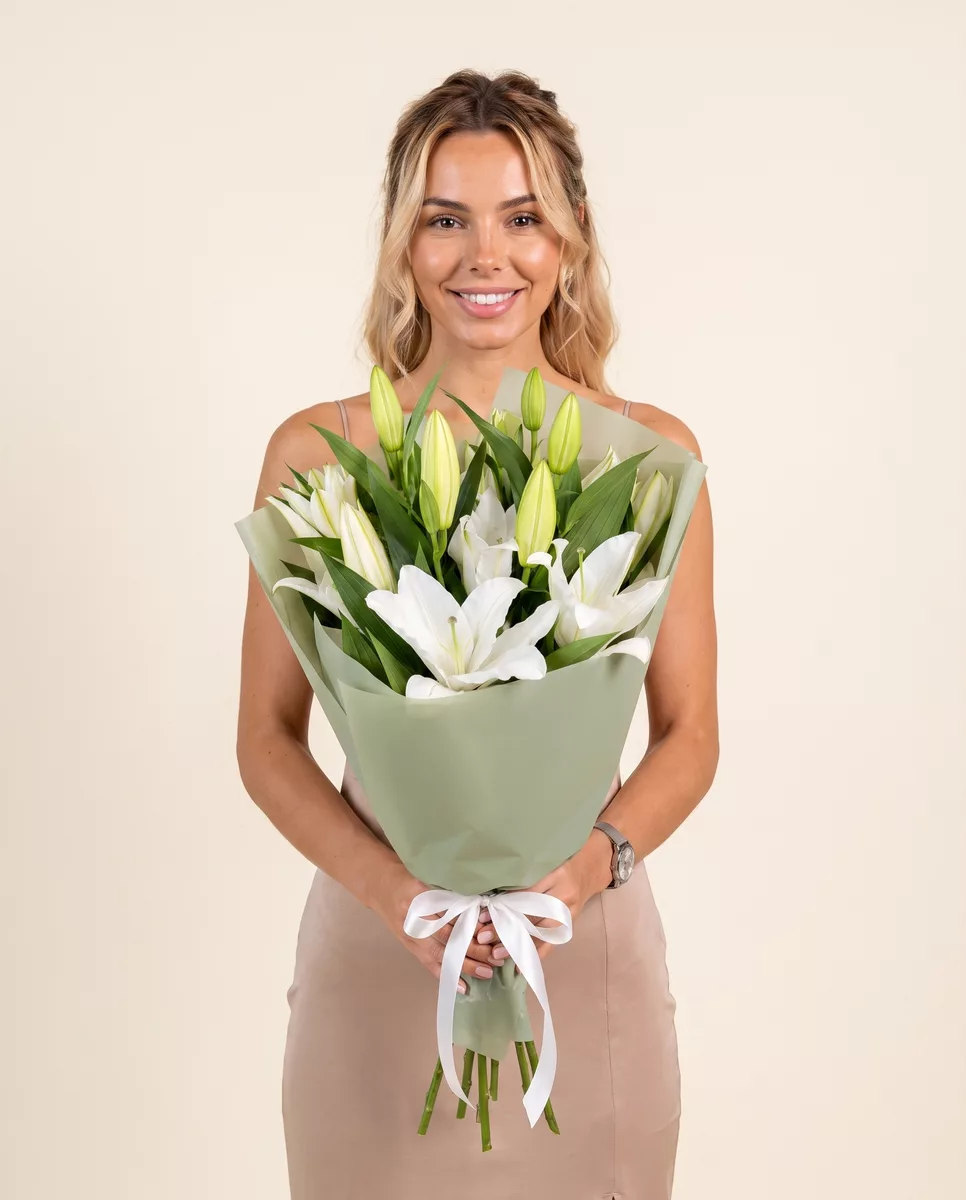
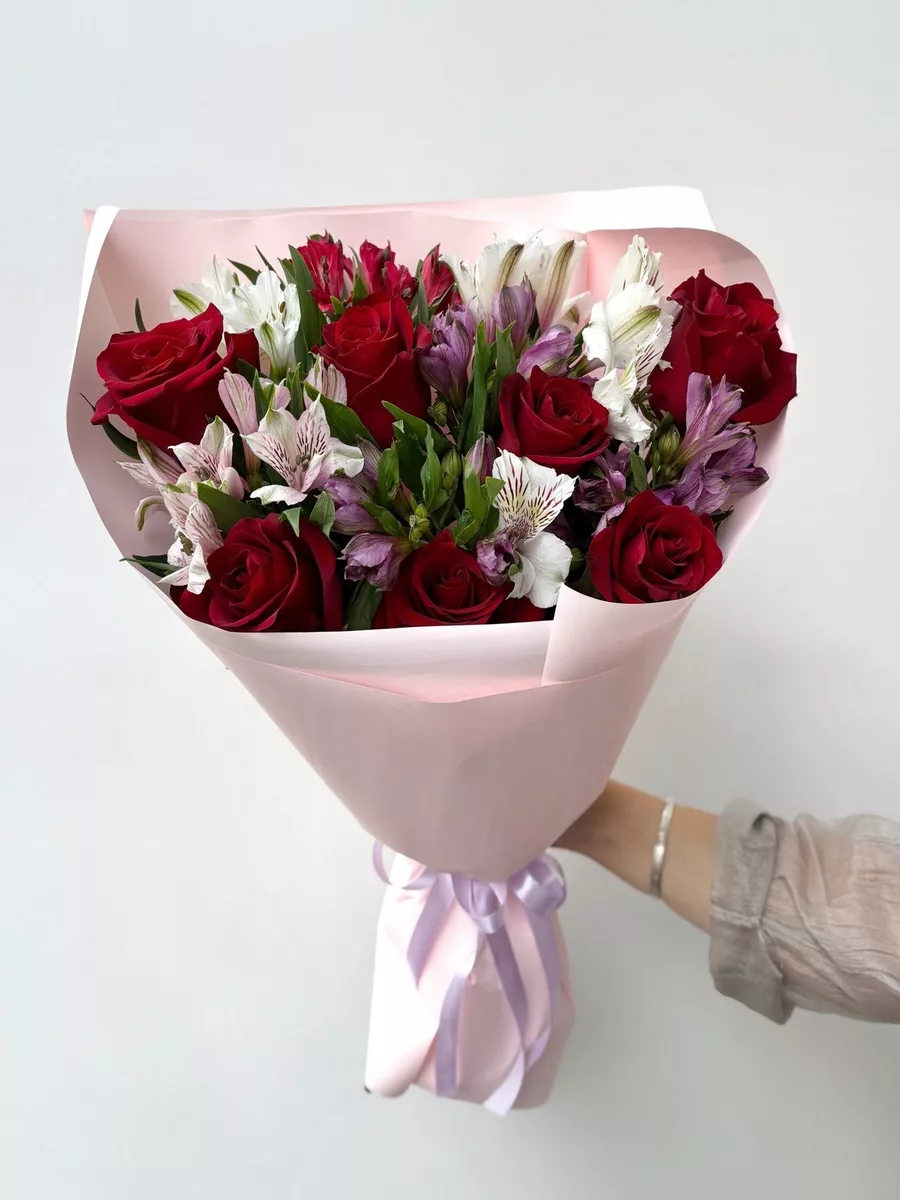
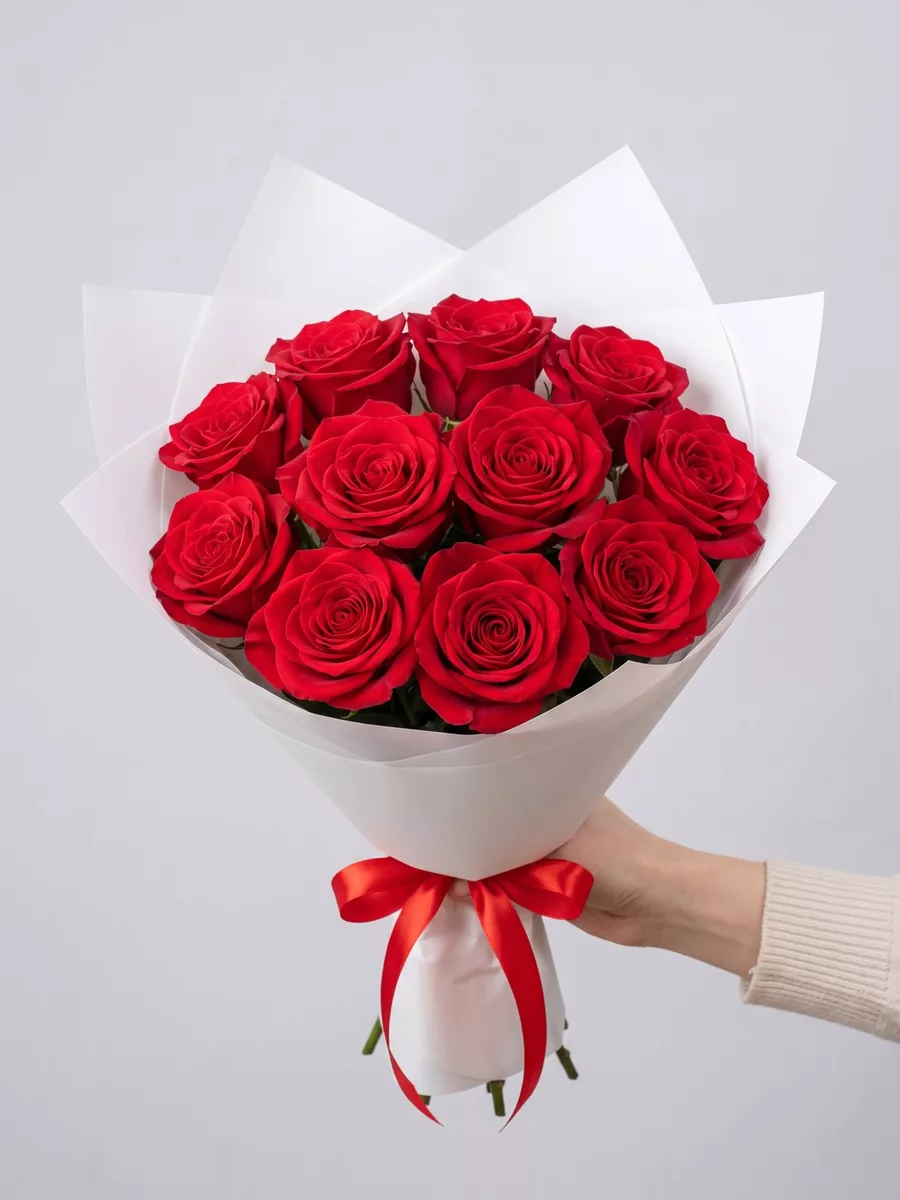
Bouquets we can deliver

What the Groom and Wedding Party Wear: Boutonnieres and Corsages
In Russian weddings, the groom traditionally wears a boutonniere that echoes — but does not exactly copy — the bride's bouquet. If she carries white garden roses and eucalyptus, his lapel might carry a single white spray rose with one small leaf. The match should feel intentional without being a miniature replica. Groomsmen typically wear simpler versions: a single stem of waxflower, a small ranunculus bud, or a sprig of hypericum berries depending on the season.
Bridesmaids, when the wedding includes them — and Russian weddings increasingly do, borrowing the tradition from Western ceremonies — often carry smaller versions of the bridal bouquet or single-variety posies. Matching is expected; coordination is the norm. A bridesmaid arriving with a bouquet of sunflowers when the bride is holding white peonies would stand out in the wrong way.
Mothers of the bride and groom are traditionally given wrist corsages or small pinned corsages. This is a moment that is easy to forget in the rush of ordering, and I would encourage every couple to include it deliberately. Roses, small orchids such as dendrobium, or a few stems of freesia work well for corsages because they are compact, hold their shape and do not wilt quickly when worn close to the body.
One mistake I see regularly: corsages ordered too far in advance and stored flat in a box. They need to be stored upright in a cool space — around five to eight degrees Celsius — and fitted no more than an hour before the ceremony begins. Pinning them too early causes bruising at the base of the petals.
Flowers as Gifts: The Guest's Unwritten Rulebook
Bringing flowers to a Russian wedding as a guest is not optional — it is expected, and arriving empty-handed would genuinely be noticed. The rules around what to bring are specific enough to be worth explaining carefully to anyone unfamiliar with Russian custom.
First, the odd-number rule applies here just as firmly as it does to the bridal bouquet. Guests bring odd numbers of stems: three, five, seven, eleven, fifteen. A round dozen is for funerals. If you are buying a bouquet from a shop, count before you leave.
Second, the flowers are usually given to the bride directly, often at the door of the venue or just after the ceremony. In more traditional settings, guests form a loose receiving line and present their bouquets one by one. The result is that the bride ends up holding an enormous armful of flowers by the time she reaches the reception table, which is both beautiful and logistically challenging. Most venues have a designated table or large vase near the entrance for this reason.
As for what to bring: roses remain the most common gift flower by a significant margin. Red roses are traditional and still widely given, though mixed bouquets of pink, white and blush tones have become equally acceptable. Chrysanthemums are common and not considered a lesser flower in Russia as they sometimes are in Western Europe. Tulips are popular in spring. Avoid bringing lilies with heavy pollen to an indoor venue — they stain clothing and the scent can overwhelm a small room.
Table Centrepieces: Height, Fragrance and the Space Between Guests
Russian wedding receptions are typically held at long banquet tables, and the centrepiece arrangement has to work within some real constraints. Guests sit close together. Conversations happen across the table. Toasts are frequent and glasses are raised often. A centrepiece that is too tall blocks faces; one that is too wide takes up the space where food should go.
The classic Russian wedding centrepiece sits in one of two zones: very low, no taller than twenty-five centimetres, so that it sits below the sightline entirely, or tall and narrow on a thin stem or candlestick so that it clears the eyeline above sixty centimetres. Anything in the middle — roughly thirty to fifty centimetres — is the awkward zone that forces guests to peer around it.
For low arrangements, compact flowers work best: garden roses, ranunculus, small dahlias in season, lisianthus and spray carnations. For tall arrangements, single-variety clusters of roses or hydrangea on elevated vessels are popular. Hydrangea is particularly efficient for large tables because a small number of stems creates a generous visual mass.
Fragrance is a genuine consideration. Freesia, hyacinth, lilac and oriental lilies are all strongly scented, and while they are beautiful, they can compete with food aromas in an enclosed room. Most experienced florists recommend keeping scented varieties for the entrance or ceremony space and using lower-fragrance flowers — roses, lisianthus, ranunculus, chrysanthemums — on dining tables.
All table flowers should be conditioned for at least twelve hours before the event and kept in water until the last possible moment before placement. A reception that starts at seven in the evening means arrangements should not be placed on dry tables before five at the earliest.
Seasonal Choices: What Is Actually Available When in Russia
One of the most common mistakes couples make when planning wedding flowers in Russia is choosing a favourite flower without checking whether it is genuinely available and in good condition during their wedding month. Russia imports a large proportion of its cut flowers, primarily from Ecuador, the Netherlands and Kenya, which means many varieties are technically available year-round — but available and beautiful are not the same thing.
Peonies are the clearest example. They are grown locally in Russia and are at their absolute peak from late May through June. During this window they are full, fragrant and long-lasting. Outside this window, imported peonies are often smaller, less fragrant and more prone to browning at the edges after a day or two.
Tulips are a spring flower and are most reliable from March through May. Dahlias are a late summer and early autumn flower, excellent from August through October. Ranunculus is best from late winter through spring. Roses, lisianthus and spray carnations are genuinely reliable throughout the year because they travel well from their growing regions.
For winter weddings — December through February — I recommend building around roses, white lisianthus, waxflower, eucalyptus and amaryllis. Amaryllis is dramatic, long-lasting and holds up beautifully in heated indoor venues where central heating can drop humidity significantly and accelerate wilting in more delicate blooms.
Always discuss your wedding month with your florist early, and ask specifically which of your preferred flowers are in natural season. The difference in quality between an in-season and out-of-season flower is something guests notice even if they cannot name it.
Timing and Logistics: When to Order and What Can Go Wrong
Flowers for a Russian wedding are not something to arrange in the final week. The larger the wedding, the earlier the process needs to begin, and there are specific timing windows that matter.
For a wedding with more than fifty guests, begin conversations with your florist at least four to six weeks in advance. This allows time to confirm seasonal availability, agree on colour palette and quantities, and place orders for specific varieties that may need to be sourced. For very large weddings — over a hundred and fifty guests — two to three months is not excessive.
The flowers themselves should be ordered from growers to arrive two to three days before the wedding. This gives time for conditioning: stems are cut at an angle, leaves below the waterline are stripped, and the flowers are held in clean water at around five to eight degrees Celsius. Roses in particular need this rest period to hydrate fully and open to the right stage — not a tight bud, not fully blown, but just beginning to open.
Delivery timing matters enormously. For a midday ceremony, flowers should arrive at the venue no later than two hours before guests are seated. For an evening reception, a mid-afternoon delivery gives florists time to arrange without rushing.
Common mistakes: ordering delivery for the morning of the wedding with no buffer time for adjustments; keeping flowers in a warm car between stops; placing arrangements on tables that have been set with candles already lit — the heat accelerates wilting noticeably. A good florist will walk through the venue layout with you and flag these risks before the day arrives.
A Russian wedding is a celebration that takes flowers seriously, and rightly so. The customs around odd numbers, the importance of the bridal bouquet, the expectation that guests arrive with blooms in hand — these are not formalities but genuine expressions of warmth and care. Understanding them means your flowers will feel right for the occasion, not just beautiful in isolation. Whether you are a bride choosing her bouquet, a guest wondering what to bring, or someone planning the table decor, the principles are the same: choose varieties that are honest to the season, respect the timing that keeps flowers fresh, and let the flowers do what they do best — make people feel that something important and joyful is happening. We deliver bouquets across Russia in 1–2 hours.
Frequently asked questions
Why do Russians always give an odd number of flowers at a wedding?
Even numbers of flowers are traditionally associated with mourning in Russian culture and are placed at graves. Odd numbers belong to celebrations. This rule applies to the bridal bouquet and to any flowers brought as a gift. Most Russian guests count the stems before purchasing, and a florist preparing a wedding order should always do the same.
Can a wedding guest bring any type of flower, or are some considered inappropriate?
Most cut flowers are welcome at a Russian wedding. Roses, tulips, chrysanthemums and mixed bouquets are all common and appreciated. The main things to avoid are strongly scented flowers like oriental lilies in a crowded indoor space, and yellow flowers in some more traditional families, who associate yellow with separation — though this attitude is much less common among younger generations.
How far in advance should wedding flowers be ordered in Russia?
For a wedding with up to fifty guests, four weeks is a comfortable minimum. Larger weddings benefit from six to twelve weeks of lead time, especially if you want specific varieties that require advance sourcing. Ordering early also protects you if your preferred flowers are in short supply around a popular wedding date such as a summer Saturday.
What flowers hold up best during a long Russian wedding reception?
Roses, lisianthus, spray carnations, chrysanthemums and waxflower are all reliable over a long evening. They tolerate the temperature changes between outdoor photo sessions and heated indoor venues better than more delicate flowers. Ranunculus and peonies are beautiful but need careful conditioning and a cool holding environment to last through a full reception.
Is it acceptable to have a non-white bridal bouquet at a Russian wedding?
Absolutely. While white and blush remain the most traditional choices, coloured bridal bouquets — deep burgundy, soft coral, lavender — are increasingly common and well received. The key in Russian wedding aesthetics is that the bouquet should feel polished and deliberate rather than casual. Colour is a personal choice; quality and presentation are what guests notice.
Ready to send a bouquet?
Pick a city, choose the flowers, and we will hand them over with a photo confirmation.
Choose a city →