
Flowers for a Russian CEO or Executive: What Actually Works
Customers who order flowers for a Russian chief executive often ask the same question at the last minute: will this look serious enough? A mixed bouquet of whatever is in season will not. Russian business culture places real weight on the quality of a gift, and a senior recipient will notice the difference between a thoughtful single-variety arrangement and something assembled in five minutes. This article covers the varieties that carry the right register, the packaging that matches a boardroom setting, and the exact phrasing that works on a card — based on what we see ordered, delivered, and occasionally sent back for revision.
Why Single-Variety Bouquets Signal Respect in Russian Business Culture
In Russia, a bouquet made entirely of one flower variety reads as deliberate and considered rather than assembled from leftovers. Mixed bouquets are common for birthdays among friends or family, but for a C-suite recipient they can feel casual or even careless. When a CEO or regional director receives a uniform arrangement of, say, fifty white peonies or thirty long-stemmed red roses, the message is that someone made a specific choice. That specificity is what registers as respect in a professional context. This is not a written rule anywhere, but it is consistent across the orders we handle for corporate clients and executive recipients in Saint Petersburg and across Russia. The logic is similar to dress code: a well-cut single-colour suit reads as more authoritative than a patterned one. Florists call this the discipline of the bouquet, and it applies directly to gifting upward in a hierarchy. When you are ordering for a person who runs an organisation, the bouquet itself should look like it was run by someone who knew what they were doing. A single variety, cut to a uniform length, wrapped without excess filler, accomplishes exactly that. It also photographs well, which matters because executive gifts in Russia frequently end up documented on company social media or internal communications. A bouquet that looks clean and intentional in a photograph carries the occasion further than one that reads as decorative noise.
Bouquets we can deliver



The Varieties That Work for Senior Recipients
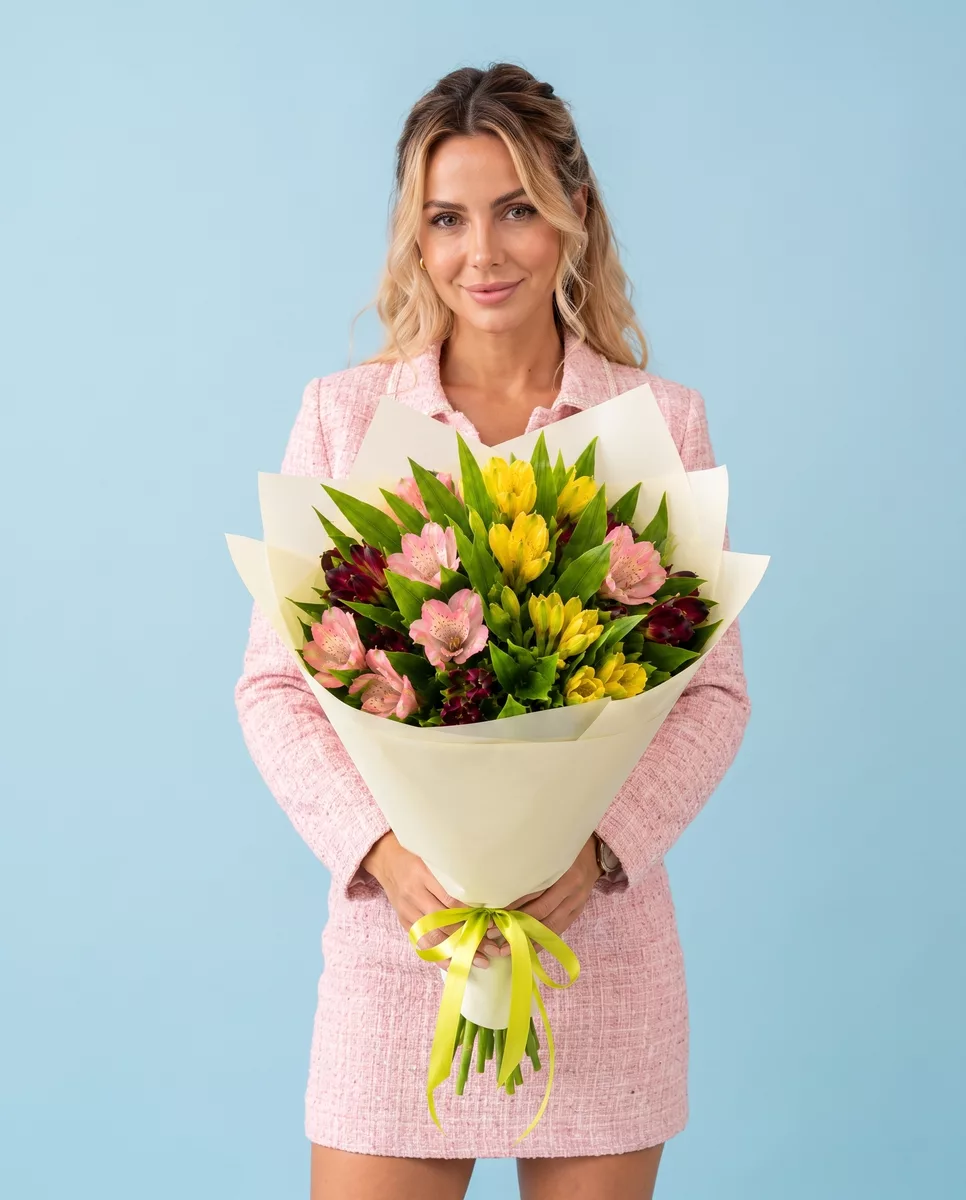
Not every flower carries the same weight in a professional gift. For male executives, long-stemmed red or white roses remain the most reliable choice, specifically large-headed varieties such as Explorer or Avalanche. These are grown to a consistent size, hold their form for several days after delivery, and are immediately recognisable as premium. For female executives, white or blush peonies when in season, white ranunculus arranged in a dense dome, or garden roses such as David Austin varieties — Juliet or Patience in particular — all read as sophisticated without being showy. Anthuriums in white or deep burgundy work well for a more architectural look that suits a modern office environment. Calla lilies, particularly white or champagne-coloured, are another strong option: they are long, structural, and require no filler to look complete. What to avoid is equally important. Chrysanthemums are strongly associated with funerals in Russian culture and should never appear in a gift for a living recipient under any circumstances. Carnations carry a Soviet-era association that many senior Russians still feel, even if they would not say so directly. Bright mixed tropical arrangements look festive rather than formal. Sunflowers, while popular in casual gifting, do not translate well to a boardroom. Stick to flowers that are either classically formal or quietly luxurious, and the variety itself will carry a significant portion of the message before anyone reads the card.
Stem Count, Proportions and What the Numbers Mean
In Russian gifting tradition, odd numbers of stems are for living recipients and even numbers are reserved for mourning. This rule is observed seriously, and breaking it — even accidentally — is a significant error. A bouquet of ten roses or twenty calla lilies will cause genuine discomfort regardless of how expensive the flowers are. Always order an odd number: eleven, fifteen, nineteen, twenty-five, thirty-one, fifty-one. For a senior executive, the stem count should also reflect the occasion's weight. Eleven stems is the minimum that reads as a considered gift rather than a token. Twenty-five to thirty-one stems is the range most commonly ordered for significant professional milestones such as a company anniversary, a promotion, or a deal closing. Fifty-one stems is appropriate for a major occasion — a landmark birthday, a significant award, or a long-term business relationship being marked formally. Beyond stem count, proportions matter. Roses for an executive gift should be on stems of at least sixty centimetres, ideally seventy to eighty centimetres. Short-stemmed roses look like they were bought at a petrol station. Long stems require a vase, which means the recipient has to engage with the gift and find a place for it — that engagement is part of the occasion. When you place the order, specify stem length explicitly. Do not assume the default will be long enough for a formal gift. Our team will confirm what is in stock at the time and advise on the closest available option if a specific length is not available that day.
Packaging That Matches a C-Suite Setting
The packaging of a flower gift for an executive is not decoration — it is the first thing the recipient sees and the context in which they interpret everything else. Kraft paper and twine are appropriate for a casual birthday or a farmers-market aesthetic. For a CEO, the packaging needs to match the environment it is entering: a corner office, a reception area, or a board meeting room. Matte or semi-matte wrapping in white, ivory, deep green, or charcoal reads as premium. Glossy cellophane reads as cheap regardless of what is inside it. A wide satin ribbon in a single neutral colour — white, champagne, or black — tied in a flat bow rather than a curled cluster adds structure without excess. Box arrangements are increasingly popular for executive gifts because they are self-contained, require no immediate vase, and sit on a desk or conference table without needing attention. A white hat box or a matte black rigid box filled with roses or peonies arranged in floral foam presents cleanly and is easy for a recipient to manage in a busy office day. When ordering, specify that the packaging should be corporate rather than celebratory. Those two words communicate a great deal to an experienced florist. Avoid balloon additions, glitter, or any packaging element that makes noise or movement. The bouquet should arrive looking like it belongs in the space it is entering, not like it wandered in from a birthday party.
Delivery Timing and Logistics for an Executive Recipient
Getting the timing right for a senior executive is more complicated than for a private address. Most CEOs and directors in Russia keep structured schedules with meetings stacked through the morning and early afternoon. A delivery that arrives during a meeting will sit at reception, potentially in a warm entrance hall, for an hour or more before it reaches the recipient. Flowers left in a heated lobby in winter, or near a window in direct summer sun, will deteriorate faster than you expect. Request a delivery window that aligns with a known break in the recipient's schedule — late morning around eleven, or mid-afternoon around three, are typically safer than nine in the morning or the middle of a working lunch. If you are delivering to a large company building, confirm the exact floor and department in advance. Reception staff at major Russian companies are accustomed to receiving deliveries but will not always alert the recipient promptly. Including the recipient's direct phone number in the delivery instructions — even if only used if there is a problem — reduces the chance of the bouquet sitting unclaimed. For same-day delivery, place the order before noon to allow enough time for the arrangement to be assembled properly rather than rushed. We deliver within one to two hours of order confirmation across Saint Petersburg, and we can coordinate delivery to office addresses in other Russian cities on the same timeline. Cold transport matters: roses and peonies should not travel in a warm vehicle, and we maintain refrigerated logistics for this reason.
What to Write on the Card: Wording That Fits Russian Business Norms
The handwritten card is where most people ordering for a Russian executive make their biggest mistake. Overly warm or personal language from a business contact reads as inappropriate in Russian professional culture, which tends to maintain a clear boundary between professional respect and personal familiarity. The correct register for a card accompanying an executive gift is formal, specific, and brief. Three to five sentences is ideal. Start with the occasion stated plainly: a congratulation on a company anniversary, a note of appreciation for a partnership, or a recognition of a specific achievement. Use the recipient's name and patronymic — this is standard in Russian professional address and skipping it, especially in a written note, signals unfamiliarity with local norms. For example: Уважаемый Александр Николаевич, which translates as Dear Alexander Nikolaevich. If you are writing in English for an executive who works internationally, the same principle applies: use the full name and title. Do not use first names only unless you have an established personal relationship. Close with a formal but warm phrase: Желаем дальнейших успехов, meaning Wishing you continued success, is appropriate and widely used. Avoid anything that sounds like it was copied from a greeting card template — executives notice generic phrasing. Keep the card handwritten rather than printed if at all possible. A printed card in a corporate envelope reads as an afterthought. A handwritten note, even brief, signals that someone took time. We offer handwritten card service with every order — specify the exact text when you place the order and we will write it clearly on quality card stock.
Common Mistakes and How to Avoid Them Before You Confirm the Order
The most frequent errors we see on orders destined for senior recipients fall into three categories: wrong flower choice, wrong number of stems, and insufficient delivery information. On flower choice, the chrysanthemum problem comes up more often than it should — customers ordering remotely, unfamiliar with Russian customs, select chrysanthemums because they are available and look substantial. They should not be used. On stem count, even numbers slip through when someone orders based on a round figure that sounds generous: twenty roses, thirty calla lilies. Always check the number is odd before confirming. On delivery information, orders to large office buildings frequently arrive with only the company name and street address. This is not enough. You need the building entrance number if there are multiple, the floor, the department or assistant's name, and a contact phone number. Without these details, a delivery in a large business centre can fail entirely or arrive an hour late because the driver spent time at the wrong entrance. Before you confirm any order for an executive recipient, run through this checklist: the variety is appropriate, the stem count is odd, the stems are long enough, the packaging is specified as corporate, the card text is written out in full, and the delivery address includes floor and contact name. These five checks take two minutes and prevent the majority of problems we are asked to fix after the fact. A gift for a senior recipient has a narrow window to make its impression — the logistics need to support the flowers, not undermine them.
Ordering flowers for a Russian CEO or executive is not complicated, but it is specific. The variety, the stem count, the packaging, the card wording, and the delivery timing all carry meaning in a professional context, and getting any one of them wrong can undermine an otherwise well-intentioned gesture. Single-variety bouquets in appropriate varieties, packaged without excess, delivered on time to a confirmed address, with a formally worded handwritten card — that combination works consistently. It works because it signals that the sender understood the occasion well enough to make deliberate choices rather than convenient ones. That signal, in Russian business culture, is the gift. We deliver bouquets across Russia in 1–2 hours.
Frequently asked questions
Can I send flowers to a male Russian executive, or is it only appropriate for women?
Flowers for male executives are entirely normal in Russian business culture, particularly for significant occasions such as a company anniversary, a major deal, or a milestone birthday. Long-stemmed red or white roses in an odd number, packaged formally, are the standard choice. The key is keeping the arrangement structured and avoiding anything that reads as decorative or casual.
What is the minimum stem count that looks serious for a CEO gift?
Eleven stems is the practical minimum for a gift that reads as intentional rather than token. For a significant professional occasion — a promotion, a major anniversary, or a long-term partnership being marked — twenty-five to thirty-one stems is more appropriate. Always confirm the number is odd before placing the order, as even numbers carry mourning associations in Russian tradition.
Is it acceptable to send flowers to a Russian executive's office rather than a home address?
Office delivery is standard and often preferable for a professional gift, as it acknowledges the professional context of the relationship. Provide the floor, department name, and a contact phone number along with the street address. Large business centres in Russian cities have multiple entrances and busy reception desks, so detailed delivery information is essential for the bouquet to arrive correctly.
Should the card be written in Russian even if I do not speak Russian?
If the executive works primarily in Russian, a card in Russian is more appropriate and will be better received. We write handwritten cards in Russian as part of our order service — provide the exact text or key points in English and we will compose and write the card in the correct formal register. For executives who work internationally, an English card is acceptable if the relationship is conducted in English.
How far in advance should I order for a delivery to arrive at a specific time at a large office?
For a timed delivery to a corporate address, place the order at least three to four hours before the required arrival time. Same-day orders placed before noon can be fulfilled within our standard one-to-two-hour delivery window. For particularly important occasions, ordering the evening before and scheduling a morning delivery gives the most reliable outcome and allows us to source specific varieties if needed.
Ready to send a bouquet?
Pick a city, choose the flowers, and we will hand them over with a photo confirmation.
Choose a city →