
Sending Flowers to Russia: The Odd Number Stem Count Rule
Every week someone calls us after placing an order to ask whether we can just add one more stem or remove one — and the reason is almost always the same. They have just learned, usually from a Russian friend or a quick internet search, that bouquets in Russia must contain an odd number of flowers. This is not a florist preference or a style trend. It is a deeply held cultural rule, and handing someone an even-numbered arrangement is considered inappropriate for a celebration. If you are sending flowers to Saint Petersburg, Moscow, Novosibirsk or anywhere else in Russia, understanding this rule before you reach the checkout screen will save you a last-minute phone call and make sure the bouquet lands exactly as intended.
Where the Rule Comes From and Why It Still Matters
The association between even numbers of flowers and mourning runs through Russian culture the way it runs through many Slavic traditions. An even number of stems — two roses, four tulips, ten mixed stems — is reserved for laying at graves or presenting at memorial services. An odd number signals life, celebration and goodwill. This distinction is not fading with younger generations the way some older customs do. Florists in Saint Petersburg and Moscow still receive firm requests every day to recount bouquets before wrapping, and recipients in their twenties notice an even count just as readily as recipients in their sixties. The rule applies regardless of the flower variety. A single-variety bouquet of fourteen ranunculus is just as much a problem as a mixed arrangement of twelve stems. It does not matter whether the flowers are expensive or modest, imported or locally grown, wrapped in kraft paper or boxed in a hat box. The count is what matters. For anyone ordering from outside Russia, this is the single most common mistake we see, not the wrong colour, not the wrong variety, but an even stem count that slipped through because the sender was thinking in round numbers. Round numbers almost always mean even numbers. Ten, twelve, twenty, fifty — all of these feel natural when you are typing a quantity into an order form, and all of them are wrong for a Russian recipient. The habit of thinking in odd numbers takes a small adjustment, but once you know it you will never forget it.
Bouquets we can deliver



Which Odd Numbers Are Actually Used in Practice
Not every odd number works equally well in practice, and knowing the realistic range helps you choose a bouquet size that looks intentional rather than arbitrary. The most common stem counts we assemble are three, five, seven, nine, eleven, fifteen, nineteen, twenty-one, twenty-five and thirty-one. Three stems is the minimum for anything that reads as a proper bouquet rather than a token gesture, and it works well for compact varieties like garden roses, peonies or large-headed dahlias where a single bloom already carries visual weight. Five and seven stems are the most popular range for everyday deliveries — a five-stem bouquet of spray roses or alstroemeria is affordable, travels well and photographs cleanly. Nine and eleven stems move into mid-range territory and suit mixed arrangements where you combine a focal flower with a secondary variety and some greenery. Fifteen and nineteen stems are where premium single-variety bouquets typically sit — fifteen long-stemmed ecuadorian roses, for example, or nineteen white lisianthus. Twenty-five and thirty-one are statement counts, often chosen for birthdays with a significant number, anniversaries or professional congratulations. One number that catches people out is thirteen. It is technically odd, but many customers and some recipients find it uncomfortable for reasons unrelated to the mourning rule — a general unease around the number itself. We do not refuse to make a thirteen-stem bouquet, but we always mention the option to go to fifteen instead. Anything above thirty-one tends to be ordered by stem weight or by the box rather than by individual count, which sidesteps the issue entirely.
How the Rule Applies to Mixed Bouquets and Arrangements
Mixed bouquets raise a question we get almost daily: does the rule count every single stem including filler and greenery, or only the focal flowers? The honest answer is that Russian florists and customers almost universally count only the flowering stems, not the eucalyptus, ruscus, pittosporum or other foliage that fills out the shape. If you order a bouquet described as fifteen roses with eucalyptus and wax flower, the count that matters is fifteen — the roses. The supporting material is not tallied. This matters because it means you should read product descriptions carefully. When a bouquet listing says seven peonies with greenery, the stem count is seven, which is correct. When a listing says ten stems mixed, you need to check whether those ten include foliage or not, because if all ten are flowering stems the bouquet is wrong for a Russian recipient. At Five Flowers we write our product descriptions to state the count of flowering stems explicitly, but if you are ever uncertain the right move is to contact us before placing the order rather than after. Branch-type flowers like lilac, viburnum or mimosa present their own counting logic because each branch carries dozens of individual florets. In practice, branches are counted as stems — one branch of lilac equals one stem. So three branches of lilac is an appropriate small bouquet. The same applies to hypericum berry branches, ornamental kale and similar materials. When a bouquet mixes branch-type flowers with standard stems, count each branch as one unit and each stem as one unit, then verify the total is odd.
Varieties That Are Easy to Count and Varieties That Trick You
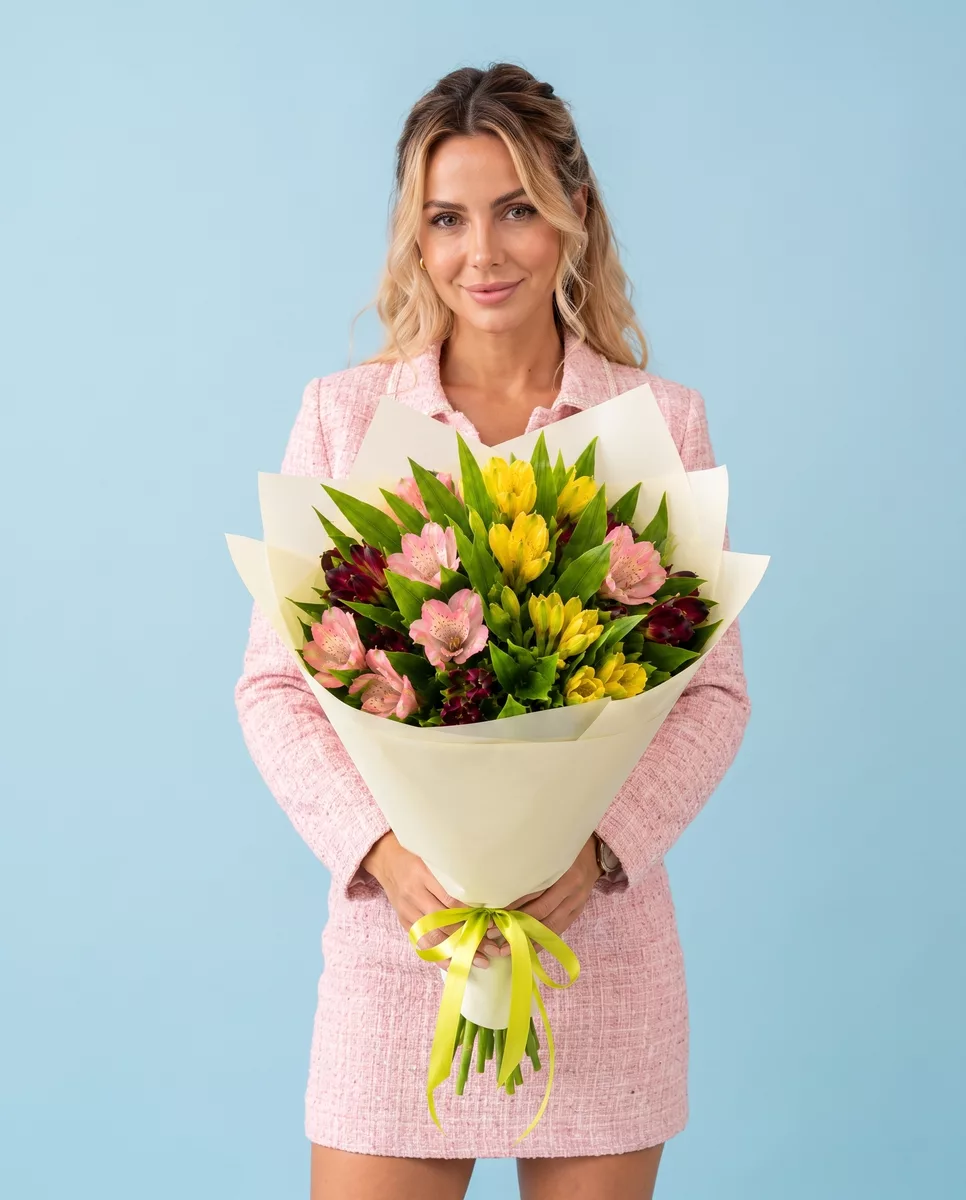
Some flowers make counting straightforward and some make it genuinely difficult, especially when you are ordering online from a photograph. Single-stemmed varieties with one bloom per stem — standard roses, tulips, peonies, sunflowers, gerbera daisies, large chrysanthemums, lisianthus — are the easiest. Each stem equals one countable unit and the photograph usually shows the number clearly. Spray varieties are where errors creep in. Spray roses, spray chrysanthemums, alstroemeria and freesia each carry multiple blooms on a single stem. The stem count might be five, but the flower-head count in the photograph could be fifteen or twenty, making the bouquet look much fuller than a five-stem description suggests. Always read the stem count in the product description rather than trying to count flower heads in the image. Double-flowered tulips, parrot tulips and fringed tulips are another source of confusion because their large, ruffled heads can overlap in photographs and make seven stems look like five or nine. Ranunculus are similarly dense and layered. For these varieties, trust the written count. Hydrangeas are sold by the stem and each stem produces one large mophead or lacecap cluster. A three-stem hydrangea bouquet is entirely appropriate and substantial in size. Orchid stems — particularly phalaenopsis cut stems and dendrobium stems — each carry multiple blooms but count as one stem. Five dendrobium stems create an elegant, elongated bouquet that counts correctly as five. Knowing these distinctions helps you read a product page accurately and verify the count without needing to contact the shop.
Seasonal Availability and How It Affects Your Stem Count Choice
Choosing a stem count in isolation from seasonal availability creates problems, because the flower you want at a specific count may simply not be in the warehouse that day. Saint Petersburg's wholesale market receives shipments from Ecuador, the Netherlands, Kenya and domestic Russian growers on a rotating schedule, and availability shifts week by week. Roses and chrysanthemums are available in consistent supply year-round and are the safest choice when you need a precise stem count on a specific date. Peonies are available from roughly late April through July, with peak supply in May and June. During that window a fifteen-stem peony bouquet is realistic; in November it is not. Tulips peak from February through April and are scarce and expensive in August. Lisianthus is available most of the year but supply tightens in high-demand periods like late February and early March around International Women's Day. If you are ordering more than a day ahead, contact us to confirm that your chosen variety is available at your required stem count. If you are ordering for same-day delivery — which we fulfil within one to two hours across Saint Petersburg — we will confirm availability when you place the order and suggest an equivalent if the first choice is short. The practical advice here is to have a backup variety in mind, one that you would be equally happy with at the same stem count. A customer who wants nineteen white tulips but will accept nineteen white lisianthus is much easier to serve on short notice than a customer who will accept no substitution at all.
Checking Your Order Before You Confirm Payment
The checkout screen is the last reliable moment to verify the stem count, and it takes less than thirty seconds if you know what to look for. First, find the product name or description and locate the number attached to the flower variety, not the total item quantity in your cart. A cart quantity of one means you are ordering one bouquet; it does not tell you how many stems are in that bouquet. The stem count is in the product title or the description field. Read it and confirm it is an odd number. Second, if you have used any customisation options — choosing a specific stem count from a dropdown, adding extra stems, removing stems to lower the price — recalculate the total after your adjustment. Adding one stem to an even-numbered base brings it to odd; adding two keeps it even. This sounds obvious but the error happens regularly when customers adjust quantities quickly. Third, check whether the bouquet includes any add-ons that contain their own flower stems, such as a single rose added to a gift set. If the gift set already contains flowers and you add a stem rose, the combined count may shift from odd to even. At Five Flowers our order notes field accepts free-text instructions, and writing something like please confirm stem count is odd before dispatch is a completely reasonable instruction that our assembly team will act on. We check counts during wrapping regardless, but an explicit note means a second person verifies it. If anything on the confirmation page is unclear, call or message us before payment clears — changes after the order enters production are possible but add time to the delivery.
What to Do If You Realise the Mistake After Ordering
Catching an even stem count after the order is confirmed but before the bouquet is assembled is straightforward — contact us immediately and we will adjust. Our production window for same-day orders is tight because we commit to one-to-two hour delivery, so the earlier you catch the error the easier the correction. If you placed an order at ten in the morning for delivery at noon and you notice the stem count issue at ten-fifteen, we have time to fix it. If you notice at eleven-fifty, the bouquet is likely already wrapped and in transit. The practical window for changes is roughly the first quarter of the time between order placement and requested delivery. If the bouquet has already been delivered with an even stem count, the situation is uncomfortable but not unfixable. A single additional stem sent as a follow-up — one rose, one tulip, one stem of something that complements the original — converts the total to odd when the recipient places it in the same vase. We can arrange a follow-up stem delivery, and while it is an extra step it resolves the issue gracefully. Recipients who understand the custom will appreciate the correction; recipients who did not know the rule will simply see an extra flower arrive. For future orders, the most reliable prevention is to save a note to yourself at the point where you select a bouquet — write the stem count next to the product name and check it against the odd-number list before you proceed to payment. A three-second check at selection is easier than a phone call during the delivery window.
The odd-number rule is one of those customs that feels minor until you get it wrong, at which point it becomes the only thing anyone remembers about the bouquet. Once you know it, applying it is simple: read the stem count in the product description, confirm the number is odd, and if you have made any adjustments to a standard product recalculate before paying. The varieties, the colours, the wrapping style — all of those matter, but the count is the foundation. Every bouquet we send from Five Flowers goes through a stem count check during assembly, and our product range is built around odd numbers from the start, so ordering through us already puts the rule in your favour. What we ask of you is that thirty-second check at checkout, because the combination of our process and your attention means the bouquet arrives exactly as it should. We deliver bouquets across Russia in 1–2 hours.
Frequently asked questions
Does the odd-number rule apply to potted plants and flower boxes as well as bouquets?
Potted plants are not counted by stem and are entirely fine to send without thinking about the rule — a single orchid plant or a succulent arrangement carries no numerical significance. Flower boxes are counted the same way as bouquets: the number of flowering stems inside the box should be odd. If you are ordering a boxed arrangement, check the stem count in the product description just as you would for a wrapped bouquet.
Is one flower ever acceptable as a gift in Russia?
One stem is technically odd and is culturally acceptable, particularly a single large rose or a single peony presented as a simple, direct gesture. It reads as intentional minimalism rather than a mistake. Where one stem becomes awkward is in a professional or formal context where a more substantial bouquet is expected. For personal gifts between close friends or partners, a single beautiful stem is a perfectly legitimate choice.
What if a bouquet I want is only available in an even stem count?
Contact us before ordering and we will adjust. Almost every arrangement we offer can be scaled up or down by one stem to land on the correct odd number. Sometimes scaling up by one stem changes the price slightly; we will tell you the difference before you confirm. We do not list even-numbered bouquets as standard products, but custom requests occasionally produce even totals, which is why checking the description and calling us early is the right approach.
Do florists in Russia ever break the rule for artistic or design reasons?
Professional florists in Russia follow the rule without exception for celebratory gifts. Some avant-garde installation work or editorial photography ignores it, but that context is clearly not a personal gift. For anything being sent to a home or workplace as a congratulatory or affectionate gesture, no florist in Saint Petersburg or Moscow would knowingly send an even-numbered bouquet. The rule is treated as non-negotiable in a retail and delivery setting.
How do I count stems in a bouquet that mixes flowers sold by the branch, like lilac, with standard single-stem flowers like roses?
Count each branch as one unit and each standard stem as one unit, then add them together and confirm the total is odd. A bouquet of three lilac branches and four roses totals seven stems — correct. Three lilac branches and five roses totals eight — not correct, adjust to four or six roses to reach seven or nine. The branch-versus-stem distinction affects visual volume but not the counting method.
Ready to send a bouquet?
Pick a city, choose the flowers, and we will hand them over with a photo confirmation.
Choose a city →