
Flower Gifts for Russian Partner Companies: Remote Ordering Explained
Every week we take orders from companies in Germany, the UAE, China and elsewhere who need to congratulate a Russian counterpart on a company anniversary, a signed contract or a national holiday — and have no one physically in Saint Petersburg or any other Russian city to hand the bouquet over. The questions are always the same: what do Russians actually expect to receive, how formal should the arrangement be, and can a foreign card message land without offending anyone? This article answers all of that from the shop floor, with real varieties, realistic timelines and the specific details that make a corporate flower gift land well rather than cause confusion.
What Russian Business Culture Expects from a Flower Gift
Russian corporate gifting with flowers is more formal than in Western Europe and considerably more generous in scale. A bouquet delivered to a company office is seen by the whole team, not just the recipient, so size and composition carry social weight. A small hand-tied bunch of five stems reads as personal and slightly romantic in a Russian context — not appropriate for a business relationship. For a company anniversary or a contract milestone, the standard expectation is a large arrangement: a round or asymmetric composition of at least 25 to 35 stems, or a standing floor arrangement in a basket or a box. White, cream and pale pink tones are universally safe for business. Red roses in large numbers are associated with romantic love, so a bouquet of 51 red roses sent to a female director, while impressive in scale, can create an awkward atmosphere in the office. Mixed compositions with white roses, lisianthus, freesia and eucalyptus read as professional and polished. Yellow flowers are not the bad omen that older Russian superstition once made them — that association has faded among urban professionals under 55 — but if your counterpart is of an older generation or from a more traditional region, it is safer to avoid a purely yellow palette. Chrysanthemums in Russia are strongly associated with funerals and cemetery visits, so they should not appear in any business gift regardless of the occasion. Knowing these three rules — avoid small bouquets, avoid red-only romantic compositions and avoid chrysanthemums — covers most of the risk.
Bouquets we can deliver



Choosing the Right Occasion and Timing Your Order
Russian business life runs on a calendar of occasions that differ from Western corporate schedules. The most common triggers for a flower gift are company foundation anniversaries, the signing or renewal of a major contract, the New Year period from late December through the first week of January, International Women's Day on 8 March, and the personal birthday of a key contact. Of these, 8 March is the single largest flower-sending day in Russia — demand is extreme, prices rise significantly in the days before, and delivery windows fill up fast. If you are planning a gift for that date, place the order at least five to seven days in advance. For a company anniversary, the delivery should arrive on the exact date, not the day before, because Russians treat the precise date seriously. For a New Year gift, the window between 25 December and 31 December works well; gifts arriving after 1 January feel late. We deliver across Russia within one to two hours of the agreed time slot, but for remote international orders we need a confirmed recipient address, a working Russian phone number for the recipient and a chosen delivery window. If you can only reach your counterpart through email, ask them to confirm a phone number — our courier will call ahead of arrival, and without a local number the delivery cannot be completed. Build in a buffer of at least 24 hours between your order and the desired delivery time when ordering from abroad.
Which Flower Varieties Work Best for Corporate Arrangements
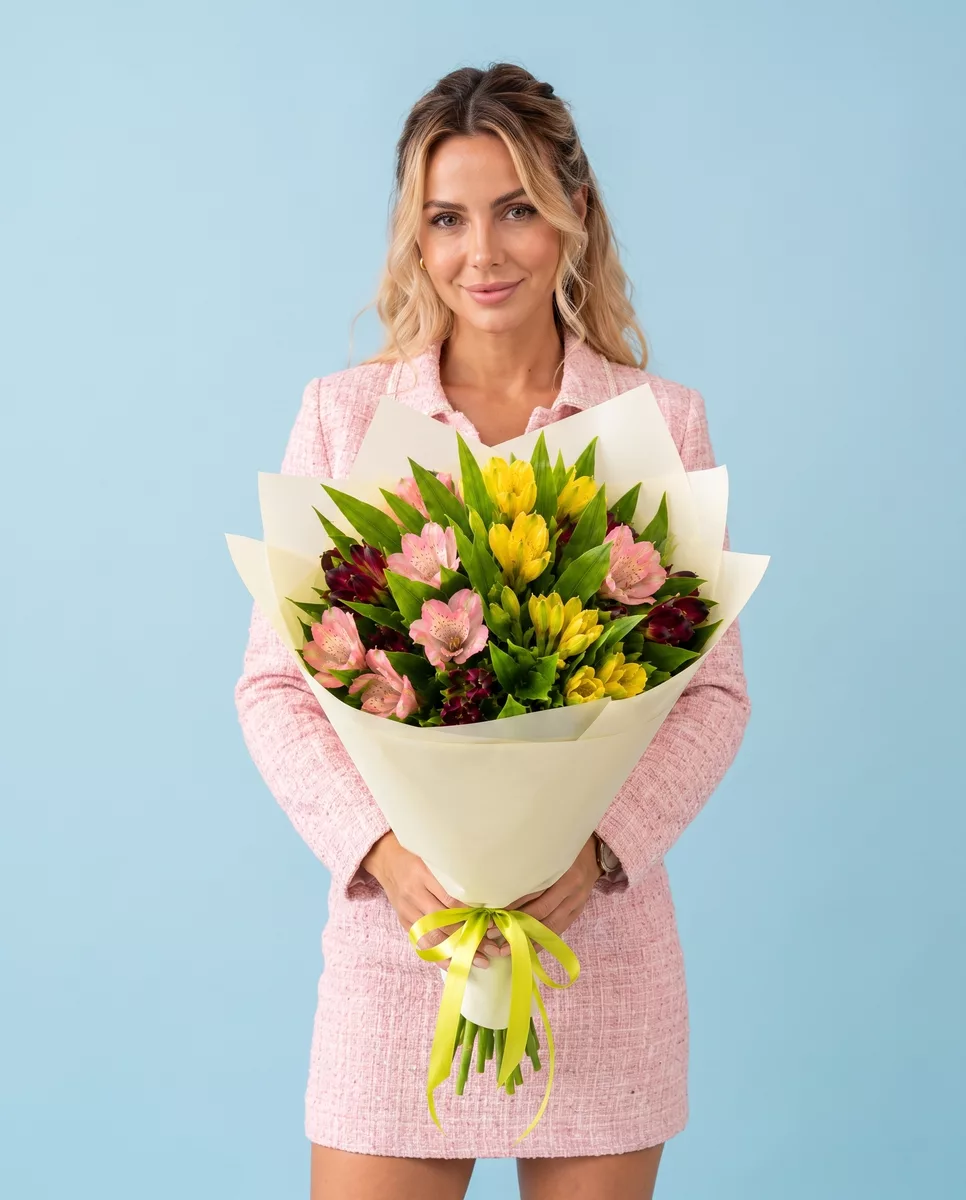
For a corporate arrangement aimed at a Russian office, the varieties that hold up best in transit, look substantial on a reception desk and require minimal care from staff are garden roses, spray roses, lisianthus, freesia, alstroemeria and ornamental branches such as eucalyptus or ruscus. Garden roses — varieties like David Austin-style blooms in cream, blush or white — read as premium without being romantic. Lisianthus adds volume and a slightly formal silhouette that suits office settings. Freesia brings fragrance, which is appreciated in a large room, but use it sparingly in arrangements going to offices where people may have sensitivities. Alstroemeria is a practical choice for arrangements that need to last a full week without water changes — it is robust and the stems hold well in floral foam or a deep vase. For standing floor arrangements in a basket, we typically combine large-headed roses, lisianthus and eucalyptus with a filler of wax flower or pittosporum to create density and a finished look that photographs well — important because your counterpart will likely photograph the arrangement and share it internally. Orchid arrangements in ceramic pots are increasingly popular for corporate gifts because they last weeks rather than days, signaling a more substantial investment. Phalaenopsis orchids in white or pale lilac are the standard choice. Avoid tropical varieties like anthuriums or birds of paradise for a first-time corporate gift — they read as unusual in a Russian office context and can seem eccentric rather than impressive.
How to Write the Card Message for a Russian Recipient
The card message is where most international senders make avoidable mistakes. Russian business communication is more formal in writing than spoken conversation, and a card that sounds casual or uses first names without an established relationship can feel presumptuous. The safest structure is: a formal greeting using the recipient's name and patronymic if you know it, the occasion being celebrated, a brief expression of respect for the partnership, and a closing with your company name. An example that works: 'Dear Irina Alexandrovna, please accept our sincere congratulations on the anniversary of your company. We value our partnership and wish your team continued success. With respect, [Your Company Name].' If you do not know the patronymic, using the first name alone with 'Dear' is acceptable in a modern business context, especially if your relationship is conducted in English. Writing the card in Russian signals effort and respect — we can transcribe a message you provide in English into correct Russian, which we do regularly for international clients. Avoid humor, idioms or cultural references that depend on shared context; they rarely translate well and can confuse the recipient. Keep the message to three to five sentences. Do not include pricing references, delivery details or any logistical information on the card — the card is a social document, not a receipt. If the gift is from a group of people or a board, list the names or use 'The team at [Company Name]' rather than a single sender name, which can create confusion about who the gift is actually from.
Navigating the Address and Delivery Logistics from Abroad
Delivery to a Russian business address has specific requirements that differ from residential delivery and from delivery logistics in most other countries. Russian addresses follow the format: city, street, building number, office number. Many large companies are located in business centers where the reception desk is on the ground floor and the company itself occupies a specific floor and office — you need both the business center name or building number and the office or floor number for the courier to reach the right place. If your counterpart is in a gated business park, there may be a security checkpoint that requires the courier to be registered in advance; ask your contact whether this applies and, if so, whether they can add our courier to the visitor list for the delivery window. We operate our own delivery across Russia, so once the address is confirmed and the delivery window is agreed, you do not need to coordinate with anyone else. Payment from abroad is accepted by card through our website, including cards issued outside Russia — confirm the accepted card types at checkout, as some international cards require a secondary verification step. When placing the order, include the recipient's full name as it appears on their office directory, the company name, the full address with postal code, and a Russian mobile number. If the recipient is not expected to be in the office on the delivery day — for example, if the anniversary falls on a Monday after a long weekend — specify a backup contact name and number so the arrangement can be received by a colleague.
Sizing and Budgeting the Arrangement Appropriately
In Russian corporate culture, the perceived value of a flower gift is read directly from its visual size and the quality of the varieties used. An arrangement that looks modest will be interpreted as modest, regardless of what it cost in euros or dollars after currency conversion. The practical minimum for a business-to-business congratulatory gift sent to mark a significant occasion is a round bouquet of 25 stems of premium roses or a mixed arrangement of equivalent volume. For a company anniversary of 10, 15, 20 or 25 years — milestone numbers matter in Russia — a floor-standing basket arrangement or a large box arrangement is more appropriate. These compositions are typically 50 to 80 stems combined with greenery and filler flowers, and they create a visual presence in the office that reflects the seriousness of the occasion. A potted phalaenopsis orchid in a decorative ceramic pot is a strong alternative for a senior executive's personal birthday because it lasts longer than cut flowers and signals considered choice rather than a standard order. When budgeting, factor in that premium varieties — garden roses, lisianthus, freesia — cost more than standard carnations or standard roses, and that a well-constructed arrangement from quality stems will look substantially better in the office than a high stem-count bouquet built from lower-grade flowers. We do not recommend specifying a very low budget and asking us to fill it — the result will not represent your company well. It is better to order a smaller but well-composed arrangement than a large one built from unsuitable varieties.
Following Up After the Delivery
Once the arrangement is delivered, a brief follow-up from your side completes the gesture and reinforces the relationship. Most Russian business contacts will send a thank-you message — by email, messenger or a phone call — within the same business day. If you do not hear anything by the following morning, it is worth checking with us that the delivery was completed successfully; we log all deliveries with a timestamp and can confirm receipt. If the delivery was to a large office and the arrangement was received by reception rather than the named contact directly, it is possible the thank-you message is delayed while the arrangement makes its way to the right desk. A short follow-up email from your side — 'We hope the flowers arrived well and that the team enjoyed them' — is entirely appropriate and gives your counterpart a natural opening to respond. In Russian business culture, acknowledging a gift with genuine warmth is standard, so the response when it comes will typically be more effusive than you might expect from a Northern European counterpart. This is genuine rather than performative — flowers are taken seriously as a gesture. If your company plans to send gifts regularly — for example, every company anniversary or every 8 March — keeping a record of what was sent, the varieties used and the recipient's response will help you build on the relationship year by year. Repeating the same arrangement to the same recipient is fine; it signals consistency. Upgrading the scale slightly on a major milestone anniversary signals that you have been paying attention to the relationship's growth.
Sending flowers to a Russian partner company from abroad is straightforward once you know the three things that matter most: the right composition for a business context, a precise delivery address with a working Russian phone number, and a card message that matches the formality of the occasion. The varieties, the scale and the timing do the communicating on your behalf — a well-chosen arrangement of garden roses, lisianthus and eucalyptus arriving on the exact anniversary date says more about your company's attention to the relationship than almost any other remote gesture. We handle international orders regularly and can advise on composition, transcribe your card message into Russian and confirm delivery with a timestamp, so you have a clear record that the gift was received. We deliver bouquets across Russia in 1–2 hours.
Frequently asked questions
Can I order flowers for a Russian company if I have no one in Russia to help coordinate?
Yes. You need three things from your side: the recipient's full office address with postal code, a Russian mobile number for the recipient or their assistant, and a payment card. We handle the preparation, delivery and confirmation entirely. You will receive delivery confirmation with a timestamp so you know the arrangement arrived.
Is it acceptable to send flowers to a male director of a Russian company?
Flowers to a male executive are appropriate for a company anniversary or a significant contract milestone, but less common for a personal birthday. For a male recipient, choose a structured arrangement — a basket composition or a box arrangement — rather than a hand-tied bouquet, which reads as more personal. White, green and cream palettes work well in this context.
How far in advance do I need to order for delivery on a specific date?
For standard dates, 24 to 48 hours is sufficient. For 8 March, the New Year period and major public holidays, place the order five to seven days ahead. Same-day orders are possible if placed before midday local Saint Petersburg time, but for international senders coordinating across time zones, next-day ordering gives more reliable results.
What if the recipient is not in the office on the delivery day?
Provide a backup contact name and Russian mobile number when placing the order. Our courier calls ahead of arrival, and if the named recipient is unavailable, the arrangement can be handed to a colleague at the same address. We do not leave arrangements unattended. If no one is available, we will contact you to reschedule within the same day.
Can the card message be written in English, or does it need to be in Russian?
A card in English is understood in most large Russian companies, especially those with international partnerships. However, a message in Russian signals effort and is always better received. If you write your message in English, we can transcribe it into correct formal Russian before printing the card — this is a standard part of our international order process.
Ready to send a bouquet?
Pick a city, choose the flowers, and we will hand them over with a photo confirmation.
Choose a city →