
Graduation Flowers in Russia: What to Send After the Diploma
Russian university graduation is one of the few occasions where flowers arrive in serious quantity — and where getting the timing or the bouquet wrong is immediately visible, because graduates stand in groups for photographs and the bouquets are right there in the frame. Customers who call us on graduation day often ask the same three questions: what is actually customary, how large should the bouquet be, and can delivery reach the venue before the ceremony ends. This article answers all three, with real varieties and the logistics details that matter.
What Russian Graduation Ceremonies Actually Look Like
Russian university graduation, called vypusknoj or den' diplomanta depending on the institution, typically runs across late June and early July, though medical and law faculties sometimes hold ceremonies in late May or early August. The ceremony itself is formal: graduates wear gowns or suits, sit in an auditorium for the diploma presentation, and then move outside or into a foyer for photographs. This outdoor or foyer phase is when flowers are presented, and it can last anywhere from forty minutes to two hours depending on faculty size. Families and friends gather near the exit and hand bouquets directly to the graduate as they emerge. Because dozens of graduates are receiving flowers simultaneously, the visual scale is significant — a small or wilted bouquet stands out immediately. The ceremony schedule is almost never published precisely, which is the core logistical problem for flower delivery. Most institutions give families a start time but not an end time, and diploma presentations can run ahead or behind by thirty to forty-five minutes. Ordering delivery for the exact minute the ceremony ends is therefore a mistake. The practical approach is to have flowers arrive at least one hour before the ceremony is scheduled to finish, or to send them to a nearby address — a relative's car, a café, a hotel lobby — where someone can hold them in a cool spot. Saint Petersburg's late-June temperatures average around 18 to 22 degrees Celsius, which is manageable for most cut flowers, but direct sun on a car seat for an hour will damage roses and peonies noticeably.
Bouquets we can deliver



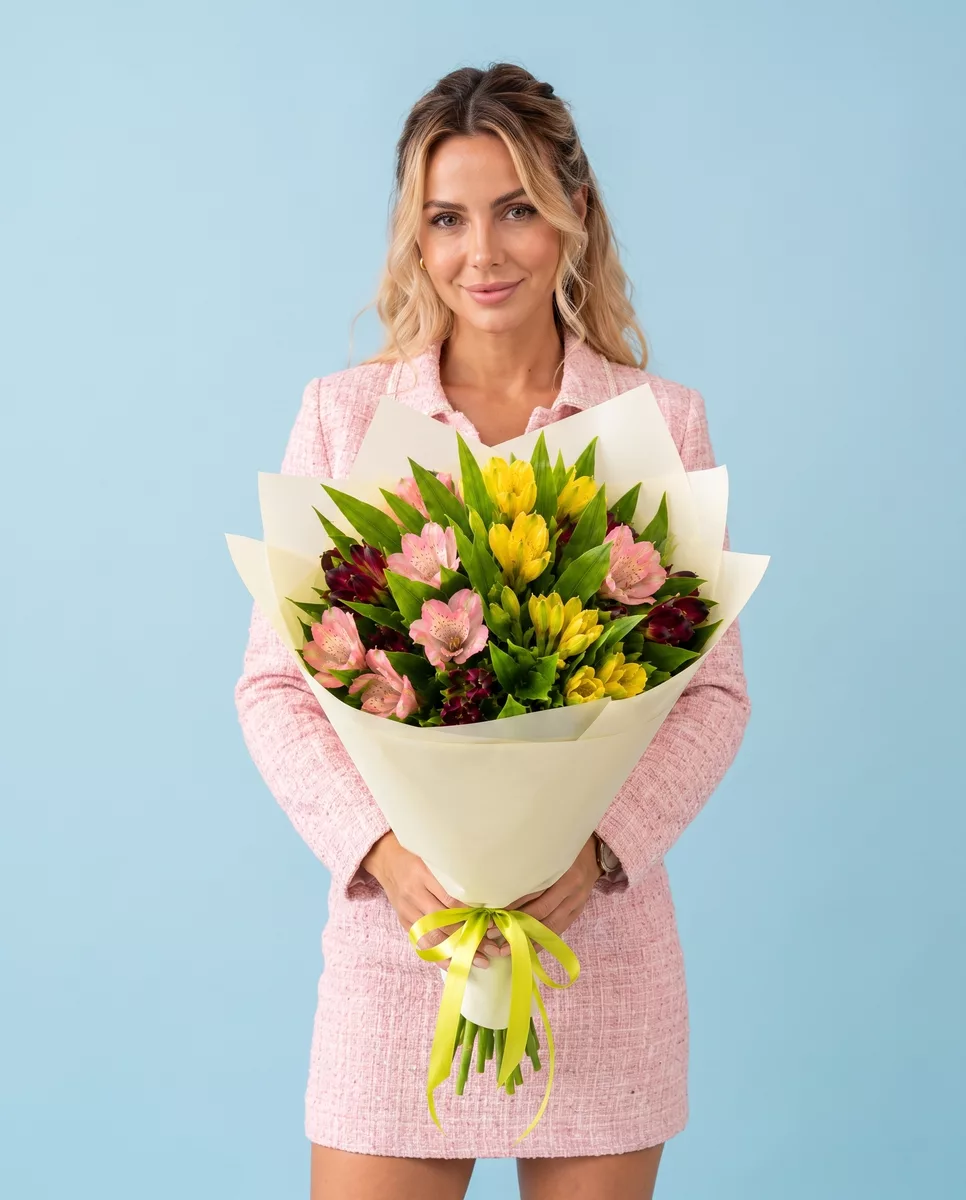
The Customary Scale: How Many Stems Russians Expect
There is an unspoken but widely observed rule in Russian gift culture that flowers for significant occasions should be odd-numbered and generous. At graduation specifically, the expectation from family — parents, grandparents, aunts and uncles — is a bouquet of at least 25 to 51 stems, not a small arrangement of 7 or 9. Customers from outside Russia frequently underestimate this and order what would be considered a standard romantic bouquet in Western Europe; the result is a graduate holding something that looks modest next to classmates' arrangements. Close friends typically give 11 to 25 stems, which is acceptable and understood as a friend's rather than a family gift. The odd-number rule applies strictly: 10, 20, or 30 stems are reserved for mourning occasions and should be avoided completely. When multiple friends are pooling money, going to 25 or 35 stems is the right move rather than stopping at 20. Roses are the most common choice for family bouquets because their stem count scales visibly — a 51-stem rose bouquet has clear physical presence. Spray roses, which carry multiple blooms per stem, can look generous while using fewer primary stems, but they read as a lighter, more informal gift, better suited to a friend's contribution than a parent's main bouquet. If the budget is a concern, mixing large-headed roses with filler like waxflower or eucalyptus is more accepted than simply reducing stem count. The bouquet's size should photograph well, which in practice means it should fill both hands when held at the graduate's waist.
Varieties That Hold Up Through a Long Ceremony Day
Graduation day is long. The graduate may receive flowers at noon and not get them into water until seven or eight in the evening, after photographs, a restaurant dinner, and travel. This makes variety choice a practical question, not just an aesthetic one. Roses are the standard choice for good reason: garden roses and large-headed hybrid tea varieties like Explorer, Avalanche, or White Naomi hold well out of water for six to eight hours in mild temperatures. Peonies are extremely popular at Russian graduation because late June falls inside their natural season, and a peony bouquet in full or three-quarter bloom looks spectacular in photographs — but peonies are sensitive to heat and should not be left in a warm car. Chrysanthemums, specifically the large disbud variety, are durable and often used in mixed bouquets to add volume without fragility. Alstroemeria holds extremely well and is sometimes used in friend-group bouquets where budget matters, though it reads as a secondary flower in Russian floral culture rather than a statement piece. Lisianthus, sometimes called eustoma, is increasingly fashionable in Saint Petersburg and photographs beautifully, but it wilts faster than roses in heat. Tulips are a spring flower and will be largely out of season by late June; if they appear, they are likely imported and will droop quickly outside water. Hydrangeas add visual mass but are water-hungry and will look tired within three to four hours without a stem in a bucket. For a ceremony in warm weather, a rose-and-peony combination or a pure rose bouquet in 25 to 51 stems is the most reliable order.
Color Conventions at Russian Graduation
Color at Russian graduation is not strictly regulated, but there are strong conventions that customers outside Russia are often unaware of. White is the dominant choice for female graduates from family members — it reads as formal, celebratory, and appropriate for a significant life milestone. Red roses are associated with romantic love in Russian culture and are therefore an unusual choice from parents or grandparents, though a friend or partner sending red roses is understood and accepted. Pink, in all its shades from blush to deep fuchsia, is the most flexible graduation color and works for family, friends, and romantic partners equally. Yellow flowers have historically been associated with separation and bad luck in Russian folk tradition, and while younger generations are less strict about this, it is still worth avoiding yellow as the dominant color in a bouquet for someone who holds traditional views — which grandparents often do. Purple and lilac tones, particularly in lisianthus and roses, are fashionable and carry no negative associations. Mixed-color bouquets are common among friend groups and read as cheerful rather than formal. For male graduates, the conventions are less rigid: white or mixed bouquets are common, and the emphasis shifts more to size and variety than to specific color. Packaging also signals formality — kraft paper wrapping reads as contemporary and relaxed, while satin ribbon and cellophane wrapping reads as traditional and ceremonial. Families ordering for a formal university graduation usually prefer the more ceremonial presentation, particularly if grandparents will be present and will form an opinion.
Timing Delivery Around the Ceremony: The Practical Window
The single most common mistake on graduation day is ordering delivery for the exact moment the ceremony ends. Ceremony end times shift, delivery windows have a margin, and the graduate is often surrounded by people and moving quickly. The correct approach is to place the order so that delivery arrives at least 45 to 60 minutes before the ceremony is expected to finish, to the address of whoever will be waiting — not to the university entrance itself, where there may be no one to receive the order and no way to keep flowers cool. In Saint Petersburg, our delivery window is one to two hours from order confirmation. On graduation days in late June, order volume increases significantly, so placing the order the evening before or early in the morning of the ceremony guarantees the time slot you need. If the ceremony is at noon and expected to finish around two, the order should be placed to arrive by one at the latest, to a person who will be at or near the venue. Flowers should be kept out of direct sunlight while waiting. A car with air conditioning running is acceptable for roses for up to two hours; a car parked in sun with windows closed is not acceptable for any cut flower. If the recipient is traveling to the ceremony from a hotel or relative's apartment, delivery to that address the morning of the ceremony is cleaner than trying to time arrival at the venue. Evening graduation dinners, which almost always follow the ceremony, are a second delivery window — many customers send a second, smaller bouquet to the restaurant to be placed on the table.
What to Write on the Card for a Russian Graduate
Flower cards at Russian graduation follow a short, direct format. The most common phrases translate roughly as: congratulations on your diploma, wishing you success in your career, proud of you. Cards are not typically long — three to five sentences is the maximum, and one or two sentences is normal. Writing in Russian is appreciated by the recipient's family even if the sender is abroad; our team can write the card text in Russian if the customer provides the message in English. Formal address matters in Russian card-writing: using the graduate's full first name and patronymic is appropriate for a message from an older relative or a formal well-wisher, while a nickname or first name alone is fine from a friend. Avoid phrases that reference the difficulty of the years of study in a complaining tone — Russian card culture at celebrations is positive and forward-looking. Do not include money amounts or gift references on the card if cash is also being given separately, as this is considered poor taste. If the bouquet is from a group of friends, listing all names on the card is standard practice and the graduate will read every name. The card should be attached securely to the bouquet, ideally inside the wrapping rather than on the outside, so it does not fall off during the handoff in a crowded foyer. If the delivery is going to a relative who will present the flowers in person, the card message can be more personal and can reference the family relationship explicitly, which adds warmth to the moment of presentation.
Ordering Graduation Flowers from Outside Russia
A significant share of our graduation orders come from customers outside Russia — parents living abroad, relatives in other cities, friends who have moved internationally but want to mark the occasion. The process is straightforward but requires attention to a few details that differ from ordering flowers domestically. First, the delivery address must be precise: building number, apartment or office number, entrance number if applicable, and a working Russian mobile number for the recipient or the person receiving on their behalf. Russian addresses without an entrance number or with an incomplete apartment number will cause delays. Second, payment from foreign cards is processed through international payment systems and may require a second confirmation step, so customers should be near their phone when placing the order. Third, time zone differences mean that a customer in New York placing an order at what feels like a reasonable hour may be placing it at three in the morning Saint Petersburg time, which affects processing. Orders placed before 10 PM Saint Petersburg time for next-day delivery are processed without issue. Fourth, card messages in any language are accepted, but if the customer wants the message written in Russian, they should note this in the order comments and provide the text. Fifth, the customer should confirm with the graduate or a local contact what the actual ceremony address is — university campuses often have multiple buildings, and the diploma ceremony is rarely in the main entrance building. Sending flowers to the wrong building on a busy graduation day creates a problem that is difficult to correct within the delivery window.
Russian graduation is one of the highest-stakes flower delivery days of the year, precisely because the bouquet is visible, photographed, and compared. Getting the stem count right — odd numbers, generous scale — matters as much as the variety. Choosing roses or peonies in white or pink keeps you within the conventions that will satisfy both the graduate and the grandparents. Timing delivery to arrive before the ceremony ends, at an address where a person is actually waiting, solves the logistics problem that trips up most orders. Place the order the evening before or early on the morning of the ceremony, confirm the correct building address, and the rest is straightforward. We deliver bouquets across Russia in 1–2 hours.
Frequently asked questions
Is it appropriate to send flowers to a male graduate in Russia?
Yes, flowers for male graduates are entirely normal in Russian culture. The bouquet is typically white, mixed, or green-toned rather than pink, and the emphasis is on size — 25 stems or more from family. Red roses from a romantic partner are also understood. The gesture is as common for men as for women at university graduation.
Can I order graduation flowers the morning of the ceremony?
You can, but graduation days have high order volume, and morning orders compete for the same afternoon delivery slots. Placing the order the evening before guarantees your preferred delivery window. If you are ordering on the day itself, do it before 10 AM Saint Petersburg time to allow enough processing time before the ceremony ends.
What is the minimum bouquet size that will not look small at a Russian graduation?
Eleven stems is the minimum for a friend's bouquet and will not look out of place in that context. For a family member — parent, grandparent, aunt or uncle — 25 stems is the practical minimum. Anything below that from a close family member will look modest compared to what other graduates receive from their families.
Are peonies a good choice for a late June graduation in Russia?
Late June is the tail end of the natural peony season in Russia, so availability is good and the flowers are at their most impressive. They photograph beautifully and are very popular at graduation. The only caution is heat: keep them out of direct sun and away from warm cars. In mild Saint Petersburg temperatures they hold well for several hours.
Can the bouquet be delivered directly to the university ceremony venue?
It is possible but risky. University entrances on graduation day are crowded, there is often no designated person to receive deliveries, and ceremony end times shift. The safer option is delivery to a nearby address where a family member or friend will be waiting — a car, a café, or a relative's apartment — and that person brings the flowers to the handoff.
Ready to send a bouquet?
Pick a city, choose the flowers, and we will hand them over with a photo confirmation.
Choose a city →