
Graduation Flowers in Russia: What to Send Your Graduate
Every June, the question lands in our messages dozens of times a day: what do you actually bring to a Russian graduation? The short answer is that flowers are not optional — they are the single most expected gift at both school and university ceremonies, and arriving without a bouquet is genuinely noticed. The longer answer involves knowing which flowers hold up under outdoor heat, how large a bouquet needs to be to read well in a crowd, and when to place your order so it arrives before the graduate leaves home.
Why Flowers Are Central to Russian Graduation Culture
In Russia, graduating from school — the eleventh grade — is called Vypusknoj, and it is treated as one of the most significant life events a family marks together. University graduation, called Zashchita or Vypusk depending on the institution, carries similar weight. Both ceremonies involve formal dress, official speeches and, without exception, flowers carried by almost every person in the hall. The tradition traces back to Soviet-era school culture, when teachers received bouquets at the end of the year, and it has expanded so that graduates themselves now receive the largest arrangements. Parents, grandparents, aunts and uncles all bring something; a graduate standing without flowers at the end of the ceremony stands out in the photographs in a way nobody wants. What this means practically is that flowers here are not a decoration — they are a social signal that you took the occasion seriously. Florists in Saint Petersburg see this demand compress into a very short window: the main school Vypusknoj ceremonies cluster around June 25th, and university defenses run through late June and early July. Orders placed the morning of the ceremony frequently cannot be fulfilled with premium stems because the supply has already moved. Booking two to three days ahead is the realistic minimum during this period, and choosing varieties that are actually in season — rather than varieties that sound impressive but must be air-freighted — keeps both quality and timing on your side.
Bouquets we can deliver



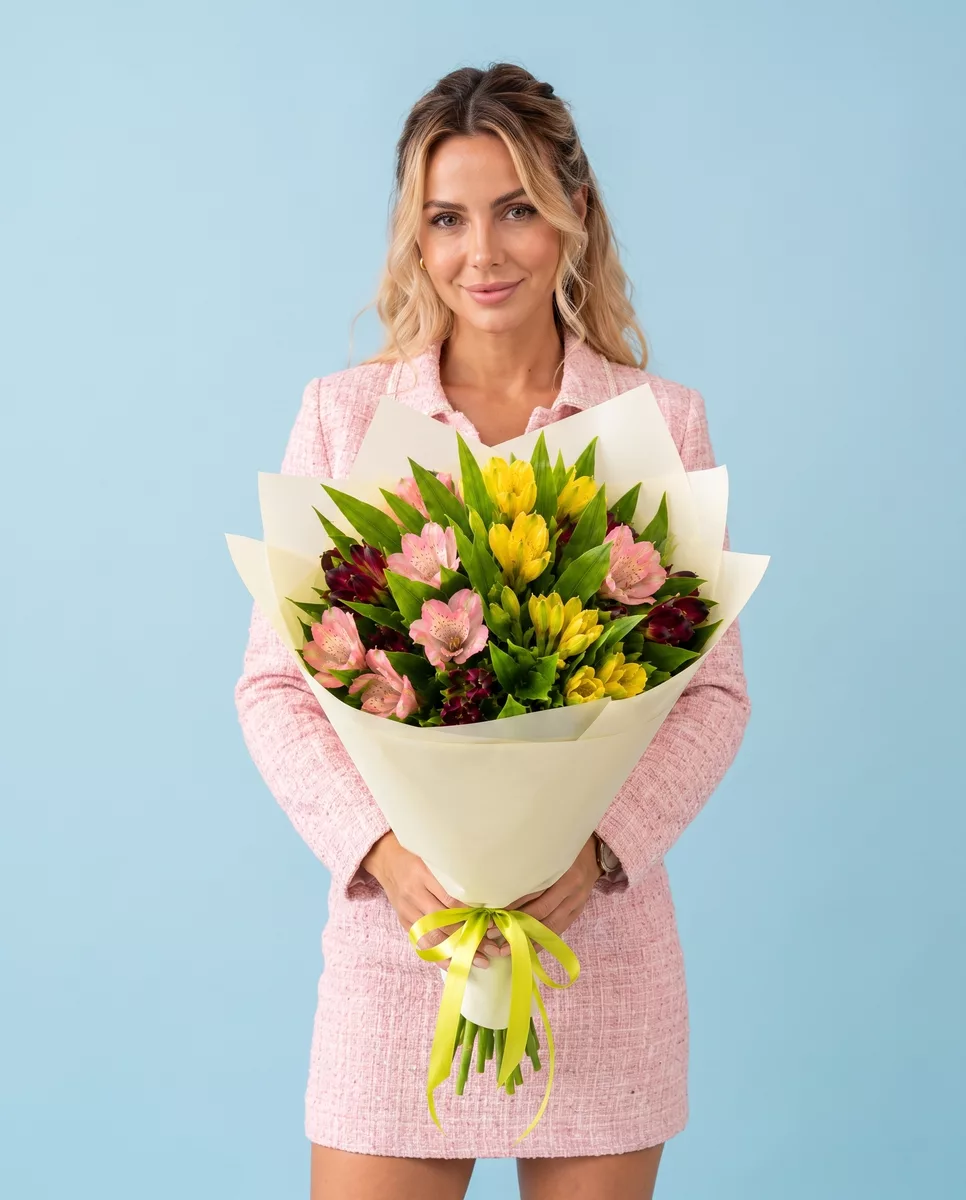
The Bouquet Sizes Russians Actually Bring
Russian graduation bouquets are large by the standards of most other countries. A single-stem rose handed to a graduate would be read as an afterthought. The baseline at a school Vypusknoj is a mono-bouquet of fifteen to twenty-five stems, and it is common to see arrangements of thirty-five or more roses, peonies or chrysanthemums arriving from immediate family. The reasoning is partly visual — ceremonies are photographed extensively, and a bouquet needs enough volume to show in a crowd — and partly cultural, where size communicates effort and affection in a direct way. University graduation tends to run slightly smaller because the ceremony is shorter and more formal, but a bouquet of eleven to fifteen stems from a close relative is still considered modest rather than generous. Odd numbers are the strong default in Russian flower-giving culture. Even numbers are associated with mourning, and while younger buyers are less strict about this, anyone ordering for a graduate's grandparents or older relatives should stick to odd counts without exception. Round numbers like ten or twenty are avoided for this reason. When ordering remotely — sending flowers to a graduate you cannot attend with in person — the safest instruction is to ask for a structured mono-bouquet rather than a mixed arrangement, because mono-bouquets photograph more clearly and the recipient can immediately see what they received. Mixed arrangements with five or six varieties read beautifully in person but compress into an indistinct mass in the ceremony photographs that will circulate for years.
Which Flowers Are Actually Given at Graduations
Roses are the dominant graduation flower in Russia, and specifically large-headed garden roses or hybrid tea roses in white, cream, pale pink or deep red. White and cream are the most photographed colors at school graduations because they contrast cleanly with the dark suits and formal dresses graduates wear. Red roses signal a more romantic or intensely personal message and are used more often by a graduate's partner than by parents or extended family. Peonies are the second major choice, and their timing aligns almost perfectly with the school graduation window — peak peony availability in Russia runs from late May through late June, which means a June 25th ceremony can be served with genuinely fresh, fully opened peonies rather than forced or imported ones. Eustoma, also called lisianthus, is widely used as both a primary flower and a supporting element; it holds its shape for several days without water, which matters when a graduate will be carrying a bouquet through a four-hour ceremony. Chrysanthemums — specifically the large single-headed Anastasia or Zembla varieties — are practical choices because they are robust, available year-round and fill volume efficiently. Hydrangeas work well in June but wilt faster than roses in warm outdoor conditions; if the ceremony is held inside an air-conditioned hall, they are fine, but for outdoor events in warm weather, roses and eustoma are more reliable. Tulips are a spring flower and are largely out of season by late June, so they appear rarely at university graduations and almost never at school ones.
School Vypusknoj Versus University Graduation: Different Expectations
The school Vypusknoj and the university graduation are distinct events with different atmospheres, and the flower expectations shift accordingly. School Vypusknoj is a full evening celebration — a formal ceremony followed by a banquet and then an all-night city walk that is a Saint Petersburg tradition specifically. Bouquets given at the school ceremony need to survive being set down, picked up, photographed and carried for several hours. This is why florists recommend flowers with strong stems and good water retention: roses, eustoma and spray chrysanthemums over delicate ranunculus or anemones. The bouquet will also be handed to a teacher at some point during the ceremony — this is standard practice, where graduates present their class teacher with flowers as a collective thank-you — so parents often prepare a separate, smaller bouquet of seven to eleven stems for the teacher rather than expecting the graduate's main bouquet to serve both purposes. University graduation is shorter, usually a two-hour indoor ceremony, and the atmosphere is more restrained. Bouquets here tend toward the elegant rather than the voluminous — a tightly wrapped arrangement of fifteen white roses or a structured hand-tied peony bouquet reads as more appropriate than the large, exuberant arrangements common at school ceremonies. University graduates also frequently receive flowers from classmates and colleagues in addition to family, so multiple smaller bouquets are normal. If you are sending to a university graduate remotely, a single well-composed bouquet of fifteen stems in a neutral color is more useful than competing with the arrangements already arriving from people physically present.
Timing and Temperature: What Goes Wrong on Graduation Day
June in Saint Petersburg runs warm, with daytime temperatures regularly reaching twenty-two to twenty-six degrees Celsius and occasionally higher. This is the detail that causes the most preventable disappointment on graduation day. Flowers ordered the evening before and left at room temperature overnight will arrive at the ceremony already half-spent. Flowers delivered the morning of the event but left in a warm car or hallway for three hours before the ceremony starts will look tired by the time photographs are taken. The practical instruction is to order delivery timed to arrive no more than two hours before the graduate leaves the house, and to keep the bouquet in a cool room — not a refrigerator, which is too cold for most cut flowers, but a shaded room away from direct sunlight. Peonies are particularly sensitive: a peony bouquet that arrives as tight buds will open quickly in warmth, which is actually desirable, but one that arrives already fully open in high heat will shed petals within a few hours. If you are ordering peonies for a June graduation, specify bud stage rather than open bloom. Roses should arrive with the outer petals just beginning to unfurl — this gives the bouquet two to three days of peak appearance. Florists packing graduation orders during the June rush are working quickly, and specifying the stage of bloom in your order note is one of the most useful things a remote buyer can do. Delivery between eight and ten in the morning on ceremony day is the window that works best for most school Vypusknoj events.
What to Write on the Card
Russian graduation cards are brief and direct. The standard formula is a congratulation on completing the stage — school or university — followed by a wish for the next one. Something like 'Congratulations on graduating — wishing you a strong start to whatever comes next' is entirely appropriate and will land better than elaborate metaphors about journeys or blooming. If you are sending from abroad or from another Russian city and cannot be present, the card is doing more work than usual — it stands in for your physical presence — so a sentence or two of genuine personal feeling is warranted. Avoid generic phrases about 'the future being bright' or 'doors opening,' not because they are offensive but because they are so common at Russian graduations that they register as filler. What graduates actually remember from cards are specific references: 'I remember when you started this program' or 'Your grandmother would have been here if she could.' Cards for teachers, if you are sending a separate bouquet to the class teacher, should be signed by the graduate's name so the teacher knows immediately who it is from — teachers receive many bouquets on Vypusknoj day and the card is how they track the gesture. Keep the handwriting or the printed text large enough to read quickly. A card attached to a large bouquet will be read while the graduate is holding it, often in a crowd, and small print gets missed entirely.
Ordering Graduation Flowers for Delivery Across Russia
The most common scenario for remote flower orders at graduations is a parent or relative who cannot travel — living in another city, working abroad, or simply unable to get to Saint Petersburg in time — who wants to ensure a bouquet arrives at the graduate's address before the ceremony. The first thing to establish is the exact delivery address and time window: ceremonies begin at fixed times, and a bouquet arriving forty minutes after the graduate has left is useless regardless of its quality. Confirm the graduate's home address rather than the ceremony venue, because florists cannot deliver to a crowded school auditorium and hand a bouquet to one specific person in a room of three hundred. Delivery to the home two to three hours before departure is the standard approach. For university graduations, which are sometimes held in the afternoon, a morning delivery gives more flexibility. When placing the order, specify the occasion explicitly — graduation orders during the June rush are handled with awareness that timing is non-negotiable, and noting 'school Vypusknoj June 25th, delivery by 10:00' in the order comments removes ambiguity. Specify the recipient's full name and a working phone number, because the delivery driver will call ahead. If the graduate is staying with family rather than at their own apartment, confirm that an adult will be home to receive the flowers. A bouquet left outside a door in June heat for an hour is a wasted order. The flowers themselves should be wrapped in paper rather than cellophane where possible — paper breathes, and a tightly cellophane-wrapped bouquet traps heat against the stems.
Russian graduation flowers are not a formality — they are the most visible part of how families mark the moment, and the choices you make about variety, size, timing and delivery window determine whether the bouquet actually serves its purpose. Roses and peonies in June, odd stem counts, delivery timed to arrive before the graduate leaves home, and a card that says something specific: these are the four things that separate a bouquet that works from one that arrives too late or wilts before the photographs are taken. If you are ordering from outside Saint Petersburg for a graduate in the city, place the order two to three days ahead during the peak June window, specify the delivery time in your order notes, and choose varieties that hold up in warm conditions rather than ones that look impressive in a photograph taken in a cold studio. We deliver bouquets across Russia in 1–2 hours.
Frequently asked questions
Is it rude to give an even number of flowers at a Russian graduation?
Yes, in Russian tradition even numbers of flowers are associated with mourning and funerals. Odd numbers — eleven, fifteen, twenty-five — are the correct choice for any celebratory occasion including graduation. Older family members in particular will notice and may be uncomfortable receiving an even-numbered bouquet, so stick to odd counts regardless of the arrangement size.
Can I send flowers directly to the graduation ceremony venue?
Delivering to a ceremony venue is not practical. Graduation halls are crowded, access is controlled and a delivery driver cannot locate one specific person among hundreds of guests and graduates. Send the bouquet to the graduate's home address, timed to arrive two to three hours before they need to leave. Confirm a working phone number so the driver can call ahead.
What flowers are actually in season for a late June graduation in Russia?
Late June is excellent for roses, peonies and eustoma, all of which are at or near peak domestic availability. Chrysanthemums are available year-round. Tulips are largely out of season by late June. Ranunculus and anemones are spring flowers and will be scarce or imported by graduation time. Choosing in-season varieties means better quality and faster delivery without air-freight delays.
Should the bouquet for the class teacher be different from the graduate's bouquet?
Yes. The teacher's bouquet is typically smaller — seven to eleven stems — and is often given collectively by the class or by a single family as a personal thank-you. It should be wrapped and carded separately with the graduate's name clearly written on the card, because teachers receive many bouquets on Vypusknoj day and need to know immediately who each one is from.
How far in advance should I order graduation flowers during the June rush?
Two to three days minimum for standard orders, and up to a week ahead if you want specific varieties like fully domestic peonies or particular rose colors. The school Vypusknoj dates cluster tightly around June 25th, which compresses demand into a short window. Morning delivery slots on ceremony day fill quickly, so placing your order early and specifying an exact delivery time in the order notes is the most reliable approach.
Ready to send a bouquet?
Pick a city, choose the flowers, and we will hand them over with a photo confirmation.
Choose a city →