
Greeting Card Wording for Flowers Sent to Russia: Phrases That Land Right
Every week we take orders from people in London, Berlin, New York and Dubai who want to send flowers to someone in Saint Petersburg, Moscow or Novosibirsk. The bouquet is chosen, the delivery address is confirmed, and then comes the pause: what do I write on the card? A blank card feels cold, but a phrase that sounds stiff or machine-translated feels even worse. This guide gives you working phrases — in English, in transliterated Russian, and with plain notes on what each one actually signals to a Russian reader — so the card does the same job as the flowers.
Why the Card Matters More Than You Might Expect
In Russia, receiving flowers without a card is unusual enough to cause mild confusion. Recipients often read the card first, before they even look at the bouquet. This is not vanity — it is because Russian gifting culture places real weight on the spoken or written word accompanying a gift. A bunch of peonies or spray roses handed over in silence reads as slightly abrupt, and a delivered bouquet with no message reads the same way. The card closes the gesture. When you order through us, the card message is printed and placed inside a small envelope attached to the wrapping. Our couriers are instructed not to hand over the bouquet without it if one has been requested, precisely because recipients notice. The message does not need to be long. Three sentences are enough. What matters is that the phrasing feels personal rather than copied from a template, and that it matches the occasion — a birthday card that uses the same wording as a congratulations card for a promotion will not cause offence, but it will feel slightly off to the person reading it. Russian readers are sensitive to register: formal phrasing to a close friend feels distant, and overly casual phrasing to a colleague can seem disrespectful. The sections below give you phrases calibrated to specific situations so you do not have to guess the register yourself.
Bouquets we can deliver



Birthday Phrases: What Russians Actually Say
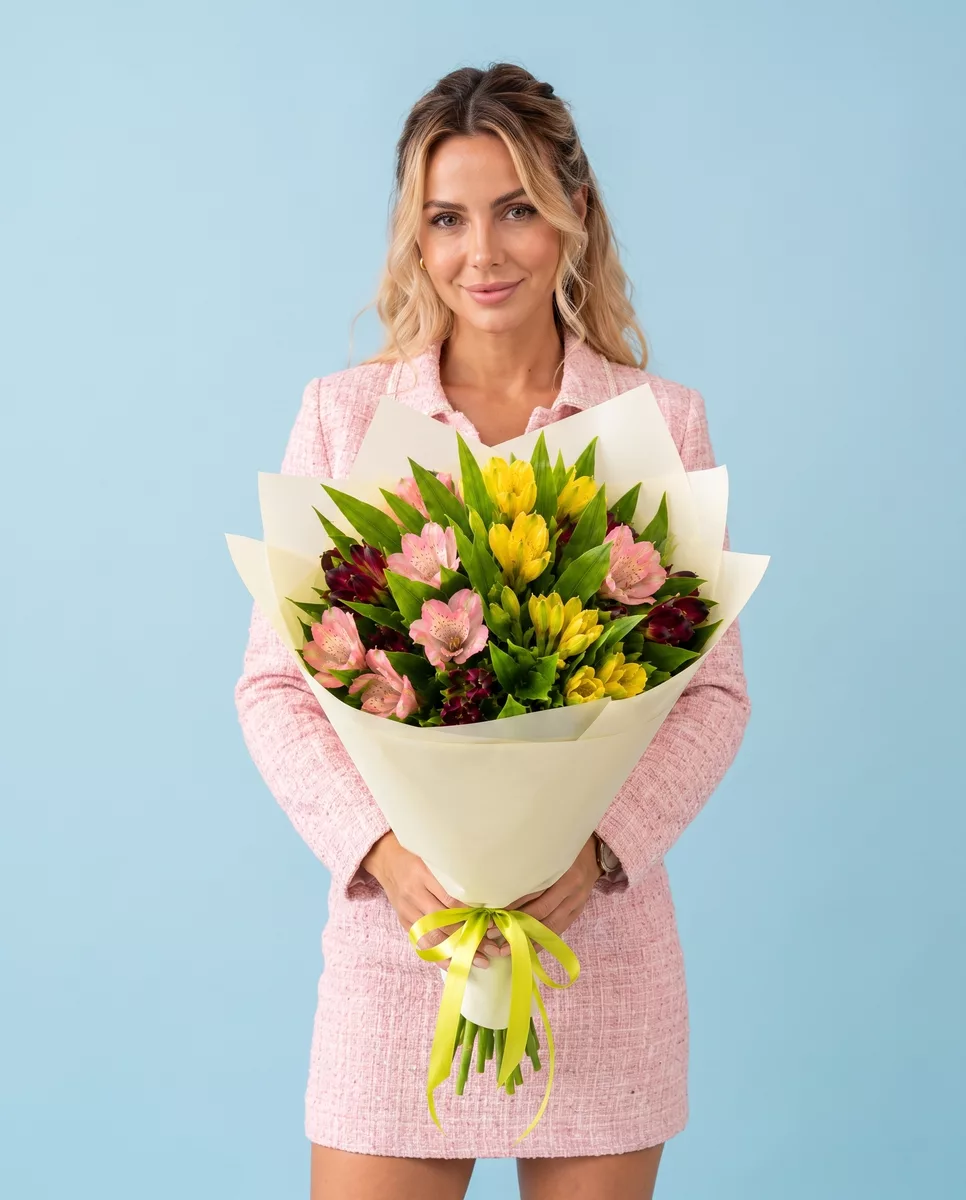
The standard Russian birthday greeting is S Dnyom Rozhdeniya, which translates directly as 'with the day of birth' and functions exactly like 'Happy Birthday.' It is pronounced roughly as 's dnyom rozh-DYE-ni-ya' and is the phrase your recipient will be most comfortable seeing on a card. You can write it in transliteration if you cannot type Cyrillic, and it will read naturally. A fuller version that works well on a card: 'S Dnyom Rozhdeniya! Zhelayu tebe schastya, zdorovya i yarkikh tsvetnykh dney,' which means 'Happy Birthday! I wish you happiness, health and bright colourful days.' The phrase yarkikh tsvetnykh dney — bright colourful days — is a genuine Russian idiom and will land warmly rather than sounding translated. For a more formal recipient, such as a colleague or a parent of a friend, switch tebe (informal 'you') to Vam (formal 'you'): 'Zhelayu Vam schastya i zdorovya.' If you want to write in English only, that is entirely acceptable — many recipients in larger cities read English well, and a card in the sender's own language carries its own warmth. 'Wishing you a birthday as bright as these flowers' is simple and works. Pair birthday bouquets with roses, gerberas or alstroemeria — varieties that hold well for several days at room temperature, which matters because Russian apartments are typically kept warm, around 22 to 24 degrees Celsius, and cut flowers feel that heat quickly.
Congratulations for Achievements, Promotions and Graduations
The Russian word for congratulations is Pozdravlyayu, and it covers birthdays, promotions, graduations, new babies and almost any positive life event. For a professional achievement or graduation, a card might read: 'Pozdravlyayu s uspeshnym okonchaniem! Ty zasluzhil eto,' meaning 'Congratulations on your successful completion! You earned this.' For a promotion: 'Pozdravlyayu s novoy dolzhnostyu — zhelayu novykh pobyed,' which translates as 'Congratulations on the new position — wishing you new victories.' The word pobyed (victories) is used in everyday Russian congratulations and does not sound grandiose; it is the standard register for professional milestones. For a graduation specifically, the word diplom (diploma) is understood by everyone: 'Pozdravlyayu s diplomom!' is short, clear and genuinely warm. One thing to know: Russians often give flowers to men as well as women for professional achievements. If you are sending to a male recipient for a graduation or promotion, a bouquet of sunflowers, chrysanthemums or a structured arrangement of eustoma and greenery is appropriate and common. Avoid arrangements that skew heavily toward pastel pink for male recipients unless you know the person well enough to know they would like it. Foliage-forward bouquets with bold focal flowers — think large-headed chrysanthemums or sunflowers — read as celebratory without being gendered. The card for these occasions should be direct and specific rather than vague: naming the achievement ('your new role,' 'your degree') makes the message feel personal.
Romantic Messages: Tone and Phrasing
Russian romantic expression on a card tends to be more direct than English equivalents. Phrases that might feel too intense in an English card are standard in Russian. 'Ya skuchayu po tebe' means 'I miss you' and is used freely between couples at any stage of a relationship. 'Ty moya radost' means 'You are my joy' and is genuinely tender without being over-the-top. For a longer message: 'S lyubovyu i neznostyu — vsegda tvoy / tvoya,' meaning 'With love and tenderness — always yours,' with tvoy used for a male sender and tvoya for a female sender. The word neznost (tenderness) carries significant warmth in Russian and is used in romantic contexts far more naturally than the English 'tenderness,' which can sound slightly formal. If you are writing in English, keep it concrete: 'These roses are the colour I think of when I think of you' works better than 'Sending all my love.' Red roses remain the clearest romantic signal in Russia, as elsewhere, but deep burgundy roses — varieties like Explorer or Black Baccara — are increasingly popular for romantic deliveries because they feel less generic. Spray roses in cream or blush work well for lighter, early-relationship messages. One practical note: if you are sending a romantic bouquet to a recipient in Russia from abroad, include your name on the card even if you think it is obvious. Flowers arriving without a clear sender name cause real anxiety for the recipient, and that is the opposite of what you want.
New Baby and New Home: Two Occasions with Specific Rules
New baby deliveries to Russia come with one important custom you should know: flowers are not traditionally brought to a maternity hospital in Russia, and visiting a newborn in the first days is not common. The appropriate time to send flowers is when the mother and baby have come home, typically three to five days after birth. A card for this occasion might read: 'Pozdravlyayu s rozhdeniem malysha! Zhelayu mame sil, a malyshu zdorovya,' meaning 'Congratulations on the birth of the little one! Wishing the mother strength and the baby health.' Addressing both mother and baby in the card is standard and expected. White or soft yellow flowers are most common for baby deliveries — white ranunculus, white tulips, or yellow mimosa if it is in season. Avoid strongly scented varieties for deliveries to homes with newborns; lilies in particular have a heavy scent that can be overwhelming in a closed room. For a new home or housewarming — novoselye in Russian — the phrase is 'Pozdravlyayu s novoseliem! Pust v novom dome budet teplo i uyutno,' meaning 'Congratulations on the new home! May the new house be warm and cosy.' Potted plants are equally appropriate for housewarming occasions and often preferred because they last longer than cut flowers. A bouquet of mixed seasonal flowers with a strong structural element — sunflowers, large chrysanthemums — reads as celebratory and suits the occasion well.
Writing in English When You Cannot Write in Russian
If transliterated Russian feels too uncertain and you cannot type Cyrillic, writing your card entirely in English is a legitimate and warm choice. Do not apologise for it on the card itself — a line like 'Sorry, my Russian is not good enough' draws attention to a gap rather than to the message. Write confidently in English and let the flowers do the cultural work. A few English phrases that translate emotionally well for Russian recipients: 'I wanted you to have something beautiful today' is simple and lands without cultural ambiguity. 'These flowers are from me to you, with everything good I can wish you' is warm and inclusive enough to work for almost any positive occasion. 'You deserve to be celebrated' works for birthdays and achievements and reads as direct rather than gushing. Avoid idioms that do not translate well if the recipient reads English as a second language: phrases like 'you knocked it out of the park' or 'this is your moment to shine' can confuse rather than warm. Stick to short sentences with concrete nouns. One thing that always works regardless of language: use the recipient's name on the card. 'Dear Natasha' or 'For Alexei' at the top of the card immediately makes the message feel personal. Russian recipients will read their own name with pleasure in any alphabet. If you know a nickname — Natasha rather than Natalya, Sasha rather than Alexander — use it; it signals real familiarity and care.
Checking Your Card Before You Confirm the Order
Before you finalise the order, read the card message aloud once. This catches two common mistakes: phrasing that sounds fine in your head but awkward spoken, and missing the recipient's name. The second most common card error we see is the sender writing about themselves rather than addressing the recipient — 'I am so proud of everything you have achieved' is fine, but three sentences of 'I feel' and 'I think' without addressing the person by name can read as self-focused. Keep the balance tilted toward the recipient. Check the spelling of the recipient's name with particular care. Russian names transliterated into Latin script have multiple valid spellings — Yulia and Julia, Ekaterina and Ekaterina, Mikhail and Mikhail — and the version the recipient uses for themselves matters to them. If you are unsure, use the spelling from whatever message or contact detail they have given you. Check the occasion phrasing matches the actual event. We have delivered birthday bouquets with cards that congratulated the recipient on their wedding because the sender copied a previous message. It is a small mistake but the recipient notices. Finally, if you are sending flowers as part of a larger gesture — alongside a gift being sent separately, or following a phone call — mention that briefly on the card: 'The rest of your gift is coming separately' or 'We spoke yesterday and I wanted to send something to go with those words.' It ties the gesture together and shows the card was written with thought.
A card message is not decoration — for a Russian recipient it is part of the gift itself. The phrases here are not translations assembled from a dictionary; they are the wording that Russian speakers actually use and expect to read on a card tucked into a bouquet of roses or tulips or ranunculus. Whether you write in transliterated Russian, in Cyrillic if you can manage it, or in confident English, what matters is that the message is specific, addressed to the person by name, and matched to the occasion. The flowers travel fast — we deliver within one to two hours across Saint Petersburg and to cities across Russia — but the card stays on the shelf long after the petals have dropped. We deliver bouquets across Russia in 1–2 hours.
Frequently asked questions
Can I write the card message in English for a recipient in Russia?
Yes, and you should write confidently in English rather than apologising for it on the card. Many recipients in Russian cities read English, and a message in the sender's own language carries genuine warmth. Keep sentences short, use the recipient's name, and avoid idioms that may not translate clearly. The flowers provide the cultural context; the card just needs to feel personal.
Is it acceptable to send flowers to a man in Russia?
Completely standard, particularly for professional achievements, graduations, and birthdays. Choose structured bouquets with bold focal flowers — sunflowers, large chrysanthemums, or eustoma — rather than arrangements dominated by pastel pink. The card wording is the same as for any recipient: address them by name, name the occasion, and keep the tone matched to your relationship with them.
When should I send flowers for a new baby in Russia?
Wait until the mother and baby are home from the maternity hospital, usually three to five days after birth. Sending flowers to the hospital itself is not a Russian custom. Once they are home, white or soft yellow flowers are most appropriate. Avoid heavily scented varieties like lilies in bouquets for homes with newborns. Address the card to the mother by name and mention the baby.
What does S Dnyom Rozhdeniya mean and how do I use it?
It means Happy Birthday, literally 'with the day of birth,' and it is the standard phrase every Russian speaker recognises immediately. Write it in transliteration on the card if you cannot type Cyrillic — S Dnyom Rozhdeniya — and follow it with the recipient's name. You can add Zhelayu schastya i zdorovya, meaning 'I wish you happiness and health,' to extend the message naturally.
Should I include my name on the card even if the recipient knows who is sending the flowers?
Always include your name. Flowers arriving without a clear sender cause genuine anxiety for the recipient, who may spend time trying to work out who sent them instead of simply enjoying the bouquet. Sign with whatever name the recipient knows you by — a nickname is warmer than a full formal name if that is how you communicate. Even a simple 'from David' at the end is enough.
Ready to send a bouquet?
Pick a city, choose the flowers, and we will hand them over with a photo confirmation.
Choose a city →