
How long do bought flowers last after you bring them home?
Bought flowers commonly last around 5–10 days in a vase, although delicate varieties may fade sooner and longer-lasting stems can remain attractive for two weeks or more. This is a practical estimate, not a guaranteed lifespan: the flower variety, its condition when purchased and care at home all affect the result. Count those days from when the recipient receives the flowers, while remembering that their condition at that point matters more than the purchase date alone.
Customers at Pyat Tsvetov (5 Flowers) often ask whether a bouquet will still look good for a birthday several days away or through a family visit. In our Saint Petersburg shops, open since 2011, that conversation starts with the flowers themselves and where they will stand. A bouquet is a collection of individual stems, so it rarely reaches one shared expiry date. Here is how to set a sensible expectation, help the flowers last and recognise when ordinary care will no longer restore them.
Typical vase life depends on the flowers you buy
As rough household guides, irises often give around 3–5 days, tulips about 5–7 days and roses roughly 5–10 days of vase life. Carnations and chrysanthemums commonly last around 10–14 days, sometimes longer with suitable care. These ranges overlap, and an individual bouquet may fall outside them. Use them to choose between flower types, rather than to calculate an exact date when a gift will stop looking fresh.
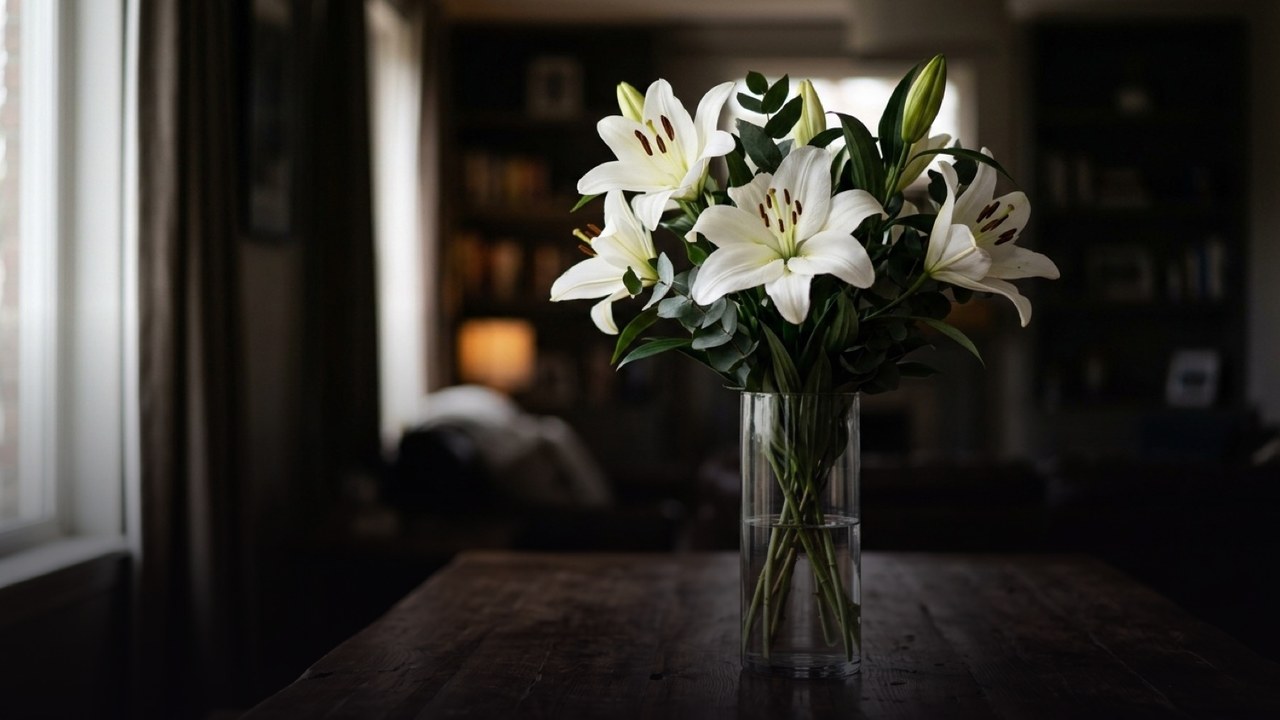
Lilies need a slightly different explanation because their buds open in succession: one flower can fade while another is just beginning. A stem with healthy developing buds may therefore provide interest beyond the life of its first open bloom. In a mixed bouquet, the most delicate flowers usually finish before the sturdier ones, so remove individual faded stems and keep the rest. If longevity matters most, our guide to chrysanthemums and their vase life explains why they are worth considering.
Read the bouquet's condition, not just the calendar
Look at several parts of the bouquet before judging how much life remains. Firm stems, healthy foliage and petals that hold their shape are useful signs, while slimy stem ends, a sour smell or spreading translucent brown patches indicate deterioration. A few dry outer petals on a rose do not, by themselves, mean the whole bloom is finished. Equally, a tightly closed bud is not proof of a longer display, because some immature or damaged buds may never open properly.
Drooping can result from poor water uptake as well as ageing, so first check whether the vase has run low or the stem ends have become dirty. Refresh the water, clean the vase and recut the stems before deciding that a slightly limp bouquet is beyond help. Improvement is possible when dehydration is the cause, but it is not certain. Petals that are already papery, heavily browned or collapsing will not become fresh again after a trim.
Bouquets we can deliver




The first hour at home: clean vase, fresh cut, enough water
Prepare a clean vase before arranging the bouquet; wash away any residue left by the previous flowers and rinse it well. Remove transport wrapping that would otherwise sit in the water, then take off leaves below the intended waterline. Submerged foliage breaks down and makes the water dirty more quickly. Choose a vase that supports the stems without packing them so tightly that you cannot check the water or remove a fading flower.
With clean, sharp scissors or secateurs, cut roughly 1–2 centimetres from the stem ends and place the flowers promptly into fresh water. A slight angled cut is practical, but a clean cut matters more than achieving a precise angle. If flower food came with the bouquet, follow its instructions and use the stated amount of water; a stronger mixture is not an improvement. Avoid improvised mixtures of sugar, coins, spirits or household cleaners, which make care harder to control and can damage flowers.
Daily care and vase placement make a difference
Check the water level every day, especially during the first days when a bouquet may drink more than expected. Top it up as needed, and replace it promptly if it becomes cloudy, develops an odour or contains fallen leaves. When changing the water, wash the vase and rinse the submerged parts of the stems gently. Recut a small amount from the ends if they have become discoloured or water uptake seems poor, using clean tools each time.
Keep the vase in a cool part of the room, away from direct sunlight, radiators and other sources of heat. Avoid a strong draught or an air-conditioning outlet that blows directly across the flowers, and keep the bouquet away from ripening fruit. A bright windowsill may look attractive in a photograph but can become warm enough to shorten the display. Our guide to where to place a vase helps you choose a position that works in an ordinary home.
Keep a mixed bouquet attractive as individual stems fade
Treat a mixed bouquet as something you can adjust, rather than an arrangement that must remain untouched. Remove fallen petals and spent flowers promptly, checking nearby stems for damage or decay. If only one flower on a branching stem has faded, remove that flower carefully while leaving healthy buds and blooms in place. As the bouquet becomes smaller, move the remaining stems into a clean, narrower vase so they still have support and look deliberately arranged.
Some changes are normal development rather than evidence that the bouquet was poor quality. Tulips can continue to lengthen and curve, lilies open gradually, and rose outer petals may become tired before the centre does. Judge the overall condition alongside these changes instead of expecting every flower to retain its arrival-day shape. For a gift, you can pass on one useful care note—keep leaves out of the water and check the level daily—without giving the recipient a long list of chores.
Time a flower delivery to Russia around the recipient
If the flowers are for a particular celebration, arrange arrival for that day or shortly beforehand, when someone can put them in water. Ordering in advance reserves your chosen delivery date; it does not mean the recipient should receive the bouquet weeks before the occasion. We deliver flowers across Russia, and orders can be placed 1–30 days ahead. Start with the bouquets catalogue, considering both the recipient's taste and whether they prefer a brief display of delicate flowers or varieties with a longer typical vase life.
Express delivery in large cities is available 1–2 hours after the order is confirmed. You can also choose delivery at an exact time with a tolerance of ±30 minutes, or a window of 09–12, 12–15, 15–18 or 18–21; in Saint Petersburg, delivery operates around the clock. City delivery costs 500 RUB, while the operator confirms the price for remote districts and suburbs when confirming the order. Check delivery and payment details when planning the date, particularly if you are ordering from another time zone.
The courier calls the recipient about 15 minutes before arrival, so provide a number on which they can be reached. If they are absent, we agree a second delivery the same day or, with the sender's consent, hand the flowers to a neighbour or concierge. Delivery is anonymous by default because the courier does not name the sender; add your name to the free message card if you want the recipient to know who sent the gift. Online checkout uses CloudPayments: check the payment options displayed there, as acceptance of every foreign card cannot be guaranteed; questions can be directed to 8 (812) 507-67-05.
Frequently asked questions
Will bought flowers last a week?
Many bouquets can remain attractive for around a week, but flower variety and condition at arrival make a substantial difference. Delicate flowers may finish sooner, while carnations and chrysanthemums often last longer with suitable care.
How long can bought flowers stay out of water?
There is no reliable allowance that applies to every bouquet, because the flower type, heat and exposure all matter. Keep the time without water as short as possible, then recut the stems and place them in a clean vase promptly.
Should I change flower water every day?
Check it daily and replace it immediately if it is cloudy, smells unpleasant or contains plant debris. If you use flower food, follow the packet's directions for mixing and refreshing the solution.
Can I buy flowers several days before a birthday?
You can, but those days will use part of the bouquet's vase life before the celebration. For a gift intended to look fresh on the day, arrange delivery on the birthday or shortly beforehand and make sure the recipient can put it in water.
Does flower food bring dying flowers back to life?
Flower food supports cut flowers when mixed according to its instructions, but it cannot repair decayed stems or dead petals. A dehydrated stem may improve after cleaning, recutting and fresh water, whereas advanced deterioration is irreversible.
Ready to send a bouquet?
Pick a city, choose the flowers, and we will hand them over with a photo confirmation.
Choose a city →