
Flower Stem Count: Choosing the Right Number for Any Occasion
The question we hear at the counter almost every day is not which flowers to send but how many. A customer will spend ten minutes picking between roses and ranunculus, then shrug and say 'just make it look full.' That shrug is where mistakes happen — a three-stem bouquet handed to a new manager reads as an afterthought, and a twenty-stem arrangement delivered to a first date can feel overwhelming. In Russia, stem count carries specific social weight that most senders outside the country do not know about, and even locals sometimes get it wrong. This article walks through the numbers that actually matter — three, five, seven, nine, and eleven — explains the logic behind each, and tells you what to check before you confirm the order.
Why Odd Numbers Are the Rule in Russia
If you have ever sent flowers to someone in Russia and been told to avoid even numbers, you were not being given superstition — you were being given a real social signal. Even-numbered bouquets are reserved for funerals and grave visits, and that association is strong enough that a twelve-rose arrangement, however beautiful, will make some recipients pause. The rule applies across generations and across regions; it is not a Moscow or Saint Petersburg thing. Florists who work the counter every day see the confusion most often with corporate orders, where a buyer used to Western conventions will request ten stems because the number fits the budget neatly. The fix is always to go to nine or eleven rather than ten, and the price difference is small enough that it never causes a problem. Odd numbers also have a practical advantage: they are easier to arrange asymmetrically, which is how most modern Russian bouquet styles are built. A five-stem tulip bouquet with one stem slightly taller than the others already has movement and depth. An even-numbered version tends to split visually into two halves. Varieties like single-headed spray roses, ranunculus, and lisianthus show this asymmetry particularly well because their blooms are round and the eye needs an anchor. When you order and the florist asks whether you want a round or cascading shape, the odd number you have chosen is already doing half the compositional work for them.
Bouquets we can deliver



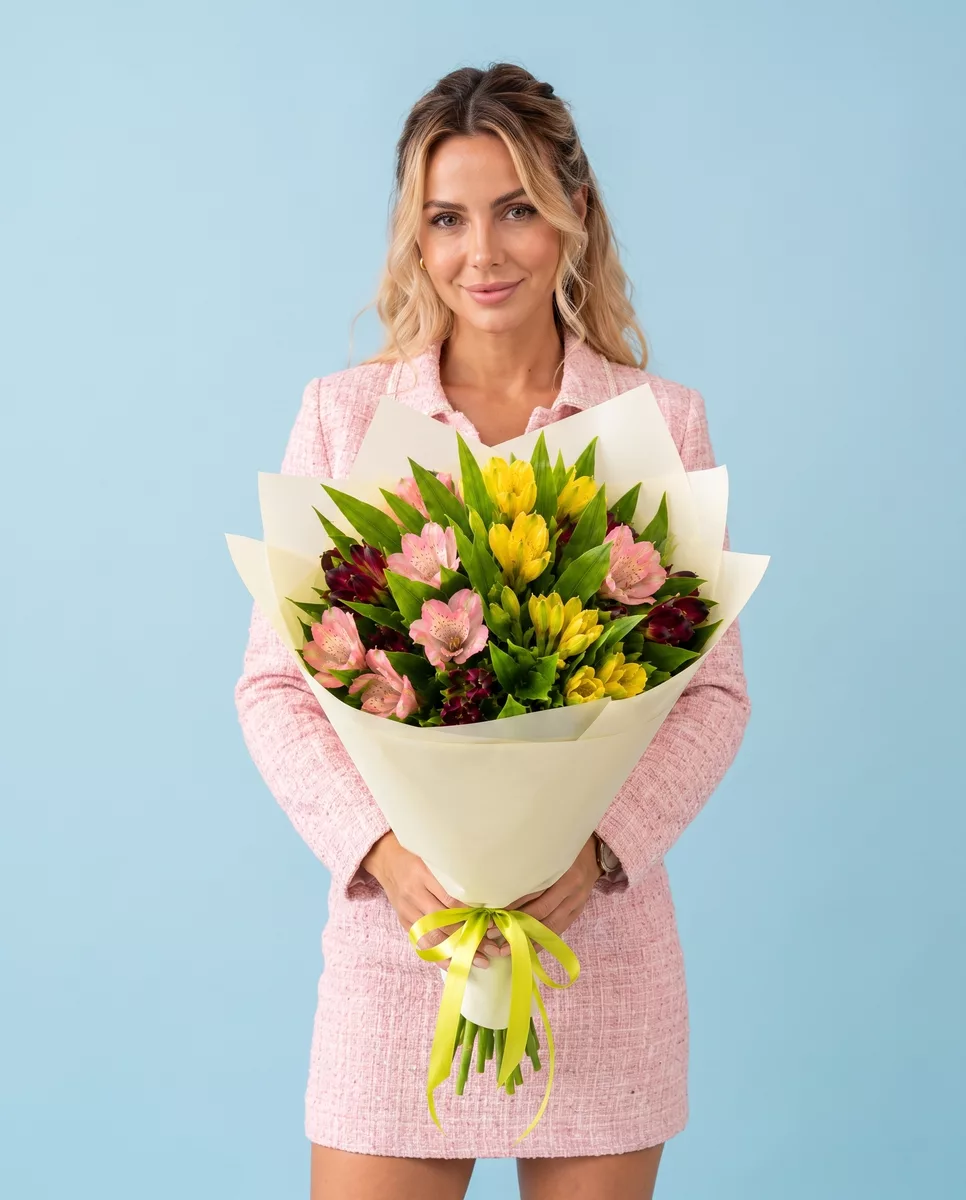
Three Stems: When It Works and When It Does Not
Three is the smallest odd number that reads as a deliberate bouquet rather than a handful grabbed from a bucket. It works very well in two specific situations: a small token between close friends who see each other regularly, and a single-variety statement piece where the flower itself is the point. Three stems of garden roses in full bloom, each head around six centimetres across, can fill a vase and look considered. Three stems of standard spray chrysanthemum will look sparse and apologetic. The variety matters more at three stems than at any other count because there is nothing else in the bouquet to carry the arrangement if the flower itself is not striking. Peonies in season, large-headed dahlias in late summer, and king proteas are flowers that can hold a three-stem bouquet with authority. Tulips, freesias, and alstroemeria cannot, because their stems are thin and their heads are small. The relationship context for three stems is genuinely limited. It suits a thank-you to a neighbour, a small gesture to a colleague on an ordinary Friday, or a single-colour accent piece for someone who is decorating a specific room. It does not suit birthdays, anniversaries, or any occasion where the recipient will be comparing what they received with what others brought. If budget is the constraint pushing you toward three, the better move is to choose one strong variety and add a single branch of eucalyptus or ruscus rather than adding a second flower type that dilutes the effect.
Five and Seven Stems: The Everyday Relationship Range
Five and seven stems are where the majority of everyday bouquets in Russia sit, and for good reason. They are large enough to look intentional, small enough to carry on public transport without embarrassment, and they fit the price points most people are comfortable spending for non-milestone occasions. Five stems work well for a colleague's birthday, a teacher's day gift, or a mid-week delivery to a partner that is not tied to any anniversary. Seven stems step up the register slightly — they read as more considered, and they are the natural choice when you want the bouquet to feel like a proper gift rather than a passing gesture. The variety choice at five and seven is more forgiving than at three. Roses, tulips, ranunculus, and lisianthus all work. Mixing two varieties becomes possible at seven: four stems of one flower and three of another creates a clear hierarchy without the arrangement looking confused. The combination that causes the most problems at this count is mixing flowers with very different stem lengths and head weights — standard roses with delicate sweet peas, for example, or sunflowers with anemones. The florist will compensate by cutting stems, but the customer should know that the result will look less like a designed bouquet and more like a compromise. At five and seven stems, the wrapping and foliage choice also become proportionally more important. A seven-stem bouquet of white ranunculus in kraft paper with dried lunaria looks like a deliberate aesthetic decision. The same seven stems in cellophane with a bow look like a petrol station purchase.
Nine Stems: The Milestone Number
Nine is the number where the bouquet shifts from everyday gesture to occasion marker. In Russian practice, nine stems signals that the sender has thought about the gift, allocated real budget, and considers the recipient and the event significant. It is the most common count for birthdays that matter — a parent's birthday, a close friend's fortieth, a first anniversary. Nine stems of garden roses in mixed blush and cream tones, with three or four stems of eucalyptus and a couple of sprigs of waxflower, is a bouquet that photographs well, lasts well, and reads well in person. At nine stems you have enough material to create a proper round bouquet or a loose garden-style arrangement, and the florist has room to use a signature technique rather than just bundling stems together. The mistake people make at nine is trying to include too many varieties. Four varieties across nine stems means some of them will appear only twice, which makes the bouquet look like a sample tray. Two strong varieties plus one foliage type is the reliable formula. For roses, nine is also the count at which stem length starts to matter noticeably — sixty-centimetre stems on nine roses create a genuinely tall, impressive arrangement, while forty-centimetre stems at the same count will look compact and a little heavy. When ordering, ask about stem length explicitly rather than assuming the florist will default to the longer option. Longer stems cost more, but at nine the price difference is worth specifying.
Eleven Stems: When You Want to Make a Clear Statement
Eleven stems is the count that removes any ambiguity about the sender's intentions. It is large enough to be visually significant when carried into a room, and it signals investment without tipping into the territory of a formal or ceremonial arrangement. The occasions where eleven works best are significant birthdays, Valentine's Day, and the kind of romantic gesture that is meant to be noticed by everyone in the recipient's office when it arrives. Eleven red roses on Valentine's Day is a classic order at Five Flowers, and the reason it works is not sentimentality — it is that eleven stems of a long-stemmed variety like Explorer or Red Naomi fills a standard vase correctly, the blooms open over three to four days in sequence rather than all at once, and the arrangement does not look overcrowded the way fifteen or twenty stems of the same variety can. At eleven stems, the foliage and filler question becomes important. A bare eleven-stem rose bouquet looks formal and a little cold. Adding three stems of eucalyptus, or a handful of gypsophila, softens the arrangement without reducing the impact of the main flower. Customers who want to send eleven stems but are working with a tighter budget can achieve a similar visual weight by choosing a variety with naturally large or multi-petalled heads — ranunculus, garden roses, or lisianthus — rather than standard single-headed roses, which need more stems to fill the same visual space. The florist can advise on which varieties are in season and will give the best result at this count on any given week.
Matching Stem Count to Relationship Distance
The number you choose should reflect not just the occasion but the specific relationship, and those two things do not always point in the same direction. A formal thank-you to a business contact who has done you a significant favour calls for seven or nine stems of something classic and neutral — white tulips, cream lisianthus, or pale-pink roses — rather than a large mixed bouquet that implies personal intimacy. A long-term romantic partner receiving flowers on an ordinary Tuesday can receive three or five stems of something they love without it reading as insufficient, because the relationship context fills in what the stem count does not say. The errors cluster at the edges. Senders who do not know the recipient well tend to over-correct by ordering too many stems, which can feel presumptuous. Senders who know the recipient very well sometimes under-correct by ordering too few, assuming the relationship will carry the gesture. A useful rule of thumb: if you are uncertain about the relationship register, land on seven. It is the count that offends nobody, works across most occasions, and gives the florist enough material to make something that looks genuinely composed. One more variable that affects the relationship read is delivery timing. A bouquet that arrives at nine in the morning on the day of a birthday has a different weight than the same bouquet arriving the evening before. At Five Flowers, same-day delivery within Saint Petersburg runs to a one-to-two hour window, so the timing is something you can actually control — and getting it right matters as much as getting the stem count right.
What to Check Before You Confirm the Order
Before you complete a flower delivery order, four things are worth confirming explicitly rather than assuming. First, check that the stem count is odd — this sounds obvious after reading this article, but the default quantity fields on many ordering interfaces are set to round numbers, and it is easy to click through without adjusting. Second, confirm the variety and whether it is in season. Peonies are available from roughly late April through June in Russia; ranunculus runs from late winter through spring; dahlias peak in August and September. Ordering an out-of-season variety means the florist will substitute, and the substitution may not match your original intention. Third, ask about stem length if the bouquet is for a formal occasion or a large vase. Forty-centimetre and sixty-centimetre stems of the same rose variety look like different flowers in an arrangement. Fourth, check the delivery window relative to the event. If the recipient is attending a celebration in the evening, a morning delivery to their home is fine; a delivery to an office at six in the evening may miss them entirely. At Five Flowers, the delivery window for Saint Petersburg is one to two hours, and the courier will contact the recipient before arrival, so last-minute coordination is possible — but it is easier to plan the timing at the order stage than to adjust it after the flowers are already in transit. A quick review of these four points before confirming takes under a minute and prevents the most common order mistakes we see every week.
Stem count is not decoration — it is information. Three stems says small gesture; seven says considered gift; eleven says this occasion matters. The variety you choose and the timing of delivery carry the rest of the message. If you are sending to someone in Russia and you are not sure of the customs, default to odd numbers, choose a single strong variety in season, and deliver in the morning of the event day. Those three decisions will get you to a bouquet that reads correctly in almost any relationship context. We deliver bouquets across Russia in 1–2 hours.
Frequently asked questions
Is it really a problem to send an even number of flowers in Russia?
Yes, it is a genuine cultural signal rather than a minor superstition. Even numbers are associated with funeral arrangements across Russia, and many recipients — especially older ones — will notice immediately. Going from ten to nine or eleven stems costs almost nothing and removes any awkward association entirely.
Can I send a large bouquet of three varieties without it looking cluttered?
Three varieties work at higher stem counts — nine or eleven — where there is enough of each flower to establish a visual rhythm. At five or seven stems, three varieties usually means some flowers appear only once or twice, which looks unresolved. Two varieties plus one foliage type is the more reliable formula at smaller counts.
Does stem count matter differently for different flower types?
Significantly. Large-headed flowers like peonies, garden roses, and dahlias have strong visual weight per stem, so five of them can look as full as nine tulips. Delicate flowers like freesias, sweet peas, or waxflower need higher stem counts to read as a proper bouquet rather than a sprig. Ask your florist which varieties punch above their weight at your chosen count.
What stem count is appropriate for a corporate gift or office delivery?
Seven or nine stems of a neutral variety — white or cream roses, pale lisianthus, or mixed white tulips — is the standard for corporate contexts. It signals respect and investment without implying personal intimacy. Avoid strong colours like red or deep purple, which carry romantic or emotional associations that can feel out of place in a professional setting.
How far in advance should I order to guarantee a specific variety and stem count?
For standard varieties — roses, tulips, chrysanthemums — same-day orders are usually fine. For seasonal or specialty flowers like peonies, ranunculus, or garden roses, ordering one to two days ahead gives the florist time to source the exact variety at the stem count you want rather than substituting. Holiday periods like March 8th require at least two to three days' notice.
Ready to send a bouquet?
Pick a city, choose the flowers, and we will hand them over with a photo confirmation.
Choose a city →