
March 8 Office Flowers: Bulk Delivery to Every Desk in One Order
Every year around March 5th the same call comes in: a manager has just realised that International Women's Day is three days away, the company has forty women across two floors, and nobody has organised anything. March 8th is Russia's most flower-intensive holiday by volume — florists see it outpace Valentine's Day by a significant margin — and office orders are the category that most often goes wrong because the person placing them underestimates lead time, forgets building access details, and picks varieties that will not survive a warm open-plan office past noon. This article explains exactly how to structure a single company-wide order so that every female colleague gets a fresh bouquet at her desk, the delivery arrives in one coordinated window, and you are not fielding complaints by lunchtime.
Why March 8th Office Orders Are Different From Regular Bulk Flower Purchases
A standard corporate flower order — say, bouquets for a client event — usually has one delivery address, a loading dock or reception desk, and a coordinator waiting on site. A March 8th office order is different in almost every practical way. You need individual bouquets, not a single arrangement, because the whole point of the holiday in Russian workplace culture is that each woman receives something personal at her own seat. Handing out flowers from a central pile at reception defeats the purpose entirely and tends to cause quiet resentment rather than goodwill. The second difference is timing pressure. March 8th is a public holiday in Russia, which means it falls on a day when many offices are either closed or running skeleton shifts. The practical delivery window is therefore March 7th for most companies, and that day is the single busiest delivery day in the Russian floral calendar. Demand for courier slots on March 7th is roughly three to four times higher than a normal weekday, which means that an order placed on March 6th will almost certainly be refused or pushed into an inconvenient late-evening window. Third, the flower market itself tightens in the two weeks before March 8th. Wholesale prices rise, specific varieties sell out at the auction level, and substitutions become more likely the later you order. Understanding these three pressures — individual presentation, compressed delivery windows, and supply constraints — is what separates a smooth company order from a chaotic last-minute scramble. Plan for March 7th delivery and place the order no later than March 1st to hold your slot.
Bouquets we can deliver



Choosing the Right Bouquet Format for an Office Setting
The format of the bouquet matters as much as the flowers inside it, and offices create specific constraints that a home delivery does not. A large, tall arrangement looks impressive in a photograph but is awkward on a desk with a monitor, a keyboard and a coffee cup already occupying the space. The practical sweet spot for an office bouquet is a compact hand-tied bunch or a small wrapped bouquet roughly 35 to 45 centimetres in total length, with stems cut so the recipient can drop it straight into a standard vase or a tall glass without needing scissors. Avoid bouquets with floral foam bases — they are heavy, they drip, and they are messy to carry home on public transport, which most recipients will do at the end of the day. The wrapping should be sturdy enough to hold its shape during courier delivery but easy to unwrap one-handed. Kraft paper or a simple sleeve works well. Cellophane alone tends to collapse and arrive looking crumpled. In terms of stem count, seven to nine stems is the standard range for a corporate gift bouquet in Russia — enough to look generous without being unwieldy. Odd numbers are the convention here; even numbers are associated with mourning and should be avoided. If your budget allows for something more substantial, eleven or thirteen stems reads as a premium gift without crossing into impractical territory. Discuss the stem count explicitly with the florist when placing the order, because default assumptions vary.
Which Varieties Hold Up Best in a Warm Office Environment
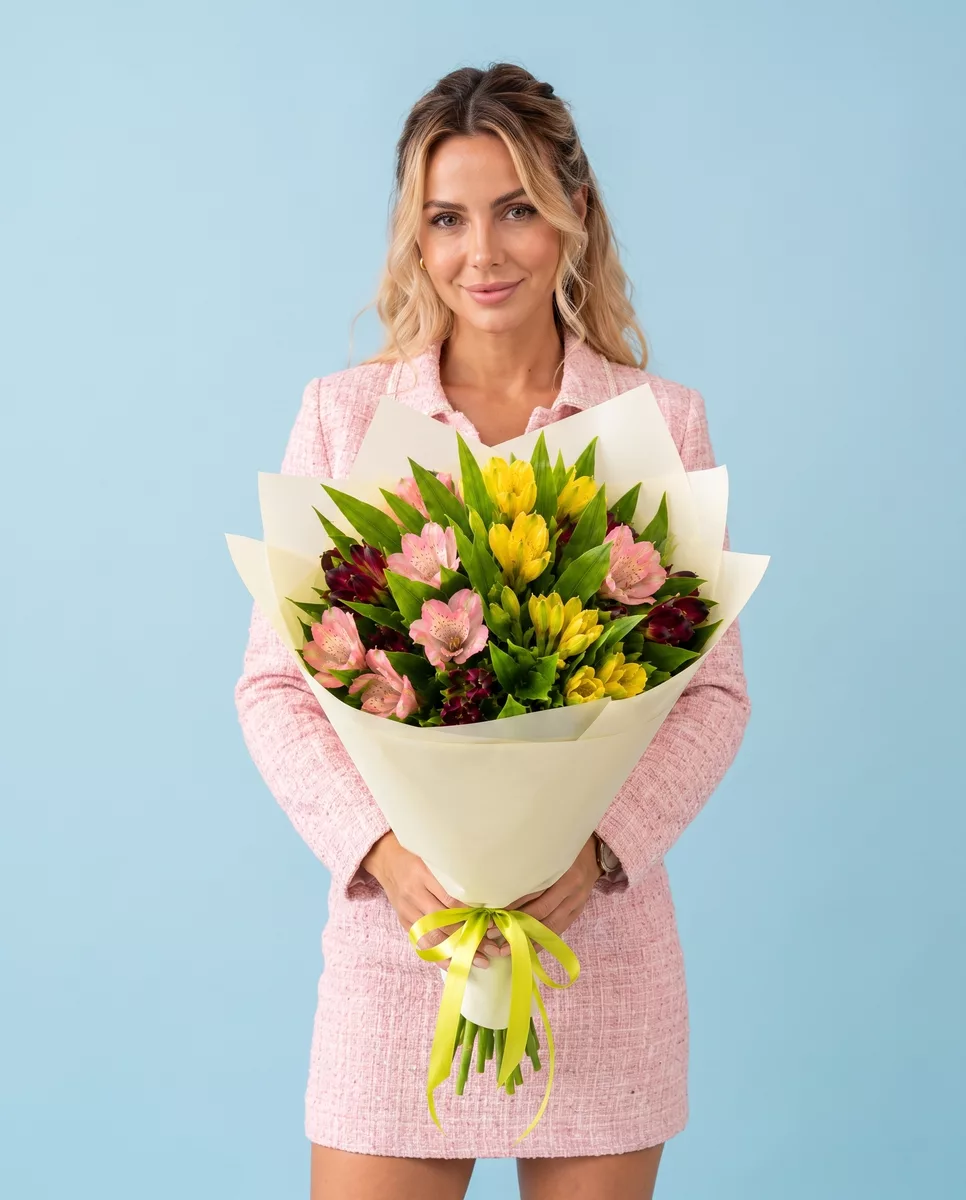
An open-plan office in late February or early March in a Russian city is typically heated to 22 to 24 degrees Celsius, sometimes warmer near radiators. That temperature range eliminates several popular flower choices immediately. Tulips, which are perhaps the single most iconic March 8th flower in Russia, are thermotropic — they continue to open and grow toward light and heat after cutting, and in a warm office they can go from tight bud to fully open and drooping within four to five hours. If you choose tulips, specify that they should be supplied as tight, closed buds and delivered in the morning, and advise recipients to keep them away from radiators. Spray roses and standard roses in mid-opening stage hold significantly better in warmth than tulips and are a reliable core flower for office orders. Alstroemeria is another strong choice — it is long-lasting, comes in a wide colour range, and does not react dramatically to temperature changes. Chrysanthemums, both spray and single-headed varieties, are extremely robust and cost-effective for large orders, though some recipients associate them with more formal or sombre occasions, so pairing them with brighter accent flowers helps the overall impression. Freesia adds fragrance and delicacy but wilts faster than roses or alstroemeria in heat. Hypericum berries, eucalyptus, and ruscus are all solid greens that add structure and last well. Avoid lily of the valley for large office orders — it is beautiful but extremely fragile post-cutting and the fragrance, while pleasant in small doses, becomes overwhelming in an enclosed space with many bouquets present simultaneously.
How to Structure the Order Logistics Across Multiple Floors or Buildings
The most common failure point in company-wide office delivery is not the flowers themselves but the information handed to the courier team. When you place the order, you need to provide a delivery manifest — a list that maps each bouquet to a specific recipient name, floor, room number or desk location, and any relevant access note. This is not optional paperwork; it is the document that determines whether the courier can complete the delivery in one organised pass or has to make repeated trips to reception asking for directions. If your company occupies a single floor of one building, the manifest is straightforward. If you have multiple floors, multiple buildings, or a security checkpoint that requires advance registration of visitors, each of these needs to be flagged in writing when you place the order, not mentioned verbally on the delivery day. Security registration in particular is a serious bottleneck — many Saint Petersburg business centres require courier accreditation at least 24 hours in advance, and a courier arriving with forty bouquets and no pre-registered pass will be turned away. Specify a single on-site contact person who will be present and reachable by phone during the delivery window. This person does not need to distribute the flowers themselves, but they need to be able to unlock doors, call security, and confirm recipient locations. Provide their mobile number directly to the shop when ordering. If any recipients work remotely on March 7th and want their bouquet delivered to a home address instead, treat each home address as a separate delivery line with its own logistics note.
Timing the Delivery Window and What Can Go Wrong
For an office delivery on March 7th, the ideal arrival window is between 10:00 and 13:00. This captures the period when most employees are at their desks, before the mid-afternoon drift toward early departures that often happens on the day before a public holiday. Deliveries requested after 15:00 on March 7th carry a real risk of finding empty desks, because many Russian companies allow staff to leave early on the pre-holiday afternoon. Early morning deliveries before 09:00 are possible but require the on-site contact to be present and the building to be fully accessible, which is not always the case. When you book your delivery window, be realistic about how long it takes to distribute bouquets across your premises. A courier team delivering to one floor of twenty recipients can typically complete the round in 25 to 35 minutes once inside the building. Two floors doubles that estimate, and any security delay adds time on top. Build a buffer into your requested window rather than booking the tightest possible slot. The most common complaint we hear after March 8th office deliveries is that some bouquets arrived warm — meaning the flowers were transported in an unventilated vehicle or held in a warm staging area too long before distribution. Ask the shop explicitly how the flowers are kept during transit. Refrigerated or temperature-controlled transport is standard practice for bulk orders and should be confirmed at the time of booking, not assumed.
Budgeting for a Company-Wide Order: What the Numbers Actually Mean
Corporate clients often approach a bulk flower order with the assumption that ordering in volume automatically produces a significant per-unit discount. The reality during the March 8th period is more nuanced. Wholesale flower prices at auction peak in the two weeks before the holiday, which compresses the margin available for volume discounts. A shop can offer better per-bouquet pricing for a large order because it reduces packaging labour and concentrates delivery logistics, but the flower cost itself is higher than it would be in, say, October. When budgeting, plan for a per-bouquet figure that reflects the holiday premium rather than an off-season benchmark. Discuss your total budget openly with the florist and ask what is achievable within it — a good florist will tell you honestly whether your budget allows for roses or whether alstroemeria and spray chrysanthemums are the realistic choice. Do not ask for a quote based on a specific variety and then expect the price to drop when you reveal the quantity; by March 7th, the variety availability is what it is. Factor in delivery cost as a separate line. A single-address office delivery is priced differently from a multi-address order where some bouquets go to home addresses across the city. Confirm whether the delivery fee is per-order or per-address, and get that in writing. Additional costs to anticipate include personalised cards for each recipient — a small addition that significantly increases the perceived thoughtfulness of the gesture — and any premium for specific colour schemes if you want the bouquets to match company branding.
Confirming the Order and Avoiding Last-Minute Changes
Once the order is placed and confirmed, treat the recipient list as locked unless a change is genuinely unavoidable. The most disruptive thing a corporate client can do in the 48 hours before delivery is add names, remove names, or change addresses, because by that point the flowers may already be sourced, the manifest is with the courier team, and any change requires manual correction across multiple documents. If you know that your headcount fluctuates — for example, because you have staff on variable contracts or because you are unsure which remote employees want office versus home delivery — build a small buffer into your initial order of two or three extra bouquets rather than trying to add them at the last minute. Extra bouquets on the day are manageable; last-minute additions to the delivery route often are not. When you receive the order confirmation from the shop, check three things immediately: the total bouquet count matches your recipient list, the delivery window matches what you discussed, and the on-site contact name and number are recorded correctly. Errors in these three fields account for the majority of problems on delivery day. If you have requested personalised cards with individual names, ask for a proof of the card list — a simple text list is sufficient — so you can catch any name misspellings before the cards are printed. Russian names can be transliterated in multiple ways and a card addressed to the wrong spelling of a colleague's name undermines the personal touch the whole exercise is meant to create. Confirm everything in writing, keep the confirmation, and share the delivery window with your on-site contact so they are not caught off guard.
A company-wide March 8th flower delivery is entirely manageable as a single coordinated order when the groundwork is done early. The variables that determine success are lead time, a complete and accurate delivery manifest, confirmed building access, and a realistic choice of varieties suited to a warm indoor environment. Place the order by March 1st, lock the recipient list as early as possible, and communicate the delivery window to whoever is meeting the courier on site. The flowers themselves — whether compact rose and alstroemeria bouquets or tulip-forward arrangements for a more traditional feel — will do their job if the logistics around them are solid. We deliver bouquets across Russia in 1–2 hours.
Frequently asked questions
How far in advance should a company place a March 8th bulk flower order?
Place the order by March 1st at the latest. This secures a delivery slot on March 7th, which is the busiest day of the year for flower couriers, and gives the shop time to source specific varieties before wholesale stock tightens. Orders placed on March 5th or 6th are likely to face limited variety availability and restricted delivery windows.
Can bouquets be delivered to different addresses — some to the office and some to employees' homes?
Yes, but treat each home address as a separate delivery line with its own timing and access details. Provide all home addresses in the original order manifest rather than adding them later. Delivery fees for dispersed addresses are typically calculated differently from a single-site office delivery, so confirm the pricing structure with the shop when booking.
What happens if an employee is unexpectedly absent on the delivery day?
Designate an on-site contact who can accept bouquets for absent colleagues and store them somewhere cool — a shaded corner away from radiators works for several hours. Inform the shop in advance that this person is the fallback recipient for any undeliverable bouquets, so the courier does not leave the building with flowers that have no home.
Is it appropriate to include personalised cards with each bouquet for a corporate order?
Yes, and it is worth doing. A card addressed to the individual recipient by name significantly increases the personal quality of the gesture. Provide the full name list when placing the order and ask for a text proof before cards are printed to catch any spelling errors. Cards are usually a minor addition to the overall order cost.
Why should bouquets have an odd number of stems for a Russian office gift?
In Russian tradition, even numbers of flowers are associated with mourning and are brought to funerals. Odd numbers — seven, nine, eleven — are the standard for celebratory and gift occasions. This convention is widely observed and a bouquet of eight stems, however attractive, would be noticed unfavourably by most Russian recipients. Stick to odd stem counts for March 8th orders.
Ready to send a bouquet?
Pick a city, choose the flowers, and we will hand them over with a photo confirmation.
Choose a city →