
New Year Flowers in Russia: What to Send Instead of Poinsettias
Every December we get the same call: someone outside Russia wants to send a poinsettia for New Year and wonders why the recipient seemed underwhelmed. The short answer is that poinsettias are a Western Christmas flower, and in Russia the big celebration is New Year's Eve on December 31st, not Christmas. The floral logic shifts completely once you understand that, and the good news is that the flowers which do work here are bold, long-lasting and easy to order remotely.
Why Poinsettias Do Not Land Well in Russia
Poinsettias are tied visually and culturally to Christmas, which in Russia is observed on January 7th according to the Orthodox calendar and is generally a quiet, religious occasion rather than a gift-giving event. The mass celebration — the one with Ded Moroz, Snegurochka, fireworks and large family dinners — happens on December 31st. When a poinsettia arrives on that date, most recipients simply do not connect it to anything meaningful. Beyond the cultural mismatch, there is a practical problem: poinsettias are cold-sensitive. Saint Petersburg winters sit well below zero, and even a short transit from van to door in minus-ten-degree air can blacken the bracts and collapse the stems within hours. The plant looks damaged before it even reaches the table. Russian florists stock them occasionally as houseplants in early December, but they are almost never used in bouquets or as a centrepiece for the New Year table. Customers who have lived in Germany, the UK or the United States often assume the December floral vocabulary is universal, but it is not. The Russian New Year table is more likely to hold a glass vase of white spray roses or a low arrangement of fir branches than anything resembling a potted holiday plant. Understanding that gap is the first step toward sending something that will actually be noticed and appreciated rather than politely set aside.
Bouquets we can deliver



Tulips: The Flower Russians Actually Expect in January
Tulips are so strongly associated with the New Year and early January in Russia that florists begin importing large volumes from the Netherlands in mid-December specifically for this period. The connection is partly historical — Soviet-era greenhouses pushed tulips for the winter holiday season — and partly practical, since tulips hold well in cold rooms and transit reliably. The varieties that perform best for New Year bouquets are double tulips such as Angelique and Ice Cream, which have a full, peony-like head that reads as celebratory, and strong single-flowered varieties like White Dream and Purple Flag. Single-colour bunches of twelve or fifteen stems in white, deep purple or coral are the most requested formats at this time of year. Tulips arrive closed and open gradually over three to five days indoors, which means a bouquet sent on December 31st will still look fresh on January 2nd or 3rd when guests come for post-New-Year visits. One common mistake when ordering remotely: asking for tulips to be sent fully open. A fully open tulip has already used most of its vase life and will droop within a day. Request tight or half-open buds and the recipient gets the full experience. Water temperature matters too — tulips prefer cool water around ten degrees Celsius, not room temperature, and the vase should be kept away from radiators, which run at full power in Russian apartments during January.
Spray Roses and Garden Roses for the New Year Table
Roses are the backbone of Russian floristry year-round, but for New Year specifically the demand shifts toward fuller, multi-petalled varieties rather than the long-stemmed single roses typical of Valentine's Day. Spray roses — varieties like Lydia, Tiny Sensation and Snowflake — cluster several small blooms on one stem and create a dense, textured look that suits table arrangements without blocking sightlines across the dinner setting. White and cream spray roses are consistently the top sellers in December and early January because they photograph well against the silver and gold decorations that dominate Russian New Year interiors. Garden roses such as David Austin's Juliet or Keira are imported in smaller quantities but are popular for premium bouquets because their quartered, cupped form has a richness that standard hybrid tea roses cannot match. For a centrepiece arrangement that will last through the January holidays — Russia has a long public holiday stretch from January 1st to 8th — roses should be conditioned in clean water for at least four hours before arranging and kept in a cool room overnight if the event is the following evening. One mistake we see often in remote orders: specifying red roses because they seem festive. Red is associated more with February 14th and March 8th in Russian floral culture. For New Year, white, champagne, blush and deep burgundy read as more appropriate and will match the table setting better than a bright red bouquet.
Chrysanthemums, Alstroemeria and What Else Survives January Transit
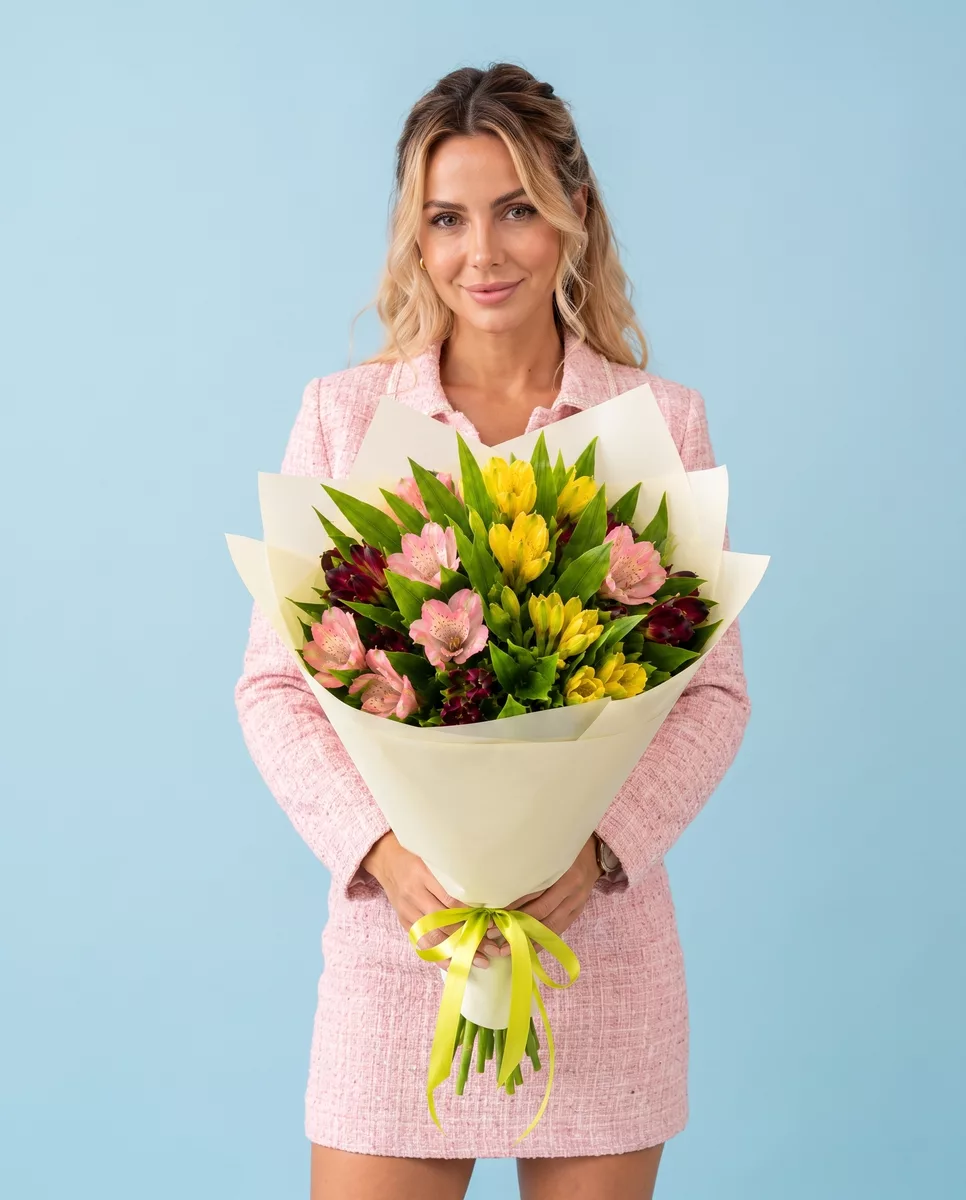
When a bouquet needs to travel across Russia — from Saint Petersburg to Novosibirsk or Yekaterinburg — the choice of flower becomes partly an engineering decision. Not every bloom survives a same-day courier run in January temperatures, and the flowers that do are worth knowing. Large-headed chrysanthemums, particularly the disbud varieties like Anastasia and Zembla, are among the most cold-tolerant cut flowers available. They arrive with a tight centre, open slowly and last ten to fourteen days in a vase, which makes them practical for recipients who will be away from home for part of the holiday week. Alstroemeria is another reliable choice: the stems are sturdy, the buds continue opening after delivery and the flower tolerates brief cold exposure far better than, say, gerbera or anthurium. Lisianthus, sold in Russia under the name eustoma, has become increasingly popular for New Year arrangements because its ruffled, rose-like blooms come in white, violet and deep purple — all colours that suit the season — and it holds for seven to ten days without special treatment. What does not survive January transit well: gerbera daisies, which bruise easily and collapse in cold; open garden roses, which are too fragile once fully bloomed; and any tropical flower such as bird of paradise or heliconia, which suffers chilling injury below eight degrees Celsius. If you are ordering a bouquet for delivery to a city where temperatures are below minus fifteen, ask specifically for cold-hardy varieties and confirm the courier uses an insulated bag.
Fir Branches, Hypericum and the Greenery That Belongs in These Bouquets
In Russian New Year floristry, greenery is not just filler — it carries specific seasonal meaning. Fir and spruce branches are the visual anchor of the holiday because the New Year tree in Russia is almost always a fir or spruce, not a pine. Adding a few fir branches to a bouquet of white tulips or spray roses immediately signals the season in a way that eucalyptus or ruscus simply does not. Florists use Nordmann fir tips, which have flat, soft needles that do not shed indoors, and blue spruce, which has a silvery tone that pairs well with white and cream flowers. Hypericum berries — available in red, white, orange and burgundy — are the most practical berry accent for winter bouquets because the stems are sturdy and the berries do not crush during delivery. Ilex, the classic Christmas holly with red berries, is available in December but less common in January; hypericum fills the same visual role more reliably. Cotton stems, which produce round white bolls on bare branches, have grown in popularity over the last three or four years as a textural element that reads as wintry without being overtly Christmas-specific. One thing to avoid: mistletoe. It is not part of Russian New Year tradition and most recipients will not recognise its significance. Wax flower — Chamelaucium — is a better white accent if you want something delicate and fragrant, and it tolerates cold transit well. A well-constructed New Year bouquet from this shop typically combines two or three flower types with fir tips and one berry or textural accent rather than relying on a single flower in quantity.
Timing: When to Order for December 31st Delivery
New Year's Eve is the single busiest delivery day in Russian floristry, and the window between noon and eight in the evening on December 31st is when demand peaks sharply. Orders placed on the morning of the 31st for same-day delivery are possible but carry risk — not because the flowers will not be available, but because delivery slots fill up and the recipient may get their bouquet at ten at night rather than in time for the dinner. The practical advice for anyone ordering from abroad or from another time zone: place the order on December 30th for morning delivery on the 31st. This gives the recipient time to condition the flowers, arrange them and have them looking their best before guests arrive. Tulips ordered the evening before will be at half-open by evening — exactly the right stage. For corporate orders or large arrangements, December 28th or 29th is more realistic; large-format work requires preparation time that same-day ordering does not allow. Russian New Year gifts are typically exchanged at midnight or just before, so a bouquet delivered at six or seven in the evening on the 31st lands at exactly the right moment. One detail that trips up remote orders: Russia has multiple time zones, and Saint Petersburg operates on Moscow Time (UTC+3). If you are ordering from Western Europe, the time difference is only two or three hours, but from the United States or Asia the gap is significant enough to cause a missed delivery window if the order is placed without checking the local time at destination.
What to Check Before You Confirm a New Year Flower Order
Several small details determine whether a New Year bouquet arrives looking as intended or becomes a disappointment. First, confirm the delivery address includes an apartment number and intercom code — Russian apartment buildings almost always have a locked entrance, and a courier who cannot get through the intercom will leave the bouquet in the cold lobby or return it. This is especially important in large residential complexes built in the Soviet era where intercom systems are old and inconsistent. Second, check whether the recipient will be home. Many Russians travel to dacha houses or visit family outside the city for the New Year week, and a same-day delivery to an empty apartment solves nothing. A brief message to the recipient — even just asking if they will be home on the evening of the 31st — prevents the most common delivery failure we see. Third, specify the water level in the bouquet packaging. Long-distance or multi-hour deliveries should include an aqua pack — a small water-filled sachet attached to the stem ends — to keep the flowers hydrated during transit. Standard bouquet wrapping without water is fine for a thirty-minute local delivery but inadequate for anything over an hour. Fourth, if the bouquet includes fir branches or other foliage, ask that it be wrapped in a sleeve that protects the flowers from the needles during transit; fir tips can bruise rose petals and tulip buds if they press against them in a tight wrap. These are not dramatic requirements — they are the kind of specifics a working florist checks automatically, and asking about them when placing a remote order signals that you know what you want.
The shift from poinsettias to tulips, spray roses and fir-accented bouquets is not about personal taste — it is about matching the flower to the occasion and the climate. Russian New Year is a warm, domestic celebration that happens in the middle of deep winter, and the flowers that work best are the ones that survive the cold, open gradually over several days and fit naturally on a table already crowded with food, champagne glasses and silver decorations. Order a day early, specify cold-hardy varieties, include an aqua pack for longer routes and confirm the recipient will be home. Those four steps account for almost every problem we see with New Year deliveries, and getting them right means the bouquet arrives looking exactly as it should. We deliver bouquets across Russia in 1–2 hours.
Frequently asked questions
Can I send a poinsettia plant instead of a bouquet for Russian New Year?
Poinsettias are rare in Russian New Year tradition and are sensitive to cold temperatures. A brief exposure to winter air during delivery can damage the bracts permanently. A bouquet of tulips or spray roses is a more culturally familiar and cold-tolerant choice for a December 31st gift.
Which flower colours are most appropriate for a Russian New Year bouquet?
White, cream, champagne, deep burgundy and violet are the most fitting colours for New Year arrangements in Russia. Bright red is more associated with Valentine's Day and International Women's Day. Silver and gold decorative elements in the wrapping complement these tones well against typical holiday interiors.
How far in advance should I order flowers for delivery on December 31st?
Ordering on December 30th for morning delivery on the 31st is the safest approach. Same-day slots on New Year's Eve fill quickly, and a morning delivery gives tulips or roses time to open to the right stage before the evening celebration begins.
What flowers travel best in Russian January temperatures?
Disbud chrysanthemums, alstroemeria, lisianthus and tulips are the most cold-tolerant cut flowers for winter delivery. Gerberas, open garden roses and tropical flowers such as bird of paradise suffer in temperatures below minus eight and should be avoided for deliveries in cold-weather cities.
Is it appropriate to include fir branches in a New Year bouquet for a Russian recipient?
Yes — fir and spruce tips are strongly associated with the New Year tree in Russia and add immediate seasonal relevance to any arrangement. Nordmann fir is preferred because it does not shed indoors. Pair it with white tulips or spray roses and hypericum berries for a composition that reads as genuinely festive.
Ready to send a bouquet?
Pick a city, choose the flowers, and we will hand them over with a photo confirmation.
Choose a city →