
Greeting Card Wording for a Russian New Year Flower Delivery
Every week around late December we field the same question at the counter: what do I write on the card? The flowers are chosen, the address is confirmed, the delivery slot is booked — and then the sender goes blank. This matters more than people expect, because in Russia the greeting card is read aloud at the table, often in front of the whole family, so clumsy phrasing lands hard. This article gives you ready phrases in English and in transliterated Russian, explains the customs behind them, and tells you what to avoid when ordering a card for flowers going to a Russian address.
Why New Year Is the Biggest Flower Moment in Russia
Russian New Year on 1 January is the centrepiece celebration of the winter season, carrying more weight than Christmas does in most Western countries. Soviet-era policy moved festive gift-giving away from Christmas and onto New Year, and that habit has stayed firm across generations. Flowers are the single most common gift sent alongside champagne, chocolates or a box of mandarins, which are themselves a New Year symbol. The peak ordering window runs from 28 December through to the evening of 31 December, with the sharpest spike on the 31st itself between noon and 6 p.m. At Five Flowers we deliver across Russia within one to two hours, but on 31 December we ask customers to book morning slots because road traffic in central Saint Petersburg and in other major cities slows the final kilometre considerably. The bouquets we sell most heavily in this window are spray roses in red and white, standard chrysanthemums, alstroemeria and tulips — tulips arrive from Dutch auctions in late December and hold well in unheated hallways, which is where Russian recipients often keep flowers to extend vase life. Knowing this context helps you pitch the card correctly: the recipient is probably hosting guests, is feeling celebratory and will read your words in a warm, slightly crowded room. The card should be short, warm and specific to the person, not a generic printed verse.
Bouquets we can deliver



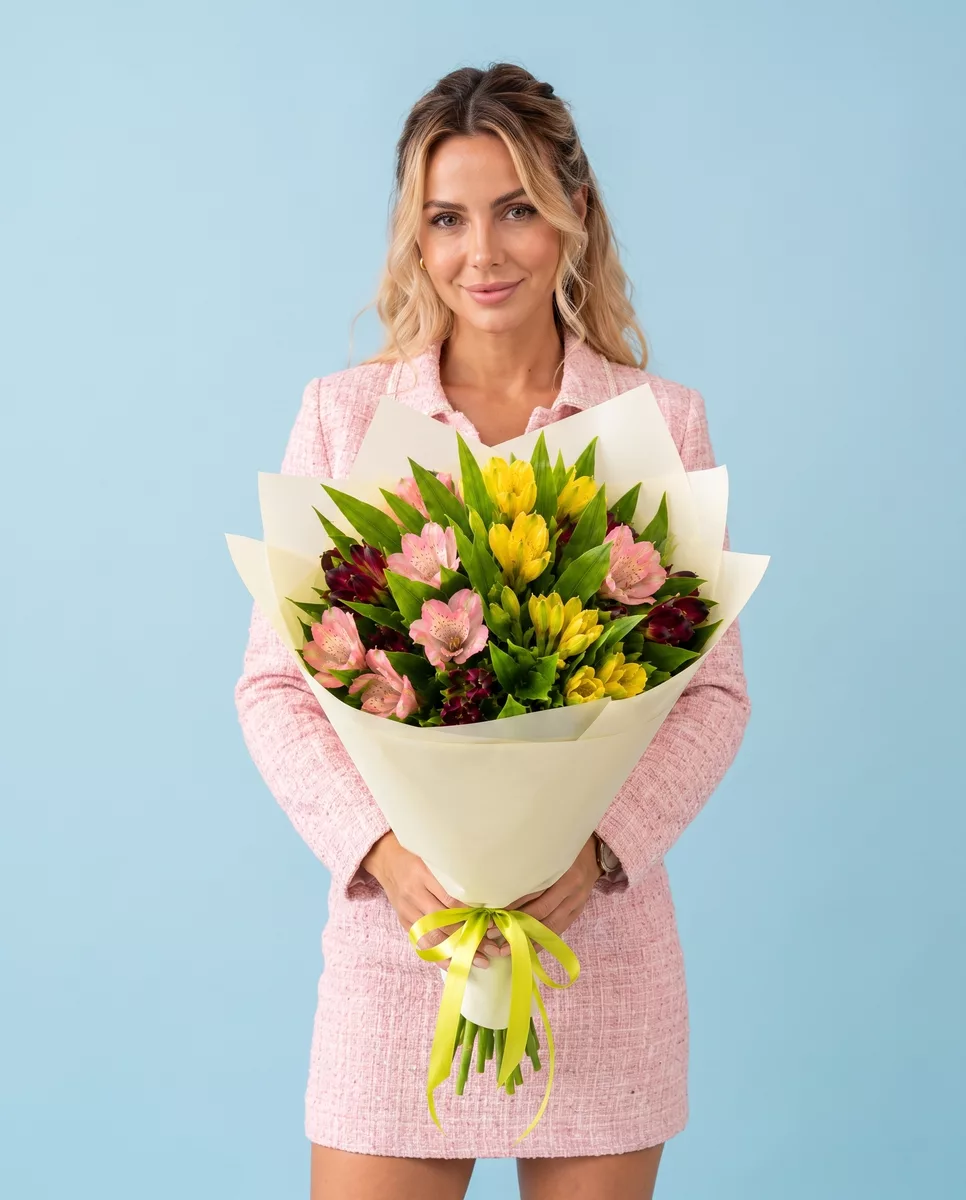
The Structure of a Russian New Year Greeting
A standard Russian New Year card follows a recognisable three-part pattern: address the person by name or relationship, offer the core wish, then add one personal line. The core wish almost always contains the phrase S Novym Godom — literally With the New Year — which functions the way Happy New Year does in English but is grammatically an instrumental case construction, meaning you are greeting someone into the new year rather than simply labelling it happy. After that phrase, Russians typically wish health first, then happiness, then something specific to the person's life. Health comes first by cultural convention and skipping it reads as slightly odd to a Russian recipient, even if the sender is foreign and well-meaning. The personal line at the end is where you can mention a shared memory, a hope for the coming year, or a quality you admire in the person. Avoid long paragraphs: a card accompanying flowers should be three to five sentences maximum, because the florist's card slip is small and dense handwriting gets lost. When you order through our website you can type your message in the notes field in either English or Russian Cyrillic, and we print it clearly on a branded card. If you are writing in transliterated Russian — Latin letters representing Russian sounds — keep the spelling consistent throughout so the recipient can read it smoothly. The phrases in the sections below are formatted for exactly that use.
Core Phrases in English and Transliterated Russian
Start with the greeting itself. In English: Happy New Year, or Wishing you a wonderful New Year. In transliterated Russian: S Novym Godom (С Новым Годом) — pronounce it roughly as S No-vim Go-dom. If you want to add warmth, extend it to S Novym Godom i Rozhdestvom, which covers both New Year and Orthodox Christmas on 7 January, a common combined greeting sent in late December. For the wish section, the most traditional line is Zhelayu vam zdorovya, schastya i blagopoluchiya — I wish you health, happiness and prosperity. In everyday usage this is shortened to Zhelayu vsego nailuchshego, which means I wish you all the best and is universally appropriate. If you are writing to a close friend rather than a relative or colleague, you can switch from the formal vy (vam) to the informal ty (tebe): Zhelayu tebe schastya v novom godu — I wish you happiness in the new year. For a colleague or a parent of a friend, stick with the formal vam. The closing line can be as simple as S uvazheniem (With respect) for professional contacts, or S lyubovyu (With love) for family. If you are a foreigner writing to a Russian friend and want to acknowledge the cultural distance warmly, Ot vsego serdtsa — From the whole heart — lands well and is easy to transliterate legibly. These phrases work on cards accompanying any of our standard New Year bouquets: a twelve-stem spray rose arrangement, a mixed alstroemeria bundle or a tulip bunch.
Phrases for Different Relationships
The relationship between sender and recipient should shape every word choice. For a parent or grandparent, formality and warmth coexist: S Novym Godom, dorogaya mama. Zhelayu vam krepkogo zdorovya, radosti i tepla v kazhdyy den — Happy New Year, dear mother. I wish you strong health, joy and warmth every day. The word dorogaya means dear and is standard in Russian family correspondence without sounding excessive. For a romantic partner, you can be more direct: S Novym Godom, lyubimaya or lyubimyy (feminine or masculine). Ya schastliv byt ryadom s toboy v etom godu i vo vsekh posleduyushchikh — I am happy to be beside you this year and in all the ones that follow. For a colleague or business contact, keep sentiment contained: S Novym Godom. Zhelayu vam uspekha, zdorovya i novykh dostizheniy v nastupayushchem godu — Happy New Year. I wish you success, health and new achievements in the coming year. For a friend you have known a long time, informality is expected: Brat, s Novym Godom! Pust etot god budet luchshe proshlogo — Bro, Happy New Year! May this year be better than the last. Note that Russian friends often drop formal structure entirely and write as they speak. When ordering flowers for a business recipient, we recommend pairing the card with a structured bouquet — chrysanthemums or standard roses in a single colour — rather than a loose, expressive arrangement, because the visual register of the flowers should match the register of the words.
What to Avoid Writing on the Card
Several common mistakes arrive in our order notes every December, and a florist sees them all. The first is wishing someone a Happy Christmas on a card going to a secular Russian household: many Russian families do not observe Christmas at all, and those who do celebrate it on 7 January, not 25 December, so a Christmas greeting on 31 December reads as foreign and slightly confused. If you want to cover both occasions, use the combined phrase S Novym Godom i S Rozhdestvom, but place it only on cards going between 1 and 6 January. The second mistake is over-length. A card slip holds roughly forty words comfortably. We regularly receive notes of two hundred words that the recipient will never read fully because they are hosting twelve people and the flowers are being unwrapped at a crowded table. Cut to what matters most. The third mistake is using the word pozdravlyayu without a follow-up wish: pozdravlyayu means I congratulate you, and in Russian it always expects a continuation — pozdravlyayu s Novym Godom, zhelayu... If you stop at pozdravlyayu it sounds incomplete. The fourth mistake is transliterating poorly. Write Schastya, not Shastya or Shastyah — the recipient will read it aloud and mispronunciation of your own wish creates an awkward moment. If you are uncertain, write in English: a clear English message is always better than garbled Russian. Finally, avoid any reference to the year just ending being difficult or disappointing, even if it was — New Year cards in Russia are relentlessly forward-looking by convention.
Timing the Card Message to the Delivery Window
The words on the card should match when the flowers arrive, not when you order them. If you book a delivery for 30 December, the message can look ahead: Vstrechaem Novyy God vmeste — We meet the New Year together — or simply Pust novyy god prinosit tolko khorosheye — May the new year bring only good things. These forward-looking phrases work naturally one or two days before midnight. If the delivery lands on 1 January itself, which we fulfil from 10 a.m. onward, the message should shift to past tense acknowledgement: S nastupivshim Novym Godom — a phrase meaning With the New Year that has now arrived, used in the first week of January the way belated is used in English but without the apologetic tone. Russian recipients understand this phrase as warm and timely rather than late. Deliveries between 2 and 13 January still carry New Year energy in Russia because the holiday period extends through Orthodox Christmas on 7 January and often informally through the weekend following. In this window, S nastupivshim remains appropriate. After 13 January, Old New Year — Staryy Novyy God, celebrated by some families on the night of 13 to 14 January by the old Julian calendar — passes and the seasonal greeting window closes. Flowers in this later period should carry a simple personal message rather than a seasonal one. Tulips, which we stock heavily through January from Dutch and domestic growers, suit these later deliveries well because they read as fresh and seasonal without being tied to a specific holiday.
Putting It Together: Sample Complete Card Messages
Here are four complete messages you can copy directly into the order notes field, adjusting the name. For a parent: Dorogaya mama, s Novym Godom! Zhelayu tebe krepkogo zdorovya, tepla i radosti v kazhdyy den nastupayushchego goda. Ty — luchsheye, chto u menya est. S lyubovyu — Dear mother, Happy New Year! I wish you strong health, warmth and joy every day of the coming year. You are the best thing I have. With love. For a colleague: Uvazhaemaya Anna Petrovna, s Novym Godom! Zhelayu vam uspekha vo vsekh nachinaniakh i khorosheye zdorovye. S uvazheniem — Dear Anna Petrovna, Happy New Year! I wish you success in all your endeavours and good health. With respect. For a close friend: Sasha, s Novym Godom, brat! Pust etot god budet polnym priklyucheniy i vsego, chego ty khochesh. Do vstrechi — Sasha, Happy New Year, mate! May this year be full of adventures and everything you want. See you soon. For a romantic partner: Lyubimaya, s Novym Godom. Etot god byl osobennym ryadom s toboy, i ya zhelayu nam oboim schastya i lyubvi v novom — My love, Happy New Year. This year was special beside you, and I wish us both happiness and love in the new one. Each of these fits comfortably on a standard card slip. When ordering spray roses or a mixed seasonal bouquet through our site, paste the message exactly as written and specify whether you want it printed or handwritten.
Getting the card right takes ten minutes and makes the whole delivery land better. Flowers from a serious shop — fresh-cut, delivered cold-chain within two hours — deserve a message that matches the effort. Use the phrases above as a starting point, adjust the name and one personal detail, keep it under forty words, and send it with confidence. If you are unsure whether to write in English or Russian, write in English: a clear, warm English message from a foreigner is always received well in Russia, and it is far better than transliterated Russian that the recipient has to decode at a party. We deliver bouquets across Russia in 1–2 hours.
Frequently asked questions
Is it acceptable to write the card message in English for a Russian recipient?
Completely acceptable. Russian recipients, especially in cities, are accustomed to receiving messages in English from foreign contacts or relatives abroad. A clear, warm English message reads better than poorly transliterated Russian. If the recipient speaks no English at all, a simple S Novym Godom followed by one English sentence works as a friendly hybrid that any family member can help translate.
What is the correct way to address an older Russian woman on a card?
Use her first name and patronymic — for example, Anna Petrovna — rather than just her first name, which would feel too familiar. Open with Uvazhaemaya (Dear, formal) and use the formal vam throughout your wishes rather than the informal tebe. Close with S uvazheniem (With respect) or S nailuchshimi pozhelaniyami (With best wishes). This structure is standard for anyone you address formally in Russian culture.
Can I send flowers and a card on 1 January, or is that too late?
Not too late at all. We deliver from 10 a.m. on 1 January, and flowers arriving on New Year's Day are very well received because the household is still in celebration mode. Use the phrase S nastupivshim Novym Godom on the card, which means the New Year has now arrived and carries no sense of lateness. Many Russian families actually prefer a daytime delivery on the 1st over a chaotic late-evening one on the 31st.
Should I mention Orthodox Christmas on the card if I am sending flowers in early January?
Only if you know the recipient observes it. Orthodox Christmas falls on 7 January, and not all Russian families celebrate it religiously. A safe combined phrase for cards sent between 1 and 6 January is S Novym Godom i S Rozhdestvom Khristovym, which covers both occasions without assuming. If you are unsure of the recipient's observance, stick with the New Year greeting alone — it is never wrong and never exclusionary.
How many words should the card message be for flowers going to a large family gathering?
Keep it to thirty to forty words maximum. At a family gathering the card is often read aloud by whoever opens the door, in front of guests, before the bouquet even reaches a vase. A long message creates an awkward pause. One address line, one core wish, one personal sentence and a closing sign-off is the ideal structure. It reads well aloud, fits the card slip and leaves the flowers to do the emotional work.
Ready to send a bouquet?
Pick a city, choose the flowers, and we will hand them over with a photo confirmation.
Choose a city →