
New Year Flowers in Russia: Traditions, Varieties and Timing
New Year, not Christmas, is the main gift-giving holiday in Russia, and flowers are part of almost every celebration from December 31 through the first days of January. Customers call us asking for red roses because they look festive, then wonder why the bouquet wilts before midnight. The answer is usually temperature shock between the street and the apartment, or a variety chosen for looks rather than vase life. This article covers what Russians actually do with flowers at New Year, which arrangements survive a winter delivery, and what details matter most when you place an order.
Why New Year Outranks Christmas for Flowers in Russia
Russia follows the Orthodox calendar, which places Christmas on January 7, two weeks after the secular New Year on January 1. For most Russian families, the night of December 31 is the centerpiece of winter celebrations: the televised address, the champagne at midnight, the table loaded with food, and the exchange of gifts. Flowers fit naturally into this ritual because they signal occasion and effort in a way that a wrapped box does not. The Soviet period reinforced the habit: imported goods were scarce, but flowers from Georgian and Azerbaijani greenhouses reached Moscow and Leningrad year-round, making a bouquet one of the few reliable luxury items a person could give. That association stuck. Today, the days between December 28 and January 2 are among the three busiest delivery periods of the year for us, alongside March 8 and Valentine's Day. The demand is not just for bouquets to give as gifts; many customers order flowers for their own tables, treating a centerpiece arrangement as part of the decoration alongside the traditional Soviet-era fir tree. Understanding this dual purpose, gift and decoration, shapes which flowers we recommend and how we advise customers to care for them through a long festive evening that often runs past 3 a.m.
Bouquets we can deliver



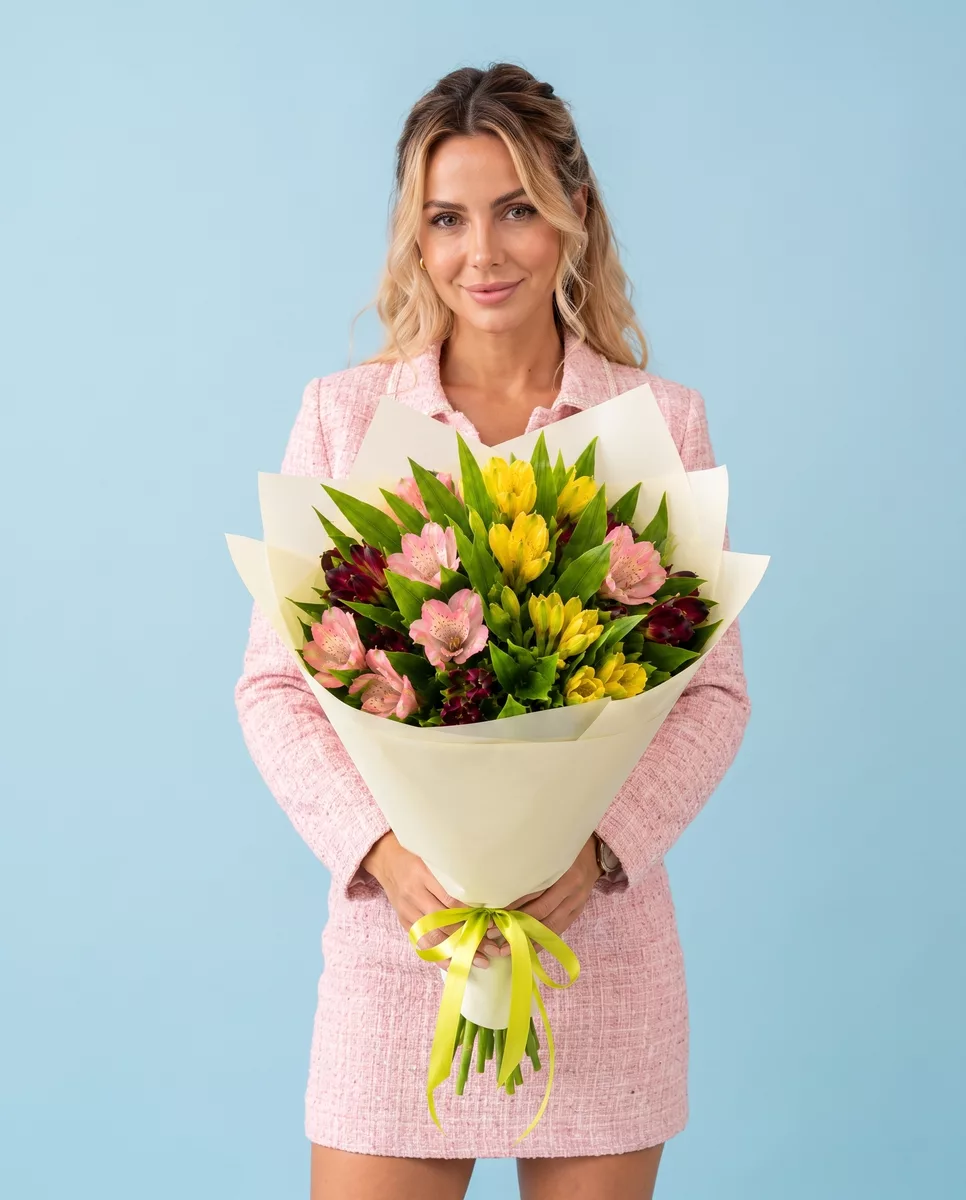
The Fir Tree and the Flower: How Arrangements Fit Russian Decor
The yolka, the decorated fir tree, dominates Russian New Year interiors, and flowers need to work alongside it rather than compete with it. Most apartments have the tree in the main room, often near a window, and the festive table in the same space. Arrangements placed on the table sit under warm indoor lighting and near food, candles, and people for several hours. This means vase life under real conditions matters more than how the bouquet photographs. We steer customers away from delicate open blooms like garden roses or fully open peonies for table centerpieces because they drop petals quickly in warm, dry apartment air. Compact arrangements with closed or half-open flowers work better: spray chrysanthemums, alstroemeria, carnations, and hypericum berries all hold their shape for forty-eight hours or more even when the room temperature climbs above twenty-two degrees Celsius. Greenery choices also matter. Russians traditionally associate the New Year with fir, pine, and spruce, so adding conifer branches to an arrangement immediately reads as festive rather than generic. We use noble fir tips, blue spruce cuttings, and sometimes eucalyptus for a similar silvery-green tone. A mixed bouquet of red spray roses, white alstroemeria, and noble fir tips placed in a low vase on the table is a combination that survives the evening, looks intentional, and does not block eye contact across the table, which matters when twelve people are seated for dinner.
Winter Delivery Realities: Cold, Timing and What Damages Flowers
Saint Petersburg in late December averages minus five to minus ten degrees Celsius, and temperatures occasionally drop to minus twenty. Flowers leaving our shop are wrapped in insulating paper sleeves and placed in temperature-controlled transport, but the last thirty seconds between the courier's hands and the recipient's door can damage tropical varieties like anthurium or orchid if the exposure is prolonged. This is not a theoretical risk: we see it most often when customers order exotic flowers for delivery to addresses with long outdoor walks from parking to entrance, or to buildings where the courier must wait outside. The practical advice is to choose cold-tolerant varieties for winter delivery if the recipient lives anywhere with an exposed approach. Roses, carnations, alstroemeria, chrysanthemums, and waxflower all tolerate brief cold exposure far better than anthuriums, tropical orchids, or bird-of-paradise. Timing is the other variable that customers underestimate during New Year. We begin receiving orders in volume from December 26, and the delivery window on December 31 fills by early afternoon. Orders placed after 2 p.m. on the 31st may not arrive before midnight depending on the delivery zone. Our consistent advice: order by December 29 if you want a specific delivery time on New Year's Eve, and specify a two-hour window rather than an exact time, because traffic in Saint Petersburg on December 31 is unpredictable from mid-afternoon onward.
Red and White: The Color Logic of New Year Bouquets in Russia
Russian New Year color conventions draw from Soviet-era decoration rather than Western Christmas palettes. Red, gold, and silver are the dominant tones, with white appearing as a snow reference. Green comes from the tree itself. This means a bouquet built around red and white flowers reads as immediately seasonal without needing ribbon, baubles, or other decoration attached to the stems. The most ordered combination in our shop during this period is red roses with white gypsophila, which is classic but ages quickly if the roses are fully open at delivery. We prefer to build the same visual effect with red spray roses, which are smaller, sturdier, and last two to three days longer in a warm room than standard large-headed roses. White alstroemeria replaces gypsophila for customers who want something with more structure. Gold and silver tones are harder to achieve with fresh flowers alone, but we use hypericum berries in burgundy and orange, dried lunaria seed pods with their silvery membrane, and sometimes cotton stems for a textural contrast that photographs well and dries gracefully if the customer keeps the arrangement. Avoid dyed or spray-painted flowers for New Year arrangements intended to last into the first week of January: the dye does not extend vase life, and the color often fades or bleeds within forty-eight hours, particularly if the customer is cutting stems and changing water as we recommend. Natural color in a cold-tolerant variety will always outlast an artificially colored flower.
Champagne and Flowers: Bouquets as New Year Gifts
Giving a bouquet alongside a bottle of champagne is one of the most common New Year gift combinations in Russia, and it creates a specific practical problem: the recipient is often holding both when they open the door. Bouquets intended to accompany champagne should be compact and easy to carry in one hand, which means we design them with a flat or slightly angled back so they can be set down on a table immediately without rolling. A mono bouquet of fifteen to twenty-one stems works better here than a wide, domed arrangement. Odd numbers are the Russian convention for gift bouquets; even numbers are reserved for mourning, and this rule is observed seriously enough that customers correct us if we get it wrong. Fifteen red spray roses tied with a satin ribbon, or twenty-one white tulips when they are in season, are both appropriate and easy to transport. Tulips deserve a separate note: they are not at their best in late December because the main Dutch tulip season peaks in February and March. We import tulips year-round, but December tulips are typically grown under artificial light and have softer stems than spring stock. They are still a good choice if the recipient specifically loves tulips, but we recommend refrigerating them immediately after receipt and cutting the stems every day. For a gift that will be displayed for several days, spray chrysanthemums or carnations are more reliable even if they feel less glamorous.
New Year Table Centerpieces: Sizes, Vessels and Flower Selection
A centerpiece for a New Year table in a Russian apartment faces specific constraints. The table is typically laden with food, which limits the footprint available for flowers. The room is warm and often smoky if older guests are present. The arrangement needs to look good from multiple angles because guests sit around the table rather than facing a single direction. Low, wide arrangements in shallow dishes or squat vases solve most of these problems. We recommend a maximum height of twenty-five centimeters for a table centerpiece so it does not block conversation. Flower choices for centerpieces should prioritize compact heads and firm petals. Spray chrysanthemums in white, cream, or burgundy are ideal: the individual florets are small, the stems are sturdy, and the flower does not shed petals even after twenty-four hours in a warm room. Alstroemeria is equally reliable and comes in red, white, orange, and pink, all of which work in a New Year palette. We add conifer greenery, hypericum berries, and sometimes small pine cones wired to picks for texture. The vessel matters more than customers expect. A clear glass cube or cylinder in a ten to fifteen centimeter diameter is the most versatile option because it suits both modern and traditional apartment interiors. Customers who want to reuse the vase after the holiday should mention this when ordering so we avoid foam mechanics that are difficult to clean. Water-based arrangements in a clean vessel with a small amount of flower food last significantly longer than foam-based ones in warm conditions.
January 1 to 7: Flowers Through the Extended Holiday
Russia's New Year holiday runs officially from January 1 through January 8, covering both the secular New Year and Orthodox Christmas on January 7. Many families celebrate twice, which means flowers given on December 31 need to survive into the first week of January or a second bouquet is needed. We deliver throughout the holiday period, including January 1, though the delivery window is longer than usual because traffic is lighter but staffing is also reduced. Customers ordering for January 7 Orthodox Christmas should note that the aesthetic is slightly different: white and gold are more traditionally associated with the religious holiday than red, and arrangements featuring white lilies, white roses, or white chrysanthemums with gold-toned accents are the most requested. Lilies require a note of caution for households with cats, as all parts of the lily plant are toxic to cats, and many Russian households keep cats. We always flag this when customers order lilies for delivery to a home address. For the full holiday period, the most practical single purchase is a mixed arrangement built around chrysanthemums and alstroemeria with conifer greenery, ordered fresh on December 30 or 31 and properly maintained. Cut one to two centimeters from each stem every two days, change the water daily, keep the arrangement away from the heating radiator, and remove any wilted individual flowers promptly. Maintained this way, a well-constructed arrangement will look presentable through January 5 or 6 in most apartment conditions, covering the core of the Russian winter holiday entirely.
New Year flowers in Russia are not an afterthought to the celebration; they are part of the ritual, as expected on the table as the champagne and the Olivier salad. The customers who are happiest with their orders are the ones who think about where the flowers will sit, how long they need to last, and what temperature conditions they will face, rather than simply picking the most visually striking option in the catalog. A compact arrangement of red spray roses, white alstroemeria, and noble fir tips will outperform a dramatic bouquet of open garden roses every time in a warm apartment on a long New Year's Eve. Order early, choose cold-tolerant varieties, keep the stems cut and the water fresh, and the flowers will carry the festive mood from the first toast on December 31 through the quieter days of early January. We deliver bouquets across Russia in 1–2 hours.
Frequently asked questions
Can I order flowers for delivery on January 1 in Saint Petersburg?
Yes, we deliver on January 1, but the delivery window is wider than usual. We recommend placing the order before midnight on December 31 and selecting a morning or early afternoon slot. Same-day January 1 orders placed after noon may be scheduled for a later window depending on volume and your delivery zone.
Which flowers last longest in a warm Russian apartment on New Year's Eve?
Spray chrysanthemums, carnations, and alstroemeria consistently outperform large-headed roses and tulips in warm indoor conditions. They tolerate temperatures above twenty-two degrees Celsius without dropping petals and hold their shape for forty-eight to seventy-two hours with basic care: fresh water, trimmed stems, and distance from heating radiators.
Is it true that even numbers of flowers are not given as gifts in Russia?
Yes, this convention is observed seriously. Even numbers of flowers are associated with mourning and funerals, so gift bouquets are always built in odd numbers: five, seven, eleven, fifteen, twenty-one, and so on. If you are ordering for a Russian recipient, always check that your bouquet count is odd to avoid an awkward moment.
Are tulips a good choice for a New Year bouquet in Russia?
Tulips are popular but not at their seasonal best in late December. Winter tulips are grown under artificial light and have softer stems than spring stock. They are a reasonable choice if the recipient loves them, but they need daily stem cuts and cool conditions. For a bouquet that must last several days, spray roses or alstroemeria are more reliable.
What should I order if I want flowers that suit both New Year and Orthodox Christmas on January 7?
White and gold tones work for both occasions. A mixed arrangement of white chrysanthemums or white alstroemeria with hypericum berries and noble fir greenery bridges both holidays visually. Order it fresh on December 30 or 31, maintain it properly, and it will remain presentable through January 7 in most home conditions.
Ready to send a bouquet?
Pick a city, choose the flowers, and we will hand them over with a photo confirmation.
Choose a city →