
Office Flower Etiquette: Bouquets for Colleagues in Russia
Every week we get orders where someone is clearly guessing — a giant red rose arrangement for a line manager's birthday, a white chrysanthemum bundle for a colleague's work anniversary, a bouquet so large the recipient had no idea where to put it during a full day of meetings. Sending flowers to a Russian workplace is not complicated, but there are a handful of customs and practical limits that, if ignored, make the gift awkward rather than appreciated. This article covers what actually works: which varieties, which sizes, which colours, and what to check before you place the order.
Why Workplace Deliveries Follow Different Rules Than Personal Ones
A home delivery lands in private. A workplace delivery lands in front of colleagues, assistants, and sometimes a whole open-plan office. In Russian professional culture this creates a specific pressure: the recipient should not look as though they are receiving something extravagant from a secret admirer, and the sender should not appear to be making a grand personal statement in a neutral space. The social reading of a bouquet happens fast, and it happens publicly. This is not unique to Russia, but Russian office culture tends to be more formal than, say, Scandinavian or American equivalents, particularly in finance, law, government and manufacturing sectors. Casual gestures that feel normal in a creative agency can read as overfamiliar in a bank. The practical consequence is that size, colour and composition all matter more in an office context. A bouquet of forty stems is a statement; a bouquet of fifteen stems is a gesture. The first draws attention and commentary; the second is easy to accept gracefully. Similarly, saturated reds and deep purples carry romantic or highly personal associations in Russian flower culture, while soft pinks, whites, creams and greens read as collegial and respectful. None of this means the bouquet should be boring — it means the choices should be deliberate. A florist who understands office delivery will steer you toward varieties that hold well in a warm office, look composed rather than theatrical, and do not require a vase the size of a bucket to display properly.
Bouquets we can deliver



Colour Palettes That Work in Professional Settings
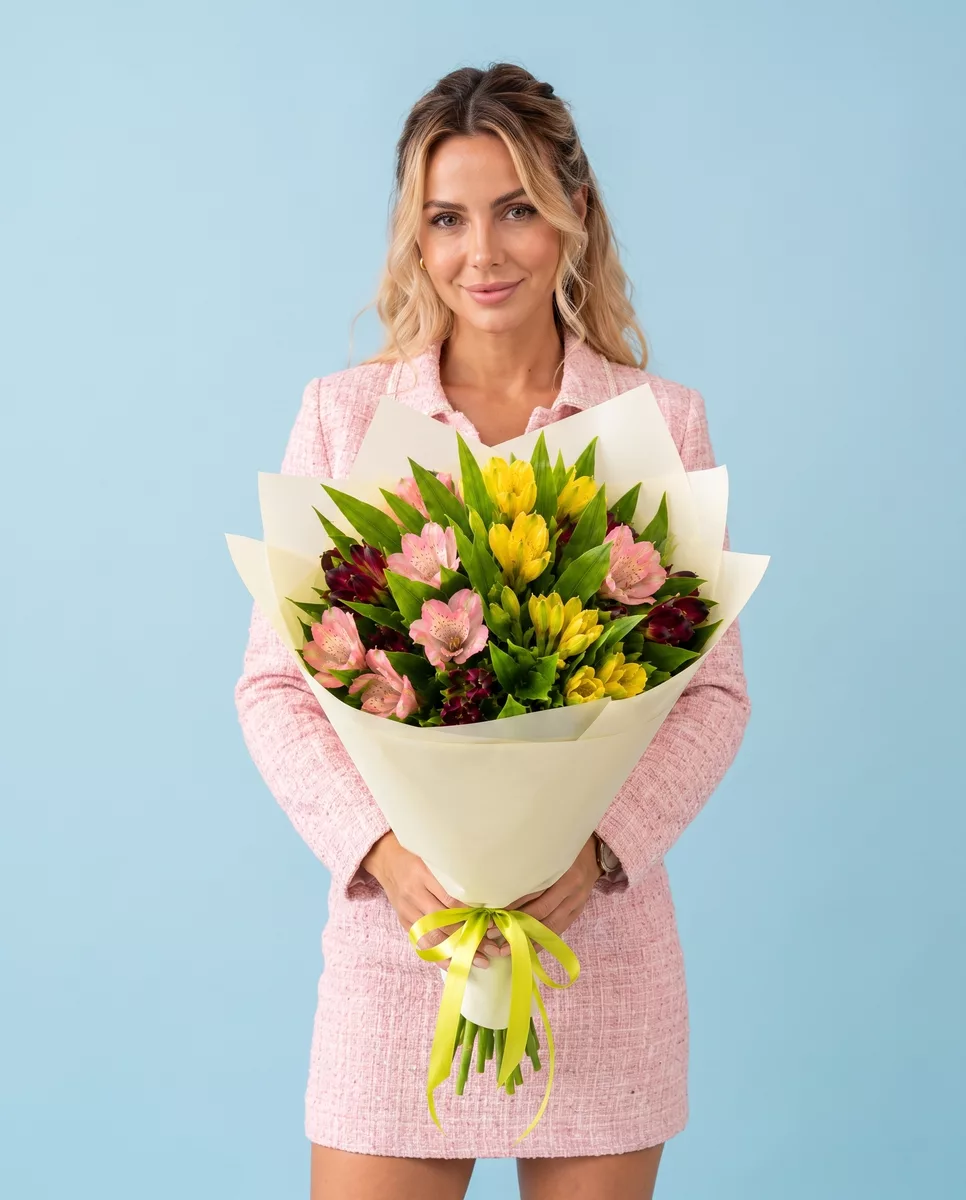
The safest and most consistently well-received palette for a Russian workplace bouquet runs through whites, creams, soft pinks and greens. White spray roses, white or blush lisianthus, cream ranunculus and pale alstroemeria are all varieties that read as polished without being cold. Adding a green element — eucalyptus, pittosporum, or even a few stems of green trick dianthus — gives the arrangement a contemporary, considered look that works across industries and seniority levels. Soft lavender is also acceptable in most contexts, particularly for women in creative or educational roles. What to avoid is more instructive than what to choose. Saturated red roses in a workplace context carry a romantic signal that most recipients will find uncomfortable in front of colleagues. Deep burgundy can work if paired with ivory and green, diluting the intensity. Yellow is culturally loaded in Russia: it is associated with separation and bad luck in traditional belief, and while younger urban recipients are less likely to hold this view, it is still common enough that yellow flowers as a standalone choice create unnecessary risk. Orange is generally fine. Hot pink depends entirely on the recipient's personality and your relationship. If you are ordering for someone you know moderately well rather than closely, stay in the white-to-blush-to-green range and you will not go wrong. These are not rigid rules but they reflect what we hear back from recipients and senders after the fact.
Bouquet Sizes That Do Not Overwhelm the Recipient
The question of size is partly about aesthetics and partly about logistics. An office worker receiving flowers at their desk still has to finish their working day, attend meetings, possibly commute on public transport, and eventually get the bouquet home without destroying it. A very large arrangement — anything requiring a tall vase and significant counter space — creates an immediate practical problem. The recipient either has to ask someone to help find a container, leave it on a communal surface where it may be moved or damaged, or carry something unwieldy on a metro or bus. None of these outcomes are what you intended. For a colleague rather than a close friend, a bouquet of eleven to fifteen stems is the standard that works well in Russian office culture. Eleven is a common number because Russian tradition holds that even numbers of flowers are for mourning — so always order an odd number. Fifteen stems gives a generous, thoughtful impression without tipping into extravagance. The bouquet should be compact enough to stand in a standard office mug or a simple round vase that the recipient or their office likely already has. If the recipient is a senior manager or director and you want to acknowledge that without being excessive, seventeen to nineteen stems in a neat, structured arrangement achieves that. We regularly build these as mono-bouquets — one variety, one colour, consistent stem length — which look deliberate and professional rather than abundant and celebratory. Avoid round, dome-shaped arrangements that require a wide-mouthed vase; cylindrical or slightly tapered compositions are easier to manage.
Which Varieties Actually Last Through a Working Day and Beyond
Russian offices are typically heated to between 22 and 25 degrees Celsius in winter, and air conditioning in summer can make the air very dry. Both conditions accelerate the aging of delicate flowers. Choosing varieties with strong longevity is not a minor point — a bouquet that wilts visibly by mid-afternoon is embarrassing for the recipient and reflects poorly on the sender. The most reliable varieties for office conditions are spray roses, which hold their form and colour well in warm dry air for five to seven days when properly conditioned. Lisianthus is another strong performer: the closed buds open gradually over several days, giving the arrangement a changing, lively quality. Alstroemeria is extremely hardy and long-lasting, though it is sometimes perceived as a budget flower — pairing it with ranunculus or spray roses immediately elevates it. Ranunculus is beautiful but more temperature-sensitive; it is a better choice in spring and autumn than in deep winter when office heating is at its most intense. Chrysanthemums last extremely well, but in Russia white chrysanthemums in particular carry a strong association with funerals and should never be sent to a workplace. Spray chrysanthemums in peach, yellow or green are a different matter and are generally fine. Gerbera daisies are cheerful and durable but tend to read as casual; they work better for a younger colleague or a creative environment. Tulips are seasonal, beloved in Russia, and appropriate for spring occasions, but they continue to grow after cutting and will lean and stretch in a warm room — factor that in if the recipient has a tidy desk.
Occasions That Justify a Workplace Delivery and Those That Do Not
The occasions that genuinely work for an office flower delivery in Russia are fairly specific. A birthday is the most common and universally accepted reason. Professional milestones — a promotion, the successful close of a major project, a work anniversary — are also well-established. International Women's Day on the eighth of March is the single largest flower-sending occasion in Russia and workplace deliveries on that date are not only normal but expected; men in offices routinely send or present flowers to female colleagues, and the gesture is entirely professional in that context. Teacher's Day on the fifth of October is significant if you are sending to someone in education. February the twenty-third, Defender of the Fatherland Day, is the male equivalent and while flowers are less traditional for men on that date, they are not inappropriate. What does not work well as an office delivery occasion is anything that might be misread. Sending flowers to a colleague to apologise for a professional disagreement is unusual and can create confusion. Sending flowers to congratulate someone on a personal life event — an engagement, a new baby — is better done outside the workplace unless you are close friends. Sending flowers to a colleague of the opposite sex without a clear professional occasion attached to the delivery will generate speculation, regardless of your intent. If the occasion is ambiguous, a brief, plainly worded card message clarifying the reason for the gift does more work than any choice of flower colour.
Timing the Delivery So It Arrives Without Disrupting the Workday
The timing of a workplace delivery matters more than most senders anticipate. Arriving during a meeting, during a lunch break when the recipient is not at their desk, or at the end of the day when the office is emptying out creates unnecessary complications. The optimal window for most Russian offices is between ten in the morning and one in the afternoon. By ten, the working day is properly underway and the recipient is settled. Before one, they have time to deal with the arrival gracefully before lunch. We deliver within one to two hours of order confirmation across Saint Petersburg, and we can reach most major Russian cities within the same window through our own logistics. When you place the order, specify a delivery window rather than a single time if the recipient's schedule is uncertain. It is also worth confirming the office address carefully: building number, entrance number, floor, and whether the office has a reception desk or a door code. Many Russian business centres have strict access procedures, and a courier who cannot reach the recipient directly will have to leave the bouquet at reception, which changes the experience of receiving it. If the recipient is working from home on the day you plan to send, a home delivery is obviously better — but confirm this before ordering, because rerouting a delivery after it has left our shop adds time. For large office buildings in city centres, ground-floor reception delivery is standard and works well; just make sure the card is clearly addressed with the recipient's full name and department.
What to Write on the Card and How to Handle the Order Practically
The card message for a workplace flower delivery should be short, clear and professional in tone. Two or three sentences is enough. State the occasion explicitly — 'Congratulations on your promotion' or 'Happy birthday, wishing you a great year ahead' — so that the recipient does not have to explain to curious colleagues why they received flowers. Avoid anything that could be read as personal or intimate, even if your relationship with the colleague is warm. In a Russian professional context, a restrained message is always more appropriate than an effusive one. If you are sending on behalf of a team, list the team or department name rather than individual names, which keeps the gesture collective and removes any suggestion of a personal relationship. On the practical side, when you order from us you will need the recipient's name, the precise delivery address including floor and office number, a contact phone number for the recipient or the reception desk, and your preferred delivery window. Do not use the recipient's mobile number as the contact if you want the delivery to be a surprise — use a reception desk number or a colleague who is in on the plan. Confirm that the office is open and the recipient is physically present on the delivery date; we cannot hold a bouquet indefinitely, and a fresh arrangement that sits undelivered for two hours loses condition. If the recipient is likely to be in back-to-back meetings, note that in the order comments and we will coordinate with reception to ensure the flowers are placed somewhere they will be found promptly and kept in water.
Getting a workplace flower delivery right in Russia comes down to a few consistent principles: odd numbers of stems in the eleven-to-seventeen range, colours in the white-to-blush-to-green palette, varieties chosen for durability in warm office conditions, and a card message that names the occasion plainly. The customs are not difficult to navigate once you know them, and a well-chosen bouquet delivered at the right time to the right address is one of the most effective professional gestures available. The mistakes we see most often — too large, too red, too vague on the card, delivered at an inconvenient hour — are all avoidable with a few minutes of thought before placing the order. We deliver bouquets across Russia in 1–2 hours.
Frequently asked questions
Is it acceptable to send flowers to a male colleague in a Russian office?
Yes, particularly on Defender of the Fatherland Day on February the twenty-third, or for a birthday or professional milestone. Keep the arrangement compact and the colour palette neutral — whites, greens and creams work well. Avoid anything that reads as romantic. A mono-bouquet of white spray roses or green trick dianthus is a safe, well-received choice for a male recipient.
Why should I avoid even numbers of flowers when sending to a Russian colleague?
In Russian tradition, even numbers of flowers are associated with mourning and are used at funerals. This association is widely held across generations and regions. An even-numbered bouquet at a birthday or professional celebration will be noticed and may make the recipient uncomfortable. Always order an odd number — eleven, thirteen, fifteen or seventeen are all common and appropriate for workplace gifts.
Can I send a potted plant instead of a cut bouquet to an office?
A potted plant is a practical alternative, particularly for a long-serving colleague or a manager who would appreciate something lasting. Succulents and small orchids work well in office conditions. The drawback is that a plant requires the recipient to take responsibility for it indefinitely, which some people find burdensome. A cut bouquet is the standard choice; a plant works best when you know the recipient actively likes them.
What is the single most common mistake people make with office flower deliveries in Russia?
Choosing red roses. Red roses carry a strong romantic signal in Russian culture and are consistently the wrong choice for a colleague unless you are in a personal relationship with them. Senders often choose red roses because they feel like a safe, classic option, but in a workplace context they create immediate speculation and put the recipient in an uncomfortable position in front of colleagues.
How far in advance should I order for a morning office delivery in Saint Petersburg?
Placing the order the evening before or by eight in the morning on the day gives us the most flexibility to build the arrangement and schedule the courier for a ten to eleven o'clock arrival. We can take same-day orders and deliver within one to two hours, but for workplace deliveries where timing matters, earlier is better. Note the recipient's name, floor and office number clearly when ordering.
Ready to send a bouquet?
Pick a city, choose the flowers, and we will hand them over with a photo confirmation.
Choose a city →