
Russian Public Holidays: When to Order Flowers to Get Them on Time
Every year we field the same calls at 10 p.m. on February 22nd: someone needs fifty mixed bouquets by nine the next morning for Women's Day gifts at the office, and they are genuinely surprised that we cannot guarantee it. Russian public holidays compress weeks of normal demand into forty-eight hours, change courier availability overnight, and empty the cold rooms of specific varieties before most customers have even started browsing. This article maps the key dates, explains what actually happens to delivery windows on and around each one, and tells you exactly what to check before you confirm an order.
Why Holidays Hit Flower Logistics Harder Than Other Retail
A flower shop is not a warehouse of shelf-stable goods. Every stem in our cold room has a sell-by window measured in days, sometimes hours, so we cannot simply stockpile inventory six weeks ahead of a holiday the way a gift retailer might. We order from growers and auction houses on tight lead times, and those suppliers also operate on reduced schedules around Russian state holidays. When a holiday falls on a Thursday, the surrounding Wednesday and Friday often see informal closures or skeleton crews at sorting facilities, which means a shipment of Ecuadorian roses or Dutch tulips that would normally arrive in thirty-six hours can take sixty or more. That delay compresses our working stock precisely when demand is highest. On a normal Tuesday in November we might dispatch forty to sixty bouquets across Saint Petersburg. On March 7th, the eve of International Women's Day, that number multiplies several times over, and every courier slot fills before noon. The practical consequence for customers is that same-day delivery, which we offer as standard on ordinary days, becomes a conditional promise on peak dates. The condition is simple: order early enough that your bouquet is assembled and loaded before the courier queue closes. Customers who understand this place orders the evening before or even two days ahead. Customers who do not understand it call us at lunchtime on the holiday itself and learn that the earliest available slot is late evening, if there is one at all. Knowing which dates trigger this pattern is the first step to avoiding it.
Bouquets we can deliver

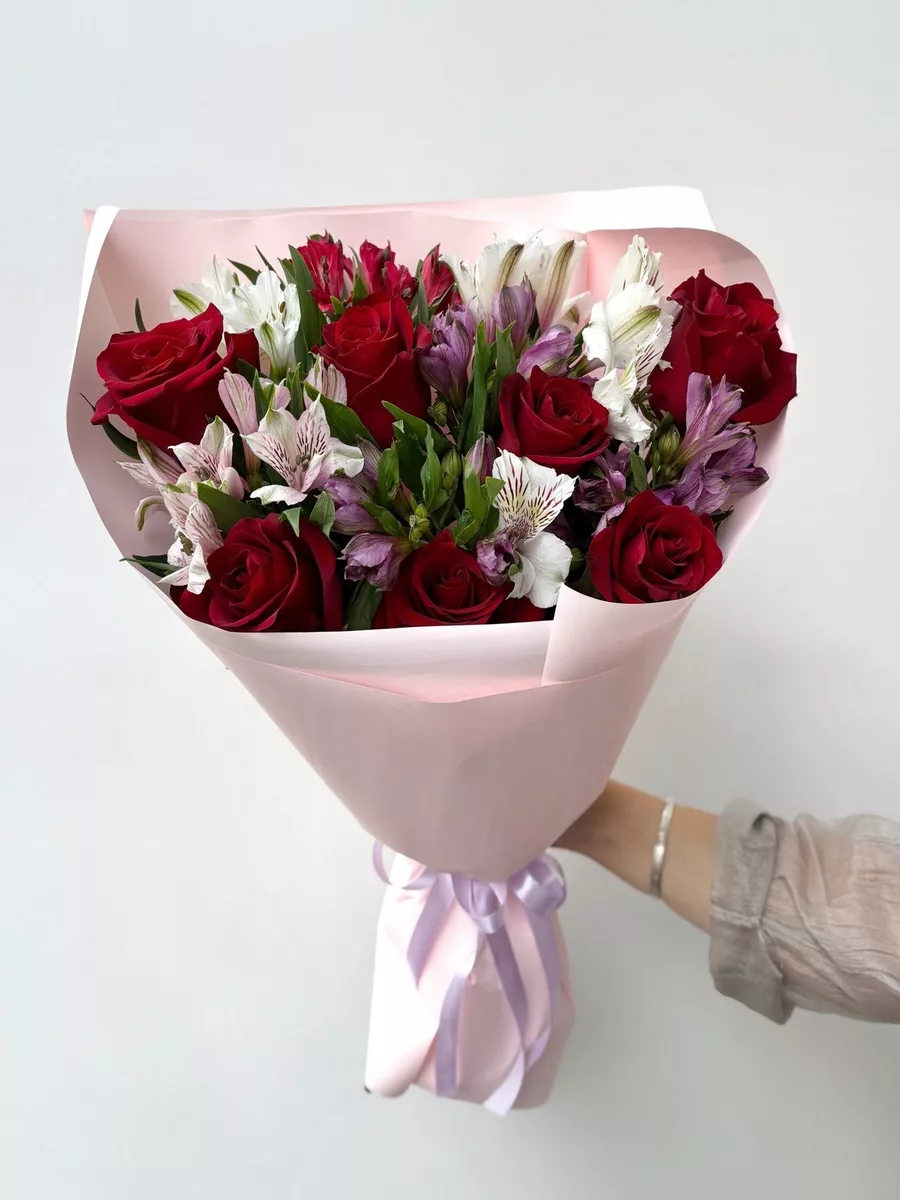


International Women's Day on March 8th: The Biggest Spike of the Year
March 8th is not a gentle uptick in orders. It is, without exaggeration, the single most demanding delivery day in the Russian floral calendar, and its pressure actually begins on March 6th. Corporate clients ordering for entire offices account for a large share of early volume, and they typically want tulips — Triumph and Darwin Hybrid varieties in yellow, pink, and white — because tulips read as the seasonal flower for this holiday. The problem is that tulips are cold-sensitive: they open fast in warm rooms, and a bouquet assembled on March 6th for delivery on March 8th needs careful temperature management the whole way. We keep them at two to four degrees Celsius in transit, but a customer who stores them in a heated hallway for twelve hours will see open blooms by morning. Roses are the second major category, with spray roses and garden-style varieties like Mondial and Explorer moving in large quantities. By March 7th afternoon, specific colors sell out first: red and coral go earliest, soft peach and cream hold longer. If you have a color preference, ordering by the evening of March 6th is not caution — it is the minimum needed to guarantee that preference is honored. Delivery windows on March 8th itself are typically available only in the morning, with afternoon slots closing by midday on the 7th. Anyone placing an order after 10 a.m. on March 8th should expect an evening delivery at best and should confirm the recipient will be home to receive it.
February 23rd: Defender of the Fatherland Day and Its Underestimated Demand
February 23rd is a public holiday honoring military service, now broadly celebrated as a day to give gifts to men — fathers, husbands, male colleagues. Flowers are less traditional here than, say, a bottle of cognac, but the market for bouquets on this date has grown steadily. More importantly for logistics, February 23rd falls one or two weeks before March 8th, which means our team is simultaneously handling holiday volume and preparing stock orders for the bigger event ahead. That operational overlap tightens our capacity. The varieties that move on February 23rd tend toward structured, less overtly romantic arrangements: anthuriums, tropical foliage, succulent arrangements, and bold single-variety bouquets of sunflowers or proteas. Sunflowers in particular are a practical choice — they travel well in cool temperatures and have a strong visual impact without reading as a romantic gesture. What customers often miss is that February 23rd is a full public holiday, meaning courier availability is reduced from the start of the day rather than from midday. We operate on a holiday schedule: fewer drivers, tighter time slots, no late-evening deliveries in most cases. Orders placed on February 22nd by early evening are processed normally. Orders placed on the morning of the 23rd enter a queue that may already be at capacity for morning and midday windows. If you are sending flowers to a male colleague or relative on this date, treat it with the same advance-planning discipline you would apply to March 8th, even though the social weight of the holiday feels lighter.
New Year and the Long January Holiday Block
Russia's New Year holiday is not a single day. Public holidays officially run from January 1st through January 8th, covering Orthodox Christmas on January 7th. For flower delivery this creates a sustained low-availability period rather than a single spike. Many suppliers and logistics operators take most of this window as leave, which means fresh stock replenishment is limited. We work through the period, but with reduced incoming shipments. The varieties available in early January reflect what was ordered and received before December 31st: amaryllis, which keeps exceptionally well in cold storage, chrysanthemums in white and yellow, and standard-grade roses. Exotic or short-lived varieties such as sweet peas, ranunculus, or garden roses are often unavailable or available in limited quantities because they cannot survive the extended cold-chain disruption that comes with holiday logistics. December 31st itself is one of the busiest single delivery days of the year. Customers ordering for New Year's Eve celebrations want large statement arrangements, and many of these orders arrive on December 30th or even the 29th. If you need delivery on December 31st, ordering by midday on the 30th is the practical threshold. For deliveries during January 1st through 8th, expect that same-day orders may not be fulfilled until the afternoon or evening, and that variety choice will be narrower than usual. Customers who want specific flowers — white amaryllis, for example, or a particular rose variety — should order at least two days ahead and confirm availability by phone rather than assuming the website catalog reflects real-time stock during this period.
May Holidays: Victory Day and the Spring Surge
May in Russia carries two significant public holidays close together. May 1st is Spring and Labor Day, and May 9th is Victory Day, one of the most emotionally important national commemorations in the Russian calendar. Victory Day is centered on remembrance of World War Two, and while we do not cover memorial arrangements in this article, the holiday creates a notable effect on general flower logistics: many suppliers and drivers take the surrounding days as informal leave, and the period from May 7th through May 10th often sees reduced courier capacity even for standard celebratory orders. May 1st is more straightforwardly a spring celebration, and the flowers associated with it are seasonal: lilac, which is highly perishable and must be delivered within hours of cutting, peonies if the season has opened early, and field-style mixed bouquets with ranunculus and anemones. Lilac is the trickiest. It wilts rapidly in warm transport and does not hold well even in a cold room beyond twenty-four hours. If you order lilac for May 1st delivery, it should be cut and dispatched the same morning. Do not order lilac for next-day delivery during warm spring weather. The broader May holiday block also coincides with the dacha migration — large numbers of Saint Petersburg residents leave the city for their country houses from late April onward, which changes delivery address patterns. If the recipient is at a dacha rather than a city apartment, confirm the address and access details carefully, as rural addresses require longer transit times and are subject to separate scheduling.
Valentine's Day: Not a Russian State Holiday, but Operationally It Behaves Like One
February 14th is not an official public holiday in Russia, but it generates order volumes that rival March 8th in the days immediately before it. The holiday is widely observed, particularly among younger urban customers, and the demand profile is heavily skewed toward red roses — specifically long-stemmed varieties in the sixty to seventy centimeter range. Freedom, Explorer, and Red Naomi are the varieties most commonly requested. All three are imported, primarily from Ecuador and Kenya, and lead times from order to arrival at our cold room are three to five days. If we have not ordered enough stems by February 10th, we cannot conjure them on the 13th. This is the core logistics reality behind Valentine's Day shortages. Customers who want a specific variety and stem count should order by February 11th at the latest. By February 13th, red rose availability is often down to what is physically in the cold room, and we fulfill orders in the sequence they were received. A customer who places a standard red rose order on the evening of the 13th may receive their bouquet, but they may also be offered an alternative variety if the requested stems are exhausted. White and pink roses hold availability longer because demand for them is lower on this date. If you are flexible on color, say so in your order notes — it increases the chance of on-time delivery. Delivery windows on February 14th fill by midday on the 13th for morning and afternoon slots.
What to Check Before Confirming Any Holiday Order
The practical checklist is short but most customers skip at least one item. First, confirm that the variety you want is actually in stock for your chosen delivery date — not just listed on the website, but confirmed by a staff member if you are ordering more than two days ahead, because catalog availability does not always reflect what will be physically present on a future date. Second, check the delivery window options carefully. On holidays we publish available time slots, and if only evening slots remain, that information is shown at checkout. Do not assume a morning slot is available because you are ordering before noon. Third, verify the recipient's address and access situation. Holiday deliveries to offices are complicated by reduced staffing — if the office building has a security desk, confirm someone will be there to sign for the order or arrange delivery to a home address instead. Fourth, check the stem count and bouquet size against what the courier can carry. Very large arrangements — over one hundred stems or with structural elements like branches — require advance notice and are sometimes not feasible on peak days when couriers are running condensed routes. Fifth, and most practically: if the delivery is time-sensitive for a specific event — a birthday dinner, a ceremony, a morning presentation — tell us the hard deadline in the order notes. We prioritize flagged time-sensitive orders within our queue. A bouquet that arrives two hours late on an ordinary Tuesday is an inconvenience. On a holiday, it can mean missing the moment entirely, and that is the outcome everyone is trying to avoid.
Russian public holidays are predictable. The dates do not move, the demand patterns repeat every year, and the logistics constraints are the same each cycle. The customers who receive their bouquets on time on March 8th, December 31st, and February 14th are almost always the ones who ordered two to three days ahead, confirmed variety availability, and specified a delivery window rather than leaving it open. The customers who call us in distress on the holiday itself are almost always the ones who assumed that same-day delivery works the same way it does in October. It does not. The flowers are the same — the roses, the tulips, the lilac — but the system moving them operates under completely different pressure. Order early, be specific about what you want and when it needs to arrive, and the holiday delivers itself. We deliver bouquets across Russia in 1–2 hours.
Frequently asked questions
Can I still get same-day flower delivery on March 8th in Russia?
Same-day delivery on March 8th is possible only if you order very early in the morning and slots remain open, which is rarely the case by 10 a.m. The safe approach is to order on March 6th or the evening of March 7th. By the holiday itself, most morning and afternoon windows are already filled from orders placed the previous day.
Which flowers sell out fastest around Russian public holidays?
Red long-stemmed roses disappear first around Valentine's Day. Tulips in pink and yellow go earliest before March 8th. Lilac has the shortest availability window of any spring variety because it cannot be stored more than a day after cutting. If you want any of these specifically, order at least two days before the holiday and confirm stock with the shop.
Does flower delivery operate on January 1st through January 8th in Russia?
Yes, delivery operates through the New Year holiday block, but on a reduced schedule with fewer courier slots and limited incoming stock. Variety choice is narrower than usual because supplier shipments slow significantly. Amaryllis and chrysanthemums are reliably available; short-lived varieties like ranunculus or sweet peas are often not. Order at least two days ahead and check availability directly.
Is February 23rd a busy day for flower delivery in Russia?
It is busier than a normal weekday and operates on a full public holiday courier schedule, meaning fewer drivers and no late-evening deliveries. Demand is lower than March 8th but the reduced capacity means slots fill faster than customers expect. Order by the evening of February 22nd to guarantee a morning or midday window on the 23rd.
What information should I include in a holiday flower order to make sure it arrives on time?
Include the recipient's full address with apartment number and entry code, a contact phone number for the recipient, your preferred delivery window as a specific time range rather than 'anytime,' and a note if there is a hard deadline. For office deliveries, confirm someone will be present to receive the order, since holiday staffing at reception desks is often reduced.
Ready to send a bouquet?
Pick a city, choose the flowers, and we will hand them over with a photo confirmation.
Choose a city →