
Sending Flowers to Your Girlfriend in Russia: What Actually Works
Every week we take orders from men outside Russia — sometimes outside Europe — who want a bouquet at a girlfriend's door the same day. The questions are always the same: which flowers survive the journey, what time is the cutoff, and what do you write on the card when you are twelve time zones away. This article answers all of that with the specifics florists actually use, not the vague reassurances you find on most websites.
Deadlines That Decide Whether the Delivery Happens Today
Same-day delivery across Russia runs on hard cutoff times, and missing them by thirty minutes means the order shifts to tomorrow. For Saint Petersburg and Moscow, orders placed before 16:00 local time reliably reach the recipient the same day. For cities in the Urals — Yekaterinburg, Chelyabinsk — the practical cutoff is closer to 14:00 because the assembly and transit window is tighter. Siberian cities such as Novosibirsk and Krasnoyarsk sit two to four hours ahead of Moscow, so if you are ordering from Western Europe or the Americas, calculate the local Russian time first, not your own. Russia spans eleven time zones, and the single most common mistake is placing an order at what feels like midday to you but is already evening in the destination city. When you open the order form, the city field sets the clock — fill it in first, then check the available delivery windows before you choose flowers or write the card message. If you have missed the same-day window by an hour or two, a morning delivery the following day is usually the better option rather than a rushed late-evening attempt, because flowers assembled under time pressure and delivered after 21:00 are rarely a pleasant surprise for anyone.
Bouquets we can deliver



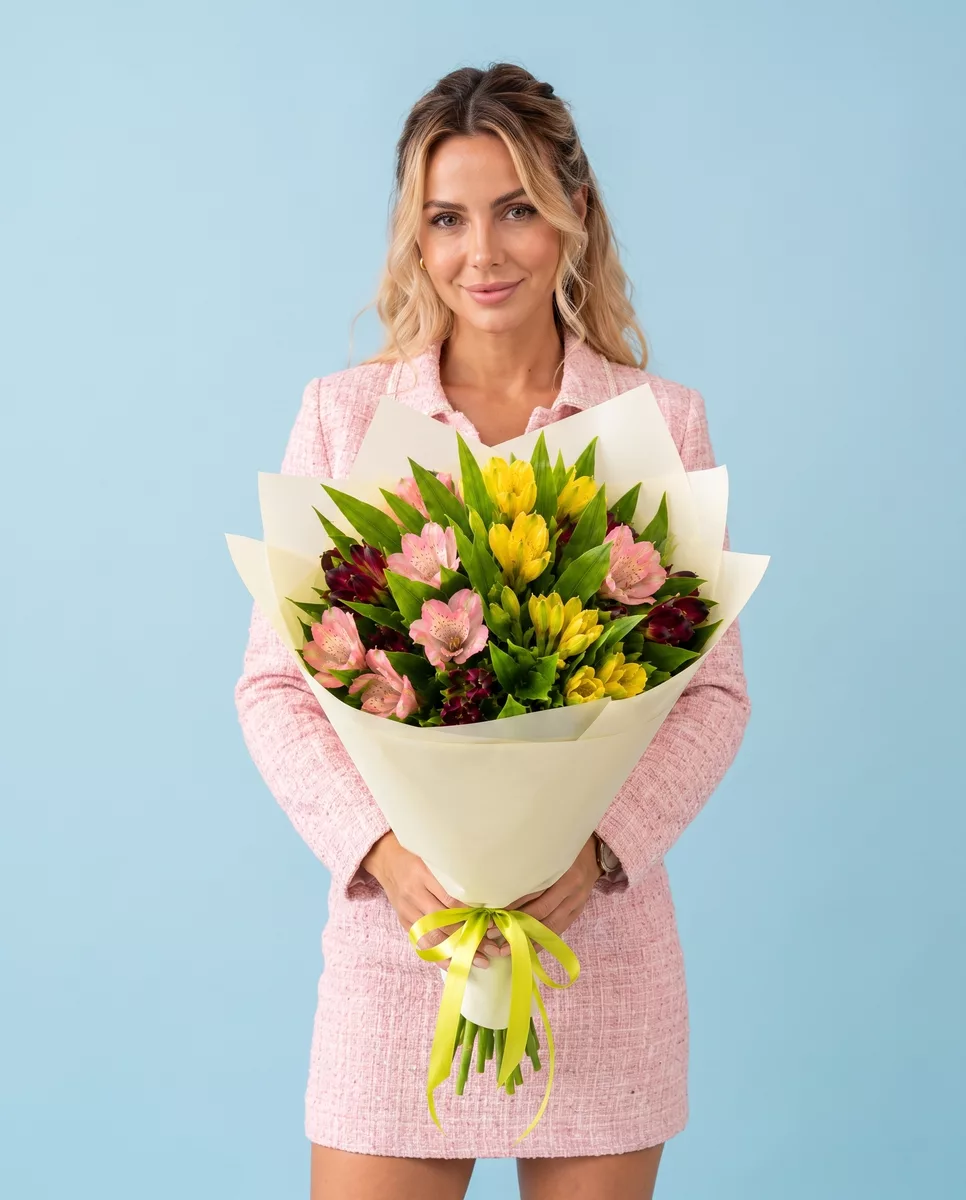
Which Flowers Hold Up During Delivery in Russian Conditions
Russia's climate creates a real problem that most overseas customers do not think about. In January in Novosibirsk the outdoor temperature can drop to minus twenty-five Celsius, and a bouquet left in an unheated car or entrance hall for fifteen minutes can show frost damage on petals that looked perfect in the shop. Roses are moderately cold-tolerant when wrapped correctly in insulating kraft paper and a thermal sleeve, but spray chrysanthemums, lisianthus and alstroemeria handle low temperatures better and arrive with less visible stress. In summer the risk reverses: heat above twenty-five Celsius wilts tulips and ranunculus within the delivery window, so those varieties are better ordered between October and April. Year-round safe choices include standard roses in bud form — not fully open — hypericum berries, waxflower, and solidago, all of which tolerate a wide temperature range. Orchid stems such as cymbidium are robust in cold but must be kept away from direct frost. When you specify the delivery address, note whether it is an apartment building with a heated lobby or a private house where the courier waits outside — that detail changes how the bouquet is packed. A good florist adjusts the wrapping based on the forecast for the delivery city on that specific date, not a generic seasonal assumption.
Bouquet Sizes, Stem Counts and What They Signal in Russian Culture
In Russia the number of stems in a bouquet carries a meaning that surprises many foreign customers. An even number of flowers is associated with mourning and is placed at graves, so bouquets for living recipients are always assembled with an odd stem count: 7, 9, 11, 15, 19, 25, 51, 101. This is not a superstition you can safely ignore — a girlfriend receiving an even-numbered bouquet will notice immediately, and so will anyone around her. The florist handles this automatically when you order a preset bouquet, but if you request a custom arrangement and specify a stem count, keep the odd-number rule in mind. In terms of size, a 15-stem rose bouquet is a confident everyday gesture; 25 stems reads as a significant occasion; 51 or 101 roses are reserved for anniversaries, declarations and major celebrations. Spray roses, which carry multiple small blooms per stem, count as a single stem each for this purpose. Peonies, when in season from May through June, are a popular choice in Russia and a single large-headed peony counts as one stem, so a 9-peony bouquet is both culturally correct and visually generous. If you are ordering for a birthday or the Russian holiday of March 8th — International Women's Day, the single biggest flower-buying day of the year in Russia — move to a larger size than you would otherwise choose, because the recipient will be comparing notes with colleagues and friends.
Writing the Card Message When You Do Not Speak Russian
A card in English is perfectly acceptable and increasingly common in Russian cities. Most recipients under forty read basic English, and a short sincere message in your own language carries more weight than a stilted translation. If you want the card in Russian, write your message in English in the order notes and ask the florist to translate it — a professional shop will do this accurately rather than running it through an automatic translator that produces awkward phrasing. Keep the message short: two or three sentences work better on a small card than a paragraph. Avoid generic phrases like 'with love and best wishes' because they read as impersonal in any language. Instead, reference something specific — the city you are both from, a date that matters, a plan you are making together. In Russian custom, the card is read privately rather than aloud in front of others, so you do not need to worry about public embarrassment from an affectionate message. One practical note: write the recipient's name exactly as it appears on her phone or doorbell, because couriers in apartment buildings use the intercom and need to call the right name. A name spelled in Latin letters is fine — Russian couriers are accustomed to both scripts. If her name has a common Russian diminutive — Katya for Ekaterina, Masha for Maria — use the form she actually goes by, not the formal version from her passport.
Confirming the Delivery Address and Getting It Right
Russian addresses follow a specific structure that differs from Western formats, and an error in any field causes the courier to spend time on the phone rather than at the door. The correct order is: city, street name, building number, apartment number, entrance number if the building has several, and floor. Many large residential buildings in Russian cities have multiple entrances — podezdy — numbered from the street, and without the entrance number a courier can circle a building for ten minutes. If you know only the street and building, ask your girlfriend's friend or use a recent message where she mentioned her address. Do not guess at apartment numbers. For gated residential complexes, which are common in newer Moscow and Saint Petersburg neighborhoods, you may also need an intercom code or the name of the management company — include that in the order notes. For office deliveries, add the company name and floor, and note the building's reception policy: some corporate offices require the recipient to come down to collect, while others allow couriers to go up. If you are not certain of the full address, order with a delivery window rather than an exact time, so the courier can call ahead and confirm details with the recipient directly — this is standard practice and does not ruin the surprise as long as the card message stays sealed. Double-check the recipient's mobile number: Russian mobile numbers are eleven digits starting with 7 or 8.
Paying from Abroad and What to Expect After You Order
International bank cards — Visa and Mastercard issued outside Russia — process normally on the shop's payment page for customers ordering from abroad. The currency shown is Russian rubles, and your bank converts at its current rate. Some banks flag the transaction as foreign and send a confirmation prompt to your phone, so keep your banking app open when you check out. After payment you receive an order confirmation by email with an order number — save this, because it is your reference for any changes. Approximately one hour before delivery you receive a notification that the courier has departed; in some cases the courier sends a brief message to the recipient's number to confirm they are on the way. You can request that this message not be sent if you want the arrival to be completely unannounced, but note that unannounced deliveries have a higher rate of nobody-home situations, which means the courier waits, calls, and if there is no answer, leaves the bouquet with a neighbor or building concierge. If your girlfriend works from home or has an unpredictable schedule, it is worth texting her yourself to make sure she will be in — you can do this without revealing the flowers are coming. Changes to delivery time or address after the order is placed are possible up to two hours before the scheduled window; after that the bouquet is already assembled and the courier is assigned.
Occasions That Russian Women Actually Remember and What to Order for Them
March 8th — International Women's Day — is not a minor date in Russia. It functions as a combination of Valentine's Day and Mother's Day rolled into one national holiday, and every woman in the country expects to receive flowers from the men in her life, whether that is a partner, father, colleague or friend. Order at least three days in advance for March 8th delivery; same-day ordering on that date is possible but the variety selection is limited by midday because demand is extraordinary. Valentine's Day on February 14th has grown significantly in Russian cities over the past decade and is now treated as a serious flower occasion, particularly among couples under thirty-five. Red roses remain the dominant choice, but many customers now move toward garden roses in apricot or blush tones — varieties like Juliet or Keira — which photograph well and feel less generic. Birthdays are the most consistent occasion year-round; for a birthday bouquet, peonies in season, garden roses, or a mixed bouquet combining roses with eucalyptus and matthiola is a reliable combination that reads as thoughtful rather than default. New Year in Russia falls on January 1st and is the biggest holiday of the year — larger than Christmas, which is celebrated on January 7th in the Russian Orthodox calendar. Flowers for New Year's Eve delivery are popular, and amaryllis, red tulips and white lilies work well for that date both visually and in terms of cold-weather durability.
Sending flowers from outside Russia is straightforward once you know the rules that Russian florists apply automatically: odd stem counts, cold-weather packaging, hard delivery cutoffs by city time zone, and an address format that includes entrance number and apartment. The variety choices that hold up best in transit — roses in bud, spray chrysanthemums, lisianthus, alstroemeria — are not compromises; they are what experienced florists reach for precisely because they arrive looking the way they did when they were assembled. Get the address right, place the order before the local cutoff, and write the card in whatever language you actually speak. The rest is handled on the shop floor. We deliver bouquets across Russia in 1–2 hours.
Frequently asked questions
Can I send flowers to a Russian city I cannot find on the website?
Use the order form and type the city name — coverage includes most regional centers and many smaller cities across Russia. If the city is outside the delivery zone, the form will notify you before payment. For remote addresses, next-day morning delivery is often available even when same-day is not.
What happens if my girlfriend is not home when the courier arrives?
The courier calls the recipient's number. If there is no answer after two attempts, the bouquet is left with a building concierge or a neighbor, and a notification is sent. To avoid this, choose a two-hour delivery window when she is most likely to be present, or request that the courier call ahead thirty minutes before arrival.
Is it rude to send an even number of flowers in Russia?
Yes, an even number is strongly associated with funerals and is considered inappropriate for any living recipient. All preset bouquets from the shop use odd stem counts by default. If you request a custom quantity, choose an odd number — 7, 9, 11, 15, 25 — and the florist will assemble accordingly.
Can I schedule delivery for a specific time rather than a window?
Exact-time delivery is available in Saint Petersburg and Moscow for an additional fee. For other cities, a two-hour window is standard. If the occasion requires a precise moment — during a dinner, at the end of a work meeting — note it in the order comments and the florist will coordinate as closely as the route allows.
Which flowers are best to avoid in January or February deliveries?
Fully open garden roses, ranunculus and anemones are most vulnerable to frost damage below minus ten Celsius. In winter, order roses in tight bud form, spray chrysanthemums, lisianthus or alstroemeria — all of which tolerate cold packaging and short outdoor exposure without visible petal damage on arrival.
Ready to send a bouquet?
Pick a city, choose the flowers, and we will hand them over with a photo confirmation.
Choose a city →