
Flower Delivery to Ardon from Abroad: Zones, Timing and What to Prepare
Most people calling us from Germany, the UAE or the United States about Ardon ask the same opening question: is it even possible? Ardon is a small city in North Ossetia-Alania, roughly 30 kilometres west of Vladikavkaz, and yes, we deliver there. What catches senders off guard is not the distance but the details — the time zone gap, which varieties travel well to the North Caucasus in summer heat, and exactly what information about the recipient you need to have ready before you place the order. Get those three things right and the bouquet arrives fresh, on time and without a single back-and-forth message at two in the morning your local time.
Where Ardon Sits and Why It Matters for Delivery Timing
Ardon sits in the Alagir district of North Ossetia-Alania at an elevation of roughly 500 metres above sea level, in the foothills of the Greater Caucasus range. The city is small — under 25,000 residents — which means street addressing can be inconsistent, and couriers need a precise apartment number, entrance code and a working Russian mobile number for the recipient. Moscow Standard Time applies here, which is UTC+3, the same as Saint Petersburg. If you are ordering from London, that is a three-hour difference; from New York, it is eight hours; from Dubai, the clocks are actually one hour ahead of Ardon. Knowing this gap matters because our delivery windows are set in Moscow time, and a sender who books a noon slot while sitting in Los Angeles is actually booking midday Ardon time — which falls in the middle of the Russian working day, perfectly fine for a home delivery but worth double-checking for an office address. Ardon is connected to Vladikavkaz by the A164 federal highway, so logistics from our nearest dispatch hub move smoothly in normal traffic. Where senders miscalculate is in assuming that because the city is small, the delivery window should be wider. In practice the opposite is true: a compact city with fewer landmarks means the courier relies heavily on the phone number to find the door, and if the recipient does not pick up, the bouquet waits in a temperature-controlled bag for no more than 40 minutes before we call the sender for instructions. Give us a backup contact number if you can.
Bouquets we can deliver



Time Zone Arithmetic for Senders in Europe, the Middle East and North America
The single most common mistake from abroad is placing an order for same-day delivery without accounting for the time already elapsed in Ardon. A customer in Berlin at 10 a.m. on a Saturday is looking at 12 noon in Ardon — still workable for afternoon delivery. A customer in Toronto at 9 a.m. is already looking at 4 p.m. in Ardon, which pushes the bouquet into early evening. Evening deliveries are absolutely possible and sometimes preferable for a surprise, but they need to be confirmed explicitly rather than assumed. Our order form asks for the desired delivery time in Moscow time, so convert before you fill it in. The safest approach for senders in the Americas is to place the order the evening before, choosing a morning or midday slot in Ardon time. That gives our florists in Saint Petersburg time to assemble the bouquet during the early hours, dispatch it from the regional hub and have it moving toward Ardon well before the chosen window. For senders in the UAE, Qatar or Kuwait — one hour ahead of Ardon — the arithmetic is simpler, but the temptation is to order late in the Gulf evening thinking it is still the same calendar day in Russia. It is not; midnight in Dubai is 11 p.m. in Ardon, and a same-day order placed then rolls into the next morning automatically. State the date explicitly in your order notes, not just the time, and you will avoid the most common scheduling confusion we see from Middle Eastern senders.
Which Varieties Hold Up on the Route to North Ossetia
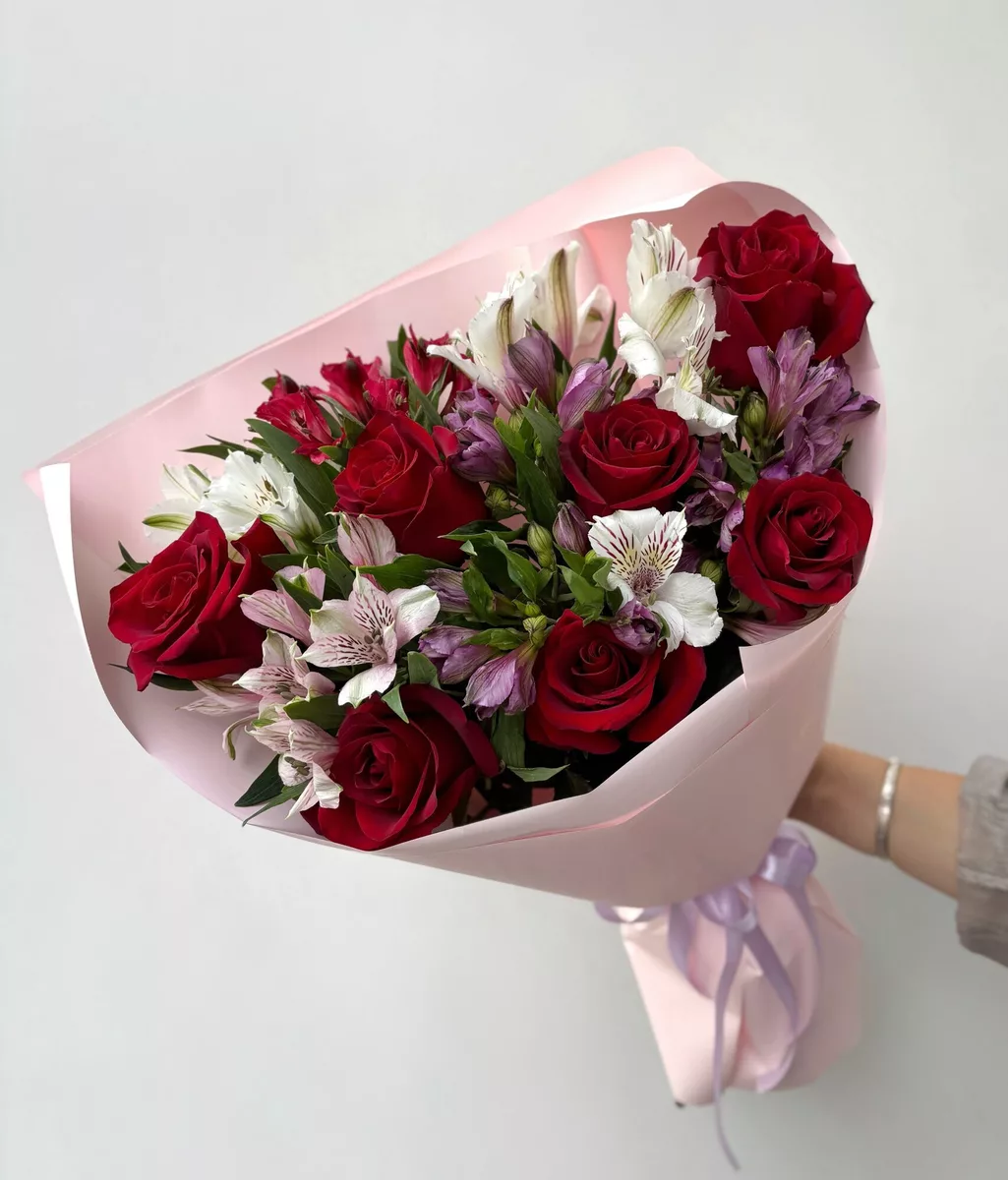
North Ossetia has a continental mountain climate with genuinely hot summers — Ardon can see afternoon temperatures above 35 degrees Celsius in July and August — and cold, sometimes snowy winters. Both extremes affect which flowers arrive looking as they should. In summer we steer senders away from garden roses with very large heads, which bruise in heat even inside chilled packaging, and toward spray roses, which are smaller-headed, more structurally robust and hold colour well. Alstroemeria is excellent year-round: the stems are sturdy, the flowers do not drop petals under temperature stress and the variety range is wide enough to match almost any colour palette. Chrysanthemums, both single-stem and bush varieties, are reliable in heat. Eustoma, sometimes called lisianthus, travels well if cut at the right bud stage — two or three open flowers per stem with the rest still in bud, which means the bouquet continues opening after arrival. In winter the challenge reverses: frost damage during the final outdoor segment of the delivery. Orchid stems, anthurium and tropical foliage are vulnerable below minus five. From November through February we recommend tulips, which are counterintuitively cold-tolerant, or carnations, which have been bred specifically for cold-chain logistics. Peonies are available from May through June and are popular for North Caucasus celebrations, but they need to be ordered with heads partially open — tight buds in a cold van can arrive looking unchanged for days, which disappoints recipients expecting an immediate display.
Seasonal Peaks, Russian Holidays and Why You Should Order Early from Abroad
Russia runs on a holiday calendar that differs significantly from Western Europe or North America, and Ardon follows it closely. The biggest single peak for flower orders is the 8th of March, International Women's Day, which is a national public holiday treated with the same commercial intensity as Valentine's Day and Mother's Day combined. We begin receiving orders from abroad for March 8th as early as late February, and same-day slots for Ardon fill by the evening of March 7th. If you are ordering from a time zone six or more hours behind Moscow, that means your local afternoon on March 7th is already the Russian evening — book at least 48 hours ahead. Other high-demand dates include February 23rd, Defender of the Fatherland Day, which is now widely used to send flowers to men; May 9th, Victory Day; and September 1st, the first day of the school year, when children traditionally bring flowers to teachers. In North Ossetia specifically, local and religious observances can add to demand in ways that are not visible on a standard Russian calendar. The practical rule for any sender abroad: if the date has any significance at all, treat it as a peak date and add 48 hours to whatever lead time you think you need. Standard non-holiday orders to Ardon need a minimum of three to four hours of lead time from the moment of payment confirmation, not from the moment you start filling in the form. Payment confirmation is the clock-start, so have your card details ready before you begin.
What the Recipient Needs to Know — and What You Should Not Tell Them
In Russia it is entirely normal for the recipient to know a bouquet is coming — the surprise element, if there is one, is usually in the composition and the accompanying card, not in the fact of delivery itself. This is worth explaining to senders from cultures where the whole point is a doorstep surprise, because a recipient who does not answer the door and does not pick up the phone creates a genuine problem for a perishable order. We always call the recipient's Russian mobile number about 15 to 20 minutes before arrival. If you want to preserve some element of surprise, tell the recipient that something is arriving on a particular day without specifying what or from whom — that is the most common approach among our international customers and it works well. The recipient needs to be physically present or have a trusted neighbour or building concierge who can accept the order. Ardon apartment buildings often have entrance codes, called domofon codes in Russian, and if the courier cannot get through the outer door and the recipient does not answer the intercom, the delivery stalls. Collect that code when you collect the address. For recipients who are elderly or who may not speak to strangers easily, adding a note in Russian on the card that the flowers are from you specifically — not from an unnamed sender — helps them feel comfortable accepting the bouquet from someone they have not met. We can write the card text in Russian if you provide it in English; just include it clearly in the order notes.
Paying from a Foreign Bank Card and Confirming the Order
International bank cards, including Visa, Mastercard and cards issued in the EU, UK, UAE and most of Asia, work on our payment page, though the experience varies by issuing bank. Some European banks flag transactions to Russian merchants for additional verification — your bank may send a one-time code or ask you to confirm via their app. Have your phone accessible when you pay. American Express cards issued outside Russia have a lower acceptance rate than Visa or Mastercard, so if your Amex is declined, switch to a second card rather than retrying the same one multiple times. Once payment goes through, you receive an email confirmation with an order number. That confirmation is your proof of booking; save it. If you do not receive it within ten minutes, check your spam folder before contacting us, because automated emails from Russian domains sometimes land there for foreign addresses. The order is not confirmed until payment clears — a filled form without payment holds nothing. From abroad, the most reliable way to reach us if something goes wrong is WhatsApp on the number listed on our site; international callers sometimes find direct calls to Russian numbers blocked by their carrier, but WhatsApp goes through cleanly. When you message, lead with your order number. Time differences mean our response may come while you are asleep; check your phone when you wake up rather than assuming silence means a problem.
The Card Message: Language, Tone and What Actually Gets Read
The card that accompanies a bouquet in Russia is typically small — a standard florist's card is about the size of a business card, sometimes slightly larger — and it travels attached to the wrapping. Most recipients in Ardon will read Russian and Ossetian; a message written entirely in English will be read but may feel impersonal to an older recipient, who might not read English fluently. For senders who want the warmth of their own words but also want the recipient to understand immediately, the best approach is to write your message in English in the order notes and ask us to translate it into Russian for the card. We do this routinely. Keep the message under 30 words in the original language; longer messages get truncated on small cards and the last line — often the most important — disappears. If the occasion is a birthday, write the name of the recipient on the card: in Russian custom, a card that begins with the recipient's name feels personal rather than generic. For name days, which are celebrated in Orthodox Christian culture and are observed in North Ossetia, the phrasing differs slightly from a birthday greeting — if you know the occasion is a name day rather than a birthday, mention it in your order notes and we will adjust the card accordingly. Avoid phrases that translate awkwardly, such as idioms built around weather or sports metaphors; they lose meaning in translation and can read as odd. A simple, direct expression of the reason for the flowers and who they are from is always the most effective card text, regardless of the occasion.
Sending flowers to Ardon from outside Russia is straightforward once the mechanics are clear: convert the time zone before booking, choose varieties suited to the season, confirm the recipient's full address including the entrance code and Russian mobile number, and treat any significant date as a peak date requiring 48 hours of lead time. The North Caucasus climate is demanding on flowers in both July heat and February frost, but the right varieties — spray roses, alstroemeria, eustoma, tulips in winter — arrive in the same condition they left our workroom. The card message, the payment confirmation and the recipient's availability at the door are the three points where international orders most often hit friction, and all three are easy to resolve if you prepare them before you open the order form rather than during it. We deliver bouquets across Russia in 1–2 hours.
Frequently asked questions
Can I order flowers to Ardon if I have no Russian phone number myself?
Yes. The phone number we need is the recipient's Russian mobile, not yours. For your own contact we can use WhatsApp, email or any messenger you specify. Include an international number or handle where we can reach you if there is a delivery issue, and we will use that instead of a Russian number.
What happens if the recipient is not home when the courier arrives?
The courier calls the recipient's mobile number 15 to 20 minutes before arrival. If there is no answer at the door, we hold the bouquet in temperature-controlled packaging and call you, the sender, for instructions. We can attempt redelivery within the same day if timing allows, or arrange a new slot. Perishable orders cannot be left unattended outside a door.
Is it possible to schedule a delivery for a specific hour rather than a general time window?
We offer time windows rather than exact minutes because traffic on the Vladikavkaz corridor varies. A two-hour window is standard. If the occasion requires the bouquet before a specific event — a dinner, a ceremony — state the hard deadline clearly in the order notes and we will schedule the dispatch to arrive comfortably before it rather than at the edge of the window.
Do Russian recipients expect an odd or even number of flowers in a bouquet?
Even numbers of flowers are traditionally associated with mourning in Russia, and most florists compose bouquets in odd numbers for celebrations. Our standard compositions already follow this convention. If you are requesting a custom number — say, one flower per year of age — state it explicitly and we will note whether the total falls on an even number and suggest an adjustment if needed.
How far in advance can I place an order from abroad for a future date?
You can book up to two weeks ahead. For peak dates such as March 8th or February 23rd, booking a week in advance from abroad is strongly recommended. The order is logged against your chosen date and the bouquet is assembled on the morning of delivery, not at the time of booking, so freshness is not affected by how early you place the order.
Ready to send a bouquet?
Pick a city, choose the flowers, and we will hand them over with a photo confirmation.
Choose a city →