
Flower Delivery to Beloyarsky from Abroad: Zones, Timing and Varieties
Beloyarsky sits in the Khanty-Mansiysk Autonomous Okrug, roughly 1,900 kilometres northeast of Moscow, and customers calling from Germany, the UAE or Canada regularly ask us whether we can actually get fresh flowers there. The short answer is yes, but the logistics are different from sending to Saint Petersburg or even Yekaterinburg, and the choices you make at the ordering stage — which varieties, which day, what time of day — determine whether the bouquet arrives in good shape or not at all.
Where Beloyarsky Is and Why Geography Matters for Your Order
Beloyarsky is a small city of roughly 20,000 people in the Yugra region of Western Siberia. It is not a regional capital, which means it does not have the same freight infrastructure as Surgut or Khanty-Mansiysk. When you order from abroad, you are not just crossing a time zone — you are dealing with a city that sits about 600 kilometres north of Tyumen and is served by a limited number of daily flights and road connections. That geography shapes everything about a flower delivery: transit time from our Saint Petersburg warehouse, the temperature the stems will experience during the final leg, and how long the courier has to complete the drop-off window. Customers sometimes assume that because Russia is one country, all cities are equally accessible. Beloyarsky requires more planning than, say, Kazan. The Khanty-Mansiysk Autonomous Okrug operates on UTC+5, which is two hours ahead of Moscow and four hours ahead of Saint Petersburg. If you are calling from London at 10 in the morning, it is already 3 pm in Beloyarsky, which may be too late for same-day delivery depending on the date. Knowing the local time before you call or submit an order form is the single most practical thing an international sender can do. It prevents the most common disappointment we hear: a customer who placed an order at what felt like midday but was already evening at the destination.
Bouquets we can deliver

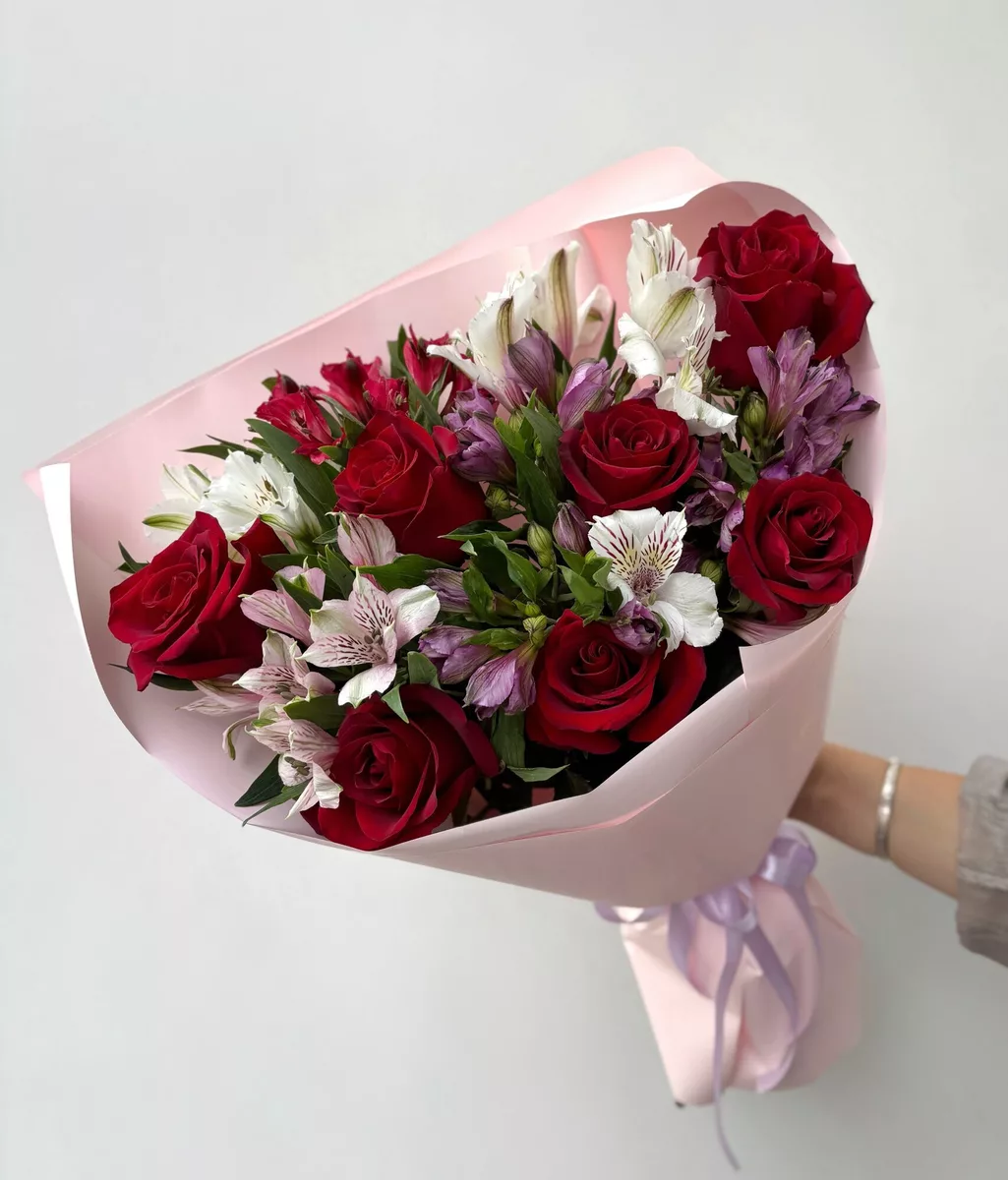


Which Varieties Travel Well to a Siberian Climate
Siberia in winter means temperatures that regularly drop below minus 25 Celsius in Beloyarsky, and even in May or September the nights can go below zero. That temperature range eliminates certain flowers from the shortlist immediately. Tropical and thin-petalled varieties — standard garden roses with many open petals, ranunculus, anemones — suffer badly in transit when outdoor temperatures are extreme, because even a brief exposure during loading or the walk from a vehicle to a door can cause petal edges to blacken or stems to collapse. Varieties that hold up reliably in cold transit include spray roses, which have smaller, tighter heads and more structural petals; chrysanthemums in button or spider forms; alstroemeria, which is bred for long shelf life and handles temperature swings better than most; and carnations, which remain one of the most cold-tolerant cut flowers available. Lisianthus is a reasonable middle option — it travels better than a garden rose but needs to be in bud rather than fully open when it leaves our warehouse. For summer orders, when Beloyarsky temperatures can reach a genuine plus 25 to 30 Celsius, the concern flips: heat accelerates opening and wilting, so the same tight-bud principle applies. Gerberas look spectacular but are among the most heat-sensitive stems we work with, and we advise against them for long-distance Siberian deliveries regardless of season. Customers who want something visually striking in summer are better served by large-headed spray chrysanthemums or double lisianthus, both of which photograph well and hold their shape.
How the Time Difference Affects an Order Placed from Abroad
Most of our international customers are in Western Europe, the Gulf states, or North America. A sender in Dubai is three hours behind Beloyarsky; a sender in New York is eight hours behind. That gap creates a practical problem: what feels like a reasonable morning order to the sender is already afternoon or evening at the destination. We process orders around the clock and our team in Saint Petersburg coordinates dispatch, but the delivery window in Beloyarsky itself is constrained by when couriers are operating and when the recipient is likely to be home or at work. The safest approach for an international sender is to place the order at least 24 hours before the intended delivery time in Beloyarsky local time. This gives us room to confirm the address, verify the recipient's availability if needed, and select stems that are at the right stage of opening for the transit duration. Orders placed with less than 12 hours of lead time in the destination time zone are possible but carry more risk, particularly for addresses outside the city centre. Beloyarsky is a compact city, but some residential addresses require additional courier time. If you are ordering for a birthday that falls on a specific date, work backwards from noon Beloyarsky time and place the order the previous evening your time. That single habit eliminates most of the timing complaints we receive from senders in different time zones. When you fill in the order form, always write the delivery date and time in Moscow time if the form asks for it — we will convert to local Beloyarsky time automatically, but specifying Moscow time removes ambiguity.
What Information You Must Provide for a Successful Delivery
Incomplete address information causes more failed deliveries to Beloyarsky than any other single factor. Russian addresses follow a specific structure: city, street name, building number, apartment or office number, and often a door code for the entrance. International senders frequently write the address in the format they are used to — street number before street name, no apartment number, no entrance code — and that format does not map cleanly onto the Russian system. When you order, provide the full address as the recipient would write it in Russian if possible, or ask the recipient to send you their address in the standard Russian format before you place the order. The building number in Russia sometimes includes a corpus number, written as korpus or k., which refers to a specific block within a larger housing complex. Omitting the corpus number in a multi-block complex means the courier may go to the wrong building entirely. Beyond the address, provide the recipient's Russian mobile number. Couriers in Beloyarsky will call ahead, and a number with the correct country code (+7 for Russia) is essential. If the recipient does not have a Russian number and uses a foreign SIM, note that in the order comments and provide a messaging app contact as a backup. The sender's name and a brief card message in Russian or English are both accepted — we can transliterate a message or leave it in English, and most recipients in Beloyarsky who receive flowers from abroad understand that the card language will reflect where the sender lives. Finally, specify whether the delivery is a surprise: if it is, we will not call the recipient in advance, but this slightly increases the risk of a missed delivery if nobody is home.
Seasonal Considerations: What Changes Month by Month
Beloyarsky has a genuinely continental climate with long winters and short but warm summers. From November through March, outdoor temperatures in transit are a real concern for stems. During this period we pack bouquets with insulating kraft and, for longer transit routes, thermal sleeves. The varieties we recommend in winter lean toward the hardiest options: spray roses, alstroemeria, carnations, and chrysanthemums. Tulips are popular in February and March around International Women's Day on March 8, which is one of the biggest flower-giving dates in Russia — more on that below — but tulips need to be transported in tight-bud form and kept upright, which adds complexity. April and May bring a thaw, and the variety range expands. Irises become available and travel reasonably well. Peonies arrive in late May and June and are extremely popular in Russia; they are best ordered in bud and will open fully within one to two days of arrival, which makes them a good choice for a gift that the recipient can watch develop. Summer months allow for the widest variety selection, but heat management becomes the priority. September and October are a reliable window: temperatures are moderate, stems are not under cold or heat stress, and the autumn chrysanthemum harvest means excellent availability of large decorative heads in rust, yellow and white. November marks the return of winter conditions, and the variety list narrows again. Planning your order around the season rather than simply picking what looks good in a photo is the most consistent way to ensure the bouquet arrives in the condition you expect.
Key Russian Dates That Drive Flower Demand — and Why They Matter
If you are sending flowers from abroad, you may not be aware of the Russian calendar dates that create the highest demand and the tightest delivery windows. The most important is March 8, International Women's Day, which in Russia is a national holiday on the scale of Valentine's Day and Mother's Day combined. On March 7 and 8, flower orders across Russia spike dramatically, and Beloyarsky is no exception. If you plan to send flowers for March 8, place your order by March 5 at the latest — ideally earlier — because stem availability at the desired quality level is genuinely constrained, and delivery slots fill. February 14 is observed but is secondary in importance to March 8 for most Russian recipients. February 23, Defender of the Fatherland Day, is a holiday on which flowers are sometimes sent to men, though the more common gift is something non-floral. May 9, Victory Day, is a solemn national holiday; flowers are given, but the mood is commemorative rather than celebratory, and recipients generally appreciate restrained, classic arrangements — white or red carnations are traditional and appropriate on this date. New Year, celebrated on January 1, is the largest gift-giving holiday in Russia, larger than Christmas, which falls on January 7 in the Russian Orthodox calendar. Sending flowers for New Year is common, and arrangements with winter greenery such as spruce tips or eucalyptus are well received at this time of year. Knowing these dates helps you plan lead time and set expectations about what varieties will be at peak availability versus constrained supply.
Checking Your Order Before You Confirm: A Practical Checklist
Before you submit or confirm any order for Beloyarsky from abroad, run through the following points. First, verify the delivery date and time in Beloyarsky local time, not your local time, and not Moscow time unless you have deliberately converted. Second, confirm the full Russian-format address including building number, corpus if applicable, apartment number, and entrance code. Third, provide a Russian mobile number for the recipient with the +7 country code. If the recipient does not have one, leave a detailed note in the order comments. Fourth, choose varieties suited to the current season and transit conditions — if you are unsure, tell us the date and we will recommend what is in good condition at that moment. Fifth, if the delivery is a surprise, say so explicitly and accept that a missed delivery is slightly more likely; consider asking the recipient to be home during a broad window without revealing the reason. Sixth, double-check the card message: if you are writing in a language other than Russian, keep it short and clear, because a long message in a language the recipient does not read well loses its impact. Seventh, note any building access restrictions — some residential buildings in Beloyarsky require the courier to be buzzed in, and if the entrance code is wrong or missing, the delivery may not complete. Finally, save your order confirmation number and the contact details for our team. If something changes on the recipient's end — they travel unexpectedly, the address was wrong — a quick message with your order number allows us to reroute or reschedule without starting from scratch. These seven checks take less than five minutes and prevent the majority of problems we see with international orders to remote Siberian cities.
Sending flowers to Beloyarsky from abroad is entirely workable when you treat it as a logistics task rather than a simple online purchase. The city is remote by most standards, the climate is demanding, and the time difference between your location and the Khanty-Mansiysk Autonomous Okrug means that timing mistakes are easy to make and hard to fix after the fact. Choose varieties that are built for transit — spray roses, alstroemeria, chrysanthemums, carnations — rather than varieties that look impressive in a photo but open or wilt before they arrive. Give us a complete address in Russian format, a working Russian mobile number for the recipient, and at least 24 hours of lead time in Beloyarsky local time. Do those three things and the chances of a successful, fresh delivery are high, regardless of whether you are placing the order from Amsterdam, Dubai or Vancouver. We deliver bouquets across Russia in 1–2 hours.
Frequently asked questions
Can I order flowers to Beloyarsky if I do not speak Russian?
Yes. Our order form accepts English, and our team can handle communication in English. The card message can be written in any language — we will include it as written. The one thing we do need is the recipient's address in the correct Russian format, so ask the recipient to send you their address in Russian before you order to avoid errors.
How far in advance should I order for a specific date in Beloyarsky?
For a regular date, 24 hours ahead in Beloyarsky local time is the minimum we recommend from abroad. For major Russian holidays such as March 8 or New Year, place the order three to five days early. Beloyarsky is a remote city and last-minute orders carry a real risk of the delivery window closing before we can complete it.
What happens if the recipient is not home when the courier arrives?
The courier will call the recipient's mobile number. If there is no answer, we will contact you as the sender using the details you provided. We can attempt redelivery or hold the bouquet, but cut flowers have a limited window. This is why providing a correct Russian mobile number and specifying whether the delivery is a surprise are both important steps before you confirm.
Are there flowers I should avoid ordering to Beloyarsky in winter?
Yes. Avoid fully open large-headed roses, ranunculus, anemones, and gerberas in winter months — November through March — because they are sensitive to the extreme cold during outdoor transit. Stick to spray roses, carnations, alstroemeria and chrysanthemums, which are structurally more robust and handle temperature drops without the petal damage that affects thinner, more open blooms.
Can I include a gift alongside the flowers, such as chocolates or a toy?
We can include small additions with the bouquet — a card, a small soft toy, or chocolates are the most common requests. Mention this when placing the order and we will confirm what is available for the Beloyarsky delivery route. Additions increase the package size and may affect how the bouquet is packed for transit, so early notice helps us prepare correctly.
Ready to send a bouquet?
Pick a city, choose the flowers, and we will hand them over with a photo confirmation.
Choose a city →