
Flower Delivery to Chaplygin from Abroad: Zones, Timing and What to Prepare
Most international orders for Chaplygin come in around birthdays and anniversaries, and the first question is always the same: can you actually get flowers there the same day? The answer is yes, but the window is narrower than in a big city, and a few details on your end — the recipient's exact address, a working Russian phone number, and the right choice of flowers for the season — will decide whether the bouquet arrives fresh or not at all. Here is everything a sender outside Russia needs to know before placing the order.
Where Chaplygin Is and Why It Matters for Delivery
Chaplygin is a small city in Lipetsk Oblast, roughly 120 kilometres southeast of Lipetsk itself. It sits in a temperate continental zone, which means cold winters with temperatures regularly dropping below minus fifteen Celsius and warm, sometimes dry summers pushing past thirty. That range matters enormously for flowers in transit: roses that travel beautifully in October can arrive with frostbitten petals in January if the courier does not use insulated packaging, and the same roses can wilt within an hour in an unventilated hallway in July. The city is compact, with a population of around twelve thousand, and most residential addresses are within a manageable delivery radius from the central part of town. There are no remote suburban sprawl zones the way a large city would have, but some addresses on the outer streets do require extra lead time. When you place an order from abroad, the practical geography means you should expect a delivery window rather than a single fixed minute — typically a two-hour slot that you agree on when ordering. The recipient should be reachable by phone during that window, because the courier will call ahead. If nobody answers and nobody is home, the bouquet waits in the vehicle, and in summer heat or winter frost that is a problem for perishable stems. Knowing the city's layout also helps you choose the right time of day: morning deliveries before noon tend to work better in summer, and midday slots are safer in winter when temperatures are at their least extreme.
Bouquets we can deliver



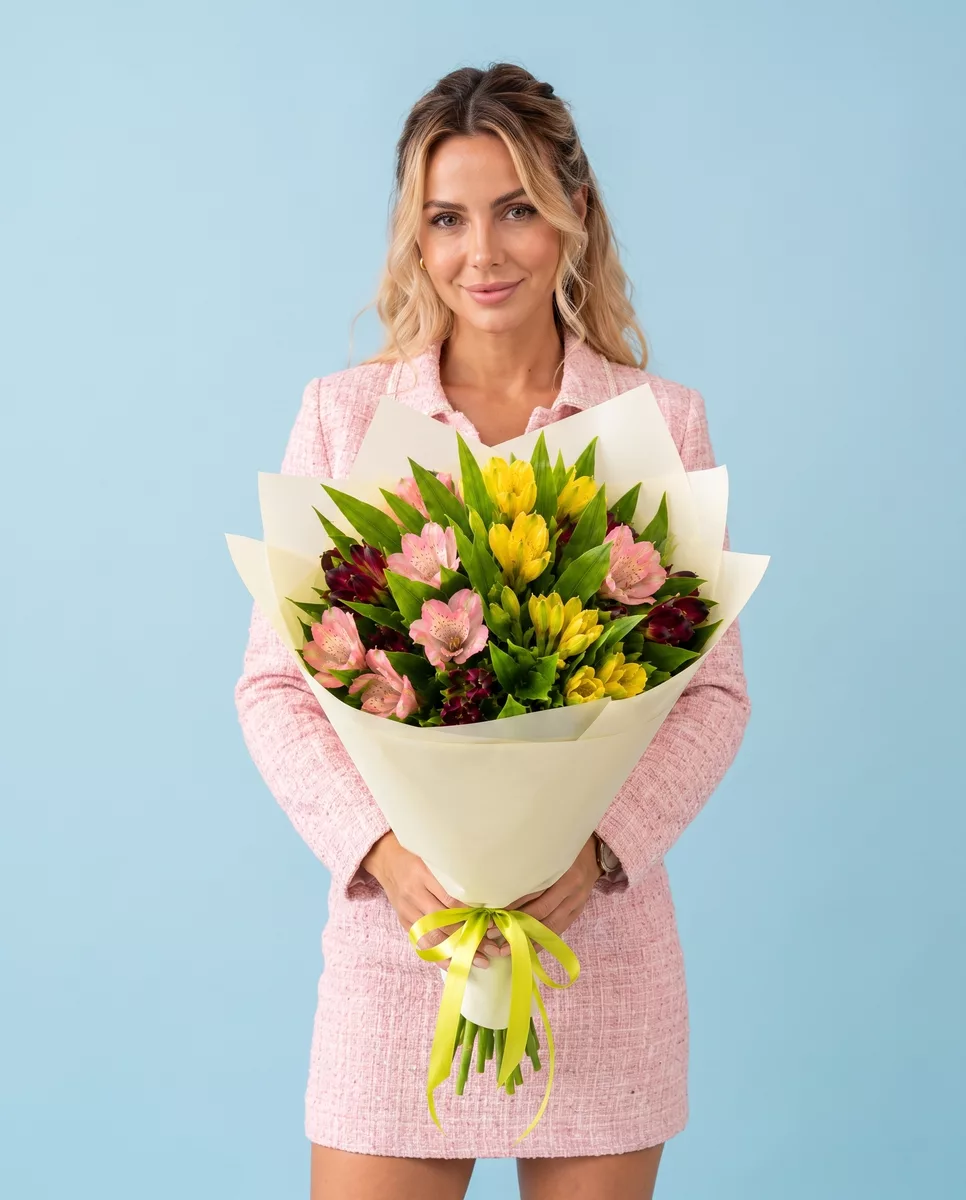
How to Place an Order from Outside Russia: the Practical Steps
Placing an order from another country is straightforward on the technical side, but there are three points where international senders consistently run into trouble. First, payment: cards issued outside Russia work through international payment systems on the Five Flowers website, and the checkout accepts standard Visa and Mastercard. If your card is declined on the first attempt, try switching off any VPN you are running, because Russian payment processors sometimes flag foreign IP addresses combined with foreign cards as suspicious. Second, the recipient's phone number must be a valid Russian mobile number starting with 7 or 8 — the courier cannot call a German or American number to coordinate the doorstep handover. If the recipient does not have a Russian number, arrange for a relative or neighbour who does to be listed as the contact. Third, the delivery address needs to be written in Russian or at least in a format the courier can read: street name, house number, apartment number, and any entry code for the building door. In many Russian apartment buildings the main entrance has a keypad lock called a domofon, and without the code the courier cannot reach the apartment. You can leave the code in the order comments field. The order form has a comments section in Russian and English, and the team reads both. Confirming the order by email and then checking your spam folder for the confirmation message is a step that saves a lot of confusion for international senders, since automated Russian domain emails occasionally land in spam abroad.
Choosing the Right Flowers for the Season and the Journey
Chaplygin receives flowers that have travelled from Saint Petersburg, which itself sources from Dutch auctions, Ecuadorian farms, and domestic Russian growers depending on the time of year. That supply chain is reliable, but it does mean you should think about which varieties hold up best over distance and temperature variation. Roses are the most popular choice year-round, and for good reason: a well-conditioned rose bud, cut at the right stage and kept in a cool vehicle, will open beautifully over two to three days after delivery. Ecuadorian large-headed varieties such as Explorer, Red Naomi, and Mondial are the workhorses of long-distance delivery because their stems are thick and their petals are dense. In spring, tulips from Dutch growers are widely available and travel well when the weather is cool, but they are fragile in heat above twenty degrees and should not be ordered for outdoor delivery in June or July. Chrysanthemums are extremely robust and hold for ten to fourteen days after cutting, making them a sensible choice if you are unsure whether the recipient will be home immediately. Alstroemeria is another durable option, often underestimated by international senders who associate it with filler rather than a main flower — a mono-bouquet of alstroemeria in coral or white is striking and lasts well. Avoid ordering open peonies in summer transit; they are magnificent but collapse quickly in warmth. Closed peony buds in May and early June, however, are an excellent choice because they open slowly over several days at room temperature, giving the recipient a changing display.
Timing Your Order: the Time Zone Question and Cut-Off Hours
This is where international senders make the most frequent mistake. Chaplygin operates on Moscow Time, which is UTC plus three, with no daylight saving adjustment — Russia abolished seasonal clock changes in 2014. If you are ordering from New York in the evening, thinking you have time to arrange a morning delivery, you may already be ordering for the following day by Moscow reckoning. If you are in London, the gap is three hours; from Los Angeles, it is eleven hours behind Moscow. The practical cut-off for same-day delivery to Chaplygin is mid-morning Moscow Time, roughly until eleven o'clock. Orders placed after that point are scheduled for the next day. The reason is not bureaucratic: it is logistical. Flowers need to be selected, conditioned, assembled, and dispatched with enough time for the courier to reach the address during daylight, especially in winter when it gets dark by four in the afternoon. For a birthday or anniversary, the safest approach is to place the order the evening before by your local time, which typically lands it in the Moscow morning queue with plenty of lead time. If you want a specific delivery time — say, arriving before the recipient leaves for work at eight in the morning — state that clearly in the comments and confirm it by email. Early morning deliveries before nine are possible but need to be agreed in advance. Weekend and public holiday deliveries are available, but Russian public holidays follow a different calendar from Western ones, so check the Russian holiday schedule if you are ordering around late April, early May, or the New Year period, when demand spikes sharply.
What Russians Expect When Flowers Arrive: Customs Worth Knowing
If you are sending flowers to someone in Russia for the first time from abroad, a few cultural points will help you choose the bouquet wisely and avoid unintentional signals. The number of flowers in a bouquet carries meaning: an even number of stems is associated with mourning and funerals, so bouquets for celebrations are always made with an odd number — five, seven, eleven, fifteen, twenty-five. A bouquet of twelve roses, which is a classic romantic gesture in many Western countries, reads differently in Russia, and a good florist will automatically adjust to eleven or thirteen. You do not need to specify this; it is standard practice. Colour choices are more relaxed than the number rule, but yellow flowers have a reputation in some older generations as a symbol of separation or betrayal, particularly yellow roses. That association is fading among younger Russians, but if you are sending to someone over fifty and you are unsure, staying with red, pink, white, or mixed palettes is the safer choice. Wrapping matters visually: Russian bouquets are typically presented in a craft paper or film wrap that is elaborate by Western standards, often with a ribbon and sometimes a small card holder attached. The card message is written in Russian if you provide it in Russian, or left in English if you write it in English — the recipient will understand a message in English, especially in a younger demographic, but for older recipients, asking a Russian-speaking friend to translate your message is a thoughtful touch. The courier hands the bouquet directly to the recipient at the door; there is no leaving it on a doorstep as is common in some countries.
Packaging and Temperature Protection for Chaplygin's Climate
The continental climate of the Lipetsk region creates real challenges for flower delivery that do not exist in, say, coastal cities with milder winters. In December, January, and February, outdoor temperatures in Chaplygin regularly sit between minus ten and minus twenty Celsius. Flowers exposed to those temperatures for more than a few minutes suffer irreversible cell damage — petals turn translucent, stems become limp, and the bouquet is effectively dead on arrival even if it looks intact at first glance. The solution is insulated packaging: a thermal sleeve or insulated box that keeps the flowers above five degrees Celsius during the walk from the vehicle to the door. When you place a winter order, confirm in the comments that insulated packaging is needed; it is standard practice but worth stating explicitly for deliveries to addresses with long outdoor paths or buildings without a covered entrance. In summer, the challenge reverses: temperatures inside a parked vehicle can reach fifty degrees in direct sun, which is lethal for roses and tulips within minutes. Deliveries in July and August are scheduled to avoid midday heat where possible, and the vehicle is kept running with climate control during stops. When you are ordering in summer from abroad, choose varieties with natural heat tolerance — chrysanthemums, alstroemeria, and sunflowers handle warmth far better than roses or peonies. If you insist on roses in summer, specify a morning delivery slot and ask for the stems to be cut short and hydrated fully before packing, which is standard preparation but worth confirming. A well-prepared bouquet in a cool vehicle, handed over quickly at the door, will arrive in excellent condition even in August heat.
What to Check Before You Confirm the Order
Before you click the final confirmation button, run through this checklist — it covers the points that generate the most calls and messages after the fact. First, verify the recipient's address includes the apartment number and the domofon code if the building has one; a house number alone is not enough for most Chaplygin apartment buildings. Second, confirm the recipient's Russian mobile number is current — people change numbers, and a disconnected number means no delivery. Third, check the delivery date against Moscow Time, not your local time, to make sure you are ordering for the right day. Fourth, re-read the card message you have written: spelling errors in Russian are easy to make if you are transliterating, and a misspelled name on a card is memorable for the wrong reasons. Fifth, check the flower count in the bouquet description to confirm it is an odd number. Sixth, if you are ordering in a cold month, make sure the order notes mention insulated packaging. Seventh, save the order confirmation email with the order number, because if you need to make a change — a different delivery time, an updated phone number — quoting the order number speeds up the process significantly. International senders sometimes assume that once the order is placed nothing can be adjusted, but changes are possible up to a few hours before the scheduled delivery, and the team can be reached by email and the website chat. The more specific your instructions in the comments field, the smoother the delivery — florists and couriers work better with precise information than with vague requests, and a detailed order rarely needs a follow-up call.
Sending flowers to Chaplygin from abroad is entirely manageable once you account for the time zone difference, the seasonal climate, and a few details about Russian customs and addresses. The actual flower selection, packaging, and delivery are handled on the Russian end — your job is to provide accurate recipient information, choose varieties suited to the weather, and place the order early enough in Moscow Time to land in the same-day queue. A well-placed order with a good address and a reachable recipient results in a fresh, properly wrapped bouquet at the door, which is exactly what the person on the other end deserves. We deliver bouquets across Russia in 1–2 hours.
Frequently asked questions
Can I order flowers for Chaplygin delivery if I do not speak Russian?
Yes. The Five Flowers website and the order comments field accept English. The card message can be written in English and delivered as written, or you can provide a Russian translation if you have one. The courier coordinates delivery by calling the recipient's Russian number, so the sender's language does not affect the process.
What is the latest I can order for same-day delivery to Chaplygin?
The practical cut-off is around eleven in the morning Moscow Time, which is UTC plus three. Calculate your local time against that — if you are in London, that means eight in the morning your time. Orders placed after the cut-off are scheduled for the following day. For guaranteed timing, placing the order the evening before your local time is the safest approach.
Why does the bouquet need to have an odd number of flowers?
In Russian tradition, even numbers of flowers are associated with funeral rites and are not given at celebrations. Bouquets for birthdays, anniversaries, and other positive occasions are always made with an odd number of stems. This is standard practice for any reputable florist in Russia and does not need to be specially requested.
What happens if the recipient is not home when the courier arrives?
The courier calls the recipient's Russian mobile number before arriving. If there is no answer and nobody is home, the courier waits briefly and attempts a second call. Leaving the bouquet unattended outside is not done, as flowers deteriorate quickly in outdoor conditions. Arranging a neighbour or family member as a backup contact is strongly recommended for uncertain schedules.
Are there flowers I should avoid ordering in winter for Chaplygin?
Open tropical flowers and thin-petalled varieties are more vulnerable to frost damage during the brief outdoor exposure at delivery. Roses in closed bud, chrysanthemums, and carnations handle cold transit better. In any case, insulated packaging is used for winter deliveries — note this in your order comments to confirm it is applied to your specific bouquet.
Ready to send a bouquet?
Pick a city, choose the flowers, and we will hand them over with a photo confirmation.
Choose a city →