
Flower Delivery to Gurevsk from Abroad: What Senders Need to Know
People call us from Germany, the United States, Israel and South Korea asking the same thing: can you actually get a fresh bouquet to someone in Gurevsk today? The answer is yes, but there are a handful of things a sender outside Russia needs to understand before placing an order — time zones, address formats, seasonal variety limits and the small customs that make a delivery land well rather than just arrive.
Where Gurevsk Is and Why It Matters for Delivery Timing
Gurevsk is a small industrial town in Kemerovo Oblast, Western Siberia, sitting in the UTC+7 time zone. That gap is the first thing an international sender tends to underestimate. If you are ordering from London at 10 in the morning, it is already 5 in the afternoon in Gurevsk, and the working day for the recipient may be nearly over. If you are ordering from New York at noon, it is the middle of the night in Siberia. Getting the time zone right is not a formality — it determines whether the bouquet arrives at the office before the person leaves, or sits in a lobby until the next morning. The town itself is compact, which actually works in your favour: delivery routes are short once the flowers are prepared, and our 1–2 hour window holds reliably. What adds time is preparation — cutting, conditioning, assembling — so the earlier in the Gurevsk day you place the order, the more variety you have in what we can build. Orders placed after 6 p.m. Kemerovo time are processed for next-day morning delivery, which is usually the right call anyway since flowers delivered in the evening to a residential address often go unattended. Always think in Gurevsk local time, not your own, and plan the arrival for mid-morning or early afternoon.
Bouquets we can deliver



How to Give Us the Recipient's Address Correctly
Russian addresses follow a specific order that differs from most Western formats, and a wrong address is the single most common reason a delivery is delayed. The correct sequence runs: country, region, city, street, building number, apartment or office number, and then the recipient's full name. For Gurevsk you would write: Russia, Kemerovo Oblast, Gurevsk, then the street name in transliteration or Cyrillic, then the building and flat number. If you only have the address in Latin characters, write it out clearly and we will handle the transliteration — do not guess at Cyrillic spelling yourself, because a single wrong letter can send a courier to a street that does not exist. Building numbering in Russian cities often includes a corpus or stroenie suffix, meaning a secondary building on the same plot. If the recipient's address has a letter after the number — say, 14A or 7 korpus 2 — include that exactly as given. Apartment buildings in Gurevsk are typical Soviet-era multi-storey blocks; the entrance number, called a podyezd, matters for large buildings. Ask the recipient in advance or request it when you place the order. A working phone number for the recipient is not optional — our courier will call ahead, and without a reachable number the delivery cannot be completed. Russian mobile numbers have the format +7 followed by ten digits; if you only have a messenger contact for the recipient, tell us and we will advise on the best approach.
What Flowers Actually Survive the Siberian Climate
Gurevsk winters are serious: temperatures regularly drop below minus 20 degrees Celsius from November through March, and even October and April carry frost risk. That temperature range directly affects which flowers we can safely deliver. Roses, chrysanthemums, carnations and alstroemeria are the most cold-tolerant cut flowers and travel reliably in insulated packaging even in deep winter. Tulips and gerbera are moderately cold-tolerant but need careful wrapping below minus 15. Tropical varieties — anthuriums, birds of paradise, orchid stems — are sensitive to cold shock and can blacken or collapse if exposed to freezing air even briefly during transfer from vehicle to doorstep. In summer, Gurevsk gets warm and dry, which creates the opposite problem: roses and peonies wilt faster in heat above 25 degrees, so we cut stems shorter and condition them in cold water longer before assembly to extend vase life. Peonies are available fresh from late May through early July and are a strong choice for summer birthdays — they open beautifully over two to three days in a Siberian apartment, which tends to be kept warm year-round. Spray roses hold longer than large-headed garden roses in both heat and cold and are worth considering if the recipient does not have easy access to a cool room. Tell us the delivery season when you order and we will steer you toward varieties that will still look good 48 hours after arrival, not just at the moment the courier knocks.
Payment from Outside Russia: What Actually Works
International bank transfers to Russian accounts have been complicated by sanctions since 2022, and the situation continues to shift. The most reliable payment method for senders outside Russia right now is a card issued in a country that has not blocked transactions with Russian payment processors — this includes cards from many countries in Central Asia, the Middle East, parts of Southeast Asia and some Latin American countries. If your card does not process, the next option is a transfer through a payment system that still operates cross-border into Russia; we can advise on which ones are currently functional when you contact us, because this changes. Senders from Europe and North America most often use a trusted person inside Russia — a friend, a colleague, a relative — who pays on their behalf and is reimbursed separately. This is a practical workaround and very common. We do not accept cryptocurrency. When you place an order, confirm the payment method first before we begin preparation, because we do not hold flower stock for unpaid orders, and popular varieties like spray roses or peony bunches sell out on busy dates. Valentine's Day, March 8 — International Women's Day, which is the biggest flower holiday in Russia — and New Year's Eve are the three dates when demand spikes hardest. On those dates, order and pay at least 48 hours in advance. March 8 in particular is treated more seriously in Russia than in most Western countries; a bouquet on that day carries real social weight.
Writing a Card Message for a Russian Recipient
A card attached to a bouquet in Russia follows a short, warm format — typically a greeting, the occasion if there is one, and the sender's name. You do not need to write in Russian; we can include your message in English with a Russian translation if you provide the English text, or you can write the message in Russian yourself if you are comfortable. A few things to know about Russian greeting conventions: Russians use the full first name and patronymic in formal situations, but close friends and family use diminutives — Sasha for Alexander, Masha for Maria, Natasha for Natalia. If you address the card by name, use whichever form the recipient uses with you. The phrase for happy birthday in Russian is s dnem rozhdeniya, often written on cards as S Dnem Rozhdeniya with capital letters. For a general congratulation the phrase is pozdravlyayu, meaning I congratulate you. On March 8 the standard phrase is s vosmym marta, literally with the eighth of March. You do not need to memorise any of this — just tell us what you want to say and the occasion, and we will phrase it naturally. One thing to avoid: do not send an even number of flowers for a celebratory occasion. In Russian tradition, even numbers of stems are associated with mourning, and an odd count — 3, 5, 7, 11, 15, 25 — is always used for gifts. We count automatically, but if you are specifying a number yourself, keep it odd.
Choosing the Right Bouquet Size for the Occasion
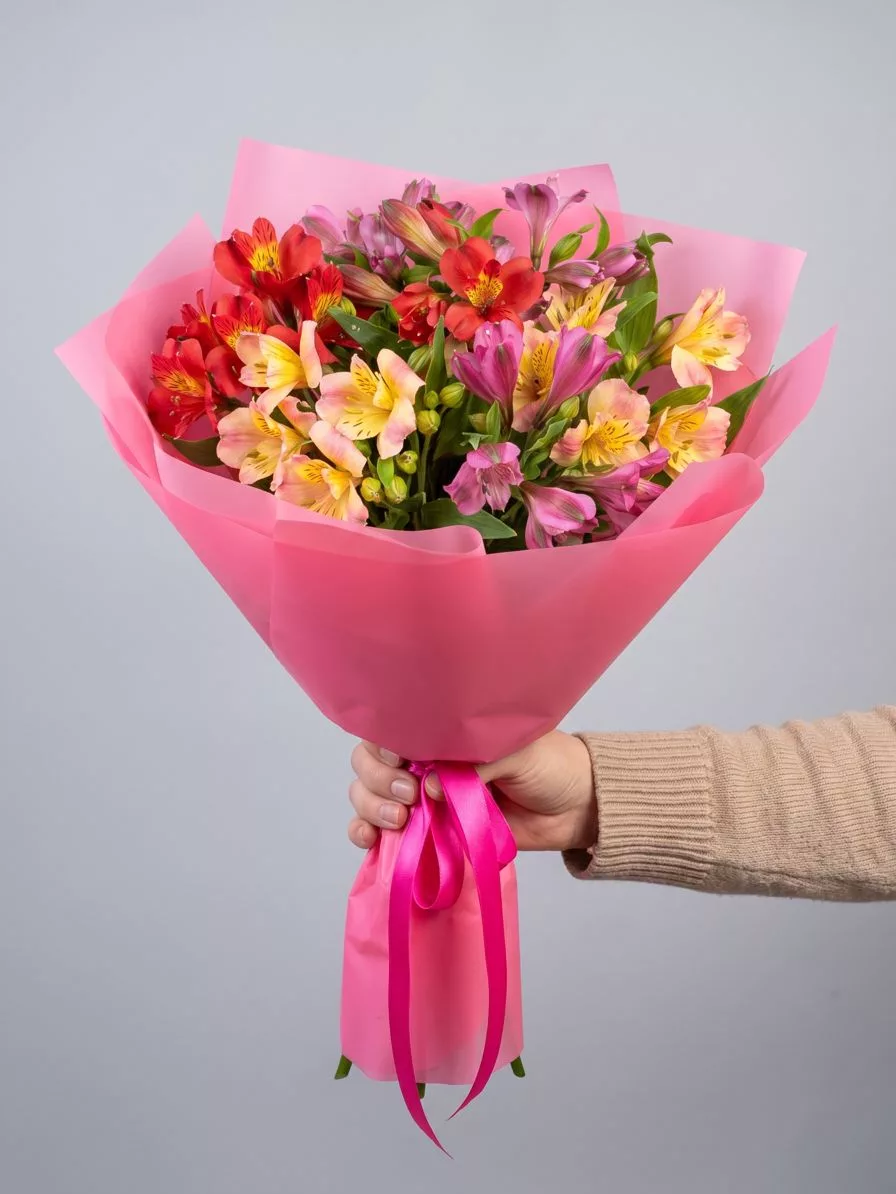
Senders from abroad often either underorder — a small five-stem bundle that looks modest for a significant birthday — or overorder — a massive arrangement that the recipient has no vase large enough to hold. The practical middle ground for most occasions is a bouquet of 11 to 15 stems of a single variety, or a mixed composition of 9 to 13 stems. Eleven roses is a classic Russian gift size for a birthday or anniversary; it reads as generous without being overwhelming. For a workplace delivery, where the recipient will carry the bouquet home on public transport or in a taxi, a tight, compact arrangement in a box is more practical than a large open bouquet. Box arrangements — flowers laid flat in a hatbox or kraft box — have become very popular in Russian cities over the past several years and travel better in cold weather because they can be closed. For a home delivery to a close relative or partner, a larger open bouquet of 15 to 25 stems makes a stronger impression. If the recipient lives alone and you are not sure about vase availability, a bouquet of alstroemeria or spray roses in a box with a small water-retaining foam insert will stay fresh for several days without needing to be arranged immediately. Seasonal single-variety bouquets — all tulips in March, all peonies in June, all chrysanthemums in autumn — tend to look more intentional and polished than mixed bouquets and are often less expensive for the same stem count.
What to Check Before Confirming Your Order
Run through this list before you submit the order, because corrections after the bouquet is assembled cost time and sometimes mean starting over. First, confirm the recipient's full name, street address with building and apartment number, and a working Russian mobile number — all three are required without exception. Second, check the delivery time you have requested against Gurevsk local time, not your own. Third, verify that your payment method will actually process; do this before the order, not after. Fourth, if the occasion is date-sensitive — a birthday, an anniversary, March 8 — specify the exact date and the preferred delivery window in hours, such as between 10 a.m. and 1 p.m. Gurevsk time. Fifth, if the recipient has any known allergies — lilies are a common trigger, as is strongly scented freesia — mention this in the order notes and we will substitute. Sixth, if the delivery is a surprise, tell us explicitly so the courier does not call the recipient with a heads-up, or tell us to call a different contact number for access. Seventh, if the building requires an entry code or an intercom call, include that in the address notes — Soviet-era apartment buildings in Gurevsk often have coded door locks. A complete order with all this information takes us the least time to process and gives the flowers the best chance of arriving in good condition at exactly the moment you intend. An incomplete order means a phone call back to you, which, given the time zone difference, can delay delivery by hours.
Sending flowers to Gurevsk from abroad is entirely workable once you account for the time zone, sort out the payment method, and give us a complete address with a phone number. The flowers are real, the delivery window is real, and the recipient gets a fresh bouquet — not a voucher or a digital card. The main thing we ask of international senders is to think in Gurevsk time and to reach us with enough lead time to prepare something worth giving. For significant dates, 48 hours' notice is comfortable. For same-day delivery, place the order before 3 p.m. Gurevsk time and we can almost always make it work. We deliver bouquets across Russia in 1–2 hours.
Frequently asked questions
Can I order flowers to Gurevsk if I am in a country where Russian bank cards are blocked?
Yes, but payment requires a workaround. Cards from many countries outside Europe and North America still process normally. Alternatively, a person inside Russia can pay on your behalf and you reimburse them separately. Contact us before placing the order and we will confirm which payment routes are currently open for your country, as the situation changes.
What is the latest I can place a same-day order for Gurevsk?
Place the order before 3 p.m. Gurevsk time — that is UTC+7 — and same-day delivery is usually possible. Orders placed after that window are prepared for next-morning delivery. For date-critical occasions like birthdays or March 8, ordering 48 hours ahead gives us the best selection of varieties and removes any timing risk.
Is an even number of flowers really a problem in Russia?
Yes, this is a genuine and widely observed custom. Even numbers of stems are associated with mourning in Russian tradition and will be noticed by most recipients. Always send an odd number — 3, 5, 7, 11, 15, 25 — for any celebratory or affectionate occasion. We count stems automatically, but if you specify a number yourself, keep it odd.
What flowers should I avoid sending to Gurevsk in winter?
Tropical varieties including anthuriums, birds of paradise and orchid stems are vulnerable to cold shock below minus 10 degrees Celsius and can blacken during the brief transfer from vehicle to building entrance. In Gurevsk winters, stick to roses, carnations, chrysanthemums, alstroemeria or spray roses — all of which travel reliably in insulated packaging through Siberian cold.
Can the card message be in English, or does it need to be in Russian?
It can be in English, Russian or both. Write your message in English and we will add a Russian translation if you want one, or we can transliterate a Russian phrase phonetically so you can write it yourself. Just tell us the occasion and what you want to say — we will phrase it in a way that reads naturally to a Russian recipient.
Ready to send a bouquet?
Pick a city, choose the flowers, and we will hand them over with a photo confirmation.
Choose a city →