
Flower Delivery to Kholmsk from Abroad: Timing, Varieties and Order Details
Kholmsk sits on the western coast of Sakhalin Island, and almost every week someone calls us from Germany, South Korea, Japan or the United States trying to send flowers there for a birthday or anniversary. The questions are always the same: can you actually deliver there, how far in advance do I need to order, and will the flowers survive the journey in good condition? The answers are straightforward once you understand the geography and the logistics, so here is everything a sender outside Russia needs to know before placing an order.
Where Kholmsk Is and Why It Matters for Delivery
Kholmsk is a port city on Sakhalin Island in Russia's Far East, roughly 9,000 kilometres from Saint Petersburg by road and air combined. The city has a population of around 28,000 and sits at the narrowest point of the Tatar Strait, which separates Sakhalin from the Russian mainland. Understanding this geography is the first thing a sender abroad needs to get right, because Kholmsk is not a city you can reach with a standard same-day courier from a central warehouse. Flowers assembled in Saint Petersburg travel by refrigerated air freight to Yuzhno-Sakhalinsk, the island's capital, and then by road to Kholmsk, a distance of roughly 90 kilometres through mountain passes. The road between Yuzhno-Sakhalinsk and Kholmsk crosses the Susunai Range and can be affected by snow, ice and fog, particularly between October and April. This is not a reason to avoid ordering — it is a reason to plan the order with a realistic time window and to communicate the delivery address precisely. Kholmsk has a clear street numbering system, but many apartment buildings have multiple entrances, and the entrance number is essential information. A sender in Tokyo or Berlin who omits the entrance number causes the same delay as a sender in Moscow would. The city's time zone is UTC+11, which is three hours ahead of Vladivostok and eleven hours ahead of Central European Time, so a sender needs to calculate local Kholmsk time when specifying a delivery window, not their own local time.
Bouquets we can deliver



How Far in Advance to Order and What the Timing Looks Like
The standard lead time for flower delivery to Kholmsk is 48 to 72 hours from the moment of order confirmation and payment. This is not a bureaucratic delay — it reflects the actual logistics chain: flowers are cut and conditioned in Saint Petersburg, packed in temperature-controlled boxes, loaded onto a flight to Yuzhno-Sakhalinsk, cleared through the airport, and driven to Kholmsk. The flight from Saint Petersburg to Yuzhno-Sakhalinsk takes approximately nine hours with a connection, and flights do not operate on every hour of every day, so the assembly and dispatch schedule depends on available flight times. For dates that matter — a birthday, a wedding anniversary, a graduation — place the order at least three full days before the target delivery date. For public holidays such as 8 March (International Women's Day), 14 February, and 1 September, extend that to five or six days, because demand across the Russian Far East spikes sharply and flight cargo space fills quickly. Senders from abroad often assume that paying a premium guarantees same-day delivery anywhere in Russia. That is not how distance logistics work, and no honest florist will promise a same-day bouquet to Kholmsk from an order placed at noon in London. What we can guarantee, given proper lead time, is that the flowers arrive fresh and the delivery window is met. When you place the order, you will receive a confirmation with the expected delivery date and a tracking update when the bouquet leaves Yuzhno-Sakhalinsk for Kholmsk.
Which Flowers Travel Well to Sakhalin and Which Do Not
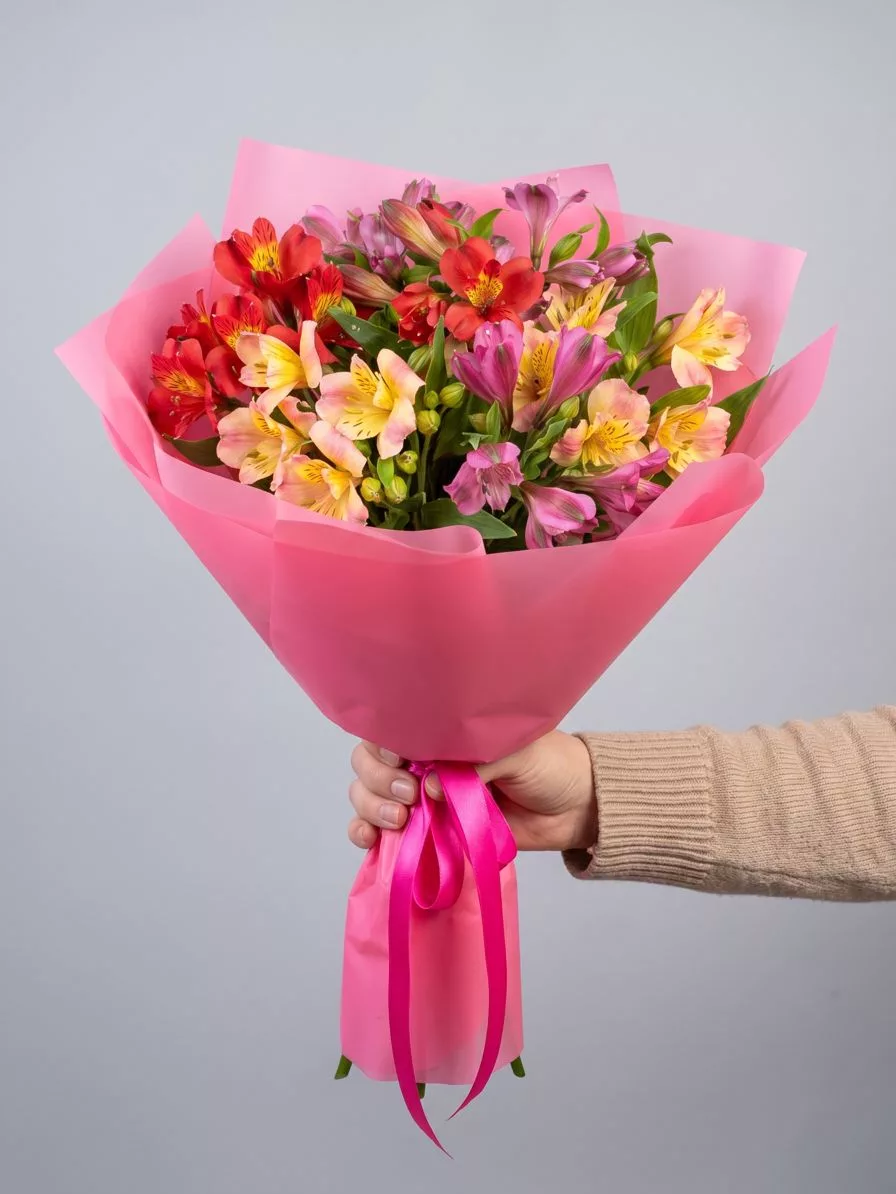
Not every variety that looks beautiful in a Saint Petersburg shop window is a good candidate for a 9,000-kilometre journey. The flowers that consistently arrive in excellent condition on long refrigerated routes are spray roses, standard roses with stem lengths of 60 to 80 centimetres, alstroemeria, chrysanthemums in both spray and standard form, statice, waxflower, and lisianthus. These varieties have firm petals, low ethylene sensitivity, and good vase life after transit — typically seven to twelve days once the recipient places them in water. Tulips and ranunculus are beautiful but fragile on long routes: tulips continue to grow in the box and can arrive misshapen, while ranunculus petals bruise easily. Peonies are seasonal from May to July and travel reasonably well within that window, but outside it they are not available in the quality needed for long-distance delivery. Tropical flowers such as bird of paradise and anthurium handle cold poorly and are not suitable for routes that pass through Sakhalin's autumn and winter temperatures. Hydrangeas are borderline: in summer they travel acceptably if the box is kept cold throughout, but in winter the risk of freezing damage on the road section between Yuzhno-Sakhalinsk and Kholmsk is real. For a sender abroad who wants to be safe, a bouquet built around garden roses or spray roses combined with alstroemeria and eucalyptus is the most reliable choice across all seasons. The recipient gets something that looks generous and lasts well, and the sender avoids the disappointment of fragile flowers that did not survive the journey.
Seasonal Temperatures in Kholmsk and What They Mean for Your Order
Kholmsk has a humid continental climate with strong maritime influence from the Sea of Japan. Winters are cold and long: January temperatures average around minus 10 to minus 14 degrees Celsius, with wind chill pushing the felt temperature lower. Summers are cool and often foggy, with July averages around 17 to 19 degrees Celsius. This temperature profile directly affects how flowers are packed and what the delivery driver needs to do at the door. In winter, bouquets are wrapped in insulating kraft paper with a heat-retaining inner sleeve, and the outer packaging is sealed to prevent cold air from reaching the stems during the walk from the vehicle to the building entrance. A recipient who leaves the bouquet in an unheated hallway for an hour after delivery risks cold damage, particularly to open roses. The sender should include a note with the order asking the recipient to bring the flowers inside immediately and cut the stems before placing them in room-temperature water. In summer, the concern reverses: Kholmsk's fog and humidity can accelerate botrytis on open petals, particularly on roses and lisianthus. Bouquets dispatched in July and August are packed with ventilation gaps and anti-fungal tissue, and the recipient should remove any packaging promptly rather than leaving the bouquet wrapped. Spring and autumn in Kholmsk are unpredictable — a late April snowfall is common, and October can bring early frost. Orders placed for these months should specify cold-weather packing regardless of the calendar date, because the mountain road between Yuzhno-Sakhalinsk and Kholmsk experiences temperature extremes that the city itself does not.
What Information the Sender Needs to Provide When Ordering from Abroad
Ordering flowers for delivery in Russia from a foreign address requires a few pieces of information that differ from a domestic order, and missing any of them causes delays that cannot be recovered once the flowers are in transit. The recipient's full name is the first requirement — not a nickname, not initials. Russian postal and courier systems use full names for building access in many apartment complexes, and a doorman or concierge who does not recognise the name on the order may refuse to accept the delivery. The street address must include the city district if the street name repeats across districts, the building number, the corpus or stroenie number if the building has one, the apartment number, and the entrance number. For a house rather than an apartment block, a landmark or gate description helps the driver. The recipient's Russian mobile phone number is essential: the driver calls ahead in Russian, so if the recipient does not speak Russian, the sender should arrange for someone to receive the call or leave a note that the recipient speaks a specific language and to send an SMS instead of calling. The sender's own contact details — a working email and an international phone number — are needed for order confirmation and for any logistics questions during transit. Payment from abroad is processed via international card or wire transfer; the order is not dispatched until payment clears, so factor in bank processing times, which can add 24 hours for some international transfers. Finally, the message card text should be provided in the language the recipient reads: we print it exactly as written, and a card in English sent to a recipient who reads only Russian is a wasted gesture.
Russian Flower Customs a Foreign Sender Should Understand
Russia has a few flower customs that are not obvious to senders from outside the country, and getting them wrong can create an awkward moment for the recipient. The most important is the odd-number rule: bouquets given as gifts always contain an odd number of stems — 3, 5, 7, 11, 15, 25, and so on. Even numbers of flowers are associated with mourning and are placed at graves or memorial sites. A sender who requests 'a dozen roses' will find that we adjust the count to eleven or thirteen, and this is not an error but a standard practice. If the specific number matters symbolically — 25 roses for a 25th birthday, for example — odd numbers align naturally with most milestone ages and anniversaries. The second custom is colour. Red roses are unambiguously romantic in Russia, more so than in many Western contexts, so a red rose bouquet sent to a colleague or a distant relative can carry an unintended message. White and cream flowers are elegant and neutral. Yellow flowers were historically considered unlucky in Soviet-era culture, though this association has weakened considerably among younger generations in cities like Yuzhno-Sakhalinsk and Kholmsk. A sender who is unsure about the relationship dynamic can request a mixed palette of pink, white and peach, which reads as warm and celebratory without any romantic or negative connotation. Wrapping matters too: Russian bouquets are typically presented with the stems wrapped in kraft paper or a decorative sleeve rather than in a vase, because the recipient is expected to choose their own container. Sending a vase separately is possible but adds shipping complexity and cost on a route as long as Saint Petersburg to Kholmsk.
What to Check Before Confirming Your Order
Before you click confirm on an order destined for Kholmsk, run through a short checklist that experienced senders use to avoid the most common problems. First, verify the delivery date against Kholmsk local time, not your own time zone: if you want flowers to arrive on a Saturday morning in Kholmsk, you need to know that Saturday morning there is Friday evening in London or Friday afternoon on the US East Coast. Second, confirm that the recipient will be at the delivery address on the specified date: Kholmsk is a working port city, and residents who work shift patterns at the port or at the ferry terminal may not be home during standard delivery hours. We can arrange evening delivery windows, but this needs to be specified at the time of ordering, not after dispatch. Third, check that the recipient's phone number is a current Russian mobile number with the country code 7: a number that has been ported, disconnected, or belongs to a landline will cause the driver to be unable to reach the recipient, and the bouquet may need to be left with a neighbour or returned. Fourth, review the bouquet composition against the season: if you are ordering in January and the composition you want includes flowers that are not available in winter, we will contact you to suggest alternatives, but this exchange takes time and may push the dispatch past the flight you need. Fifth, save the order confirmation number and keep the contact email accessible: if there is a flight delay or a road closure on the Yuzhno-Sakhalinsk to Kholmsk route, we will contact you at that address with an updated delivery estimate, and a sender who cannot be reached cannot approve changes.
Kholmsk is one of the more demanding delivery destinations in Russia because of its island location, mountain road access, and the time zone gap that complicates communication for senders in Europe, the Americas or East Asia. None of that makes delivery impossible — it makes preparation the deciding factor. A sender who provides accurate address details, places the order with 48 to 72 hours of lead time, chooses varieties suited to long refrigerated transit, and understands that the recipient's local time is the reference clock will almost always be satisfied with the result. The recipient in Kholmsk gets fresh flowers that look as though they were assembled around the corner, not carried across nine time zones, and that is the point of the whole exercise. We deliver bouquets across Russia in 1–2 hours.
Frequently asked questions
Can I order flowers for Kholmsk if I have no Russian bank card?
Yes. We accept international Visa and Mastercard payments as well as wire transfers from foreign accounts. Wire transfers can add up to 24 hours for the payment to clear, so factor that into your lead time. Once payment is confirmed, we send an order confirmation to your email and begin assembling the bouquet for the next available flight to Yuzhno-Sakhalinsk.
What happens if the recipient is not home when the driver arrives in Kholmsk?
The driver calls the recipient's Russian mobile number before arriving. If there is no answer, the driver waits briefly and attempts a second call. If the recipient remains unreachable, the bouquet is held and a second delivery attempt is arranged, but this depends on the flowers remaining in good condition. To avoid this, specify a delivery window when ordering and confirm with the recipient that they will be available.
Are there flowers I should avoid ordering for Kholmsk in winter?
Avoid hydrangeas, open peonies, and tropical varieties such as bird of paradise and anthurium in the period from November through March. These varieties are either unavailable in reliable quality or vulnerable to cold damage on the road section between Yuzhno-Sakhalinsk and Kholmsk. Roses, alstroemeria, chrysanthemums, lisianthus and statice are all safe choices throughout winter and travel well in insulated packaging.
Can I write the message card in English or another foreign language?
You can write the message in any language, and we print it exactly as provided. However, if the recipient reads only Russian, a card in English will not be understood. If you are unsure of the recipient's language preference, you can send us the text in both languages and we will print both on the card. Cards are printed in a standard font and included inside the bouquet packaging.
Is 8 March delivery to Kholmsk possible if I order from abroad?
Yes, but only with an order placed at least five to six days before 8 March. International Women's Day is the highest-demand date in the Russian flower calendar, and flight cargo space to Sakhalin fills quickly. Orders placed two or three days before the date risk missing available flights and arriving late. Early ordering also gives you a wider choice of varieties before the most popular compositions sell out.
Ready to send a bouquet?
Pick a city, choose the flowers, and we will hand them over with a photo confirmation.
Choose a city →