
Flower Delivery to Kireevsk from Abroad: Zones, Timing and What to Prepare
Kireevsk is a small town in Tula Oblast, about 220 kilometres south of Moscow, and customers calling from Germany, the UAE, the United States or Israel ask us the same cluster of questions every week: can you actually reach it, how far in advance do I need to order, and what flowers survive the drive from our Saint Petersburg warehouse? This article answers all of that with the specifics a sender abroad genuinely needs, not a list of vague reassurances.
Where Kireevsk Sits and Why It Matters for Delivery
Kireevsk is a town of roughly 25,000 people in the Kireevsky District of Tula Oblast. Its position matters because it is not on a major federal highway; the most direct route runs through Tula city itself, adding logistical steps that do not exist for, say, a delivery inside Moscow. When you order from abroad, you are not just paying for flowers — you are paying for a coordinated route that starts at our cold storage in Saint Petersburg and ends at a specific door in Kireevsk. The distance from Saint Petersburg to Kireevsk by road is approximately 900 kilometres, which means same-day dispatch and same-day arrival is only realistic if the order is confirmed very early in the morning, Moscow time. Tula Oblast sits in a continental climate zone: winters are genuinely cold, dropping well below minus fifteen Celsius in January and February, and summers can push above thirty Celsius in July and August. Both extremes affect which flowers travel well. Roses with dense petal counts, such as Mondial or Explorer, handle cold transit better than open single-petal varieties. In summer heat, any arrangement with open gerberas or fully blown peonies will arrive in poorer condition than tight buds would. Knowing the season when you order is the first practical step, and we will return to variety choices in a later section. The key takeaway for a sender abroad is that Kireevsk is reachable but requires more lead time than a city delivery, and that lead time calculation starts from the Moscow time zone, not your local one.
Bouquets we can deliver



Time Zones and the Moscow Clock: What Senders Get Wrong
The single most common mistake from senders in Western Europe or North America is placing an order according to their own local time and assuming the florist's working day mirrors theirs. Our operations run on Moscow Standard Time, which is UTC plus three, with no daylight saving adjustment — Russia abolished seasonal clock changes in 2014. That means when it is nine in the morning in London, it is already noon in Moscow. When it is nine in the morning on the United States East Coast, it is five in the afternoon in Moscow, and the operational window for same-day dispatch to a regional destination like Kireevsk has already closed. Senders from the UAE are actually in a more convenient position: Abu Dhabi and Dubai run on UTC plus four, so the morning hours there overlap well with our early working window. Senders from Germany, France or Spain face the largest gap in winter, when Central European Time is UTC plus one, making the Moscow workday start feel almost invisible. The practical rule is this: if you want flowers delivered to Kireevsk on a specific date, place the order by nine in the morning Moscow time on the day before that date at the very latest. For weekend deliveries, Friday morning is the cutoff for Saturday, because courier logistics to smaller towns do not run on Sunday schedules the same way. Many senders try to order on a Saturday evening their time for a Sunday delivery the next morning, and that combination is simply not achievable for Kireevsk regardless of how urgently it is requested. Setting a phone alarm for Moscow time is a small habit that prevents a lot of disappointment.
Choosing Flowers That Survive a Long-Distance Route
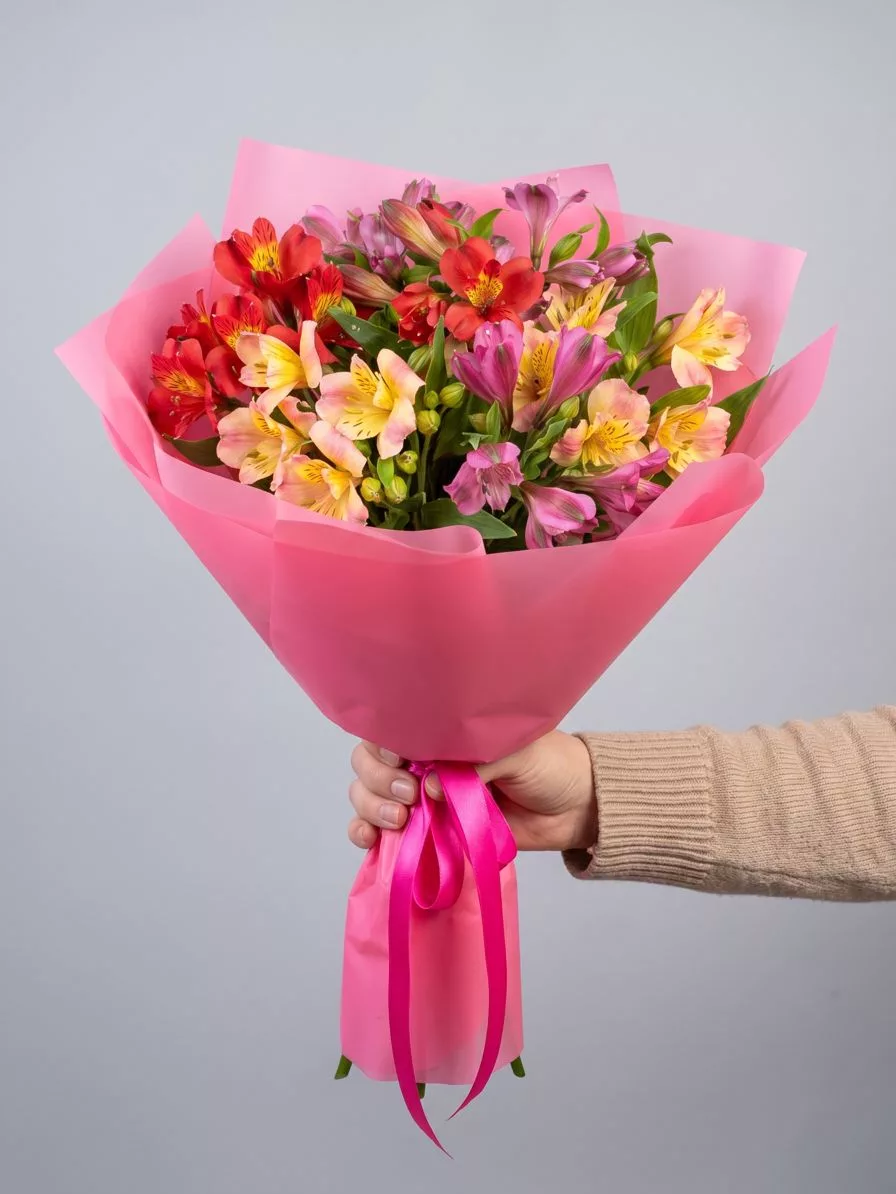
A bouquet that looks perfect in a Saint Petersburg cold room can arrive in poor condition in Kireevsk if the variety was wrong for the season and travel time. The flowers that consistently perform well on longer routes are spray roses, single-stem roses with tight buds, alstroemeria, chrysanthemums in both button and standard form, and statice used as filler. Carnations, which many senders from Western Europe underestimate because they are considered old-fashioned there, are genuinely excellent travellers — they hold water efficiently and do not bruise easily in transit packaging. Tulips are popular in Russia and are fine in winter and spring when temperatures keep the buds closed, but in summer they open fast and can look spent on arrival. Peonies are beloved in Russia and peak from late May through June; if you are ordering during that window, specify tight buds rather than open blooms, because an open peony on a warm van is a wilted peony by the time it crosses into Tula Oblast. Orchid stems, particularly cymbidium, travel surprisingly well because they are already cut at a long stem and are robust against vibration. What to avoid for Kireevsk routes: open hydrangeas in summer, fully open lilies in any season, and any arrangement described as featuring garden roses with many petals, such as David Austin types, unless the order is placed for a cool autumn or winter delivery. Sunflowers work in summer if the heads are still partially closed. When in doubt, ask us to choose the arrangement based on the season and travel time rather than picking from a photograph taken in ideal studio conditions.
How to Place an Order from Outside Russia Without a Russian Phone Number
This is a practical obstacle that stops many international senders before they even get to choosing flowers. Russian e-commerce checkout systems are often built around a Russian mobile number for SMS confirmation, and if you have a German, Israeli or American SIM, the verification step can simply fail. We handle international orders through direct contact rather than pushing you through an automated checkout that was not designed for foreign numbers. When you reach out, you will need to provide the recipient's full name written in Russian if possible, or in Latin letters with a note that you are unsure of the transliteration. The delivery address must include the street name, building number, apartment number if applicable, and the town name Kireevsk written clearly. Russian addresses often include a district or microdistrict name that is not the same as the street, so if the recipient gave you an address with the word rayon or mikrorayon in it, include that exactly as written. Payment from abroad is handled by card through an international gateway; we do not require a Russian bank account. When confirming the order, specify the preferred delivery window in Moscow time, the recipient's phone number in full international format, and whether the recipient knows a delivery is coming. In Russian custom, surprise deliveries are common and appreciated, but if the recipient works shifts or lives in a building with a strict entry system, a heads-up avoids a failed delivery. Include a card message in Russian if you can, or in English with a note that the recipient reads English — we will not translate or alter your message.
Russian Flower Customs a Sender from Abroad Should Know
Flower-giving in Russia follows a few conventions that differ enough from Western European or North American norms to matter when you are composing a bouquet remotely. The most important is the odd-number rule: bouquets given as gifts should contain an odd number of stems — three, five, seven, eleven, fifteen, twenty-five. Even numbers are associated with mourning and funerals, and a recipient who counts fifteen roses will feel the thought behind it, while a recipient who counts twelve may feel an unintended message. When you order and specify a number, make sure it is odd. Our team will flag it if you accidentally request an even count. Colour choices carry softer associations: red roses signal romantic love unambiguously, and sending them to a colleague or a distant relative can create an awkward situation. White flowers are neutral and elegant for most occasions. Yellow flowers were historically associated with separation or jealousy in Soviet-era popular culture, though younger Russians largely do not hold this belief. If you are unsure, a mixed bouquet of pink, cream and white tones reads as celebratory and warm without any loaded symbolism. Name days, called imeniny in Russian, are celebrated alongside birthdays and are sometimes more important to older recipients. If you know the recipient's name and roughly when their name day falls, it can be a meaningful occasion to send flowers even if it is not a birthday. Teacher's Day on October fifth and International Women's Day on March eighth are the two dates when flower demand in Russia peaks sharply, and ordering for those dates requires significantly more lead time than usual.
What to Check on the Delivery Confirmation
Once you have placed an order for Kireevsk, the confirmation you receive should contain specific details that you need to verify before assuming everything is in order. First, check that the delivery date is written in day-month-year format and matches the date you intended — confusion between month and day in the American date format has caused real delivery errors when the order was taken by a system that expected European format. Second, confirm that the recipient's phone number is listed with the full country code, which for Russia is plus seven. A number written without the country code can fail to connect when the courier calls ahead. Third, read the address back carefully: Kireevsk has several residential areas, and a missing building number or corpus designation, which is a secondary building identifier common in Russian address systems, can send a courier to the wrong entrance of a housing block. Fourth, check the delivery time window in Moscow time, not your local time, and make sure it accounts for the recipient's likely schedule. A delivery window of ten to twelve Moscow time is fine for someone at home but pointless for someone who works a standard office shift. Fifth, if you requested a specific variety or colour, confirm it appears on the order rather than a generic description like seasonal bouquet. Florists sometimes substitute when stock changes, which is normal, but you want to know in advance if the white roses you chose have become cream spray roses. A substitution is not a problem if you know about it; it becomes a problem only when it is a surprise after delivery.
Seasonal Availability and the Best Times to Order for Kireevsk
Russia's flower market runs on a combination of imported stock and domestic greenhouse production, and the mix shifts significantly by season. From November through February, the majority of cut flowers in Russian wholesale come from Ecuador, Colombia, Kenya and the Netherlands. Ecuadorian roses in this period are at their best — long stems, dense heads, excellent vase life — and varieties like Vendela, Avalanche and Explorer are reliably available. This is a good window for ordering roses to Kireevsk because the cold transit actually helps preserve them. March is the most difficult month to order for: demand around March eighth, International Women's Day, clears out wholesale stock across Russia in the days before and immediately after, and prices rise while availability drops. If you are ordering for a birthday or anniversary that falls in early March, place the order at least a week in advance. April and May bring Dutch tulips and the first domestic greenhouse tulips, and this is the peak window for tulip arrangements if the recipient likes them. Late May and June are peony season, sourced from both Dutch growers and Russian domestic farms in southern regions. July and August shift back to rose-heavy arrangements because many other varieties struggle in heat. September and October are excellent months overall: temperatures are moderate, transit conditions are good, and chrysanthemums and autumn sunflowers are in strong supply. The Tula Oblast region itself has a noticeable autumn, so a warm-toned arrangement of orange and burgundy chrysanthemums with solidago filler lands well culturally and practically in September and October.
Sending flowers to Kireevsk from abroad is not complicated once you have the right information in front of you. The distance is real, the time zone gap is real, and the seasonal variation matters more than most senders expect — but none of these are obstacles that cannot be planned around. Order early by Moscow time, choose varieties suited to the season and the travel distance, get the address right down to the corpus number, and keep the odd-number rule in mind. The recipient in Kireevsk will receive fresh flowers at their door, and the effort you put in from thousands of kilometres away will be entirely visible in the result. We deliver bouquets across Russia in 1–2 hours.
Frequently asked questions
Can I order flowers for Kireevsk if I do not speak Russian?
Yes. Contact us in English and provide the recipient's address and phone number. If you have the address in Russian script, include it exactly as written. We will handle the delivery communication with the recipient in Russian, and your card message can be in English or any language you choose — we deliver it as written without translation.
How many days in advance should I order for a specific date in Kireevsk?
For most dates, one full day in advance by nine in the morning Moscow time is sufficient. For March eighth, New Year period deliveries, or any date where the recipient has a narrow availability window, two to three days ahead is safer. Weekend deliveries to Kireevsk should be confirmed by Friday morning Moscow time at the latest.
What happens if the recipient is not home when the courier arrives?
The courier calls the recipient's phone number before arrival. If there is no answer and no entry is possible, we contact the sender to arrange a second attempt or an alternative address. This is why providing a working phone number for the recipient in full international format, starting with plus seven for Russia, is essential when placing the order.
Are there flowers I should definitely avoid ordering for summer delivery to Kireevsk?
Open hydrangeas, fully blown peonies, and open-headed gerberas travel poorly in summer heat on a long route. Stick to tight rose buds, alstroemeria, chrysanthemums or carnations for July and August orders. If you want something more unusual, ask us what is arriving fresh that week rather than selecting from a fixed catalogue image.
Can I include a gift alongside the flowers, such as chocolates or a soft toy?
Small additions like a box of chocolates or a plush toy can be included with the bouquet for Kireevsk delivery. Specify the item when ordering so we can confirm it is in stock and pack it securely with the flowers. Fragile or liquid gifts, such as wine or glass ornaments, are not suitable for long-distance courier routes and we will suggest alternatives.
Ready to send a bouquet?
Pick a city, choose the flowers, and we will hand them over with a photo confirmation.
Choose a city →