
Flower Delivery to Kolpashevo from Abroad: Zones, Timing and Varieties
Kolpashevo sits in the Tomsk Oblast, roughly in the geographic center of Russia, and customers calling from Germany, the UAE or Canada regularly ask the same opening question: can you actually get fresh flowers there from outside the country? The answer is yes, but the distance, the Siberian climate and the logistics gap between your time zone and ours mean that a few things need to be understood before you place an order. This article covers what matters — varieties that survive the journey, timing windows that work, and the practical steps a sender abroad needs to take.
Where Kolpashevo Is and Why Geography Shapes Every Order
Kolpashevo is a town of roughly 24,000 people on the Ob River in the Tomsk Oblast, sitting about 270 kilometres northwest of Tomsk city. It is not a regional capital, which means the flower supply chain runs through larger hubs before reaching it. When you order from abroad, you are not simply picking flowers off a local shelf — the order is assembled and dispatched from a professional cold-chain operation that accounts for the distance to the recipient. The town experiences a continental Siberian climate: winters drop well below minus 25 Celsius and summers can push past plus 30. Both extremes matter for flower survival. A spray rose that handles a Moscow winter perfectly can freeze in transit to Kolpashevo in January if packaging is not adapted for sub-zero conditions. Conversely, in July, the same rose needs insulated packaging to avoid heat damage during the final leg of delivery. Understanding the geography also helps with timing expectations. Kolpashevo is four hours ahead of Moscow Standard Time, which is seven hours ahead of Central European Time and ten or eleven hours ahead of the US East Coast. When a sender in London places an order at 9 am, it is already 1 pm in Kolpashevo. Factor this into any plan for a birthday morning delivery or a surprise timed to a specific event. The address itself matters too: always confirm whether the recipient is in the town centre or in one of the surrounding rural settlements, because delivery radius and timing differ.
Bouquets we can deliver



Varieties That Reliably Reach Kolpashevo in Good Condition
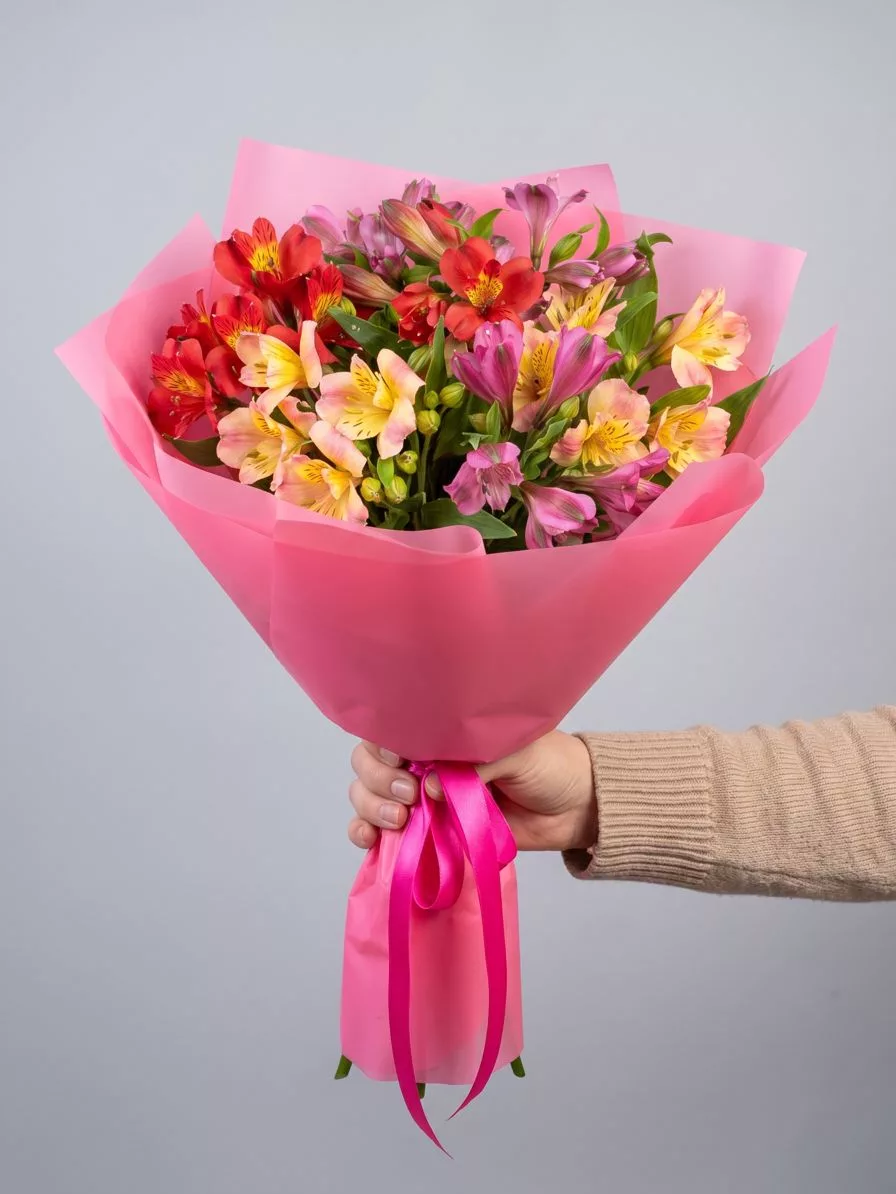
Not every flower that looks beautiful in a European florist's window is a sensible choice for a long-distance delivery to Siberia. The varieties that consistently arrive in strong condition are those bred for travel and temperature tolerance. Garden roses with dense petals — David Austin-style varieties like Juliet or Keira — hold their structure better than thin-petalled hybrid teas during extended transit. Standard chrysanthemums, both spray and single-headed, are exceptionally robust and remain one of the most reliable choices year-round. Alstroemeria travels well because its blooms open gradually, meaning the flowers are often still in bud at dispatch and open beautifully at the recipient's home. Lisianthus, sometimes called eustoma, is another strong performer: the multiple buds on each stem mean even if outer petals suffer minor transit stress, inner buds open fresh. Gerberas, on the other hand, are fragile. Their single large head bruises easily and they are sensitive to ethylene gas, which accumulates in packaging. Tulips are seasonal — they work well in spring but become unreliable in summer heat. Peonies are wonderful from May through June but have a very short vase life once open, so timing the dispatch to catch them in bud is critical. Orchid stems, particularly dendrobium, are a strong choice for corporate or celebratory orders because they last up to two weeks and tolerate temperature variation better than most tropical flowers. When ordering from abroad, lean toward these proven varieties and resist the temptation to request something delicate simply because it is available in your local market.
Time Zones, Order Windows and When to Place Your Request
The single most common mistake senders from abroad make is placing an order at the last minute by their own clock without accounting for the time difference. Kolpashevo operates on Tomsk Time, which is UTC plus 7. A customer in Los Angeles placing an order at 8 pm Pacific Time is placing it at noon the following day in Kolpashevo — useful to know if the birthday is that same Kolpashevo day. Conversely, a sender in Tokyo placing an order at 9 am is placing it at 7 am Kolpashevo time, which is actually an excellent window for a same-day morning delivery. The practical rule is to place your order at least three to four hours before the desired delivery time in Kolpashevo. For deliveries before noon local time in Kolpashevo, placing the order the evening before is strongly recommended, regardless of where you are calling from. This is especially true for large arrangements or orders that include premium varieties like peonies or David Austin roses, which require preparation time beyond a standard bouquet. Seasonal peaks also affect lead time. The week before March 8 — International Women's Day — is the busiest flower delivery period in all of Russia, including Siberia. If you are sending for that date, placing the order three to five days in advance is not overcaution; it is simply necessary. The same applies to Valentine's Day on February 14 and the New Year period. Outside these peaks, same-day delivery to Kolpashevo is achievable when the order arrives within the working window, but confirming this at the time of ordering is always the right step.
How to Place an Order When You Are Outside Russia
Ordering from abroad involves a few practical steps that differ from a domestic Russian order. Payment is the first consideration: international bank cards, including Visa and Mastercard, work for online orders, though some senders from countries under financial sanctions have reported card declines. In those cases, alternative payment methods such as international wire transfer or certain digital wallets can be arranged — it is worth asking directly when placing the order rather than discovering the issue at checkout. The order form requires a recipient address in Russian. If you do not write Russian, you can provide the address in transliteration — writing Cyrillic sounds in Latin letters — and the team will convert it. However, the street name, house number and apartment number must be accurate. Kolpashevo uses standard Russian address formatting: street name first, then house number, then apartment number if applicable. Including the recipient's phone number is not optional — it is essential. Delivery in Russia always involves a call or message to the recipient to confirm they are available to receive the flowers. If the recipient does not answer, the delivery will be attempted again, but this adds time. If you want the delivery to be a surprise, note this explicitly in the order comments, and the team will handle the coordination without spoiling it. Include your own international contact number and the best way to reach you — WhatsApp or Telegram work well across borders — so that any questions about the order can be resolved quickly without email delays.
Seasonal Considerations for Siberian Deliveries
Siberia's climate makes seasonality a practical concern, not just an aesthetic one. In winter, from November through March, temperatures in Kolpashevo regularly fall below minus 20 Celsius. Flowers in transit must be packaged in insulated boxes with heat packs to prevent freezing. Roses and chrysanthemums handle this well when packaged correctly. Tropical flowers such as anthurium and bird of paradise are genuinely risky in these conditions and are better avoided for winter orders. The transition months of October and April carry unpredictable temperature swings, which require the same insulated packaging as deep winter. Summer in Kolpashevo, July in particular, brings the opposite problem. Temperatures above plus 28 Celsius can wilt unprotected flowers within hours. Insulated cool packaging is used in summer as well, though the mechanism is reversed — keeping heat out rather than cold out. Sunflowers and gerberas are especially vulnerable in summer heat; alstroemeria and lisianthus hold up much better. Spring, specifically May and June, is arguably the best season for flower delivery to Kolpashevo from a purely botanical standpoint. Temperatures are moderate, peonies are available and in peak quality, and lilac — a flower with deep cultural meaning in Russia — is in season. If you have flexibility on timing and the purpose of the bouquet allows it, scheduling a delivery for late May or early June gives you access to the widest range of quality seasonal varieties. Autumn, September and October, brings dahlias and late-season roses into good availability before the cold sets in, making it a solid window for orders requiring something beyond the standard chrysanthemum or spray rose.
What Russian Flower Customs Mean for Your Order
Senders from outside Russia sometimes make choices that feel natural at home but land oddly in a Russian context. The most important cultural note is the odd-number rule: bouquets given as gifts in Russia traditionally contain an odd number of stems — one, three, five, seven and so on. Even numbers of flowers are associated with mourning and are placed at graves. This is not a rigid law, but it is a deeply held convention, and a recipient in Kolpashevo will notice. When ordering a bouquet, specify an odd stem count or simply let the florist compose the arrangement, as they will apply this rule automatically. Colour symbolism is less rigid than many foreigners assume. Red roses are romantic but also given between friends and family members without any awkward connotation. Yellow flowers are sometimes said to bring separation, but this belief is generational and not universal — many younger Russians in Siberia pay no attention to it. White flowers are clean and celebratory, not exclusively associated with weddings. If you are uncertain, a mixed bouquet with pink, white and soft coral tones is universally well-received for birthdays, anniversaries and professional occasions. Wrapping style also carries meaning. Russian bouquets are often elaborately wrapped, with the packaging considered part of the gift. A bouquet that arrives in simple craft paper is not considered inferior, but a well-wrapped arrangement with a ribbon signals that care was taken. When ordering for a significant occasion — a milestone birthday, a work anniversary, a congratulation on a new home — mentioning the occasion in the order notes allows the florist to adjust the presentation accordingly.
Checking Your Order: What to Confirm Before You Pay
Before finalising any international order to Kolpashevo, run through a short checklist. First, confirm the recipient address down to the apartment number and entrance code if the building has one — many Soviet-era apartment blocks in Siberian towns have a code-locked entrance, and a delivery driver without it will be stuck outside. Second, verify that the recipient's phone number is in full international format, starting with the Russian country code 7, followed by the ten-digit number. Third, check the delivery time you have selected against Kolpashevo local time, not your own. A tool as simple as a world clock website will prevent the most common timing error. Fourth, if you are ordering flowers that include any premium or seasonal variety — peonies, David Austin roses, fresh lilac — confirm availability directly before paying, as these varieties are not always in stock and substitution without notice is frustrating. Fifth, review the card message carefully. If you have written the message in English, confirm whether you want it printed in English or translated into Russian. Recipients in Kolpashevo will generally read a short English message without difficulty, but an older recipient may prefer Russian. Sixth, save your order confirmation number and the contact details for the shop. International time zones mean that if a question arises about your order, you need to be able to reach the shop efficiently rather than searching for contact information under pressure. A few minutes of checking before payment prevents almost every problem that international senders encounter after the fact.
Sending flowers to Kolpashevo from abroad is entirely achievable when the order is placed with the right lead time, the right varieties and accurate recipient information. The distance is real, the Siberian climate is a factor in every season, and the time zone gap requires a moment of arithmetic before you click confirm. Get those three things right — timing, variety choice and a complete address with a working phone number — and the bouquet reaches the recipient in good condition, properly wrapped and on the day that matters. We deliver bouquets across Russia in 1–2 hours.
Frequently asked questions
Can I order flowers to Kolpashevo if I am paying from a non-Russian bank account?
Most international Visa and Mastercard payments process without issue on our website. If your card is declined due to banking restrictions in your country, contact us directly — we can discuss alternative payment methods including international transfer. Always have your order details ready when you reach out so we can resolve it quickly.
How far in advance should I order for a specific delivery time in Kolpashevo?
For same-day delivery, place your order at least three to four hours before the desired arrival time using Kolpashevo local time as your reference. For morning deliveries, ordering the previous evening is strongly recommended. During peak periods such as March 8 or Valentine's Day, place your order three to five days ahead to guarantee availability and timing.
What flowers should I avoid ordering for a winter delivery to Kolpashevo?
Avoid tropical varieties such as anthurium, bird of paradise and heliconia in winter months. These flowers do not tolerate temperatures below zero even with insulated packaging. Gerberas are also risky in deep cold. Stick to roses, chrysanthemums, alstroemeria or lisianthus, all of which handle cold-weather packaging reliably during Siberian winters.
Does the bouquet have to contain an odd number of flowers?
Yes, for any celebratory or gift occasion in Russia, an odd number of stems is the correct choice. Even numbers are associated with mourning and grave flowers. When you order without specifying a stem count, our florists apply the odd-number rule automatically. If you are ordering a large arrangement by weight or size rather than stem count, this is handled within the composition.
Can I send a card message in English, or does it need to be in Russian?
You can send the card in English — many recipients in Kolpashevo, particularly younger ones, will read it without difficulty. However, if the recipient is elderly or you are unsure, note in your order that you would like the message translated into Russian and we will handle it. Keep the message short and clear to ensure accurate translation.
Ready to send a bouquet?
Pick a city, choose the flowers, and we will hand them over with a photo confirmation.
Choose a city →