
Flower Delivery to Your Mother in Russia: What to Order and How to Get It Right
Every week we take calls and messages from people in Berlin, Toronto, Dubai and Tel Aviv who want to send flowers to their mothers in Russia and are not sure where to start. The questions are always the same: will the flowers actually arrive fresh, can someone deliver on a Sunday, does Mum need to be home, and what should they order when they have no idea what is in season. This article answers all of that in the order it matters, starting with timing and ending with the note card.
When to Place the Order Relative to Russian Time Zones
Russia spans eleven time zones, and this is the single detail most people abroad get wrong. Saint Petersburg and Moscow run on UTC+3, so if you are in New York it is already the middle of the Russian night when your evening begins. Ekaterinburg is UTC+5, Novosibirsk UTC+7, Vladivostok UTC+10. The practical consequence is that a same-day delivery order placed at 9 a.m. your local time in London arrives at our shop at noon Moscow time and can still reach your mother the same afternoon in Saint Petersburg or Moscow. The same order placed at 9 a.m. New York time lands with us at 5 p.m. Moscow time, which is too late for same-day delivery in most cities. Our cut-off for same-day orders is 16:00 Saint Petersburg time, and we recommend placing by 14:00 to give the courier a comfortable window. For dates that matter, such as 8 March, Mother's Day or your mother's birthday, place the order at least two days ahead regardless of time zone. Demand on those dates is high, specific varieties sell out, and delivery slots fill before noon local time. If you are unsure of the cut-off for your mother's city, message us with her address and we will tell you the latest order time immediately. Never assume that because a website accepts your order it has confirmed a same-day slot — always ask for explicit confirmation.
Bouquets we can deliver



Which Flowers Travel Well Across Russian Cities
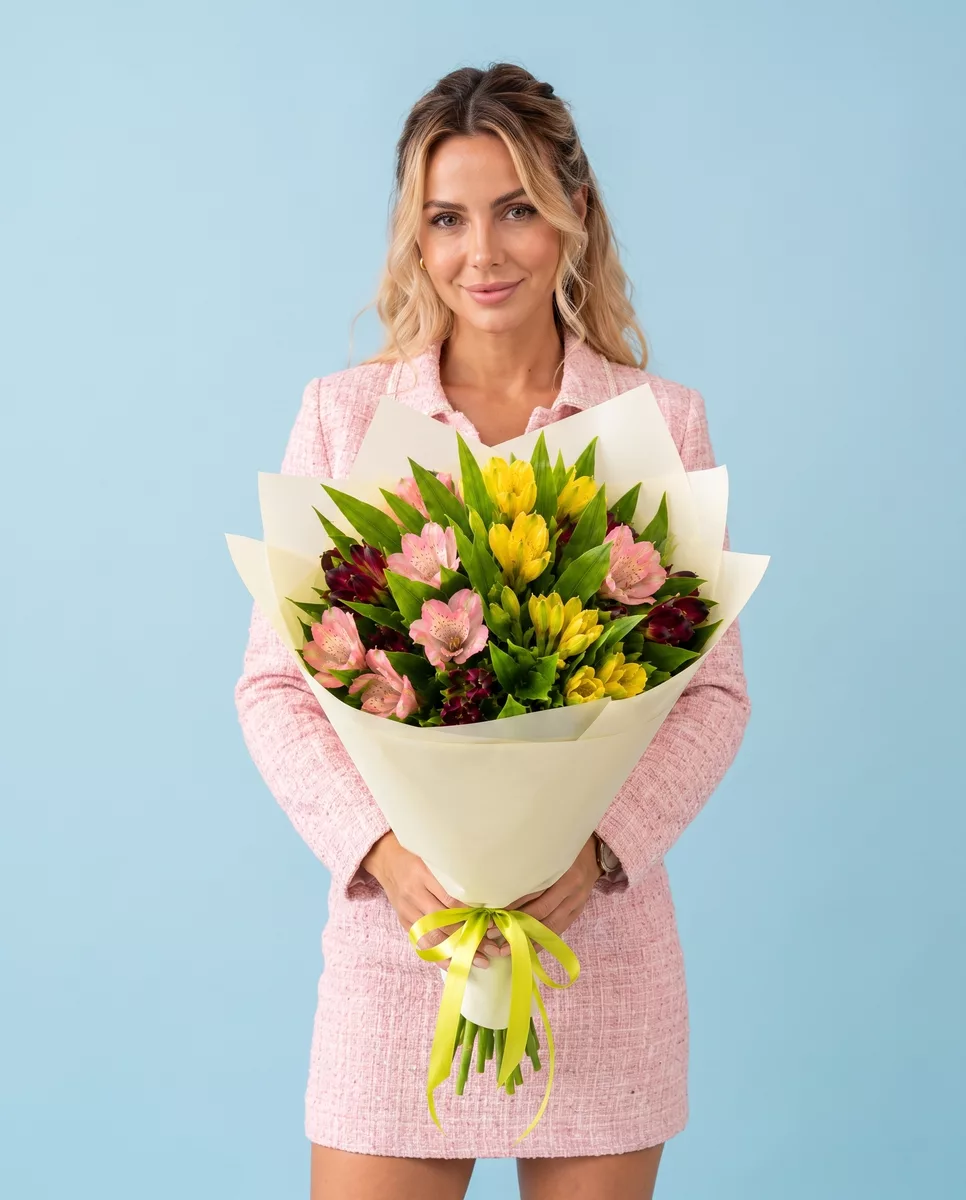
Not every flower that looks beautiful in a shop photograph holds up through a courier bag and a Russian winter doorstep. Roses, spray roses, chrysanthemums, alstroemeria, eustoma and carnations are the workhorses of Russian flower delivery because they are robust, widely available in Russian wholesale and last seven to fourteen days when conditioned properly. Garden roses and peonies are seasonal — peonies peak in May and June, garden roses from June through September — and outside those windows they either do not exist or arrive in poor condition from very long supply chains. Tulips are popular in Russia, especially around 8 March, but they are sensitive to temperature swings and do not survive poorly insulated delivery bags in temperatures below minus five Celsius. If your mother lives in Siberia and it is January, tulips are a risk; spray chrysanthemums or alstroemeria are not. Orchid stems, specifically Cymbidium sprays and single Phalaenopsis blooms, have become fashionable in premium Russian bouquets and travel well in cold weather. Sunflowers are cheerful and inexpensive but have thick stems that need conditioning time, so order them for next-day delivery rather than same-day. Hydrangeas are beautiful but drink enormous amounts of water and should only be ordered when the delivery window is under two hours. When in doubt, ask us to build around roses and eustoma — it is the combination that fails least often across all seasons and cities.
Sizes, Stem Counts and What Russian Mothers Actually Receive
In Russia, bouquets are almost always sold in odd stem counts — 11, 15, 21, 25, 51, 101. Even numbers are associated with funerals and are avoided entirely for celebratory gifts. If you are ordering from a non-Russian platform and it offers you 12 roses, change it to 11 or 13 before you confirm. Our bouquets start at 11 stems for a compact everyday arrangement and scale up to 51 or 101 stems for milestone birthdays and major holidays. A 15-stem bouquet of standard roses with greenery and wrapping is a solid, respectable gift that does not look skimpy when unwrapped. A 25-stem mixed bouquet with eustoma, spray roses and eucalyptus reads as genuinely generous and photographs well, which matters because your mother will almost certainly send you a photo. The 51-stem formats are for anniversaries, round birthdays — 60, 70, 75 — and 8 March when the gesture needs to match the occasion. Greenery and fillers such as eucalyptus, pistache, ruscus and wax flower add volume and extend vase life by reducing stress on the focal flowers, so do not ask us to remove them to cut costs. Wrapping in Russia is elaborate by Western standards: kraft paper, fabric, ribbon and a water-retaining base pad are standard, not optional extras. The pad keeps stems hydrated for up to four hours in transit, which is what makes one-to-two-hour delivery viable even in summer.
Giving the Right Delivery Address and Reaching Your Mother
Russian addresses follow a specific format that differs from Western conventions, and errors here are the most common reason a delivery is delayed. The correct order is: city, street name, building number, corpus or stroenie if applicable, apartment number, floor, entry code. Corpus and stroenie refer to secondary building numbers within a complex — many Soviet-era apartment blocks have them, and without the corpus number the courier may stand outside the wrong entrance for twenty minutes. The entry code, called a domofon in Russian, is the intercom code for the main door of the building. Most Russian apartment buildings have one, and without it the courier cannot enter. Ask your mother in advance or check with a sibling or neighbour. If your mother lives in a private house rather than an apartment block, note that clearly and confirm there is a gate or doorbell the courier can use. We always call the recipient before arrival, but if your mother does not answer unknown numbers — which is increasingly common in Russia due to spam calls — the delivery can fail even with a perfect address. The safest approach is to warn her that a call from an unfamiliar Saint Petersburg number is coming and she should answer it. If she is elderly or hard of hearing, provide a second contact number, ideally a relative who lives nearby. We can also leave the bouquet with a neighbour or building concierge if she pre-authorises that, but we need that instruction in the order notes, not as an afterthought after a missed delivery.
Key Russian Dates When Your Mother Expects Flowers
Russian calendar has several dates when not sending flowers reads as a significant omission rather than a neutral choice, and adult children abroad should know them. The most important is 8 March, International Women's Day, which in Russia is a major national holiday equivalent in emotional weight to a combination of Mother's Day and Valentine's Day. Every woman expects acknowledgement on 8 March, and a bouquet from a child living abroad carries particular meaning. Order at least three days ahead because our volume on that date is ten to fifteen times a normal day and specific varieties — tulips, mimosa, ranunculus — are pre-sold by the end of February. The second critical date is your mother's birthday. Russians treat birthdays seriously and a missed flower delivery on that day is remembered. Mother's Day in Russia falls on the last Sunday of November, introduced in 1998, and is growing in cultural weight each year though it has not yet reached the scale of 8 March. New Year, celebrated on 31 December and 1 January, is the largest Russian holiday of the year, and flowers are a common gift in the days leading up to it — white roses, white eustoma and spruce branches with berries are the typical palette. Orthodox Christmas on 7 January is observed but is quieter and flowers are less expected. If your mother has a name day — imeniny — and you know the date, a bouquet on that day is a thoughtful gesture that most Russians abroad-raised children overlook entirely.
Writing the Note Card in Russian When You Do Not Speak the Language
A bouquet without a note is anonymous, and your mother will want to know the flowers are from you specifically. We include a small printed card with every order and you can write the message in English — we will print it exactly as you type it. However, if you want the card in Russian, which your mother will appreciate more, here are reliable phrases you can copy directly. For a birthday: S dnem rozhdeniya, dorogaya mama — lyublyu tebya. That means Happy Birthday, dear Mum — I love you. For 8 March: S prazdnikom vesnyi, mamochka — this translates loosely as Happy spring holiday, Mum, which is how Russians often phrase 8 March greetings. For no particular occasion: Prosto tak, potomu chto ty luchshaya — Just because, because you are the best. Avoid translating English idioms literally into Russian through an online translator because the results are often grammatically awkward and your mother, who grew up with the language, will notice. Keep the message short and direct — Russian card culture favours warmth over length. If you want to add a longer personal message, write it in English and ask us to include it as a second card; many of our international customers do exactly this. You can also send a voice message to your mother's phone at the same time as the delivery, which pairs well with the physical bouquet and creates a moment rather than just a transaction. We can coordinate the delivery window with you so you know roughly when to call.
What to Check Before You Confirm the Order
Before you click confirm on any flower delivery to Russia, run through this list because each point represents a mistake we see at least once a week. First, confirm the delivery city is one we serve — our delivery area covers Saint Petersburg and a growing number of Russian cities, and the checkout page will tell you if an address is outside our zone. Second, check the delivery date against Russian public holidays: on major holidays such as 8 March and New Year, delivery slots are limited and must be booked in advance. Third, verify the stem count is an odd number. Fourth, paste the full address including corpus, apartment and entry code into the address field rather than a shortened version. Fifth, provide two phone numbers for the recipient if possible — hers and one backup. Sixth, read the note card text one more time before submitting, especially if you used a translation tool. Seventh, confirm your own contact details are correct because we may need to reach you if there is a question about the order while you are asleep in a different time zone. Eighth, check that the payment went through and you received an order confirmation by email — do not assume the order is placed until you have that email. Ninth, if the bouquet is a surprise, do not post about it on social media before it arrives, because your mother may see it and the surprise is lost. Finally, save our contact details so you can reach us quickly if you need to adjust the delivery time after placing the order.
Sending flowers from abroad to your mother in Russia is genuinely straightforward once you account for the time zone gap, the address format and the odd stem count rule. The flowers themselves — roses, eustoma, alstroemeria, chrysanthemums — are available year-round and travel well. The dates that matter most are 8 March, her birthday and, increasingly, the last Sunday of November. Place the order early, write the note in Russian if you can, give us a backup phone number, and the bouquet will reach her door fresh within one to two hours of dispatch. We handle the logistics; your job is simply to remember the day. We deliver bouquets across Russia in 1–2 hours.
Frequently asked questions
Can I order flowers for my mother in Russia if I have no Russian bank card?
Yes. Our checkout accepts international Visa and Mastercard payments as well as several other methods available to customers outside Russia. If you encounter a payment issue, contact us directly and we will find a solution. Many of our regular customers from Europe, North America and the Middle East pay without any difficulty using foreign-issued cards.
What happens if my mother is not home when the courier arrives?
Our courier calls ahead before arrival. If she does not answer, we attempt the call twice and then contact you. You can instruct us in the order notes to leave the bouquet with a neighbour or building concierge if she pre-authorises it. We do not leave flowers unattended outside a door without explicit permission, as weather and theft are real risks in Russian apartment blocks.
Is it possible to deliver flowers to a small Russian city, not just Moscow or Saint Petersburg?
Our delivery zone is expanding and currently covers Saint Petersburg and a number of other Russian cities. Enter the recipient's full address at checkout to see if her city is within our delivery area. If it is not currently listed, contact us — we add new zones regularly and may be able to help or advise on the realistic options for her location.
How fresh will the flowers be when they arrive, given the long distance from the shop?
We use water-retaining base pads in all bouquet wrapping, which keeps stems hydrated for up to four hours in transit. Our target delivery window is one to two hours from dispatch. Roses and eustoma conditioned in our coolers before dispatch will last seven to twelve days in a vase at home, provided your mother changes the water every two days and trims the stems slightly.
Should I tell my mother the flowers are coming, or keep it a surprise?
A surprise works well if she answers calls from unknown numbers — our courier will call from a Saint Petersburg number before arrival. If she screens calls, warn her to expect a delivery without revealing what it is. For elderly mothers or those with mobility issues, it is safer to confirm she will be home in a general window so the delivery does not fail on the first attempt.
Ready to send a bouquet?
Pick a city, choose the flowers, and we will hand them over with a photo confirmation.
Choose a city →