
Flower Delivery to Neftegorsk from Abroad: Zones, Timing and What to Prepare
Most international orders for Neftegorsk arrive at night Saint Petersburg time, which means the sender is sitting in Berlin or Toronto working through a checkout form without a clear picture of what happens next. Neftegorsk in the Samara region is a small city, and small cities have specific delivery windows, specific seasonal stock, and specific things that go wrong when the sender skips a detail. This article covers what you actually need to know before you place the order.
Where Neftegorsk Is and Why It Matters for Delivery
Neftegorsk sits in the Samara region of Russia, a mid-sized industrial city with a population that makes it neither a remote village nor a regional capital. The city has reliable road access, which means delivery within the region is consistent rather than dependent on weather closures or long rural routes. What matters for a sender abroad is understanding that the distance from Saint Petersburg is significant — the bouquet is assembled fresh and dispatched through the regional delivery network, not stored in a local warehouse. Delivery windows in Neftegorsk are typically structured in morning, afternoon, and evening slots, and the slot you choose at checkout is what the recipient actually receives. If you are ordering from a time zone that is five or more hours behind Moscow, pay close attention to the conversion: a same-day order placed at 10 PM your time may already be the following morning in Russia. The Samara region operates on Moscow time plus one hour, so Neftegorsk runs an hour ahead of Moscow. That single hour catches international senders repeatedly, especially those ordering for a birthday morning delivery. Concrete advice: convert the delivery time you want into Samara local time first, then check what that looks like in Moscow time, and only then look at your own clock. The shop processes orders in Moscow time, so your mental arithmetic needs to land there. Getting the time zone right is the single most effective thing an international sender can do before touching anything else in the form.
Bouquets we can deliver



What Varieties Travel Well to the Samara Region
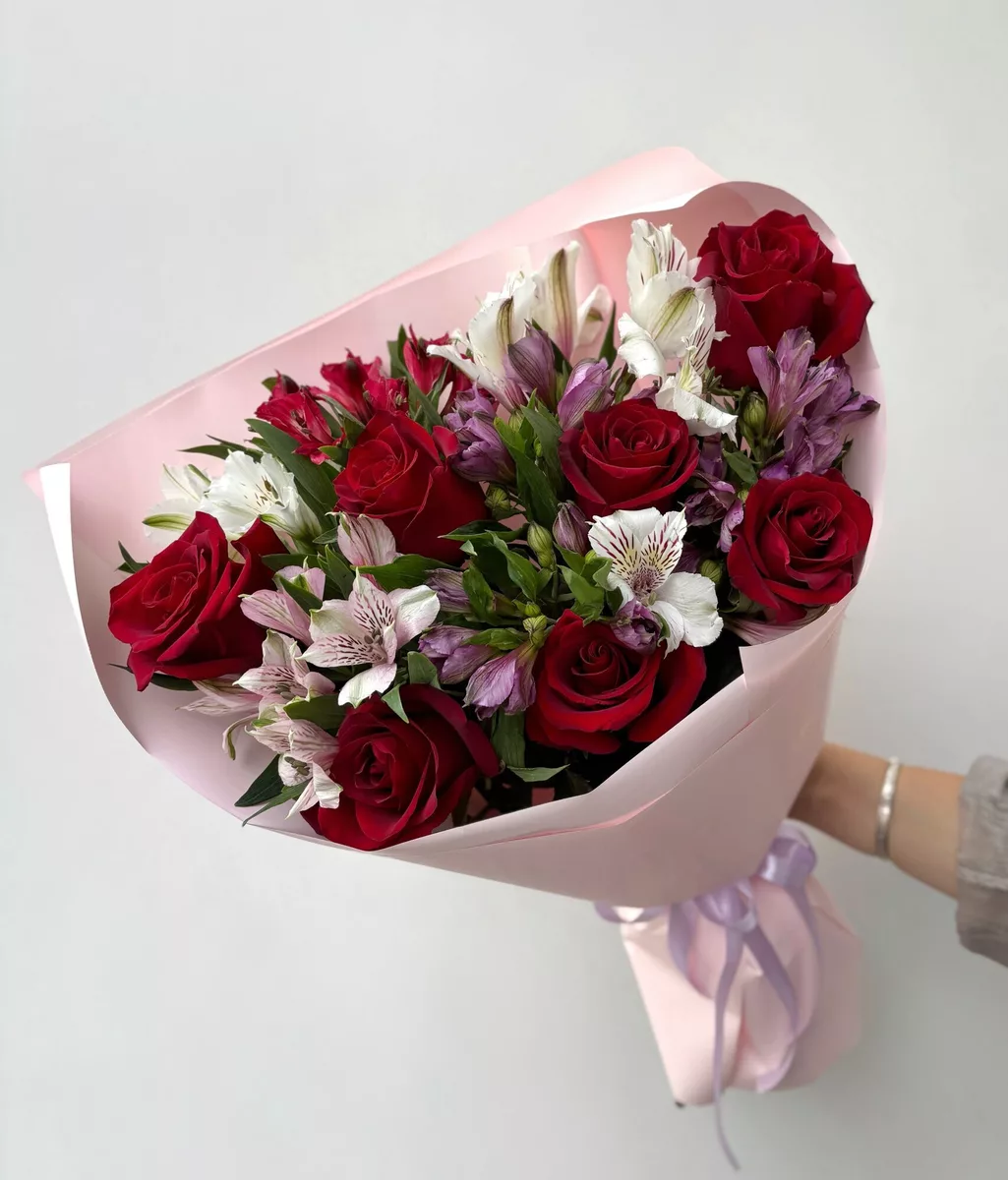
Not every flower that looks good in a Saint Petersburg cooler will look good on a doorstep in Neftegorsk after transit. The varieties that hold up best are those with dense, firm petals and sturdy stems. Spray roses and standard roses in bud form are consistently reliable — a bud that opens over two or three days gives the recipient far more enjoyment than a fully open bloom that arrives bruised. Alstroemeria is another strong choice: the multiple blooms per stem mean that even if one head is slightly damaged in transit, the rest of the cluster compensates. Chrysanthemums, both single-headed and spray types, are among the most transit-tolerant flowers available and are widely appreciated in Russian flower culture without carrying any specific occasion meaning that would limit their use. Eustoma, sometimes called lisianthus, travels well in bud and opens beautifully over several days, making it a good filler and feature flower simultaneously. Gypsophila adds volume and is essentially indestructible in a properly packed bouquet. What tends to suffer on longer routes are large open peonies in summer, fully open garden roses, and any tropical variety that requires stable humidity. If you want peonies specifically — and many senders do because they are a genuinely beloved flower in Russia — order them in tight bud form and note in the order comments that the recipient should trim the stems and place them in warm water to encourage opening. Calla lilies travel acceptably if packed with care, but their large single bloom makes any bruising immediately visible.
Seasonal Availability and What Changes Month by Month
Ordering flowers internationally means you are often ordering from a season that does not match Russia's. Someone in Australia placing an order in July is in the middle of their winter while Neftegorsk is in peak summer heat. That temperature gap matters because summer in the Samara region means outdoor temperatures that can exceed 30 degrees Celsius, which affects how long a bouquet stays fresh after delivery. In practical terms, summer orders should lean toward heat-tolerant varieties — spray chrysanthemums, alstroemeria, and roses in tight bud — rather than delicate open blooms. Winter orders face a different challenge: temperatures in Neftegorsk regularly drop below minus 15 Celsius in January and February, and bouquets need proper cold-weather packaging to survive even a short walk from the delivery vehicle to the door. The shop handles this packaging as standard, but it is worth knowing that the recipient should bring the bouquet indoors before unwrapping it and let it acclimatize for ten minutes rather than tearing the packaging off immediately in the cold. Spring is the easiest season logistically — tulips, ranunculus, and freesia are all in good supply from February through April, and temperatures are mild enough that transit stress is minimal. Autumn brings dahlias, sunflowers, and solidago into good availability, and these varieties suit the season well without requiring special handling. If you have a specific flower in mind, the order form allows you to note preferences, and the florist will substitute the closest available option if your first choice is out of season or temporarily unavailable.
How to Fill in the Recipient's Details Correctly
This is where the majority of failed deliveries originate, and it is almost always an avoidable problem. Russian addresses have a specific structure that differs from Western formats, and a sender who writes the address the way they would for a UK parcel will cause confusion. The correct order in Russian addressing is: city, street name, building number, apartment number. Neftegorsk has several residential districts, and many buildings have both a main number and a corpus or block designation — written as something like building 14, corpus 2, apartment 37. If you have the address in Cyrillic from the recipient, paste it exactly as given rather than transliterating it yourself, since transliteration errors in street names are common and can send the courier to the wrong street entirely. The recipient's phone number is not optional. Russian delivery relies heavily on courier-to-recipient phone contact, particularly for apartment buildings where the courier needs to be buzzed in. An international sender often leaves this field blank because they do not have the Russian number memorized, but it is worth asking the recipient for it in advance even if it feels awkward — the alternative is a failed delivery attempt. If the recipient is at a workplace rather than a home address, note the company name and any gate or reception instructions. Many industrial workplaces in cities like Neftegorsk have security checkpoints, and a courier arriving without the recipient's name on an expected visitor list may be turned away. The order comments field exists precisely for these details, and using it thoroughly is one of the most useful things an international sender can do.
The Card Message and Language Customs in Russia
A card message is included with every bouquet, and for an international sender this is often where a small cultural gap appears. Russian recipients genuinely appreciate a personal message, and a message in Russian — even a short one — is almost always received more warmly than one in English. If you are not a Russian speaker, writing your message in English is completely fine and will be understood by most recipients, particularly younger ones. However, if you want the message transliterated or translated, you can include the English text in the order comments and request a Russian version, and the florist will handle it. A few customs worth knowing: in Russia, flowers are traditionally given in odd numbers for celebratory occasions, so a bouquet of 5, 7, 11, or 15 stems is the norm rather than the even numbers common in Western Europe. Even numbers of flowers are associated with funerals, so if you are specifying a stem count, keep it odd. This is not a rigid rule that will cause offense if broken, but it is the kind of detail that shows care and knowledge of the culture, which recipients notice. Birthday messages tend to be direct and warm in Russian tradition — something like congratulating the person and wishing them health and happiness is entirely appropriate and not considered generic. Name days, called imeniny, are also celebrated in Russia and are sometimes confused with birthdays by international senders; if you are unsure which occasion you are marking, the person who told you about it is the best source of clarification.
Payment from Outside Russia and What to Expect
International payment for Russian flower delivery has specific realities that a sender should understand before starting the checkout process. Russian payment infrastructure operates somewhat separately from global systems, and not all international cards process smoothly on Russian e-commerce platforms. The most reliable approach for an international sender is to use a card that has been confirmed to work with Russian merchants, or to use a payment method that the shop explicitly lists as accepted for international orders. If your first payment attempt is declined, it is almost always a bank-side block rather than a problem with the order itself — many Western banks flag Russian merchants automatically, and a quick call to your bank's card services line to authorize the transaction resolves it in most cases. Currency conversion happens at your bank's rate rather than a fixed shop rate, so the amount that appears on your statement in your home currency will reflect whatever exchange rate your bank applies on the day of the transaction. It is worth knowing that the price you see on the site is in Russian rubles, and the conversion can look surprisingly affordable or surprisingly expensive depending on the current rate and your home currency. Processing time for international payments can occasionally be slightly longer than domestic ones, so placing the order at least a few hours before the desired delivery slot gives enough buffer for any payment verification steps. Once payment is confirmed, you receive an order confirmation, and from that point the order is in the system with the delivery details you provided.
What to Check Before You Confirm the Order
Running through a short checklist before hitting confirm prevents the majority of problems that international senders contact us about after the fact. First, verify the delivery date in Russian local time — Samara time is Moscow plus one hour, and Moscow is UTC plus three, so adjust accordingly from wherever you are placing the order. Second, confirm that the recipient's phone number is in the address field and that it is a current Russian mobile number; if you only have a foreign number for them, note this in the comments and include any alternative contact. Third, read the address back to yourself and check that the apartment number is included — street-level delivery to a residential building without an apartment number means the courier cannot complete the delivery. Fourth, check the stem count if you have specified one: odd numbers for celebratory bouquets. Fifth, review the card message for spelling, since the florist prints it exactly as written. Sixth, if you have a preference about substitution — meaning whether you want the florist to substitute a similar flower if your first choice is unavailable, or whether you want to be contacted first — note this in the comments. Most international senders prefer to be contacted rather than surprised, but the time zone difference means that contact may not be possible before the delivery window closes, so giving the florist permission to substitute with a similar variety and color family is often the more practical choice. Finally, save your order confirmation number: if you need to follow up, it is the fastest way to locate your order.
Ordering flowers for someone in Neftegorsk from abroad is genuinely straightforward once you have the time zone, the address format, and the variety selection sorted. The city is well-served by regional delivery, the seasonal stock is consistent and predictable, and the cultural details around odd stem counts and card messages are easy to apply once you know them. The mistakes that cause problems are almost always administrative rather than logistical — a missing apartment number, a phone field left blank, a time zone miscalculation. Work through the checklist in the final section before confirming, and the bouquet will arrive on time and in good condition. We deliver bouquets across Russia in 1–2 hours.
Frequently asked questions
Can I order flowers for Neftegorsk delivery if I do not speak Russian?
Yes. The order form works in Russian but the fields are straightforward — name, address, phone, date, time slot, and message. You can write your card message in English and it will be printed as written. If you want it translated into Russian, add that request in the comments field along with your English text.
How far in advance should I place an order from abroad?
Placing the order at least 24 hours before the desired delivery time is the safest approach for international senders, mainly because payment processing occasionally takes longer across international banking systems. Same-day orders are possible if placed early enough in the Russian morning, but the time zone gap makes this difficult for senders in the Americas.
What happens if the recipient is not home at the delivery time?
The courier contacts the recipient by phone before arriving and again on arrival. If there is no answer, a second delivery attempt is arranged. This is why the recipient's Russian mobile number is essential — without it, a missed delivery has no easy resolution and the bouquet cannot be left unattended in Russian apartment buildings.
Is there a minimum order value for delivery to Neftegorsk?
Minimum order thresholds vary and are shown at checkout based on the delivery zone. Neftegorsk falls within the Samara regional delivery area, and the applicable minimum is displayed before you confirm payment. Checking this early in the process avoids surprises at the final step.
Can I send a specific flower that is not shown in the catalog?
Use the order comments field to describe what you are looking for — variety, color, approximate stem count. The florist will confirm availability before assembly. If the exact variety is not in stock, you will be offered the closest alternative in the same color family and style rather than a random substitution.
Ready to send a bouquet?
Pick a city, choose the flowers, and we will hand them over with a photo confirmation.
Choose a city →