
Flower Delivery to Opochka from Abroad: Zones, Timing and What to Order
Opochka is a small town in Pskov Oblast, about 530 kilometres south of Saint Petersburg, and senders calling from Germany, the US or Israel usually ask the same first question: can you actually get fresh flowers there the same day? The honest answer is yes, but the logistics work differently from a city order, and a few details — the right bouquet size, the correct address format, the time-zone gap — decide whether the delivery lands cleanly or turns into a frustrating back-and-forth. This article walks through everything a sender abroad needs to confirm before clicking the order button.
Why Opochka Is Reachable but Requires Planning
Opochka sits on the Velikaya River and has a population of roughly 10,000 people, which means it is served but not on the same frequency as Pskov city itself. Deliveries from Saint Petersburg reach Opochka via a courier route that covers the Pskov region, so the window is longer than an urban same-day slot — typically the bouquet arrives within the day if the order is placed before noon Moscow time. Senders in Western Europe are three hours behind Moscow, and senders on the US East Coast are eight hours behind, so the practical cutoff for a same-day order from abroad is around 9 a.m. Eastern or 2 p.m. Central European time. Missing that window does not mean the flowers are impossible; it means they arrive the following morning, which is still a perfectly solid outcome for a birthday or anniversary. The key mistake senders make is placing the order at the end of their own working day without accounting for the time difference, then being surprised that the bouquet is scheduled for the next calendar date. Confirm the Moscow time on the order confirmation screen and match it against the recipient's schedule — if she is at work until 6 p.m. local time, an afternoon delivery slot actually works in your favour regardless of which country you are ordering from. Opochka addresses should include the street name in Russian transliteration or Cyrillic, the building number, the apartment number if applicable, and the recipient's mobile number — a Russian mobile starting with +7 is strongly preferred because the courier will call ahead.
Bouquets we can deliver



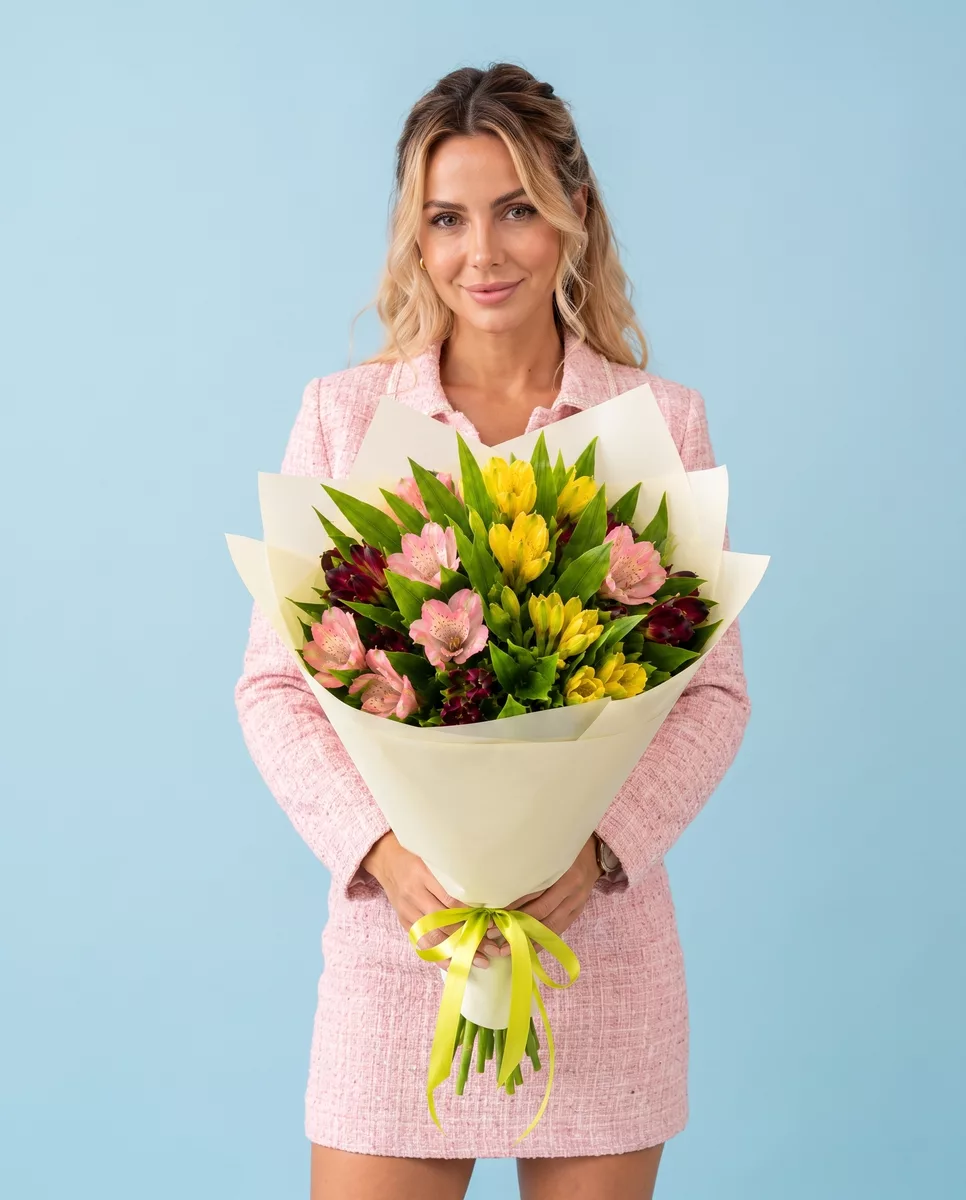
What the Recipient Will Actually Receive: Bouquet Formats
Because Opochka is a smaller town, oversized installations or elaborate hat-box arrangements that work well in central Saint Petersburg are not the right call here — they are harder to transport over distance without damage and can feel out of proportion when delivered to a private apartment or a small office. The formats that travel best and look genuinely impressive on arrival are mono-bouquets of 15 to 25 stems, mixed bouquets built around a structural flower plus two or three accent varieties, and wrapped single-variety bunches. For the structural flower, spray roses, standard garden roses, chrysanthemums and alstroemerias all hold their form well over a several-hour courier journey when temperatures are managed correctly. Eustoma is a popular choice in spring and summer because its ruffled petals read as luxurious without being fragile in transit. Tulips are excellent from February through April but need to be ordered in odd numbers — 11, 15, 21 — because even numbers are associated with mourning in Russian tradition, and a sender from abroad who does not know this can accidentally create an awkward moment. Gerberas are bright and cheerful but their stems are prone to bending under their own weight during long transport, so they work better in a compact hand-tied format rather than a tall vase arrangement. Peonies, when in season from late May through June, are arguably the most universally loved flower among Russian recipients and survive transit beautifully because they are cut in bud and open over 24 to 48 hours after delivery. Confirm with the shop which varieties are in stock for your chosen date, because seasonal availability shifts week by week.
Russian Flower Customs a Foreign Sender Should Know
The odd-number rule is the one that catches almost every first-time sender from abroad: bouquets in Russia are given in odd numbers — 3, 5, 7, 11, 15, 21, 51, 101 — because even numbers are reserved for grave flowers. This applies regardless of the flower type, so a bouquet of 10 roses or 12 tulips will read as culturally wrong to most Russian recipients even if the sender had no idea. The shop will automatically compose bouquets in odd numbers, but if you specify a quantity in the order notes, make sure it is odd. A second custom worth knowing is that yellow flowers carry a connotation of separation or infidelity in some Russian regions, particularly among older recipients — this is not universal and younger urban Russians often dismiss it, but if the recipient is over 50 or lives in a more traditional household, it is safer to choose another colour or mix yellow with white and pink to dilute the association. Red roses are the most straightforwardly romantic gift and are understood that way by virtually everyone. White flowers are elegant and appropriate for birthdays, professional milestones and congratulations. For a name day — imeniny — which is celebrated by many Russians on the feast day of their patron saint, a single-variety bouquet in the recipient's favourite colour is the most thoughtful choice. If you do not know the recipient's preferences, a mixed bouquet of roses and eustoma in soft pink or cream is reliably well-received across age groups and occasions. The greeting card message can be written in English if you prefer; the courier will deliver it as written.
Timing the Order Across Time Zones
The time-zone calculation is the single most common source of confusion for senders abroad, and getting it wrong by even two hours can shift a birthday delivery from the morning of the celebration to the following day. Moscow time is UTC+3 and does not observe daylight saving, which means the gap between Moscow and other cities changes twice a year on the European and North American side. In winter, London is three hours behind Moscow; in summer, two hours behind. New York is eight hours behind Moscow in winter and seven in summer. Tel Aviv, which has a large Russian-speaking diaspora, is one hour behind Moscow in winter and the same as Moscow in summer. The practical rule is this: if you want flowers delivered to Opochka on a specific date, place your order before 9 a.m. Moscow time on that date. Convert that to your local time and set a reminder. If the occasion is a surprise and you want morning delivery, the order should ideally be placed the evening before in Moscow time, which for a sender in California means placing it in the early afternoon Pacific time. For a sender in Australia, the time gap is large enough that ordering a full day in advance is the safest approach. Always check the order confirmation for the scheduled delivery date in Moscow time rather than relying on your browser's local clock display. If the delivery date on the confirmation does not match your intention, contact the shop immediately — changes are easy to make before the bouquet is assembled but impossible once the courier has departed.
Payment and Address Entry for International Senders
Paying from abroad is straightforward: the shop accepts international bank cards including Visa and Mastercard issued outside Russia, and the transaction processes in Russian roubles at your bank's current exchange rate. Some banks flag Russian merchant transactions as unusual and trigger a security hold, so it is worth notifying your bank in advance or having a backup card ready. The address field is the other area where errors concentrate. Russian addresses follow a specific order that differs from Western convention: country, region, city or town, street, building number, apartment or office number, recipient name. For Opochka, the region is Pskovskaya Oblast. The street name should be entered in the Latin transliteration that matches the official Russian spelling — for example, ulitsa Lenina rather than Lenin Street — because the courier's navigation system uses Russian-standard addressing. If you are not sure of the exact address, ask the recipient's family member or a mutual contact rather than guessing; an incorrect building number in a small town causes a delay that is difficult to resolve remotely. The recipient's phone number is mandatory and should be a working Russian mobile number starting with +7. If the recipient does not have a Russian number and only uses a foreign SIM, note this in the order comments and provide an alternative contact — a neighbour, a family member or a colleague — who can meet the courier. The courier will call approximately 30 minutes before arrival, so the recipient needs to be reachable at that number during the delivery window you have chosen.
Seasonal Flower Availability and Temperature Considerations
Opochka has a continental climate with cold winters, and this affects both which flowers are available and how they are transported. From November through March, temperatures regularly drop below minus 10 degrees Celsius, and flowers transported without proper insulation can suffer cold damage — petal blackening on roses, limpness in tulips, browning on the outer petals of chrysanthemums. The shop packs cold-weather orders in insulated wrapping and coordinates delivery windows to minimise the time the bouquet spends in unheated spaces, but the recipient should be home or reachable so the handoff is quick. Asking the recipient to meet the courier at the building entrance rather than waiting for a door-to-door delivery in winter is a practical tip that senders from warmer climates often do not think to mention. In summer, Opochka can reach 25 to 28 degrees Celsius, and heat is the opposite problem — roses and eustoma need to be kept out of direct sunlight after delivery and placed in water within an hour. The shop will include care instructions with the bouquet, but a quick message to the recipient reminding them to unwrap and water the flowers immediately after delivery is always worthwhile. Spring and early summer — April through June — are the best window for ordering premium varieties: Dutch tulips are still available in April, peonies arrive in late May, and garden roses begin their main season in June. Autumn brings dahlias, solidago and spray chrysanthemums, all of which are sturdy travellers and look genuinely seasonal rather than generic. Ordering a flower that is in its natural season always produces a better result than ordering an out-of-season variety that has been forced in a greenhouse.
What to Check Before Confirming the Order
Before you press the final confirm button, run through five specific checks. First, verify the delivery date shown on the summary screen is in Moscow time and matches the occasion date in Opochka — they are the same time zone, so no conversion is needed for the recipient's side, only for yours. Second, count the stems in the bouquet description and confirm the number is odd. Third, read the address back against whatever source you used — building number, apartment number and the recipient's name spelled as it appears on their door if the building has a coded entrance. Fourth, confirm the recipient's phone number digit by digit; a single transposed digit means the courier cannot reach them. Fifth, check that the card message is written exactly as you want it to appear — punctuation, capitalisation and the sender's name — because the card is printed and cannot be edited after the order is confirmed. If you are ordering as a surprise and do not want the recipient to see the order confirmation, use your own email address rather than theirs for the booking. Most senders from abroad also find it useful to screenshot the order confirmation including the order number, because if you need to follow up from a different time zone the order number is the fastest way for the shop's team to locate your booking. A correctly placed order with a verified address and a reachable recipient almost always arrives without incident; the problems that do occur are nearly always traceable to one of these five points.
Sending flowers to Opochka from abroad is genuinely doable and, when the logistics are handled correctly, results in a delivery that feels immediate and personal despite the distance. The variables that matter most are the time-zone calculation, the address accuracy, the recipient's phone number and the seasonal bouquet choice. Get those four elements right and the rest of the process is straightforward. The shop handles the route, the packaging and the courier call — your job is to place the order with correct information and at the right Moscow time.
Frequently asked questions
Can I order flowers for Opochka delivery if I am outside Russia and do not speak Russian?
Yes. The Five Flowers website operates in Russian but the order form accepts Latin-script address entries and the card message can be written in English. The courier will deliver the card exactly as written. Payment works with international Visa and Mastercard cards. Having the recipient's Russian mobile number is the only hard requirement on the recipient's side.
How far in advance should I place the order from a different time zone?
For same-day delivery to Opochka, the order must be placed before 9 a.m. Moscow time on the delivery date. Convert that to your local time — for New York that is roughly 1 a.m. Eastern in winter. If that cutoff is impractical, place the order the evening before in your local time, which safely covers the Moscow morning window and allows for a morning delivery slot.
Why do Russian bouquets always have an odd number of flowers?
Even numbers of flowers are traditionally associated with funerals and grave offerings in Russia. Giving an even-numbered bouquet to a living recipient is considered bad luck by many Russians, particularly older generations. The convention applies to every flower type. The shop composes bouquets in odd numbers by default, but if you specify a quantity in the notes, make sure it is odd — 11, 15, 21 and so on.
What happens if the recipient is not home when the courier arrives in Opochka?
The courier calls the recipient's mobile number approximately 30 minutes before arrival. If there is no answer and no one is home, the courier will attempt a second call and wait briefly before returning the bouquet. To avoid this, provide a backup contact in the order notes — a neighbour or family member — and let the recipient know a delivery is coming, even if you keep the sender's identity a surprise.
Are there flowers I should avoid sending to Opochka in winter?
Gerberas and open-headed large roses are the most vulnerable in sub-zero temperatures because their petals bruise quickly when chilled. Chrysanthemums, spray roses, alstroemerias and eustoma handle cold transit significantly better. If you are ordering between November and March, mention the season in the order notes so the shop can pack appropriately and choose the sturdiest stems from the available stock.
Ready to send a bouquet?
Pick a city, choose the flowers, and we will hand them over with a photo confirmation.
Choose a city →