
Flower Delivery to Pikalevo from Abroad: What You Need to Know
Every week someone calls us from Germany, Finland or the United States wanting to send flowers to a relative in Pikalevo and immediately asks the same question: how long will it actually take? Pikalevo is a small industrial town in the Leningrad Oblast, roughly 230 kilometres east of Saint Petersburg, and the honest answer involves a few moving parts — courier routing, seasonal stock, and the details the sender needs to get right from a different time zone. This article covers all of it plainly, without the vague reassurances you usually get.
Where Pikalevo Sits and Why Distance Shapes Your Order
Pikalevo sits in the Boksitogorsky district of the Leningrad Oblast, a town of roughly 22,000 people built around aluminium and cement production. From our Saint Petersburg base the road distance is approximately 230 kilometres along the A114 highway, which means a courier run is a committed same-day trip rather than a quick urban hop. We plan Pikalevo deliveries on a scheduled basis, so the cut-off time for placing your order matters more here than it does for central Saint Petersburg addresses. If you are calling from London, Berlin or Helsinki, remember that Saint Petersburg runs on Moscow Time, which is UTC plus three hours with no daylight saving adjustment. A sender in New York placing an order at 9 a.m. Eastern Standard Time is already looking at 5 p.m. in Saint Petersburg, which is close to the last window for same-day dispatch to Pikalevo. Senders in Central Europe have a slightly more comfortable margin. The practical takeaway is this: place your order before noon Saint Petersburg time if you want the bouquet to arrive the same calendar day. Orders placed later are scheduled for the following morning delivery, which is still fast by the standards of inter-city flower logistics in Russia. Knowing the geography also helps you set expectations for the recipient, who may be surprised to receive a delivery from Saint Petersburg rather than a local source.
Bouquets we can deliver



Delivery Windows and How to Choose the Right One
We offer two main delivery windows for Pikalevo: a morning slot targeting arrival between 10 a.m. and 1 p.m., and an afternoon slot targeting arrival between 2 p.m. and 6 p.m., both in local time. Because Pikalevo is in the same time zone as Saint Petersburg, there is no additional conversion to worry about once you have the Saint Petersburg cut-off in mind. For the morning slot, your order needs to be confirmed and paid before 10 p.m. the previous evening Saint Petersburg time, which gives us time to assemble the bouquet, condition the stems overnight and load the courier vehicle at first light. For the afternoon slot, orders confirmed before 9 a.m. on the day of delivery are accepted. International senders often underestimate how firm these cut-offs are. Unlike a city delivery where a courier can turn around in twenty minutes, a Pikalevo run is a dedicated trip and the vehicle leaves on schedule. If you miss the window by even thirty minutes, the next available slot is the one we can honestly promise. We recommend building in a buffer of at least two hours beyond the cut-off when ordering from a time zone more than four hours behind Saint Petersburg. One more practical point: always provide a working Russian mobile number for the recipient. Our courier will call ahead when approaching Pikalevo, and without a contactable number the delivery cannot be completed even if the address is correct.
Which Flowers Travel Well Over 230 Kilometres
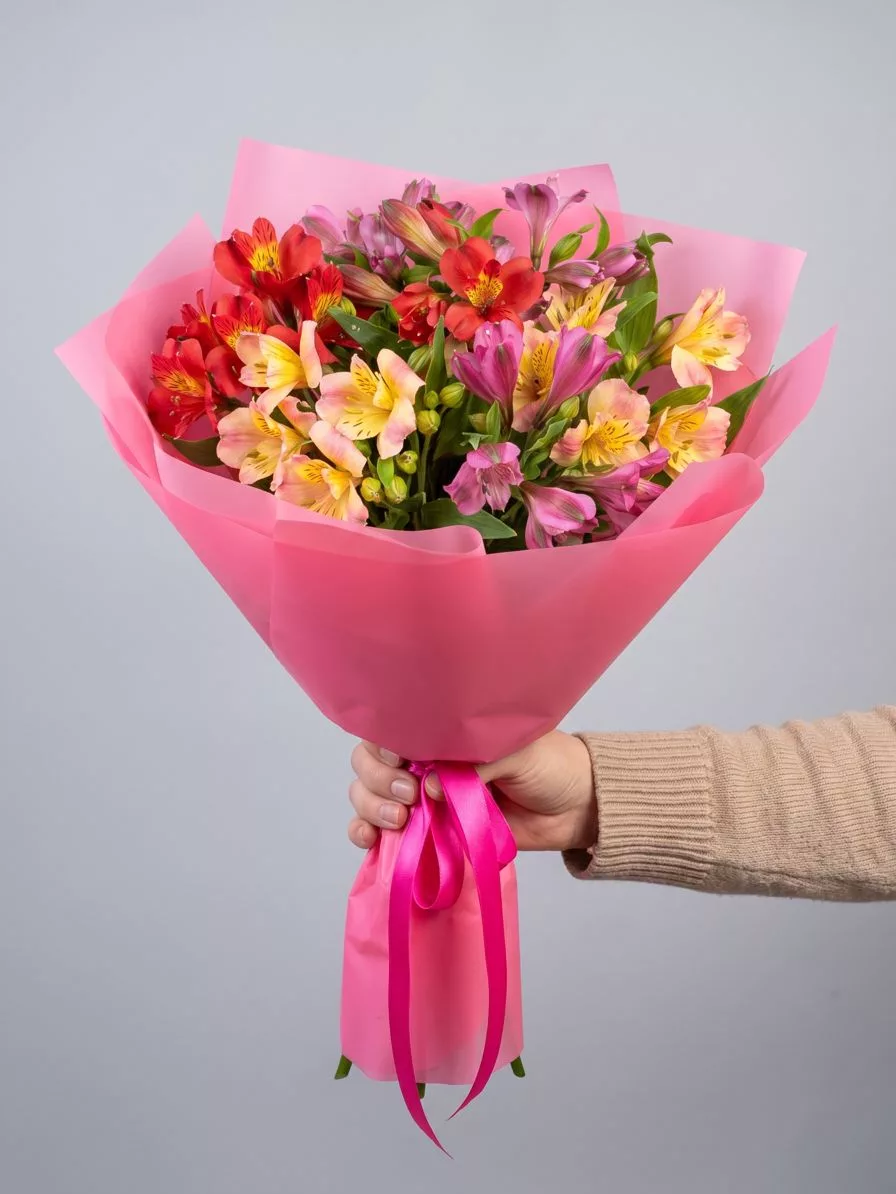
Not every variety that looks beautiful in a Saint Petersburg studio arrives in the same condition after a two-to-three hour road journey, especially in summer when the car interior heats up despite insulated packaging. The varieties that consistently perform well on longer runs include spray roses, standard roses with tight bud closure, alstroemeria, chrysanthemum blooms, lisianthus and statice. These stems are structurally robust, hold water efficiently and do not bruise easily during transit. Tulips are a more nuanced case: in autumn and winter they travel excellently because the cold ambient temperature keeps them firm, but in July and August we advise against tulips for Pikalevo deliveries unless the order is placed for a morning slot and the day temperature is below 25 degrees Celsius. Hydrangea is another variety we handle carefully on long routes. A full hydrangea head is thirsty and can wilt within an hour if the packaging does not maintain humidity. We use water-tube inserts for hydrangea on any delivery beyond 100 kilometres, but if you are ordering in high summer, a mixed bouquet centred on roses or alstroemeria is a more reliable choice. Peonies are available from late May through June and they travel well in bud form — the recipient gets to watch them open over two to three days, which is actually a pleasant experience. Avoid asking for fully open peony heads on a long delivery; they are fragile at that stage. Orchid stems, specifically Cymbidium, are another solid option for autumn and winter orders.
Seasonal Availability and What Changes Month by Month
Russia's flower market is heavily import-dependent, with the majority of cut stems arriving from Ecuador, the Netherlands, Colombia and Kenya. This means that for roses, standard carnations, gypsophila and most tropical foliage, availability is relatively stable year-round. What changes seasonally is the domestic Russian crop and the perishability risk tied to weather. January and February bring reliable cold-chain conditions from Saint Petersburg to Pikalevo, and the road is generally passable, though we monitor weather forecasts and will contact you if a severe snowstorm makes same-day delivery impossible. March is the busiest month in Russia because of International Women's Day on the 8th, which is the single largest flower-giving occasion in the country. If you are sending flowers for that date, place your order at least five to seven days in advance because stock of premium varieties — Dutch tulips, red roses, ranunculus — is allocated quickly. April through June sees the arrival of domestic peonies, lilac branches and field-grown tulips, all of which are popular and priced well during their peak weeks. Summer orders should lean toward spray roses, alstroemeria and lisianthus for the reasons explained in the previous section. September and October are excellent months for chrysanthemums and dahlias, both of which arrive in strong condition and hold colour well. November through December suits roses, hypericum berries and eucalyptus-accented arrangements, which photograph well and feel appropriate for year-end occasions.
How to Place an Order from Outside Russia Without a Russian Bank Card
This is the question international senders ask most often and get the most confusing answers about. Russian domestic payment systems such as Mir are not accessible from foreign-issued cards, particularly since 2022. We accept payment through our website via international card processing routes that remain operational for cross-border transactions, as well as through bank transfer for larger orders. When you reach the checkout, select the international payment option if it appears, or contact us directly by email or WhatsApp before completing the order so we can confirm the current available method. Payment confirmation is required before we begin assembling the bouquet, so factor in any bank processing time. Transfers from European banks to Russian accounts can take one to three business days depending on the correspondent bank chain, which makes card payment the faster and more reliable route for time-sensitive deliveries. When filling in the order form, you will need to provide: the recipient's full name in Russian if possible, or a phonetic transliteration if not; the full postal address including the street, building number, apartment number and postcode; and a working Russian mobile number for the recipient. The postcode for central Pikalevo is 187650, but if the address is in a different part of the town, confirm the correct code with the recipient beforehand. A greeting card message can be written in any language; our courier will deliver it as written. If you want the message in Russian, provide your text and we can transliterate or translate short phrases on request.
Russian Gifting Customs an International Sender Should Know
Flower-giving in Russia follows a few conventions that differ from Western European or North American norms, and knowing them will help you choose a bouquet the recipient will feel comfortable receiving. The most important rule concerns odd and even numbers of stems. In Russian tradition, even numbers of flowers are associated with mourning and are brought to cemeteries or memorial occasions. Always order an odd number of stems: 5, 7, 9, 11, 15, 21, 25. Our bouquets are composed with this in mind, but if you are customising a specific stem count, keep the odd-number rule in your head. Red roses carry a strong romantic connotation in Russia, just as they do in most of Europe, so a large red rose bouquet sent to a colleague or a distant relative can feel unexpectedly intimate. For non-romantic occasions — a birthday for an aunt, a congratulation for a neighbour — mixed bouquets with white, pink or yellow roses, alstroemeria or chrysanthemums read as warm and celebratory without romantic implication. Yellow flowers have a complicated reputation in some older Russian communities, where yellow is sometimes associated with separation or infidelity, though this belief is much less prevalent among younger generations. If you are unsure, ask us and we will suggest a palette. White flowers are appropriate for births, graduations, housewarmings and most celebratory occasions. Wrapping style matters too: Russian bouquets are typically presented in decorative kraft paper or cellophane wrap, often with a ribbon, and the recipient expects to unwrap the stems themselves at home.
What to Double-Check Before You Confirm the Order
International orders for Pikalevo have a higher rate of delivery complications than city orders, and almost all of those complications trace back to four fixable mistakes made at the order stage. First, verify the recipient's address in full. Pikalevo has several residential districts and the street names are not always intuitive to a non-Russian speaker. Ask the recipient to send you their address in Russian text — a screenshot from their contact details or a message in a chat app — and paste it directly into the order form rather than attempting to transliterate from memory. Second, confirm that the recipient will be reachable on the delivery day. If they work a shift job at one of the local industrial facilities, they may not be home during the afternoon slot. Either choose the morning window or arrange for a neighbour to receive the bouquet. Third, check the date carefully against the Russian calendar. Russia observes a number of public holidays on which normal working schedules shift, including the extended New Year holiday period from January 1 through January 8, Victory Day on May 9, and several others. Deliveries during holiday periods are possible but should be booked well in advance. Fourth, re-read the greeting card message before submitting. Corrections after the bouquet is assembled and the card is printed require a reprint, which costs time. If the message is in a language other than Russian, read it aloud once to check for typos — our team reads the card as delivered and cannot always catch errors in Finnish, German or English.
Sending flowers from abroad to a town like Pikalevo is genuinely doable and, when the logistics are handled correctly, the bouquet arrives in good condition and on time. The variables that matter are the Saint Petersburg time zone cut-off, the variety choice relative to the season, the recipient's contactable mobile number, and the completeness of the address. Get those four things right and the distance becomes a detail rather than an obstacle. We have been running long-distance deliveries across the Leningrad Oblast long enough to know which routes work and which flowers hold up, and Pikalevo is a route we cover reliably. We deliver bouquets across Russia in 1–2 hours.
Frequently asked questions
Can I order flowers for Pikalevo delivery if I have no Russian bank card?
Yes. We accept international card payments through cross-border processing routes that remain available for foreign-issued cards. For larger orders, bank transfer is also possible, though it takes longer to clear. Contact us directly before ordering if you want to confirm which payment method is currently fastest from your country.
How many days in advance should I order for International Women's Day delivery to Pikalevo?
At least five to seven days before March 8. This is the busiest flower occasion in Russia and premium varieties — Dutch tulips, red roses, ranunculus — are allocated quickly. Ordering early also gives you the best choice of bouquet compositions and guarantees your preferred delivery window rather than whatever slot remains available.
What happens if the recipient is not home when the courier arrives in Pikalevo?
Our courier calls the recipient's mobile number before arrival. If there is no answer and no one is home, the courier will attempt contact again and wait a short time. If delivery cannot be completed, we will contact you as the sender to arrange a second attempt. This is why a working Russian mobile number for the recipient is essential — without it, the bouquet cannot be handed over.
Are there flowers I should avoid ordering for a Pikalevo delivery in summer?
In July and August, avoid fully open peony heads and tulips unless you book the morning slot on a cool day. Hydrangea can also be risky in high heat unless water-tube inserts are used. Safer summer choices are spray roses, alstroemeria, lisianthus and standard roses in tight bud form, all of which handle road heat and travel time much better.
Why do Russian bouquets always have an odd number of flowers?
Even numbers of stems are traditionally associated with mourning in Russian culture and are brought to cemeteries or memorial services. Odd numbers are for celebratory and affectionate occasions. All our bouquets are composed with this convention in mind, but if you specify a custom stem count, always choose an odd number: 7, 9, 11, 15, 21 and so on.
Ready to send a bouquet?
Pick a city, choose the flowers, and we will hand them over with a photo confirmation.
Choose a city →