
Flower Delivery to Primorsko-Akhtarsk for Senders Outside Russia
Most calls we get from abroad about Primorsko-Akhtarsk start the same way: the sender has a birthday or anniversary to mark, has no idea whether the town is even on a delivery map, and needs someone to explain the process plainly. Primorsko-Akhtarsk is a small city on the Azov Sea coast in Krasnodar Krai, and yes, we deliver there — but the distance from Saint Petersburg, the southern summer heat, and the practicalities of ordering across time zones all shape what you should choose and when you should place the order.
Where Primorsko-Akhtarsk Is and Why It Matters for Your Order
Primorsko-Akhtarsk sits on the eastern shore of the Azov Sea, roughly 100 kilometres northwest of Krasnodar city. It is a resort and fishing town with a population of around 30,000, which means it is not a major logistics hub but it is fully reachable. The distance from Saint Petersburg is approximately 2,200 kilometres by road, so we do not drive the flowers down ourselves — the order is routed through our fulfilment network to reach the recipient within the promised window. What matters to you as a sender is understanding that the city is in the southern Russian climate zone, which is dramatically different from Saint Petersburg. Summers in Primorsko-Akhtarsk are hot and humid, with July and August temperatures regularly reaching 35 degrees Celsius. That heat is the single biggest factor in deciding which flowers to send and at what time of day. A bouquet of garden roses that would last three days in a Moscow apartment can wilt within hours if left on a doorstep in August sun. Winters are mild compared to central Russia — frost is rare and brief — which actually makes January and February easier months for flower delivery here than they are in Siberian cities. Spring arrives early, often by late February, which means local seasonal flowers begin appearing sooner than in northern regions. When you place an order from abroad, you are setting a chain of logistics in motion, and knowing the geography helps you make smarter choices about timing and variety.
Bouquets we can deliver



Time Zones and When to Place Your Order from Abroad
Primorsko-Akhtarsk runs on Moscow Standard Time, which is UTC+3. If you are calling or ordering from Western Europe, you are 2 to 3 hours behind. From the east coast of North America, the difference is 8 hours, and from the west coast it is 11 hours. From Australia or East Asia the gap closes from the other direction. This matters because our operators confirm orders in real time, and because the delivery window you choose for the recipient needs to be a time when someone is actually home to receive the bouquet. We strongly recommend placing orders at least 24 hours ahead of the intended delivery time, and 48 hours ahead if you are ordering around a Russian public holiday. The main holidays to be aware of are New Year (1 January), Orthodox Christmas (7 January), Defender of the Fatherland Day (23 February), International Women's Day (8 March), May Day (1 May), and Victory Day (9 May). On 8 March in particular, demand across all Russian cities is extremely high and same-day orders for that date routinely cannot be fulfilled — order by 6 March at the latest. When you contact us from abroad, please write the recipient's address in full Russian transliteration or in Cyrillic if you have it, because partial addresses cause delays. The street name, building number, apartment number, and the recipient's phone number are all required. If you do not have the recipient's exact address, we can sometimes work with a workplace address, but a home address is always more reliable for a surprise delivery.
Which Flowers Travel Well to a Southern Coastal Town
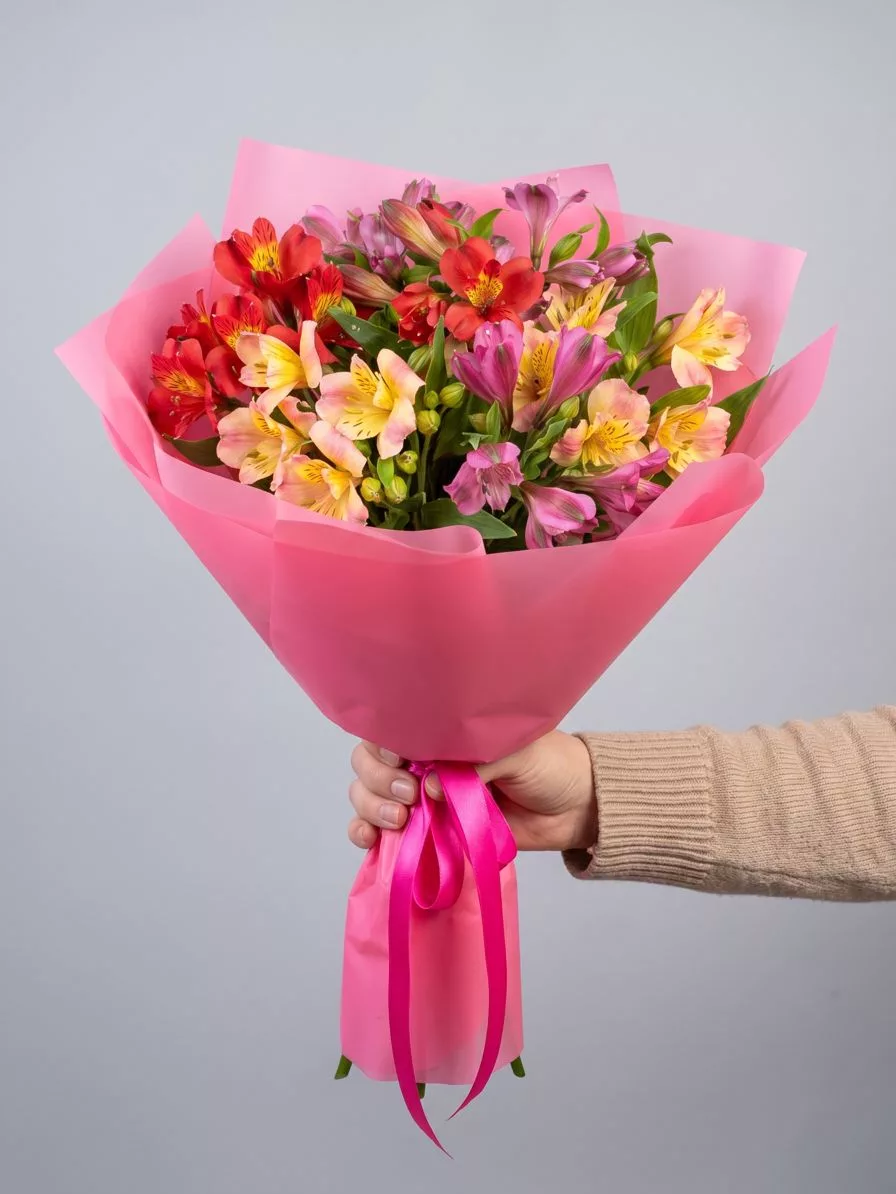
The Azov coast is not the place to send delicate, moisture-sensitive flowers in summer without thinking it through. Lily of the valley, sweet peas, and anemones are beautiful but fragile in high heat and should only be considered from October through April when temperatures are manageable. For summer deliveries between June and September, the most reliable choices are spray chrysanthemums, alstroemeria, and sturdy single-stem roses — varieties like Explorer, Avalanche, or Red Naomi hold their shape in heat far better than garden-style blooms such as lisianthus or ranunculus. Tropical flowers like anthuriums and birds of paradise are naturally heat-tolerant and make a strong visual statement; they are a practical choice for warm-month deliveries to the south. Orchids in a pot rather than a cut arrangement are another option worth considering — a potted Phalaenopsis orchid survives transport and heat better than cut stems and lasts weeks rather than days. In autumn and winter, the range opens up considerably. September through November is actually an excellent window for roses, peonies (if available from Dutch imports), and mixed seasonal bouquets with solidago, hypericum berries, and leucadendron. February and March are peak peony import months from Ecuador, so a peony bouquet sent for a March birthday lands well. Always tell us the approximate indoor conditions if you know them — a recipient with air conditioning changes our recommendations significantly, because a cooled apartment in August is a completely different environment from an un-airconditioned house.
Bouquet Sizes, Composition and What the Numbers Mean
International senders often ask us to describe bouquet sizes in terms they recognise, so here is how we think about it. A small bouquet contains 9 to 15 stems and fits in a standard vase; it is the right size for a thank-you or a casual birthday gesture. A medium bouquet runs 21 to 35 stems and is what most people picture when they imagine a proper birthday delivery — visible, generous, and easy to arrange. A large or statement bouquet starts at 51 stems and is used for significant anniversaries, milestone birthdays, or moments when you want the recipient to feel genuinely celebrated. Mono-bouquets — a single variety in quantity — are very popular in Russia. Fifty red roses, thirty white chrysanthemums, or twenty-five alstroemeria stems in a single colour make a strong impression and photograph well, which matters because recipients almost always send a photo back to the person who ordered. Mixed bouquets with a focal flower and supporting greenery are also common; a typical example would be roses as the focal flower with ruscus, eucalyptus, and waxflower as filler. We do not use artificial greenery. For summer deliveries to Primorsko-Akhtarsk, we recommend keeping mixed bouquets tighter in composition — fewer variety types means fewer fragile elements and a bouquet that holds together better in the heat. If you are sending to mark a Russian name day rather than a birthday, the occasion is treated with the same warmth as a birthday, and a mid-size bouquet of 21 to 25 stems is the standard gesture.
Russian Flower Customs an International Sender Should Know
A few conventions around flowers in Russia are different enough from Western European or North American norms that they catch international senders off guard. The most important one is the odd-number rule: bouquets for living recipients should contain an odd number of stems — 7, 9, 11, 15, 21, 25, and so on. Even numbers of flowers are associated with mourning and funerals, so a bouquet of 10 or 12 roses sends an unintended message. We always compose bouquets in odd numbers by default, but if you are ordering a set quantity, keep this in mind. Yellow flowers carry a complicated reputation in parts of Russia — some people associate yellow roses or yellow tulips with separation or bad luck, while younger urban recipients often have no such association at all. If you are unsure, ask us and we will give you an honest read based on the recipient's likely generation and background. White flowers are perfectly appropriate for birthdays and celebrations — they do not carry the funeral connotation they sometimes do in other cultures. Wrapping style matters visually: Russian bouquets are typically presented in kraft paper, fabric, or a decorative box rather than in a plastic sleeve, and the presentation is considered part of the gift. We wrap to a high standard as a matter of course. Finally, if you want to include a greeting card with a message in Russian, we can transcribe a short message you provide in English into Russian — just include your intended text in the order notes and specify that you want it translated.
How to Give the Delivery Address and Contact Details Correctly
This is where most international orders run into practical trouble, and it is worth being precise. A Russian address is written in a specific order: street name, building number, apartment or office number, city, and postal code. For Primorsko-Akhtarsk, the postal code range is 353860. An example of a correctly formatted address would be: ulitsa Pervomayskaya, dom 14, kvartira 7, Primorsko-Akhtarsk, 353860. If you are copying an address from a messaging app or a social media profile, double-check that the building number and apartment number are both present — many people write their city and street but omit the apartment number when sharing their address casually. The recipient's mobile phone number is mandatory for delivery. Russian mobile numbers follow the format +7 followed by ten digits. If you only have a local number written without the country code, add +7 at the front. We call or message the recipient before arrival to coordinate, so a working phone number is not optional — it is what makes the delivery happen smoothly. If the delivery is a surprise and you do not want us to reveal the sender, tell us explicitly in the order notes and we will say only that a delivery is coming, not from whom. Some senders prefer to give us a neighbour's number or a building concierge number for surprise deliveries; that works too as long as someone can physically receive the bouquet and keep it cool until the recipient is home. Do not assume a building has a doorman — in many Russian residential buildings there is a locked entry door with an intercom, and we need the apartment number to buzz through.
Payment from Outside Russia and What to Expect After Ordering
International payments to Russian businesses require a little more planning than a domestic card transaction. Due to ongoing banking restrictions, standard Visa and Mastercard transactions issued outside Russia do not process through Russian acquiring systems. We accept payment via international bank transfer, and in some cases through payment systems that remain operational for cross-border transactions — our operators will confirm the current available options when you contact us, because this landscape changes. We recommend contacting us by email or through our website contact form rather than expecting a phone call to connect easily from abroad, though WhatsApp and Telegram work reliably for real-time communication. Once payment is confirmed, you will receive an order confirmation with the delivery window. On the day of delivery, we send a notification when the bouquet is on its way and a second confirmation once it has been received. If the recipient is not home during the delivery window, our courier will attempt contact by phone; if there is no response, we will coordinate a new delivery window with you. We do not leave bouquets unattended outside a door in summer heat — a bouquet left in 30-degree sun for two hours is not something we would hand to a recipient in good conscience. If you have a specific delivery time tied to a party or dinner, tell us and we will schedule accordingly, building in a buffer so the flowers arrive before the event rather than during it.
Sending flowers to Primorsko-Akhtarsk from abroad is entirely manageable when you have the right information in front of you. The key variables are the southern summer heat, which shapes your variety choices more than anything else; the time zone difference, which determines when you need to place the order; and the address and phone details, which are the mechanical requirements that make delivery actually happen. Order with enough lead time, choose heat-appropriate flowers from June through September, keep the stem count odd, and communicate clearly about the delivery window. We handle the rest. We deliver bouquets across Russia in 1–2 hours.
Frequently asked questions
Can I order a same-day delivery to Primorsko-Akhtarsk from abroad?
Same-day delivery is possible if you place the order before noon Moscow time and the recipient's address and phone number are confirmed immediately. In practice, international senders benefit from ordering 24 to 48 hours ahead, because time zone differences and payment confirmation steps take time. Around major Russian holidays, same-day is not available at all.
What happens if the recipient is not home when the flowers arrive?
Our courier calls the recipient before arriving. If there is no answer and no one is home, we coordinate a new delivery window with you, the sender. We do not leave bouquets outside in summer heat or in an unsecured location. A neighbour or building concierge can receive the bouquet on the recipient's behalf if you arrange this in advance.
Is it acceptable to send yellow flowers to someone in Primorsko-Akhtarsk?
Younger recipients in Russian cities today generally do not hold the traditional association between yellow flowers and separation. Older recipients, particularly those over 50, may still find it awkward. If you are unsure of the recipient's age or sensibility, we recommend choosing another colour or asking us — we will give you a straightforward answer based on context.
Can you include a greeting card message in Russian if I only speak English?
Yes. Write your message in English in the order notes and specify that you want it translated into Russian for the card. We will render a short, natural-sounding message in Russian. If you want the card to be in English only, that is also fine — just tell us your preference clearly when ordering.
Which months are best for sending flowers to Primorsko-Akhtarsk from abroad?
October through May is the most comfortable window for a wide range of varieties, because temperatures are moderate and flowers travel and last well. June through September requires heat-tolerant choices such as spray chrysanthemums, alstroemeria, anthuriums, or roses in sturdy varieties. February and March are excellent for imported peonies and roses ahead of the 8 March holiday season.
Ready to send a bouquet?
Pick a city, choose the flowers, and we will hand them over with a photo confirmation.
Choose a city →