
Flowers for a Russian Grandmother: Varieties, Notes and Delivery
Russian grandmothers — babushki — are not sentimental about flowers the way a twenty-year-old might be. They know their roses from their spray roses, they notice whether carnations are fresh by the firmness of the calyx, and they will absolutely put the bouquet in water before they read the card. That practical eye is exactly why ordering for an older Russian woman requires more thought than picking whatever looks bright on a screen. The wrong variety, a wilted stem, or a note that feels like a corporate form letter will land flat. Get the flowers right, however, and a babushka will keep them on the kitchen windowsill for two weeks and tell every neighbour who sent them.
Why Older Russian Women Have Strong Flower Preferences
Women who grew up in Soviet-era Russia developed their flower tastes in a market where choice was limited but quality was scrutinised closely. Carnations, gladioli, chrysanthemums and certain rose varieties were the flowers available at kiosks outside metro stations, and those are the flowers that carry genuine emotional weight for women now in their sixties, seventies and eighties. Exotic tropical stems — anthuriums, bird of paradise, protea — often read as cold or unfamiliar rather than impressive. A babushka is more likely to appreciate a dense bunch of fragrant garden roses than an architectural arrangement of stems she cannot name. Fragrance is particularly important. Many older Russian women associate scent directly with freshness and quality; an unscented flower is sometimes viewed with suspicion, as though it has been grown too fast or stored too long. Varieties like Yves Piaget roses, which carry a strong old-rose perfume, or white Oriental lilies such as Casablanca, score consistently well for this reason. Colour preferences also run traditional: deep red, warm pink, white and cream are safe choices. Bright orange or purple can work in mixed arrangements but rarely as the dominant colour. Understanding these preferences is not about limiting your order — it is about choosing stems that will actually be loved rather than politely accepted and left on a shelf.
Bouquets we can deliver



The Best Rose Varieties for a Babushka's Bouquet
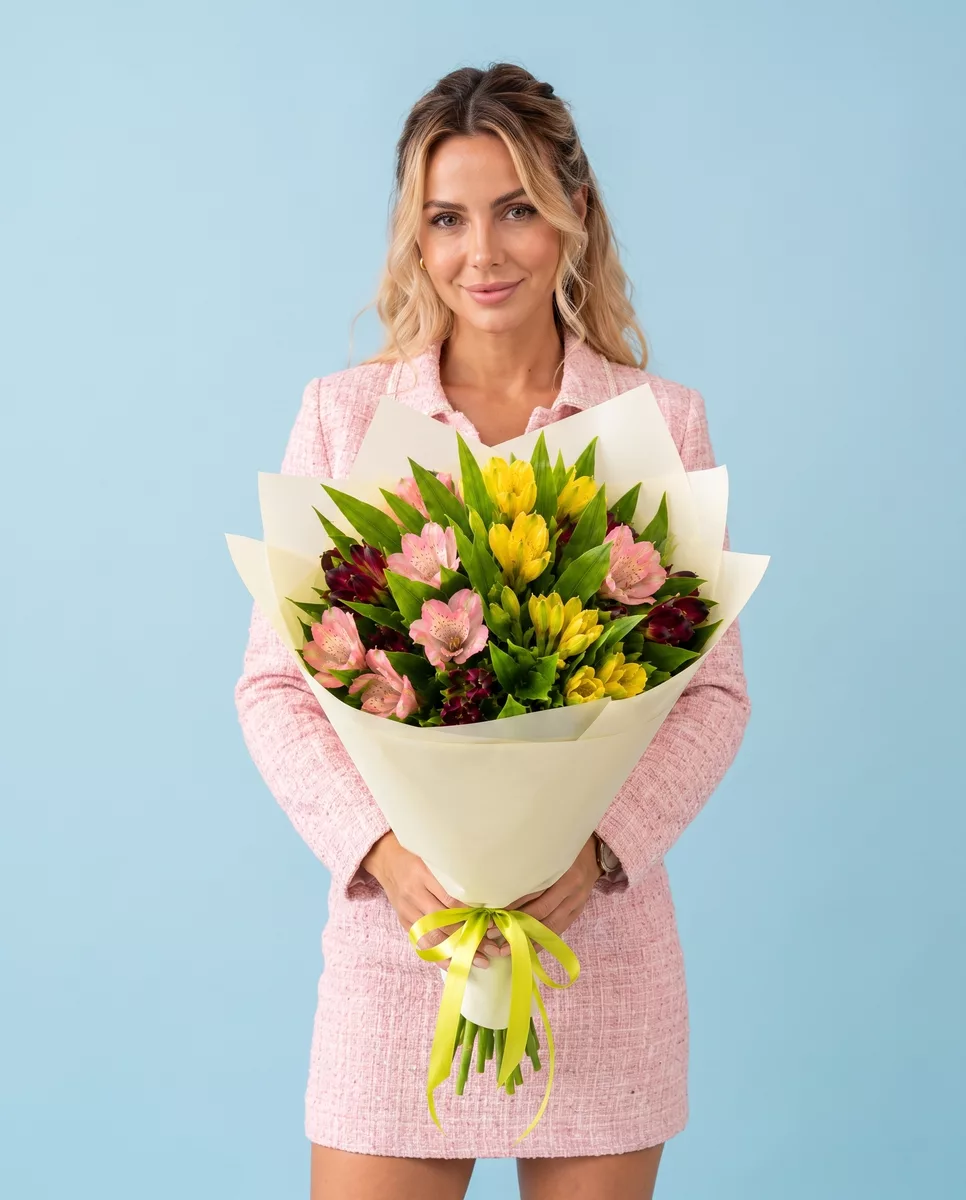
Standard long-stemmed roses are always appropriate, but variety selection matters more than stem count. For an older Russian recipient, garden-style roses with dense, many-petalled heads outperform the sleek single-layer blooms popular in contemporary arrangements. The David Austin-style varieties — bred to mimic antique roses with cupped centres and layered petals — are a strong choice because they look substantial and carry scent. Specific varieties worth requesting include Yves Piaget, a deep pink with intense fragrance; Juliet, a warm apricot with a tight, rounded head; and Keira, a soft blush that opens slowly and lasts well in a warm apartment. For classic red, ask for Explorer or Freedom rather than cheaper spray-fill roses, as the head size and petal count signal quality immediately. Stem length matters too. A babushka living in a standard Russian apartment will have a tall glass vase, a Soviet-era crystal one, or a ceramic pitcher — she will cut the stems to fit. Order stems of at least 60 cm so she has flexibility. Roses should arrive in bud or at the very first stage of opening; a rose that is already fully open at delivery has perhaps two days left. Our couriers carry bouquets upright in water-lined packaging specifically to prevent premature opening during transit. Avoid white roses as a standalone bouquet for an older Russian woman — in Russian tradition, white flowers alone are more commonly associated with formal occasions, and a mixed white-and-pink arrangement is a safer call.
Carnations, Chrysanthemums and Gladioli: The Underrated Classics
These three flowers are where many younger customers make a mistake by dismissing them as old-fashioned. For a babushka, they are not old-fashioned — they are correct. Carnations in particular carry strong positive associations: they were the Soviet-era celebration flower, given at graduations, anniversaries and Women's Day on the 8th of March. A large-headed standard carnation in deep red or bright pink signals that the sender put genuine thought into the choice rather than defaulting to whatever the algorithm suggested. Spray carnations, which have multiple small blooms per stem, add volume and last exceptionally well — up to three weeks with basic care. Chrysanthemums deserve similar reconsideration. The large single-headed chrysanthemum, sometimes called a disbud, comes in white, yellow, bronze and deep burgundy. White disbud chrysanthemums are a classic choice for older women and hold their shape for two to three weeks. Spider chrysanthemums with their long, curling petals add texture to any arrangement without introducing unfamiliar tropical elements. Gladioli are the most seasonal of the three — they peak in late summer and early autumn — but when available they make an immediate impression. A single stem of gladiolus can reach 80 to 120 cm and carries twelve to twenty individual florets that open progressively from the bottom up, meaning the arrangement effectively refreshes itself over seven to ten days. Mixing gladioli with carnations and a few roses produces a full, generous bouquet that reads as a serious gift rather than a token gesture, which is exactly the register most people want when sending to a grandmother.
Fragrant Lilies and When to Use Them
Oriental lilies are among the most fragrant cut flowers available, and fragrance, as noted earlier, is a strong positive signal for older Russian women. Casablanca is the benchmark: a large white bloom with prominent stamens, intense perfume, and a vase life of seven to twelve days depending on room temperature. Stargazer, the deep pink Oriental lily with white edges and dark spotting, is equally fragrant and adds strong colour. Both varieties arrive in bud and open over two to four days at room temperature, which means the recipient gets a bouquet that visibly changes and improves after delivery — a detail that older women who pay close attention to their flowers genuinely enjoy. There are two practical points to communicate clearly when ordering lilies for delivery to an older recipient. First, the orange pollen from lily stamens stains fabric and surfaces permanently. Many florists remove the stamens before delivery; we do this as standard, but it is worth confirming. Second, lilies are toxic to cats. If you know the recipient has a cat, choose a different flower entirely — carnations, roses and chrysanthemums are safe alternatives. Room temperature in a Russian apartment in winter can reach 24 to 26 degrees Celsius near radiators, which accelerates lily opening significantly. Advise the recipient to keep the vase away from direct heat sources and to change the water every two days. Lilies work best as a centrepiece flower in a mixed arrangement rather than as a standalone bouquet, where their strong scent can become overwhelming in a small room.
Seasonal Flowers That Resonate: Spring Through Autumn
Russian grandmothers grew up with a strong sense of flower seasonality because out-of-season flowers simply were not available for most of the twentieth century. That awareness persists. Sending tulips in January is perfectly possible with modern supply chains, but a babushka may well comment that they are not in season — and she will be right in her frame of reference. Working with the season rather than against it produces a more appreciated result. In late February and early March, tulips are the dominant choice, specifically because of International Women's Day on the 8th of March, the single most important flower-giving occasion in Russia. Single-colour bunches of tulips in pink, red or white, tied simply with ribbon rather than wrapped in elaborate packaging, are the traditional format. Darwin hybrid tulips, with their large heads and sturdy stems, hold up better than smaller varieties during delivery. From May through July, peonies are the prestige flower. Sarah Bernhardt, a deep pink with a light fragrance, and festiva maxima, a white with occasional red flecks, are the varieties most associated with the classic Russian dacha garden. A babushka who grew up with a dacha will respond to peonies the way a person responds to a familiar smell — immediately and warmly. In August and September, dahlias and late-season gladioli are appropriate. From October through January, roses, chrysanthemums and carnations carry the arrangement, supplemented by branches of eucalyptus or wax flower for texture.
Writing the Card: What to Say and What to Avoid
The card is where most orders go wrong for recipients of this generation. Russian grandmothers read cards carefully and remember what was written. A generic printed message — 'Wishing you all the best' or 'With love' followed by a name — is noticed as minimal effort. The card should say something specific: reference the occasion, name the relationship, and include at least one personal detail. 'Dear Valentina Ivanovna, happy birthday — we remember how you always grew roses in the dacha garden, and we hope these bring some of that warmth to your apartment' is the kind of message that gets read aloud to a neighbour. Addressing a Russian grandmother correctly matters. The standard respectful form uses first name and patronymic — for example, Natalya Petrovna rather than just Natalya. If you do not know the patronymic, using a respectful title such as 'Dorogaya babushka' (dear grandmother) or simply her first name with a warm opening is acceptable. Avoid overly casual language or abbreviations; this is a generation that considers careful writing a mark of respect. In terms of language: if you are ordering from outside Russia and writing the card in English, that is completely fine — a card in English from a grandchild abroad carries its own meaning. We can print the card in English exactly as you write it. If you want the message in Russian but do not speak the language, write what you want to say in English in the order notes and specify that you need a Russian translation; we will handle it and send you the text for approval before printing.
Delivery Timing, Temperature and What to Check Before Ordering
Delivery timing for an older recipient requires more planning than for a younger one. A babushka is likely to be at home during the day, which makes daytime delivery straightforward, but she may also take an afternoon walk, visit the polyclinic, or be unreachable by phone for stretches of time. When placing the order, provide a mobile number and, if possible, a building entrance code, since many Saint Petersburg apartment buildings have keypads or intercom systems. Our couriers will call ahead, but having a backup contact — a neighbour, a building superintendent — is worth noting in the order. Temperature affects the bouquet significantly. In winter, flowers move from a warm shop into sub-zero outdoor temperatures and then into a warm apartment. We wrap winter bouquets in insulating packaging to prevent cold shock, which causes petals to blacken within hours. If the recipient is likely to leave the bouquet near a cold window overnight, advise her to move it to a warmer spot. In summer, the risk reverses: apartments without air conditioning can reach 30 degrees, and lilies and tulips will open and decline within two to three days rather than the expected week. Hardy summer choices include chrysanthemums, carnations and alstroemeria, which tolerate heat better than most. Before confirming the order, check three things: the delivery address includes the apartment number and entrance number; the recipient's phone number is correct and the phone is likely to be on; and the card message is written out in full rather than left as a placeholder. These three points account for the majority of delivery complications we see.
Ordering flowers for a Russian grandmother is one of the more considered purchases a customer can make, and the details — variety, fragrance, card wording, delivery timing — make the difference between a bouquet that is appreciated for a day and one that is talked about for months. The flowers listed here are not suggestions pulled from a trend report; they are the varieties that come back in customer messages as 'she absolutely loved them' rather than 'she said thank you.' A large-headed carnation, a fragrant garden rose, a stem of Casablanca lily, or a generous bunch of pink tulips in early March will land correctly every time, provided they arrive fresh, upright and accompanied by a card that actually says something. The practical checks — address, phone number, temperature considerations, card text — take two minutes and prevent the problems that make a thoughtful gift feel careless. We deliver bouquets across Russia in 1–2 hours.
Frequently asked questions
Is it appropriate to send flowers to a Russian grandmother I have never met in person?
Yes, and it is considered a respectful gesture. Address the card formally using her first name and patronymic if you know it. A simple, warm message in either English or Russian is appropriate. The act of sending flowers from abroad carries its own significance and will generally be received very positively regardless of how well you know each other.
How many flowers should be in the bouquet — is there a minimum that feels generous?
Russian flower-giving tradition historically favoured odd numbers for celebratory bouquets, though this convention is less strictly observed now. A bouquet of nine, eleven or fifteen stems reads as generous. More important than count is head size and stem quality — seven large-headed garden roses make a stronger impression than fifteen thin spray roses, and an older recipient will notice the difference immediately.
Are there any flowers I should definitely avoid sending to an older Russian woman?
Avoid sending a bouquet composed entirely of white flowers, as this can carry unintended associations for older Russian recipients. Strongly scented lilies should be avoided if the recipient has cats, as Oriental lilies are toxic to them. Unfamiliar tropical varieties — anthuriums, bird of paradise — tend to be received politely but without particular warmth by this generation.
Can I schedule delivery for a specific time, such as before a birthday dinner?
Yes, you can specify a delivery window when placing your order. For a delivery timed to a birthday dinner, aim for a window that ends at least ninety minutes before the event begins, which gives the recipient time to arrange the flowers and have them on display. Make sure the recipient's phone is reachable so the courier can confirm entry to the building.
What should I do if the recipient is not home when the courier arrives?
Provide a secondary contact number in the order notes — a neighbour, a relative in the same building, or a building superintendent who can accept the delivery. Our couriers will call before arrival and wait briefly, but flowers cannot be left unattended in a hallway in cold or hot weather without risk of damage. A confirmed secondary contact prevents the vast majority of missed-delivery situations.
Ready to send a bouquet?
Pick a city, choose the flowers, and we will hand them over with a photo confirmation.
Choose a city →